Malaysia’s e-Invoice mandate now covers every implementation phase. For businesses with annual turnover above RM5 million, the interim relaxation periods ended in 2025. Only taxpayers up to RM5 million retain relaxation, and that runs until 31 December 2027.
For most enterprises, then, e-Invoicing is no longer a finance project. It is a standing obligation. And a surprising share of it touches HR.
Salaries are out. Much of what surrounds them is not.
Start with the good news. Employment income under a contract of service is currently exempt from e-Invoice. The Inland Revenue Board of Malaysia (LHDN, also known as IRBM) confirms this in its e-Invoice FAQs, and notes that the exemption is subject to periodic review.
So payroll itself does not generate e-Invoices. The difficulty lies at the edges of payroll, where employment income meets business expense.
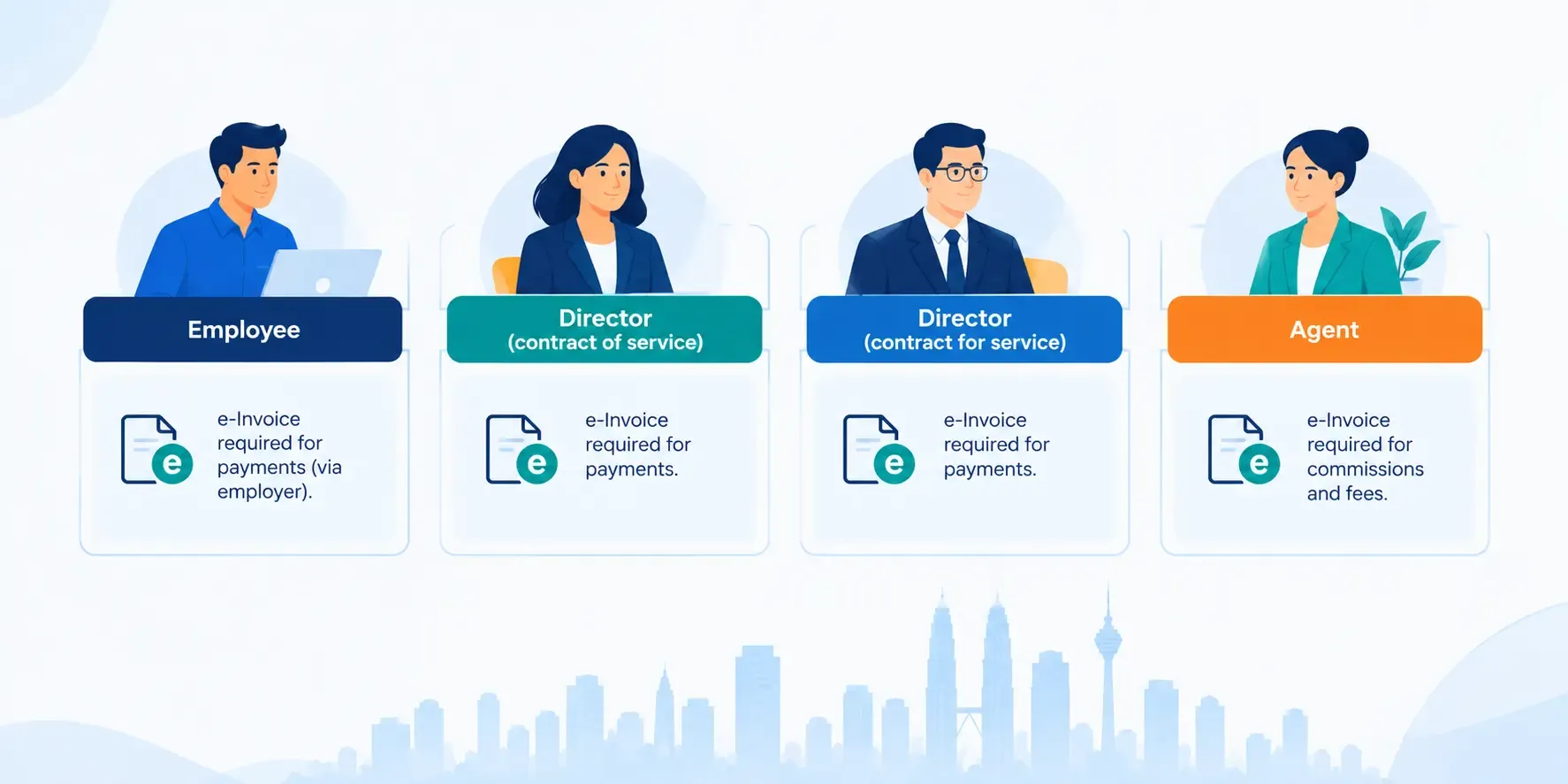
Director fees are the first test. Where a director has a contract of service, the fees are employment income and stay exempt. Where the director has a contract for service, the director must issue an e-Invoice to the company. HR holds the contract. Finance books the fee. Both need to know which one it is.
Claims and perquisites: a concession with a condition

LHDN’s e-Invoice Specific Guideline (Version 4.9, September 2026) deals with employee benefits and claims in two sections.
Section 6 covers perquisites and benefits: club and gym memberships, professional subscriptions, and allowances such as travel, petrol, parking and meals. Employees are expected to ask suppliers to issue e-Invoices in the employer’s name, to the extent possible.
LHDN recognises this is not always practical. It accepts e-Invoices in the employee’s name, or existing receipts, as proof of expense. Payments to foreign suppliers need no self-billed e-Invoice. But the concession applies only where the perquisites and benefits are clearly stated in the employer’s policy.
Section 7 covers expenses employees incur on the employer’s behalf: accommodation, tolls, mileage, parking, telecommunications and overseas costs. The same concession applies, provided the employer can prove the employee was acting on its behalf.
The implication is simple. Your benefits and claims policy is now a tax document. HR writes it. Finance relies on it.
Commissions, agents and staff loans
The sharpest risk sits in sales remuneration.
Payments to agents, dealers and distributors require the paying company to issue a self-billed e-Invoice, whether the agent is an individual or a corporate. These payments cannot be consolidated into a monthly e-Invoice. For insurers, property developers and automotive businesses that rely on agency forces, this is a material volume.
Employed sales staff are different. Their commissions are employment income and remain exempt. The line between an employee on commission and an appointed agent must therefore be clean. A misclassified worker becomes a compliance gap in two places at once.
Staff loans are the second edge case. Where an employer charges interest on a staff loan, the employer must issue an e-Invoice for the interest received. That interest is often recovered through payroll deductions, so payroll data feeds a finance obligation.
One further rule applies across all industries. From 1 January 2026, any single transaction above RM10,000 must carry its own e-Invoice rather than sit inside a consolidated one.
What HR and finance need to agree on
1. One classification register. Every person paid is an employee, a director under a contract of service, a director under a contract for service, or an agent. Each category has a different e-Invoice treatment.
2. A policy that names the benefits. If a perquisite is not clearly stated in policy, the documentation concession may not apply.
3. A claims workflow that asks first. Give employees the company’s details so they can request e-Invoices in the employer’s name before paying.
4. A map of payroll deductions that create income. Staff loan interest is the obvious one. Check for others.
5. Clear ownership of corrections. LHDN’s e-Invoice Special Voluntary Disclosure Programme (SVDP) runs from 7 July 2026 to 31 December 2027. Each entity in a group must disclose separately.
The stakes are real. Failure to issue an e-Invoice is an offence under Section 120(1)(d) of the Income Tax Act 1967. It carries a fine of RM200 to RM20,000, imprisonment of up to six months, or both, for each non-compliance. Responsibility stays with the company even where a vendor manages the process.
Where systems help
None of this needs a new payroll engine. It needs HR data that finance can trust. Contract types, benefit entitlements, claim records and loan deductions must sit in one place, with an audit trail.
That is the role of an enterprise HR and payroll platform such as MiHCM Enterprise: a single record of who each person is to the business, and how they are paid.
The e-Invoice rules will keep evolving. LHDN reviews its exemptions periodically. Organisations that align HR and finance now will absorb those changes in a policy update, not a scramble.
Frequently Asked Questions
• When does the e-Invoice interim relaxation period end? For taxpayers with turnover up to RM5 million, 31 December 2027. Relaxation for larger taxpayers ended in 2025.
• What is the e-Invoice SVDP? LHDN’s Special Voluntary Disclosure Programme lets taxpayers correct e-Invoice non-compliance between 7 July 2026 and 31 December 2027. Each entity discloses separately.
• Is staff loan interest subject to e-Invoice? Yes. An employer that charges interest on staff loans must issue an e-Invoice for the interest received.
• Can transactions above RM10,000 be consolidated? No. From 1 January 2026, any single transaction above RM10,000 requires its own e-Invoice.
• Do Malaysian employers need to issue e-Invoices for salaries? No. Employment income under a contract of service is currently exempt from e-Invoice, according to LHDN’s e-Invoice FAQs. The exemption is subject to periodic review.
• Are director fees subject to e-Invoice in Malaysia? It depends on the contract. Fees under a contract of service are employment income and exempt. A director under a contract for service must issue an e-Invoice to the company.
• Do staff expense claims need e-Invoices in Malaysia? Employees should request e-Invoices in the employer’s name where possible. LHDN accepts e-Invoices in the employee’s name or existing receipts, provided the benefit is stated in the employer’s policy or the employee acted on the employer’s behalf.
• Do commissions to agents need a self-billed e-Invoice? Yes. Companies paying agents, dealers or distributors must issue a self-billed e-Invoice, and these cannot be consolidated.
• What is the penalty for not issuing an e-Invoice in Malaysia? A fine of RM200 to RM20,000, imprisonment of up to six months, or both, for each non-compliance, under Section 120(1)(d) of the Income Tax Act 1967.
Sources
• LHDN, Implementation of e-Invoice in Malaysia: FAQs (updated 4 September 2026) – phases, interim relaxation, director fees, employment income exemption, penalties, SVDP
• LHDN, e-Invoice Specific Guideline Version 4.9 (7 September 2026) – Sections 6 and 7 (perquisites, benefits, employee expenses), Section 8.3(g)(ii) (staff loan interest), Section 9.4 and Table 3.6 (agents, RM10,000 rule)