
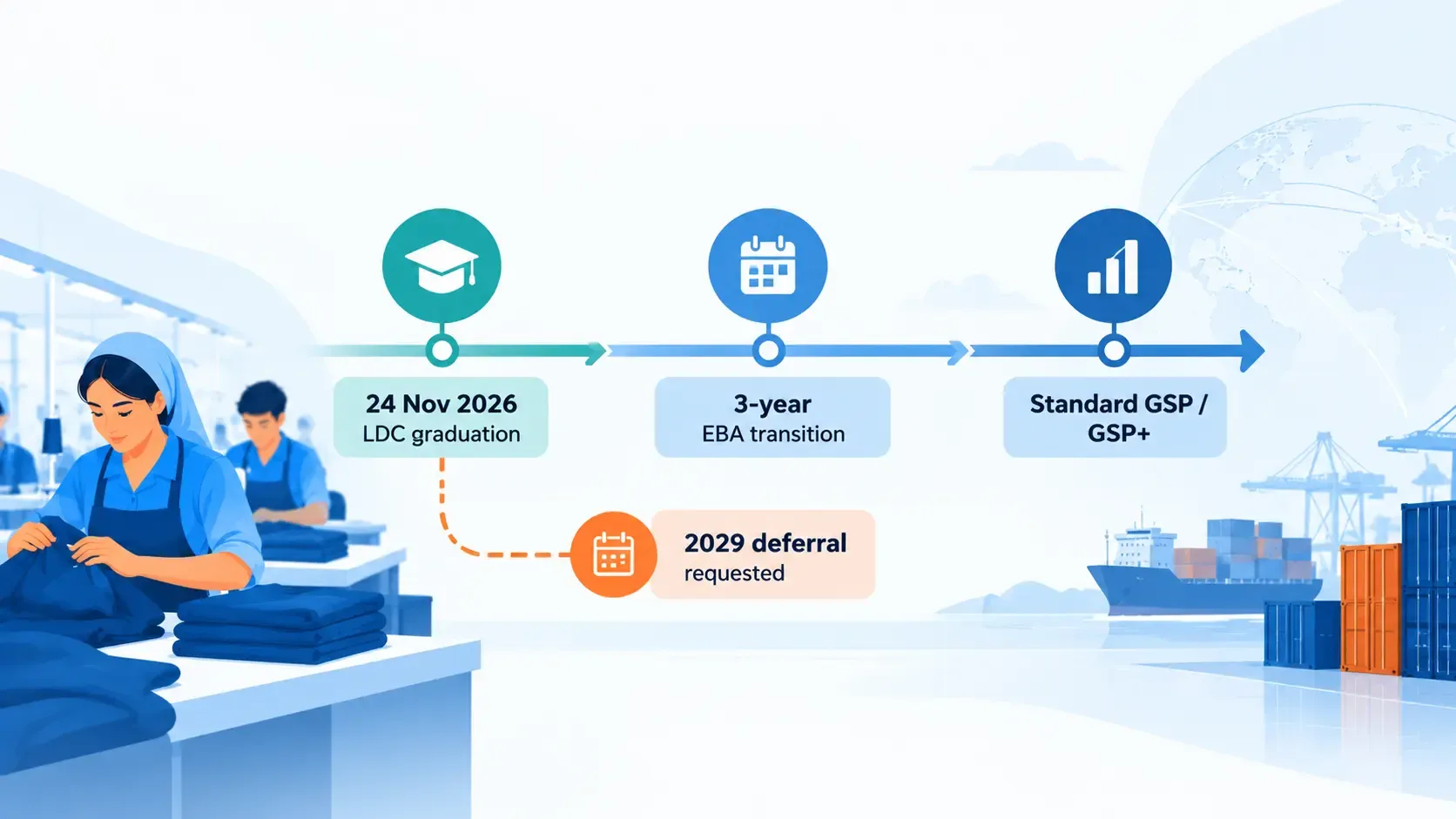
Bangladesh is scheduled to graduate from the United Nations’ Least Developed Country (LDC) category on 24 November 2026. That date was set by UN General Assembly resolution 76/8 in 2021.
It may move. In February 2026, the Government asked the UN to extend the preparatory period to 24 November 2029. In July, the UN Economic and Social Council (ECOSOC) recommended that the General Assembly decide before the current graduation date.
For manufacturers, the precise year matters less than the direction. Graduation is coming. The trade preferences that shaped Bangladesh’s export model will narrow. And the gap will have to be closed on the factory floor.
What actually changes
As an LDC, Bangladesh exports to the European Union duty-free and quota-free under the Everything But Arms (EBA) scheme. The EU allows graduating countries to keep EBA preferences for three years after graduation. After that, a country moves to the Standard GSP or, if it qualifies, GSP+.
The rules are also changing. The EU’s new Generalised Scheme of Preferences applies from 1 January 2027. According to the European Commission, it strengthens the link between trade preferences and compliance with international standards.
In other words, post-LDC market access will depend less on status and more on evidence: of labour standards, of workplace safety, and of the capacity to sustain both.
Labour standards are now a trade asset

Bangladesh has moved early. In November 2025, it ratified ILO Conventions 155 and 187 on occupational safety and health, alongside Convention 190 on violence and harassment at work. According to the International Labour Organization, Bangladesh became the first country in Asia to ratify all of its fundamental instruments.
The Government also promulgated the Bangladesh Labour Act (Amendment) Ordinance, 2025.
Ratification is a national commitment. Implementation happens in individual factories. Buyers, auditors and trade partners will look for proof that safety systems, grievance channels and fair working conditions operate in practice. That proof is workforce data.
Why productivity becomes the margin
When a tariff advantage narrows, price competitiveness must come from somewhere else. For labour-intensive manufacturing, that means output per worker, per line and per hour.
Productivity in this sense is not about longer shifts. Excessive overtime raises cost, fatigue and compliance risk at the same time. It is about fewer unplanned absences, better skills matching, faster onboarding and less rework.
Most factories already hold the raw data. It sits in attendance systems, payroll registers, training logs and line reports. The problem is that it rarely sits together.
Five things to prepare now
1. Measure productivity at the level you manage it. Track attendance, absenteeism, overtime and turnover by line and shift, not just by factory. Patterns that are invisible in monthly totals become obvious at line level.
2. Make compliance auditable. Working hours, wage payments, leave, safety training and grievance cases should be recorded as they happen, with a clear trail. Retrofitting evidence before an audit is slow and unconvincing.
3. Build a skills inventory. Know who is trained on which operations. Multi-skilled workers make lines more resilient when orders, styles or absences shift.
4. Get payroll right first time. Wage and overtime errors damage trust, drive turnover and create audit findings. Accurate, on-time pay is a productivity measure as much as a compliance one.
5. Treat Convention 190 as an operating requirement. A credible process for reporting and resolving harassment protects workers and reduces attrition. It also answers questions buyers are increasingly asking.
The systems question
None of this requires a new strategy. It requires connected people data. Attendance, payroll, training and case records need to sit in one system that HR, compliance and factory leadership can all trust.
That is the role of an enterprise HR and payroll platform such as MiHCM Enterprise, supported locally by MiHCM Bangladesh: a single, auditable record of the workforce, from the gate to the payslip.
The window is the opportunity
Whether graduation lands in 2026 or 2029, the transition period is a window, not a reprieve. Manufacturers that use it to build productivity and compliance capability will compete on more than price. Those that wait will discover the gap only when the preferences have gone.
Frequently Asked Questions
• When does Bangladesh graduate from LDC status? Bangladesh is scheduled to graduate on 24 November 2026 under UN General Assembly resolution 76/8. The Government has requested an extension to 24 November 2029, and ECOSOC has recommended that the General Assembly decide before the scheduled date.
• What happens to EU duty-free access after LDC graduation? The EU allows graduating countries to keep Everything But Arms (EBA) preferences for three years after graduation. After that, a country moves to the Standard GSP or, if eligible, GSP+.
• Why does LDC graduation matter for workforce productivity? As tariff preferences narrow, manufacturers must protect competitiveness through output per worker, lower absenteeism, better skills deployment and fewer payroll and compliance errors.
• Which ILO conventions has Bangladesh ratified? In November 2025, Bangladesh ratified ILO Conventions 155, 187 and 190, becoming the first country in Asia to ratify all fundamental ILO instruments, according to the ILO.
Sources
• UN DESA, List of Least Developed Countries – note on resolution A/RES/76/8 – graduation date of 24 November 2026
• UN-OHRLLS, Bangladesh Graduation Readiness Assessment – scheduled graduation date
• BSS, ECOSOC backs Bangladesh’s request for LDC graduation extension (22 July 2026) – deferral request and ECOSOC recommendation
• The Business Standard, Bangladesh’s LDC graduation: when and how will UN decide? – Second Committee date
• European Commission / EEAS, Factsheet: The new EU Generalised Scheme of Preferences – new GSP from 1 January 2027; three-year EBA retention after LDC graduation
• European Commission and EEAS, Joint report on the GSP 2023–2025 (Council document ST-12037-2026) – three-year EBA transition after graduation
• ILO, Landmark ratifications by Bangladesh (20 November 2025) – Conventions 155, 187, 190; Labour Act (Amendment) Ordinance, 2025