Every month, Thai employers do the same three things: Run payroll. Withhold tax. File PND1.
It sounds routine, but it rarely is. The withholding figure is not a flat percentage; it is a projection of each employee’s full-year tax liability, sliced into 12. Change a salary, add a bonus, hire mid-year, and the projection moves. Miss the filing date and the surcharge starts running the next day.
This guide sets out what PND1 is, when it is due, how the withholding is worked out, and where the process most often breaks.
What PND1 is, and who files it
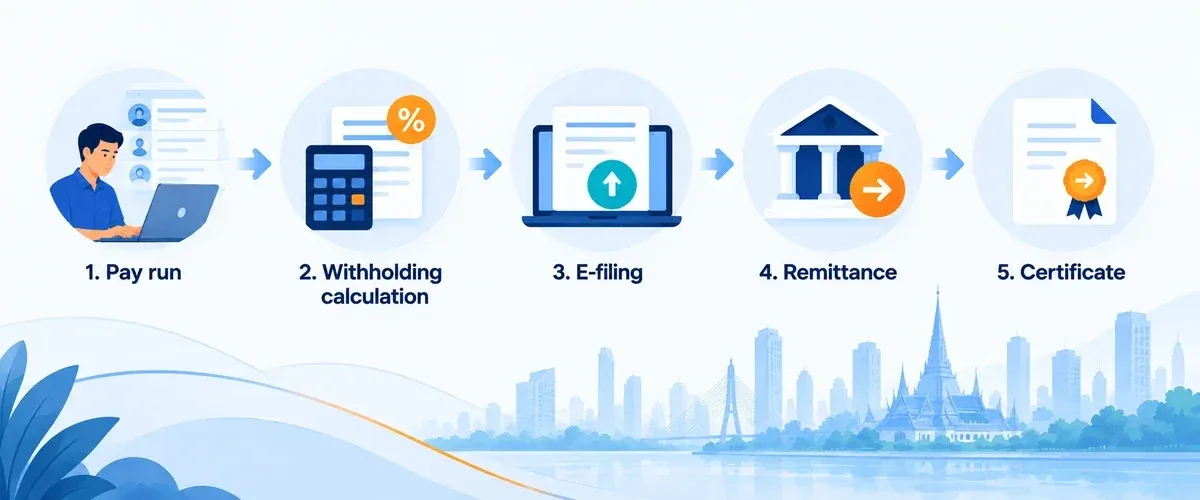
PND1 (ภ.ง.ด.1) is the monthly withholding tax return that employers file with the Thai Revenue Department for personal income tax deducted from employment income: salaries, wages, bonuses, allowances, and benefits in kind.
The obligation sits with the employer, not the employee. Under the Revenue Code, the payer of employment income must deduct tax at source, remit it, and report it. If the employer fails to withhold, the employer remains liable for the tax.
PND1 covers employees. It is not the same form as its neighbours, and the distinction is decided by who is being paid, not what they are being paid for:
| Form | Used for |
| PND1 | Employment income paid to employees |
| PND3 | Payments to individuals who are not employees — contractors, freelancers, individual landlords |
| PND53 | Payments to juristic persons — companies and registered partnerships |
| PND1 Kor | The annual reconciliation of the year’s PND1 filings |
Classifying a Thai limited company on PND3 because the service looked like freelance work is one of the most common filing corrections. Check the recipient’s registration, not the invoice description.
The deadlines that matter
PND1 is filed monthly, for the month in which payment was made.
| Return | Paper filing | Filing via the Revenue Department e-filing system |
| PND1 (monthly) | Within the 7th day of the following month | Within the 15th day of the following month |
| PND1 Kor (annual) | Within 28 February of the following year | Within 8 March of the following year |

Two rules sit behind that table, and both change how you should plan.
E-filing is now the default, not the option
Under the Director-General’s Notification on Income Tax (No. 451), from 1 January 2025 withholding tax returns are to be filed using the Revenue Department’s e-filing system. Where a filer is unable to use e-filing, a written explanation must be submitted at the same time as the paper return.
For most employers the practical effect is simple: the 15th is your date, and paper is an exception that now has to be justified.
The eight-day extension has an expiry date
The extra eight days granted to electronic filers is not a permanent feature of the Revenue Code. It comes from a Ministerial Notification issued on 12 January 2024, which applies to e-filings made between 1 February 2024 and 31 January 2027.
Unless a further notification extends it, the statutory paper deadline — the 7th — applies again from February 2027. Payroll calendars built on the 15th should carry a review point before then.
| Build the date, do not assume itWhere the 7th or the 15th falls on a weekend or public holiday, the deadline shifts to the next working day.Treat the Revenue Department tax calendar as the monthly source of truth rather than a fixed internal date.Set the internal payroll close two to three working days ahead of the filing date, not on it. |
How the monthly withholding figure is calculated
This is where PND1 differs from most withholding regimes in the region. There is no flat rate on employment income. The employer projects, then divides.
The method runs in five steps.
1. Project the employee’s total assessable employment income for the full tax year, based on what they are expected to earn.
2. Apply the standard employment expense deduction — 50% of income, capped at THB 100,000.
3. Apply the employee’s personal allowances and deductions — the THB 60,000 personal allowance, spouse and child allowances where they apply, social security contributions, provident fund contributions, insurance premiums and other declared reliefs.
4. Apply the progressive rates to the resulting net income to arrive at the projected annual tax.
5. Divide by the number of pay periods remaining in the year. That is the month’s withholding.
Thailand’s personal income tax rates
| Net income (THB) | Rate |
| 0 – 150,000 | Exempt |
| 150,001 – 300,000 | 5% |
| 300,001 – 500,000 | 10% |
| 500,001 – 750,000 | 15% |
| 750,001 – 1,000,000 | 20% |
| 1,000,001 – 2,000,000 | 25% |
| 2,000,001 – 5,000,000 | 30% |
| Over 5,000,000 | 35% |
The rates are marginal. Only the slice of income that falls inside a band is taxed at that band’s rate, which is why effective rates sit well below the headline figures.
Because the calculation is a projection, anything that changes expected annual income changes every remaining month. A bonus paid in July does not simply add tax in July — it lifts the projection, and the recalculated liability is spread across the months that are left. Employees notice. Finance teams field the question. A payroll system that can show the workings is worth more than one that only shows the answer.
What changed on 1 January 2026
Social security contributions reduce taxable income, so a change to the contribution base changes PND1 withholding.
From 1 January 2026, the monthly wage ceiling used to calculate Social Security Fund contributions rose from THB 15,000 to THB 17,500 under a ministerial regulation issued on 11 December 2025. The contribution rate is unchanged at 5% for the employer and 5% for the employee, so the maximum monthly contribution per party rose from THB 750 to THB 875. The minimum contribution base remains THB 1,650 per month. Further increases are scheduled in 2029 and 2032.
Two consequences for payroll. Employer cost rises by up to THB 1,500 a year for each employee earning above the ceiling. And the deduction feeding the PND1 calculation rises with it — so any payroll engine still capping at THB 15,000 is now producing the wrong withholding figure as well as the wrong contribution.
The annual obligations: PND1 Kor and Form 50 Tawi
Twelve monthly filings are not the end of it.
PND1 Kor is the annual reconciliation. It reports the year’s total employment income and total tax withheld, by employee, and is due within 28 February of the following year — or 8 March where filed electronically.
Form 50 Tawi is the withholding tax certificate issued under Section 50 bis of the Revenue Code. It is the employee’s evidence that tax was deducted and remitted, and they need it to file their own annual return.
The issuing deadlines are specific:
• For employees still in service, within 15 February of the year following the tax year.
• For employees who left during the year, within one month of the date employment ended.
That second date is the one that gets missed. A leaver in March needs their certificate in April, not the following February — and by then the payroll team has usually moved on.
What late filing costs
There are two separate exposures, and they behave differently.
The surcharge. Under Section 27 of the Revenue Code, failure to remit within the time limit attracts a surcharge of 1.5% per month, or part of a month, of the tax payable or remittable, excluding any fine. Part of a month counts as a full month. The surcharge is capped at the amount of tax payable.
The fine. Failing to file on time carries a criminal fine not exceeding THB 2,000 under Section 35. In practice, area revenue offices apply a lower comparative fine on monthly returns — commonly reported as THB 100 per return when up to seven days late and THB 200 when more than seven days late. These figures are administrative practice, not statutory rates, and they apply per return: PND1, PND3 and PND53 all late in the same month are fined separately.
The asymmetry is the point. The fine is small and fixed. The surcharge compounds on the tax itself, and on a mid-sized payroll the tax is not small. Late filing is cheap; late remittance is not.
Where PND1 goes wrong
The failures we see most often in Thai payroll operations are not exotic.
• Projections that never get revised — the annual estimate is set in January and left alone through promotions, bonuses and resignations.
• Allowances taken on trust — employee-declared reliefs carried forward year on year without a fresh declaration or supporting evidence.
• Benefits in kind left out — employer-provided accommodation, or tax paid by the employer on the employee’s behalf, is assessable income and belongs in the calculation.
• Mid-year joiners annualised as if they had worked the full year, inflating the projection and over-withholding.
• PND1 and PND1 Kor that do not reconcile — twelve monthly filings that add up to a different number from the annual summary, which is a reliable audit trigger.
• Leavers without certificates — the one-month rule missed because offboarding and payroll run on separate calendars.
• Filing dates treated as fixed, so a deadline that shifted for a public holiday is missed by a day.
Building a close calendar that holds
Compliance here is a scheduling problem as much as a tax one. Four controls cover most of the risk.
1. Freeze payroll inputs early. Set a cut-off for changes that leaves room to check the output before filing, not after.
2. Reconcile monthly, not annually. Compare the PND1 total to the payroll register every month. Finding a variance in month three is an adjustment; finding it in February is a restatement.
3. Trigger certificates from offboarding. Make Form 50 Tawi part of the leaver workflow, not the year-end workflow.
4. Verify the date each month against the Revenue Department calendar rather than working from a remembered 7th or 15th.
How MiHCM helps
MiHCM supports Thai payroll operations with statutory calculations maintained against current rates and thresholds, automated withholding computation across the tax year, and reporting built for the Revenue Department’s formats. Statutory changes — the 2026 social security ceiling among them — are applied centrally, so payroll teams are not patching spreadsheets in January.
Employee self-service handles allowance declarations, so reliefs feeding the PND1 calculation come from the employee and carry an audit trail. And because payroll, leave and employee records sit in one system, a leaver triggers the certificate rather than waiting for someone to remember.
For the full picture of Thai payroll obligations — social security, provident funds, leave entitlements and reporting — see the MiHCM Thailand Payroll Guide. [LINK]
Frequently Asked Questions
When is PND1 due in Thailand?
PND1 is due within the 7th day of the month following payment for paper filings, and within the 15th day for filings made through the Revenue Department’s e-filing system. Where the deadline falls on a weekend or public holiday, it shifts to the next working day.
Who has to file PND1?
Any employer paying employment income in Thailand. The obligation to withhold, remit and report sits with the employer. If tax is not withheld, the employer remains liable for it.
What is the difference between PND1 and PND1 Kor?
PND1 is the monthly withholding tax return. PND1 Kor is the annual reconciliation of the year’s PND1 filings, due within 28 February of the following year, or 8 March where filed electronically.
What is the penalty for filing PND1 late?
A surcharge of 1.5% per month or part of a month on the tax payable, capped at the amount of tax, under Section 27 of the Revenue Code, plus a criminal fine not exceeding THB 2,000 under Section 35. Area revenue offices commonly apply a reduced comparative fine on monthly returns.
Is e-filing of PND1 compulsory?
Under the Director-General’s Notification on Income Tax (No. 451), withholding tax returns are to be filed through the Revenue Department’s e-filing system from 1 January 2025. A filer unable to do so must submit a written explanation alongside the paper return.
How is PND1 withholding calculated?
The employer projects the employee’s annual employment income, applies the standard expense deduction of 50% capped at THB 100,000, applies personal allowances and other reliefs, calculates tax at Thailand’s progressive rates, and divides the result across the remaining pay periods.
When must Form 50 Tawi be issued?
Within 15 February of the year following the tax year for employees still in service, and within one month of the termination date for employees who left during the year.
Did social security contributions change in 2026?
Yes. From 1 January 2026 the monthly wage ceiling rose from THB 15,000 to THB 17,500, lifting the maximum monthly contribution per party from THB 750 to THB 875. The 5% rate is unchanged.