
 ২০২৬ সংস্করণ
শ্রীলঙ্কা বেতন-ভাতা নির্দেশিকা 2026
From EPF and ETF to gratuity and APIT — here's what employers in Sri Lanka need to stay compliant in 2026, and how the right HR platform makes it manageable.
এখনই ডাউনলোড করুন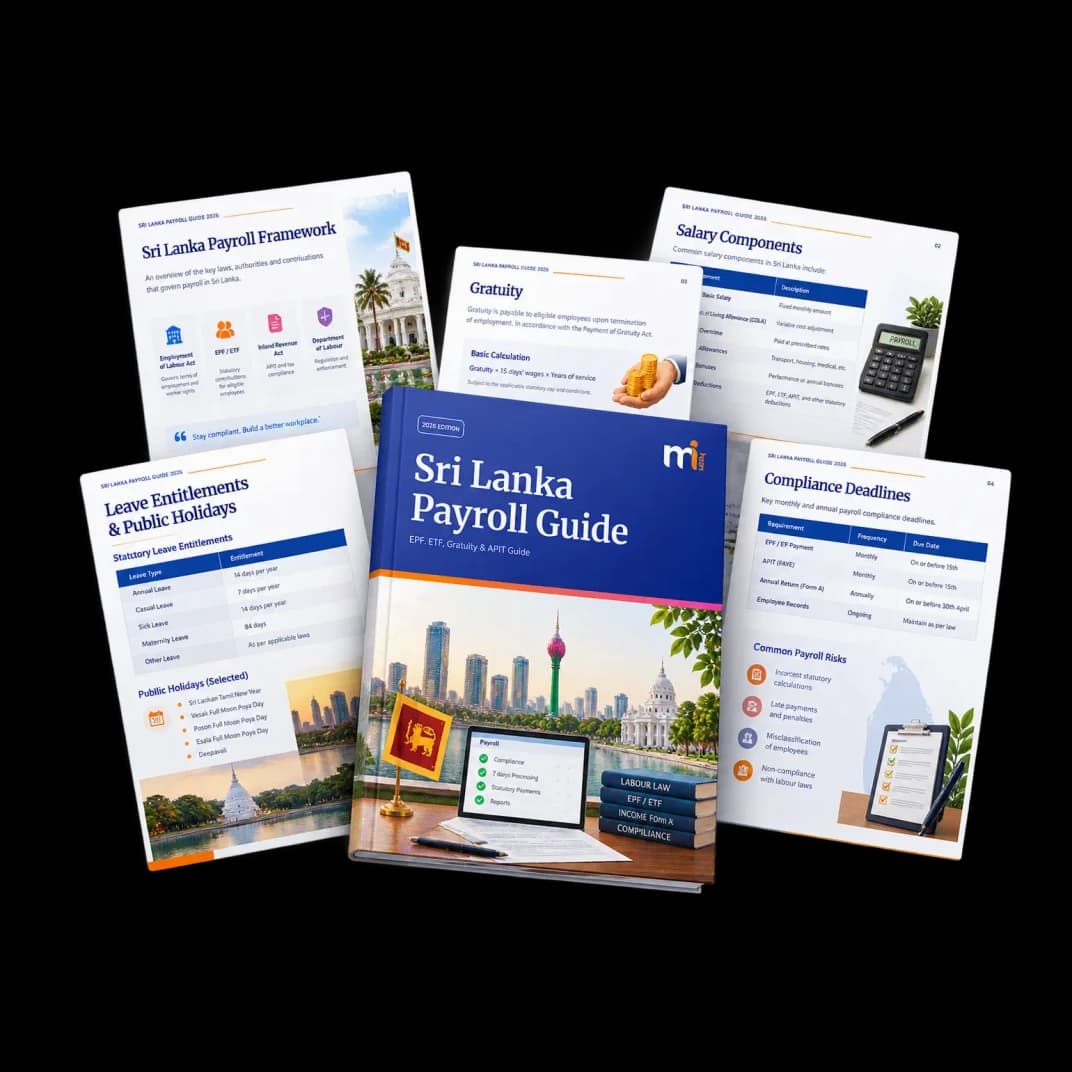
এই গাইডটি কেন গুরুত্বপূর্ণ
Every payroll run in Sri Lanka carries statutory weight.
Get it right, and your people are paid accurately, your EPF and ETF contributions land on time, and your APIT withholding is correctly calculated for every employee. Get it wrong, and the consequences — surcharges, Inland Revenue scrutiny, Labour Tribunal claims — accumulate quickly.
Sri Lanka’s payroll framework is not complicated in principle. But it is detailed, and the details have changed more than once in the past year. Here is a plain-language overview of what employers need to manage in 2026.
এই গাইডটি ব্যাখ্যা করে:
How EPF and ETF contributions work, and when they are due
When gratuity applies and how it is calculated
How APIT is withheld and remitted
Salary components, leave and overtime rules
The most common payroll compliance mistakes
How MiHCM Payroll handles it all
The four core statutory frameworks
Every employer in Sri Lanka is responsible for four core statutory obligations on each employee’s monthly payroll:
ইপিএফ
Employees’ Provident Fund
Mandatory retirement savings. Employers contribute 12% of total earnings; employees contribute 8%, with no salary cap. Contributions are due to the Central Bank’s EPF Department by the last working day of the following month.
ETF
Employees’ Trust Fund
A separate, employer-funded benefits fund. Employers contribute 3% of total earnings; there is no employee contribution. Same due date as EPF.
বখশিশ
A lump-sum benefit for employees who complete five or more years of service with an employer of 15 or more workmen, calculated at half a month’s salary per completed year for monthly-rated workmen. Payable on termination for any reason, not only retirement.
APIT
Advance Personal Income Tax
Progressive income tax withheld at source and remitted to the Inland Revenue Department. The correct deduction depends on each employee’s monthly earnings and non-cash benefits, applied against IRD Tax Table No. 01. Due by the 15th of the following month.
সর্বাধিক সাধারণ ব্যর্থতাগুলি
Where things go wrong
The most common compliance failures in Sri Lankan payroll are not dramatic — they are systemic.
Calculating EPF, ETF or gratuity on basic salary alone, when qualifying allowances should be included too.
Applying the pre-April 2025 APIT personal relief after the threshold moved to Rs. 150,000 a month.
Treating gratuity and TEWA termination compensation as the same payment, when they are calculated under separate statutes and can both apply.
Working from last year’s minimum wage after the Rs. 30,000 rate took effect in January 2026.
How MiHCM handles Sri Lanka Payroll
Statutory rules built in
MiHCM Payroll is built to handle the full scope of Sri Lanka’s statutory obligations out of the box. EPF, ETF, gratuity and APIT calculations are embedded directly into the payroll engine, with contribution rates, tax tables and Wages Board rules maintained in line with regulatory updates.
Correct rates every pay run
Every pay run automatically applies the correct EPF (12%/8%) and ETF (3%) rates, the current APIT tax table, and the appropriate overtime, no-pay and late-deduction formulas for Shop & Office or Wages Board employees.
Submission-ready outputs
Submission-ready outputs are generated as standard. Bank remittance files for salary, EPF and ETF are formatted for Sri Lanka’s major banks — including Bank of Ceylon, Commercial Bank, HNB, HSBC, People’s Bank, NSB, Seylan, Sampath, DFCC and the Central Bank — while T9 and T10 certificates and EPF/ETF page totals are generated automatically for each half-year period, removing much of the manual effort that typically dominates payroll month-end.
সম্পূর্ণ গাইড পান