
 2026 Edition
Malaysia Payroll Guide
Everything Malaysian HR and payroll professionals need — EPF, SOCSO, EIS, PCB/MTD, leave entitlements, compliance deadlines and practical guidance. All in one comprehensive guide.
Download Now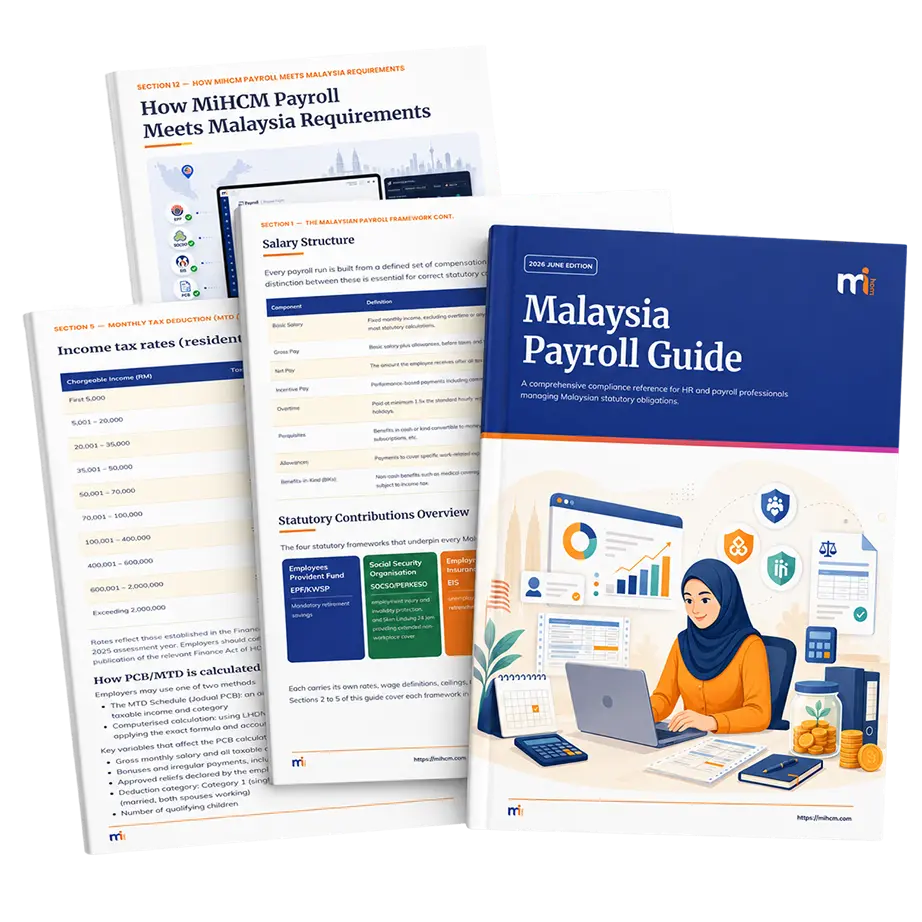
Why This Guide Matters
Every payroll run carries legal weight.
Every payroll run in Malaysia carries legal weight. Get it right, and your people are paid accurately, your contributions land on time, and your business stays on the right side of four separate statutory frameworks. Get it wrong, and the consequences range from financial penalties to prosecution. For HR and payroll teams, the challenge is real. Malaysian payroll is not complicated in principle — but it is detailed, and the details matter. Here is a plain-language overview of what employers need to manage in 2026.
This guide explains:
The Malaysian Payroll Framework
Employees Provident Fund (EPF/KWSP)
Social Security Organisation (SOCSO/PERKESO)
Employment Insurance System (EIS)
Monthly tax deduction (MTD/PCB)
Leave entitlements and public holidays
Compliance calendar and deadlines
How MiHCM Payroll meets Malaysia requirements
The Four Statutory Frameworks
Four obligations. Every month. Get all four right.
EPF
Employees Provident Fund
Mandatory retirement savings. Employers contribute 12–13% of wages (depending on whether the employee earns above or below RM5,000 per month); employees contribute 11%. Submissions are due by the 15th of the following month.
SOCSO
Social Security Organisation
Provides employment injury and invalidity protection. Employer contributions are about 1.75% of wages, while employees contribute around 0.5%, with a RM6,000 monthly wage ceiling for the Invalidity Scheme. From June 2026, SOCSO also administers Skim Lindung 24 Jam, adding employee-borne premiums of 0.75%, rising to 1.25% from 2031. No additional employer contribution applies. Payments are due by the last day of the following month.
EIS
Employment Insurance System
Funds financial support for retrenched employees. Employers contribute 0.2% and employees 0.2% of monthly wages, capped at RM6,000. Also due by month end, submitted alongside SOCSO via the PERKESO ASSIST portal.
PCB / MTD
Potongan Cukai Bulanan / Monthly Tax Deduction
Progressive income tax deducted at source and remitted to LHDN. The correct deduction depends on each employee's salary, declared reliefs, tax category and number of dependants. Due by the 15th of the following month.
Most Common Failures
The most common failures are systemic, not dramatic.
These are the mistakes that happen when payroll is managed manually, systems aren't configured correctly, or teams are stretched across too many obligations at once. The penalties — fines, dividend charges and director liability — are real.
Applying the wrong EPF employer rate at the RM5,000 wage threshold
Missing the EA Form deadline for employees who left mid-year
Misapplying the RM6,000 wage ceiling for SOCSO and EIS
Multi-state public holiday mismanagement across Peninsular and East Malaysia
Processing a bonus without triggering a PCB recalculation
Failing to register a new joiner with SOCSO before month close
Incorrect pay component classification across EPF, SOCSO and PCB
How MiHCM Handles Malaysia Payroll
Built for Malaysia. Every obligation, automated.
MiHCM handles EPF, SOCSO, EIS and PCB calculations automatically. Every pay run applies the correct employer and employee rates. Submission-ready output files are generated as standard. EA Forms and E Forms are produced at year-end automatically.
Auto-calculated statutory rates
EPF 12%/13% split, SOCSO/EIS RM6,000 ceiling, progressive PCB — all applied automatically every run.
Submission-ready output files
EPF, SOCSO and EIS contribution files for direct upload. e-Data PCB in LHDN-prescribed format for MyTax.
Year-end forms automated
EA Forms and E Form generated automatically, removing the February–March deadline pressure.
35+ statutory reports
Borang A, Borang E, CP-39, CP21, CP22, CP22A, Lampiran B, PTPTN and more — one click.
Skim Lindung 24 Jam ready
New June 2026 SOCSO premium handled automatically in the payroll engine.
Multi-country platform
Malaysia, Singapore, Thailand, Sri Lanka, Cambodia and more — unified HR platform.
Get the Full Guide