
 2026 Edition
Bangladesh Payroll Guide
Everything Bangladeshi HR and payroll professionals need — Provident Fund, Gratuity, WPPF, Personal Income Tax (TDS), leave entitlements and the 2026 Labour Law reforms. All in one comprehensive guide.
Download Now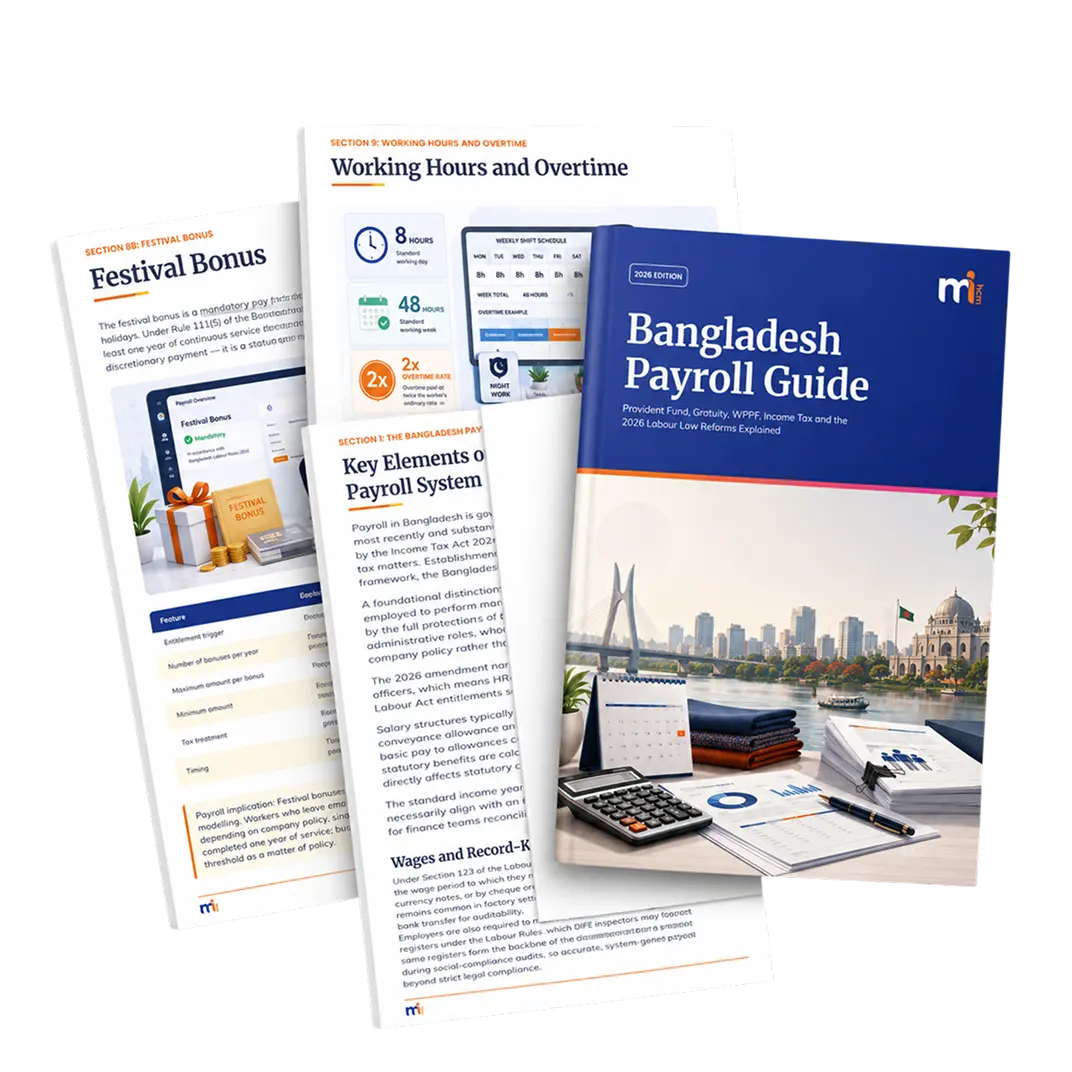
Why This Guide Matters
Every payroll run carries legal weight.
Every payroll run in Bangladesh carries legal weight. Get it right, and your people are paid accurately, your contributions land on time, and your business stays on the right side of a labour law that has just undergone its broadest reform in over a decade. Get it wrong, and the consequences range from financial penalties to Labour Court claims. For HR and payroll teams, the challenge is real. Bangladeshi payroll is not complicated in principle — but it is detailed, and the details matter, especially with so much having changed in 2026 alone.
This guide explains:
The Bangladesh Payroll Framework
The Labour (Amendment) Act 2026
Provident Fund
Gratuity
Workers' Profit Participation Fund (WPPF)
Personal Income Tax and TDS
Minimum wage and leave entitlements
Termination, retrenchment and resignation
Compliance calendar and penalties
How MiHCM supports Bangladesh payroll compliance
The Three Statutory Frameworks
Three pillars. One reform cycle. Get all three right.
Provident Fund
mandatory retirement savings
Establishments with 100+ permanent workers must now form a provident fund automatically. Worker contributes 7–8% of basic wage; employer matches. Income earned by the fund is taxed at 15%; contributions are otherwise tax-exempt.
Gratuity
end-of-service lump sum
30 days' wages per year of service (up to 10 years); 45 days' wages per year beyond that. Payable on death, discharge, resignation, retrenchment or termination.
WPPF
Workers' Profit Participation Fund
Qualifying companies pay 5% of net profit, split 80:10:10 across the Workers' Participation Fund, Workers' Welfare Fund and the government Welfare Foundation Fund — within 9 months of year-end.
Most Common Failures
The most common failures are systemic, not dramatic.
These are the mistakes that happen when payroll configuration was correct when first set up but was never revisited as the law changed. Given how much changed in 2026 alone, an annual review against the current gazetted text is now a baseline requirement, not a discretionary exercise.
Treating provident fund as optional once the 100-worker threshold is met, rather than automatic
Misclassifying managerial staff as "workers" under the narrowed 2026 definition
Failing to maintain a funded, audited gratuity scheme, leading to disputes over what's payable
Missing the new 3-year resignation benefit trigger, still applying the old 5-year rule
Applying the old 11-day festival holiday count or the old 112-day maternity leave figure
Calculating overtime on basic wage alone rather than basic wage plus dearness allowance
Overlooking WPPF and WWF obligations for qualifying companies at audit time
How MiHCM Supports Bangladesh Payroll Compliance
Built for Bangladesh. Every reform, automated.
MiHCM Payroll handles provident fund, gratuity, WPPF and TDS calculations automatically for Bangladesh. Every pay run applies the correct contribution rates, accrual rules and NBR slab structures — configured for a labour law that has just undergone its broadest reform in over a decade.
Auto-calculated statutory rates
Provident fund (7–8%), gratuity 30/45-day tiers, and progressive TDS — all applied automatically every run.
Gratuity accrual, whichever is higher
Automatic accrual using the 30-day / 45-day service-length rules, compared against compensation on exit.
WPPF distribution tracking
Net profit allocation logic supporting the 80:10:10 split, with cash and retained portion tracking.
Statutory reports for Bangladesh
Provident fund trustee reports, WPPF distribution records and TDS deposit reconciliation — one click.
NBR slab structures, updated yearly
Monthly TDS recalculated automatically as thresholds and rates change each fiscal year.
Multi-country platform
Malaysia, Thailand, Cambodia, Bangladesh, Sri Lanka and more — unified HR platform.
Get the Full Guide