HR systems hold some of the most sensitive data an organisation has: salaries, bank details, identity numbers, medical leave, performance reviews. Every HR software vendor knows this, and most answer it the same way, with a row of security badges on the website.
Badges are a starting point, not an answer. Each certification proves something specific, covers a defined scope and leaves things out.
This blog explains what SOC 2 Type II, ISO/IEC 27001 and ISO/IEC 27701 each prove, what they do not, and how HR, IT and procurement teams should read the evidence.
Three standards, three different questions
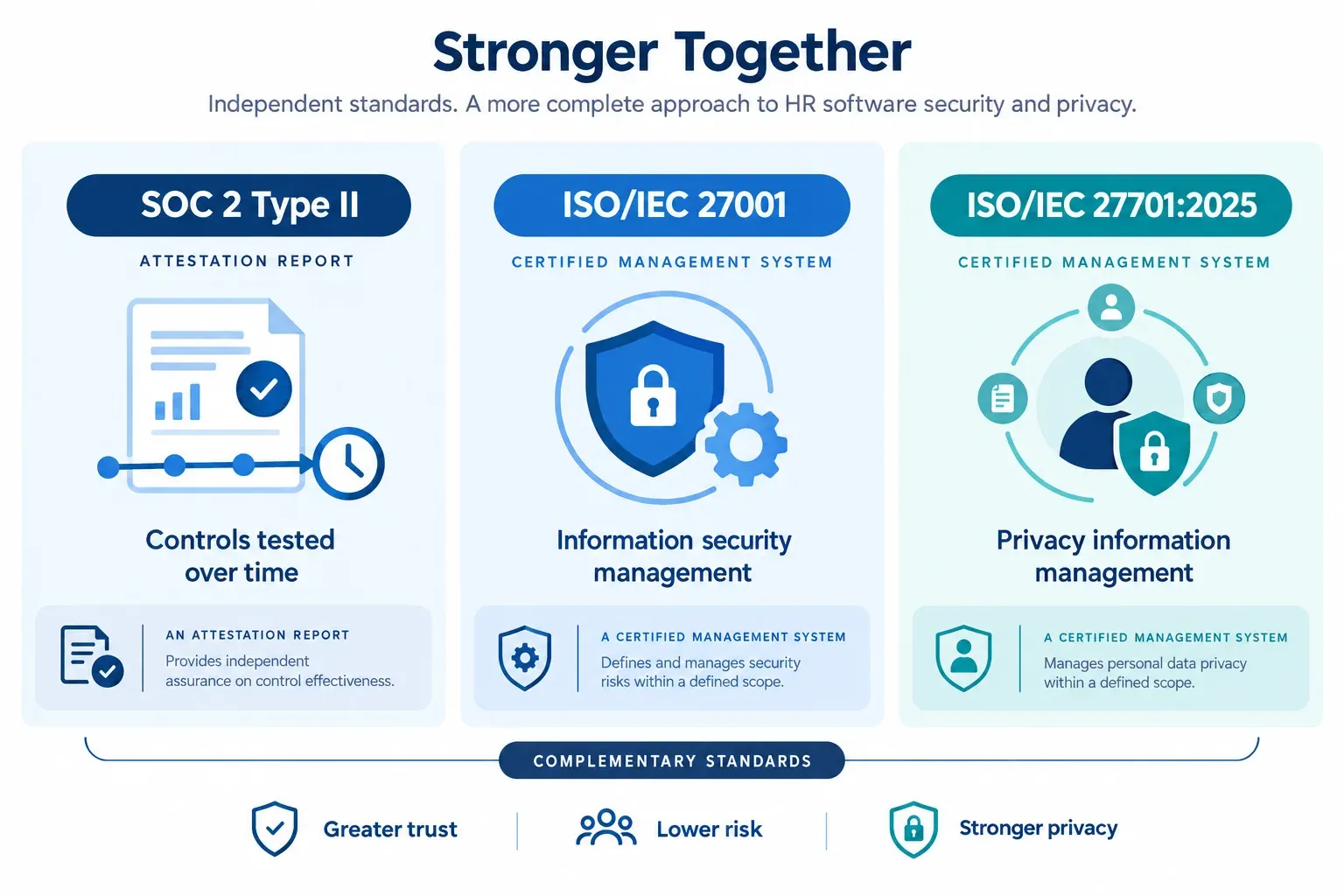
The three are often listed together, but they answer different questions.
Standard | What it is | Who issues it | What it answers |
|---|---|---|---|
SOC 2 Type II | An attestation report on a service organisation's controls, based on the AICPA's Trust Services Criteria | An independent CPA firm | Were the vendor's controls designed well and did they operate effectively over a period of time? |
ISO/IEC 27001 | An international standard for an information security management system (ISMS) | An accredited certification body | Does the vendor run a managed, risk-based system for information security within the certified scope? |
ISO/IEC 27701:2025 | An international standard for a privacy information management system (PIMS) | An accredited certification body | Does the vendor run a managed system for protecting personal data within the certified scope? |
SOC 2 Type II: evidence over time
A SOC 2 report examines a service organisation's controls against the Trust Services Criteria set by the American Institute of Certified Public Accountants (AICPA). The Trust Services Criteria comprise security, availability, processing integrity, confidentiality and privacy. The common criteria related to security are included in every SOC 2 examination; the other categories are included when relevant to the engagement.
The type matters. A Type I report covers the design of controls at a specific point in time. A Type II report covers both the design and the operating effectiveness of controls over a period of time. For an HR system that runs payroll every month, that difference is significant: Type II shows the controls kept working, not just that they existed on one day.
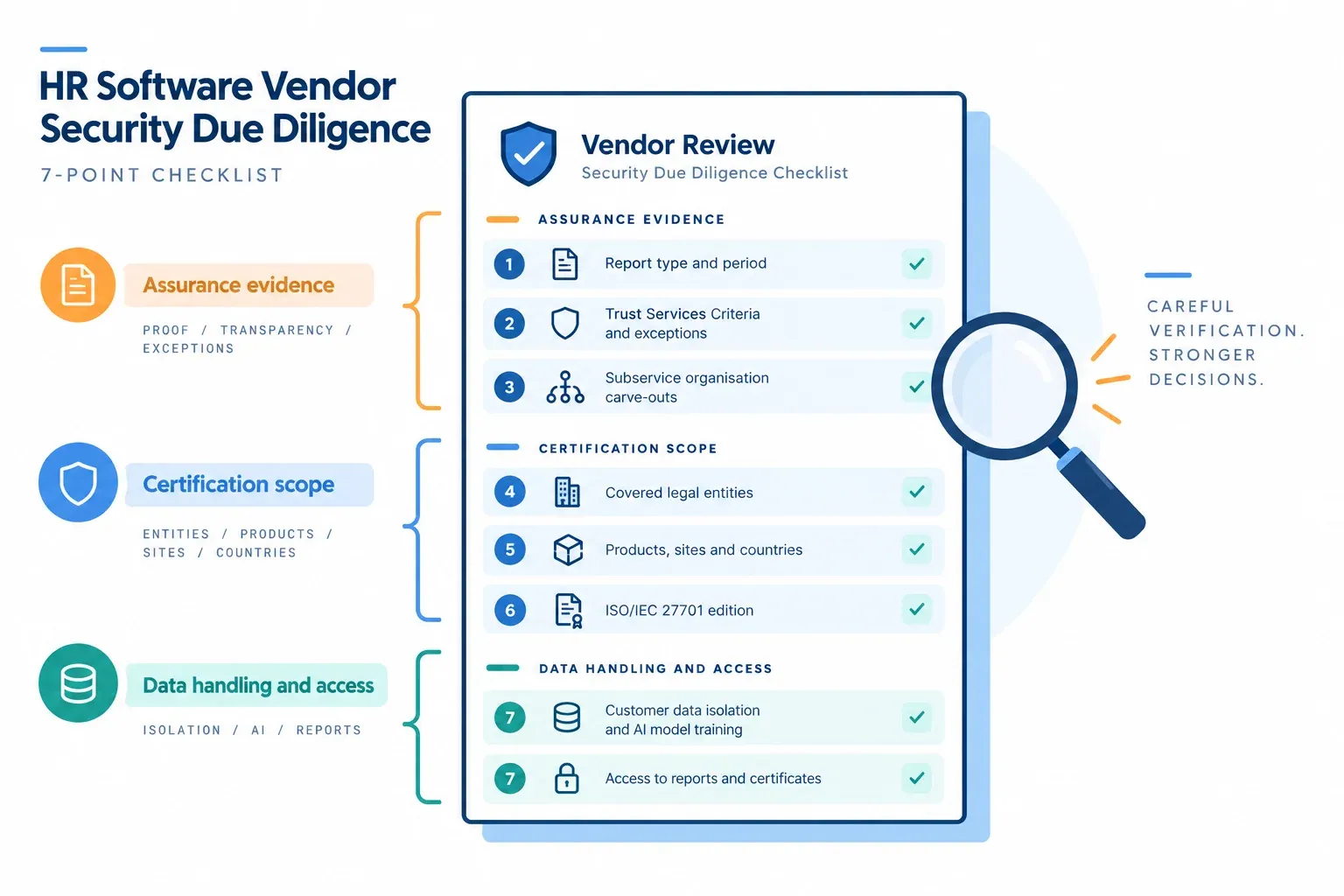
A SOC 2 report is a report, not a certificate. To understand it, read beyond the cover:
- The period: which months the auditor tested.
- The criteria: which of the five Trust Services Criteria are included.
- The system description: which products, services and locations are in scope.
- Exceptions: any controls the auditor found did not operate as described.
- Carve-outs: whether subservice organisations, such as hosting providers, are excluded and need their own reports.
ISO/IEC 27001: a managed security system
ISO/IEC 27001 sets requirements for an information security management system. Certification shows that an accredited certification body has audited the vendor's system against the standard for a defined scope.
The value of ISO/IEC 27001 lies in the management system. It requires a vendor to assess information security risks, choose controls to treat them and keep improving. The limit lies in the scope. A certificate covers the organisation, sites and services named on it, and nothing else.
ISO/IEC 27701:2025: privacy in its own right
ISO/IEC 27701 covers privacy information management. ISO/IEC 27701:2025, published in October 2025, is an independent privacy information management system standard. It can be used on its own or aligned with ISO/IEC 27001, with expanded guidance for data controllers and processors.
For HR software, this matters. An HR vendor processes personal data on behalf of every client. ISO/IEC 27701 shows that the vendor manages that responsibility through a defined, audited system.
What certifications do not prove
No certification proves that a breach cannot happen. Certifications show that controls and management systems were assessed against a standard, within a scope, at a time.
Nor do they replace legal compliance. Data protection laws, such as Malaysia's Personal Data Protection Act 2010, Thailand's Personal Data Protection Act B.E. 2562 or Sri Lanka's Personal Data Protection Act, place obligations on employers as well as vendors. A vendor's certificate supports an employer's compliance. It does not discharge it.
And a certificate is only as useful as its scope. A vendor certified for one entity, product or country is not certified for all of them.
Questions to ask any HR software vendor
- Is your SOC 2 report Type I or Type II, and which period does it cover?
- Which Trust Services Criteria are included, and were there any exceptions?
- Which legal entities, products, sites and countries do your ISO/IEC 27001 and ISO/IEC 27701 certificates cover?
- Which edition of ISO/IEC 27701 are you certified against?
- Are any subservice organisations carved out of your reports, and can we see their reports?
- How is our data separated from other customers' data, and is it used to train AI models?
- How can we access your reports and certificates during procurement, and under what terms?
How MiHCM approaches it
MiHCM holds SOC 2 Type II, ISO/IEC 27001 and ISO/IEC 27701:2025 certifications. Its ISO/IEC 27701:2025 certification was reported in 2026 as covering its operations in Malaysia and Sri Lanka, which is exactly the kind of scope detail buyers should check for any vendor.
MiHCM's AI products are covered by the same approach to data. MiHCM states that customer data remains logically isolated and is not used to train foundation AI models. Prompts and responses may be retained under internal governance controls for evaluation, retrieval-augmented generation and prompt improvement. MiHCM's Trust Portal lists ISO/IEC 27001, ISO/IEC 27701:2025 and SOC 2 Type II assurance; confirm the applicable legal entity and report availability during procurement.
That matters as HR adds AI. MiA ONE, MiHCM's AI-powered personal assistant, handles everyday HR requests such as leave, check-ins and approvals. Syntra, MiHCM's AI-powered HR intelligence solution, answers workforce questions in plain language. Both work on HR data, so the same questions about isolation, retention and training apply to them as to the core HR system.
An illustrative scenario: a vendor security review
Consider a regional enterprise replacing its HR and payroll system. The scenario is illustrative.
The IT security team sends each shortlisted vendor the same questionnaire. Instead of accepting badges, it asks for the SOC 2 Type II report, the ISO certificates and their scope statements.
For one vendor, the SOC 2 report covers only security, and the ISO certificate covers a different entity from the one that would sign the contract. For another, the reports cover the right entity and period, the privacy certificate is the 2025 edition, and the vendor explains in writing how customer data is isolated and whether it is used to train AI models.
The decision is easier because the team compared evidence, not logos.
The bottom line
SOC 2 Type II shows that controls worked over time. ISO/IEC 27001 shows a managed security system. ISO/IEC 27701:2025 shows a managed privacy system. None of them is a guarantee, and each is only as good as its scope. Read the reports, check the scope, and ask how your data is handled, including by AI.
Book a demo to discuss MiHCM's security and privacy assurance.