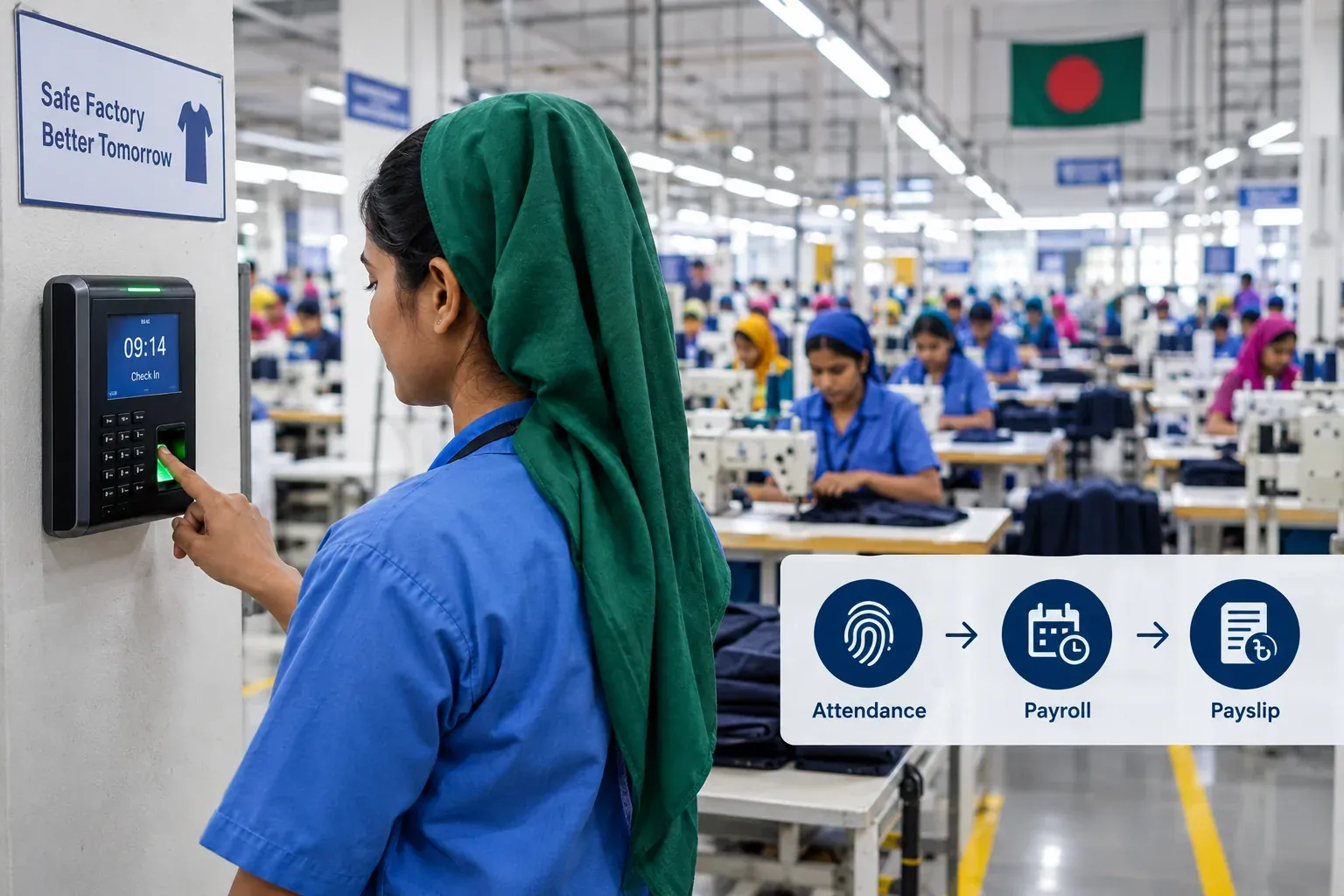
In a Bangladeshi garment factory, attendance is not an HR record. It is the foundation of everything that follows: wages, overtime, attendance bonuses, buyer audits and, ultimately, orders.
A factory with several thousand workers records tens of thousands of punches every week across gates, lines and shifts. Every one of them becomes a payroll fact. When attendance is wrong, overtime is wrong. When overtime is wrong, wages are wrong. And when wages are wrong, the problem surfaces as worker grievances, failed social audits and lost business.
This article sets out how garment factories can capture attendance at scale, apply the Bangladesh Labour Act's rules on hours and overtime, manage shifts, and carry every punch from the factory gate to the payslip. It draws on MiHCM's work with garment and apparel manufacturers.
Why attendance carries so much weight in garment payroll
Most payroll systems are built for salaried staff on fixed hours. Garment manufacturing works differently.
- Scale: factories employ thousands of workers, often across several units.
- Variable earnings: overtime, attendance bonuses, production incentives, night allowances and piece-rate elements sit alongside time-rated pay.
- Grade-based structures: wage grades split pay into fixed components such as basic, house rent, medical, conveyance and food, and downstream calculations depend on that split.
- Constant change: high turnover and seasonal hiring mean the employee master file changes materially every month.
- Production pressure: order peaks push hours up quickly, often unevenly across lines.
Each of these is manageable on its own. Together, at scale, they defeat spreadsheets and paper registers. And almost every one of them depends on accurate attendance.
The legal framework: hours and overtime
The Bangladesh Labour Act 2006 and the Bangladesh Labour Rules 2015 set the rules every attendance and payroll system must apply.
Provision | What it says | What it means for attendance |
|---|---|---|
Daily hours (section 100) | An adult worker ordinarily works no more than 8 hours a day, and may work up to 10 hours subject to the overtime provisions | Every shift needs a recorded start and end, checked against 10 hours |
Weekly hours (section 102) | Ordinarily no more than 48 hours a week; with overtime, no more than 60 hours in any week and an average of no more than 56 hours a week over a year | Weekly totals and a rolling yearly average must be tracked for every worker |
Overtime pay (section 108(1)) | Twice the ordinary rate of basic wage, dearness allowance and any ad hoc or interim wage | Overtime hours must be captured exactly and paid on the correct base |
Piece-rate workers (section 108(2)) | English-language sources indicate that the 2018 amendment excluded piece-rate workers from the section 108(1) overtime-rate formula; Bangladeshi legal confirmation of the current text is required | Piece-rate and time-rated workers need different pay rules |
Hourly rate (rule 102) | For monthly-paid workers, secondary English-language summaries describe the hourly rate as one 208th of the relevant monthly wage under rule 102. Confirm the current official rule and the wage components included before publication. | The divisor behind every overtime payment must be right |
Two points deserve emphasis. First, overtime is calculated on basic wage, dearness allowance and any ad hoc or interim wage, not on gross pay. Second, the weekly limit and the yearly average are separate tests. A factory can stay under 60 hours every week and still breach the 56-hour average across the year.
An illustrative worked example
Illustrative only. Here is a calculation for one monthly-paid, time-rated worker. The figures are illustrative, not wage-board rates. The example assumes that Tk 8,000 is the complete wage base relevant under the current rule. Confirm the applicable wage components and divisor before using this formula operationally.
- Basic wage: Tk 8,000 a month, with no dearness allowance or ad hoc wage
- Hourly rate: Tk 8,000 ÷ 208 = Tk 38.46
- Overtime rate: Tk 38.46 × 2 = Tk 76.92 an hour
- Overtime worked in the month: 20 hours
- Overtime pay: 20 × Tk 76.92 = Tk 1,538.40
Calculate the same overtime on gross pay and the factory overpays. Calculate it on basic wage when the factory pays an ad hoc or interim wage, and it underpays. Either way, the attendance record behind those 20 hours must be accurate, or every figure after it is wrong.
Shift patterns on the factory floor
Garment factories rarely run a single shift. Cutting, sewing, finishing and washing may run different hours. Night shifts appear during peaks. Lines extend their hours unevenly as orders demand.
That creates three attendance challenges:
- Assigning the right shift: each punch must be matched to the shift the worker was rostered on, including night shifts that cross midnight.
- Separating normal hours from overtime: the system must know where a worker's ordinary hours end and overtime begins, on each day and in each week.
- Handling the edges: late arrivals, early departures and early-in overtime all need consistent rules, applied the same way for every worker.
Where attendance goes wrong
Most attendance problems in garment factories are not dramatic. They are systemic.
- Paper registers and manual entry: records that are hard to verify and easy to question in an audit.
- Separate systems: attendance captured in one system and payroll processed in another, with no reconciliation between them.
- Overtime without authorisation: extra hours worked but not approved in advance, or approved but not recorded.
- Inconsistent rounding and grace periods: different supervisors treating late arrivals differently.
- Limits checked too late: weekly hours and the yearly average reviewed after payroll, not before.
- Untraceable edits: corrections with no record of who changed what, when or why.
The fix for all of them is the same principle. Attendance and payroll must share a single source of truth, with electronic capture feeding directly into the calculation engine and every adjustment controlled.
Capturing attendance at scale
The first decision is how workers record time. Different methods suit different parts of a factory.
Capture method | Where it fits | What to consider |
|---|---|---|
Fingerprint biometric | Factory gates and unit entrances | Ties each punch to the worker; device placement and throughput at shift change matter |
Facial recognition | High-volume gates and hygiene-sensitive areas | Contactless and fast; lighting and enrolment quality matter |
RFID or barcode cards | Line-level or section-level tracking | Quick to use; cards can be shared, so pair with biometric checks where needed |
Mobile clock-in with GPS | Supervisors, field staff and off-site teams | Useful outside the factory; confirm location rules |
MiHCM's Time and Attendance supports biometric, RFID, barcode and mobile clock-in, including facial recognition, fingerprint and GPS-based capture. MiHCM Enterprise for Bangladesh connects to automated biometric devices, including fingerprint attendance machines and face scanners.
From the gate to the payslip
A reliable attendance process follows the same path every pay cycle.
- Capture: workers punch in and out on biometric or card devices at the gate or unit.
- Match: each punch is matched to the worker's rostered shift, including night shifts.
- Apply rules: grace periods, late arrivals and early departures are applied consistently.
- Separate overtime: hours beyond the normal day or week are identified as overtime.
- Authorise: overtime is checked against prior authorisation.
- Check limits: daily, weekly and yearly-average limits are reviewed for every worker.
- Calculate: payroll applies the correct base and rate to normal hours and overtime.
- Reconcile and pay: attendance and payroll are reconciled before salaries are processed.
When these steps run in one system, a punch at the gate on Monday morning becomes a correct line on the payslip at month end, with a record of every step in between.
Shift and overtime rules a system should enforce
When evaluating an attendance system for a garment factory, look for rules that are configured once and applied to every worker:
- grace periods for late arrival, set by policy rather than by supervisor
- treatment of late arrivals and early departures
- early-in overtime that counts only with prior authorisation
- overtime policies with different rates for different job categories
- separate rules for time-rated and piece-rate workers
- reports on overtime, late hours and absenteeism by line, section and unit
MiHCM supports customisable grace periods, handles late arrivals and early-in overtime with prior authorisation, and supports single, double and triple overtime policies with custom rates for job categories. Attendance analytics show overtime, late hours and absenteeism trends, and HR can build pay-related reports alongside existing attendance and leave reports covering overtime, absence without leave and daily absenteeism.
Connecting attendance to production
In a well-run garment factory, payroll data and production data are inseparable. Units produced per worker feed piece-rate calculations. Attendance at the gate feeds overtime and bonus calculations. Production bonuses depend on both.
That means the payroll engine must receive attendance and production data directly, whether from biometric devices, mobile clock-in or a manufacturing execution system (MES), without manual re-entry.
In the case of a prominent global apparel manufacturer which uses MiHCM across HR, payroll, attendance, talent management and workforce analytics, MiHCM integrated with its manufacturing execution system, enabling data to flow from the shop floor to payroll without manual re-entry.
For Bangladeshi manufacturers, the lesson is practical. When production and attendance data reach payroll automatically, the factory removes one of the largest sources of error and dispute: re-keying.
MiHCM's garment customers include long-established names. Timex Garments, which has operated in the apparel industry since 1967, put its reason for choosing MiHCM simply: "We chose MiHCM because I know how it is built and how it works."
Payroll that follows attendance
Attendance only creates value when payroll uses it correctly. MiHCM Payroll runs automated calculations and localised statutory requirements in one system with attendance.
- Customisable salary formulas: the Advanced Formula Builder handles grade structures, overtime bases and incentive rules.
- Payroll checklist: confirms that attendance, loans and increments are covered before salaries are processed.
- Flexible payment schedules: supports the pay cycles a factory actually runs.
- Pay-related reports: overtime, absence and pay summaries for finance, management and auditors.
MiHCM Enterprise for Bangladesh is localised to Bangladeshi labour laws and regulations and is built for organisations from 250 to more than 20,000 employees. MiHCM's guide to payroll for the ready-made garment industry in Bangladesh covers the wider payroll picture.
Leave, absence and attendance bonuses
Attendance is not only about hours worked. It also decides who was absent, whether the absence was authorised and whether a worker qualifies for an attendance bonus.
When leave sits in a separate register, a worker on approved leave can look absent in the attendance system and lose a bonus they were entitled to. A worker who was absent without leave can look present if a supervisor forgets to update the register. Both errors end up as grievances.
MiHCM's Leave and Absence Management keeps leave in the same platform as attendance and payroll, and reports on absence without leave and daily absenteeism show the gaps before payroll runs.
Rolling out electronic attendance in a factory
Moving from registers or standalone devices to an integrated system is an operational change, not just a software installation.
- Enrol every worker: capture biometric data and link each worker to the right grade, section and shift.
- Plan device placement: put enough devices at each gate to handle shift change without queues.
- Configure the rules first: set grace periods, overtime authorisation and job-category rates before go-live.
- Run in parallel: compare the new system with existing records for at least one pay cycle.
- Train supervisors: make sure line chiefs know how to request and approve overtime in the system.
- Tell workers what changes: explain how time is recorded and how they can raise a query.
Seeing overtime patterns with Syntra
Overtime builds up line by line and week by week. By the time it shows in a monthly report, the peak has often passed.
Syntra, MiHCM's AI-powered HR intelligence solution, lets HR and factory leaders ask questions about overtime and attendance in plain language and follow up with more questions. Which sections ran the most overtime last month? How does that compare with the same period last year? Is higher overtime in one section coinciding with higher absence there?
Syntra links data across attendance, performance and resignations, so it can help leaders investigate possible drivers behind a trend, not only see that the trend exists. Findings can be exported to PowerPoint, Excel or PDF for management reviews.
MiA ONE for supervisors and staff
Not every worker uses a smartphone, but supervisors, line chiefs and office staff increasingly do. MiA ONE, MiHCM's AI-powered personal assistant, lets employees check in, request leave and receive notices by conversation, with each request validated against policy before it reaches an approver. Managers approve requests in the conversation, so overtime and leave decisions are not held up while they are on the floor.
An illustrative week in a knit factory
Consider a knitwear factory near Gazipur with two units and around 4,000 workers. The scenario is illustrative.
On Monday, workers punch in at fingerprint and face-recognition devices at each unit's gate. Each punch is matched to the rostered shift. Late arrivals within the grace period are treated the same way for every worker.
On Wednesday, a buyer brings forward a shipment. The finishing section needs extra hours. Supervisors request overtime, and line managers approve it in advance. Early-in overtime without authorisation does not count.
By Friday, HR reviews weekly hours. A small group in finishing is close to 60 hours for the week. Their Saturday rosters are adjusted before the limit is reached.
At month end, the payroll checklist confirms attendance is complete. Overtime is calculated at twice the ordinary rate of basic wage, using the hourly divisor the factory has confirmed under the current rule. Piece-rate workers in the knitting section are paid under their own rules. The factory manager asks Syntra how overtime this month compares with the last peak season, and takes the chart to the management meeting.
When the buyer's social auditor visits the following month, every worker sampled has attendance, overtime approvals and payslips that match.
An evaluation checklist for garment factories
- Can the system connect to the biometric and card devices you use, at every gate and unit?
- Does it match punches to rostered shifts, including night shifts that cross midnight?
- Are grace periods, late arrivals and early-in overtime handled by configured rules?
- Can overtime require prior authorisation, with different rates for different job categories?
- Does it support separate rules for time-rated and piece-rate workers?
- Can HR see weekly hours and the yearly average for every worker before payroll runs?
- Does attendance feed payroll directly, with a checklist before every pay cycle?
- Can it receive production data from your manufacturing execution system?
- Does it scale to your headcount across units and entities?
- Can leaders ask questions about overtime and attendance without waiting for a report?
The bottom line
In a garment factory, every punch at the gate is a payroll fact, an overtime calculation and a piece of audit evidence. Capture it electronically. Apply the Labour Act's rules consistently. Carry it straight into payroll. Then the hardest part of garment HR becomes the most reliable.
Book a demo to see MiHCM's attendance, shift and overtime management for garment manufacturers.
Sources
- Bangladesh Labour Act 2006, Chapter IX: working hours and leave
- The Daily Star: Garment pieceworkers not eligible for overtime pay
- BIPO Times, September 2022: Bangladesh labour law and rule 102
- MiHCM: Payroll for the ready-made garment industry in Bangladesh
- MiHCM: Payroll for the garment and apparel industry
- MiHCM Enterprise for Bangladesh