Most conversations about AI in HR start with the technology. The useful ones start with the work.
In a Thai enterprise, HR work splits into two kinds. There is the doing: thousands of small requests, approvals and check-ins every week. And there is the understanding: what is happening to attendance, overtime, performance and turnover, and what leaders should do about it.
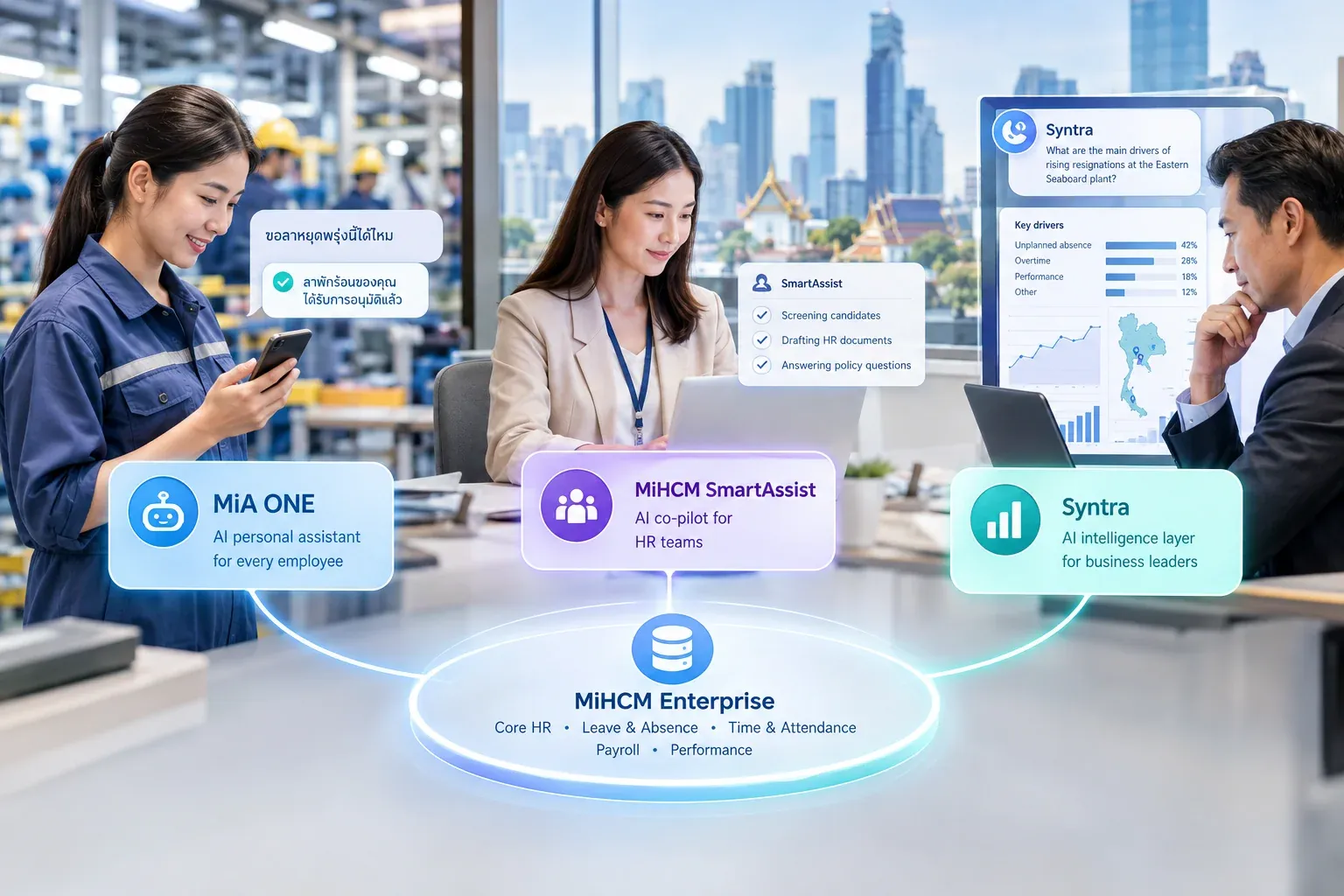
MiHCM has built an AI product for each. MiA ONE is the AI-powered personal assistant that helps employees and managers get everyday HR work done. Syntra is the AI intelligence layer that helps leaders understand their workforce. MiHCM SmartAssist, the AI-powered HR co-pilot, supports HR teams in between.
This article explains what each product does, how they work together in practice and what Thai enterprises should get right to put AI to work in HR.
Two jobs, two products
AI tools for HR often promise everything at once. That is usually where they fall short. A tool designed to answer an employee's leave question is not the right tool to investigate possible drivers of rising turnover in one region.
MiHCM keeps the jobs separate.
Job | Who it serves | MiHCM product |
|---|---|---|
Get everyday HR work done | Employees and line managers | MiA ONE |
Support HR teams with routine tasks and hiring | HR practitioners and recruiters | MiHCM SmartAssist |
Understand the workforce and decide what to do | Business leaders and HR leadership | Syntra |
The separation is deliberate. MiA ONE serves the employee experience. It does not try to be an executive analytics tool, and Syntra does not try to be a self-service portal. Each does one job well, and the data flows between them.
MiA ONE: the employee layer
What it is
MiA ONE is a personal AI assistant for every employee. It sits on top of the HR system and turns everyday HR tasks into a conversation. Employees can use it on the web and on iOS and Android, by chat or by voice.
The pattern is simple: ask, confirm the details, move on. MiA ONE validates policies, pre-fills requests and completes tasks in real time, so work keeps moving without manual steps.
What employees do with it
- Check in. Geo-based check-ins record attendance from wherever the employee works, whether that is a plant, a branch or a client site.
- Request leave. Employees ask for leave in a sentence. MiA ONE checks the balance and the policy and pre-fills the request.
- Keep timesheets current. Timesheets are updated as part of the working day, not reconstructed at month end.
- Get policy answers. Policies, guidance and updates come to the employee in the flow of work.
- Stay informed. Notices, reminders and organisation-wide updates reach every employee, including those without a desk.
What managers do with it
Managers are where HR processes most often stall. A request waits for approval while the manager is on the factory floor, in a meeting or travelling between branches.
With MiA ONE, requests arrive already validated against policy, and managers approve them in the conversation. MiA ONE also uses organisational and team data to give managers secure, AI-powered assistance for clearer day-to-day decisions.
Policy and governance built in
MiA ONE brings policies, guidance and updates directly into the flow of work, so every action is aligned, acknowledged and auditable. For HR, that matters as much as speed. A request that is checked at source does not need correcting later, and every action leaves a record.
Syntra: the intelligence layer
What it is
Syntra is MiHCM's AI-powered HR intelligence solution. It acts as a personal business-intelligence expert for leaders, turning workforce data into answers, charts and analysis.
When MiHCM unveiled Syntra at MiHCM Connect 2025, the company described it as working on each client's private MiHCM tenant data, combined with the organisation's own enterprise data, business systems and documents. MiHCM states that customer data remains logically isolated and is not used to train foundation AI models. Prompts and responses may be retained under internal governance controls for evaluation, retrieval-augmented generation and prompt improvement.
Ask in plain language
Syntra understands natural language. A leader asks a question in plain words and receives an answer drawn from the organisation's own data, then asks follow-up questions to dig deeper.
Syntra links data across attendance, performance, resignations and more. That means it can help investigate possible drivers behind a trend, not only show that the trend is happening.
One view across regions and teams
For a Thai enterprise with a Bangkok head office, plants on the Eastern Seaboard and branches upcountry, workforce data is usually scattered across sites and spreadsheets. Syntra brings performance, attendance and productivity across regions or teams into one view, without multiple dashboards or manual reports.
Board-ready outputs
Syntra exports its findings to PowerPoint, Excel or PDF, complete with visuals and narrative. Analysis that once took days of spreadsheet work becomes material ready for a leadership review.
Connected to the systems you already run
Syntra connects to MiHCM and to third-party solutions through secure APIs, consolidating workforce data into one intelligent view. It can work with the systems a Thai enterprise already runs, not only with MiHCM.
Where SmartAssist fits
Between the employee and the boardroom sits the HR team. MiHCM SmartAssist is an AI-powered HR co-pilot with two specialised solutions:
- SmartAssist for Core streamlines routine HR tasks.
- SmartAssist for Recruitment automates candidate screening against the criteria HR sets, supporting smarter, faster and fairer shortlisting.
SmartAssist is designed to work irrespective of the HR system in use.
In practice, that means an HR team can hand routine drafting and screening to SmartAssist and spend more time on the work that needs judgement: employee relations, workforce planning and advising managers.
How the three work together
The value comes from the connection. The table below shows how a typical set of workforce tasks moves through MiHCM's AI products.
Task | Who | Product | Result |
|---|---|---|---|
Apply for leave next week | Employee | MiA ONE | Request validated against policy and pre-filled |
Approve three pending requests | Line manager | MiA ONE | Approved in the conversation, with a full record |
Shortlist applicants for a new production role | Recruiter | SmartAssist for Recruitment | Candidates screened against defined criteria |
Investigate rising resignations at one plant | HR director | Syntra | Possible drivers investigated by linking attendance and performance data, explored through follow-up questions |
Prepare the quarterly workforce review | Chief executive | Syntra | Analysis exported to PowerPoint for the board |
Every task in the table touches the same underlying data. The leave request approved through MiA ONE in the morning is part of the attendance picture Syntra reads in the afternoon.
The data foundation underneath
AI products are only as useful as the records they work on. In MiHCM, both MiA ONE and Syntra sit on the same foundation: MiHCM Enterprise, which runs core HR, leave and absence, time and attendance, payroll and performance for medium and large organisations.
That shared foundation works in both directions. When an employee requests leave through MiA ONE, the request is validated against the policies configured in MiHCM Enterprise and recorded there once approved. When a check-in is made, it becomes part of the attendance record that payroll and reporting rely on.
Syntra then reads those records, alongside data from other systems connected through secure APIs. The result is a loop. Everyday work captured through MiA ONE produces cleaner data, and cleaner data produces more reliable answers in Syntra.
For a Thai enterprise, this is the practical difference between adding AI on top of scattered spreadsheets and building it into the system of record.
AI HR in practice: a day at a Thai enterprise
To see how this works, consider a Thai manufacturing and distribution group with a head office in Bangkok, two plants on the Eastern Seaboard and sales branches across the country. The scenario is illustrative.
7:30: on the plant floor
A line supervisor arrives at the plant and checks in through MiA ONE. Her location is recorded with the check-in.
One of her team messages MiA ONE to ask for a day's leave on Friday. MiA ONE checks his balance, pre-fills the request and sends it to her. She approves it before the shift starts, without leaving the line.
10:00: at head office
An HR officer in Bangkok usually spends her morning answering the same policy questions by phone and email. Today, many of those questions have gone to MiA ONE, which answers from the company's configured policies.
She spends the morning on a new onboarding plan instead.
13:00: in recruitment
The group needs to hire production staff before its peak season. A recruiter uses SmartAssist for Recruitment to screen applications against the criteria HR has set, and moves straight to interviews with a shortlist.
16:00: in the HR director's office
Overtime at one plant has been climbing. Under the Labour Protection Act, overtime and holiday work combined may not exceed 36 hours a week, so the HR director needs to know where the pressure is.
She asks Syntra which departments ran the most overtime last month and how that compares with the previous quarter. Syntra answers with a chart.
She asks a follow-up: is the overtime linked to absence? Syntra links the attendance data. Syntra shows that higher unplanned absence coincides with higher overtime in the department, giving HR a line of inquiry to test.
17:30: preparing for the board
The HR director exports the analysis to PowerPoint for the next day's leadership meeting. The conversation that follows is about testing that line of inquiry and addressing absence in one department, not about whose numbers are right.
What changed
None of the people in this scenario learned a new system. The supervisor and her team used a conversation. The HR officer gained a morning. The recruiter started with a shortlist. The HR director answered a board-level question in minutes, with data the whole leadership team could trust.
Deploying AI in HR: what Thai enterprises should get right
Start with clean data
AI is only as good as the data behind it. Before rollout, check that employee records, organisation structures, leave policies and attendance rules are complete and current. Errors in the source data become confident errors in the answers.
Configure policy before you automate it
MiA ONE validates requests against the policies configured in the system. If those policies are out of date, the assistant will apply out-of-date rules faster. Review leave entitlements, approval routes and working-hour rules first.
Plan for language and channels
Thai enterprises often run a mixed workforce: office staff at head office, frontline teams in plants and branches, and regional or expatriate managers. Confirm which languages and channels each group needs during scoping, and plan the rollout around how each group actually works.
Treat employee data with care
Employee data in Thailand is personal data under the Personal Data Protection Act B.E. 2562 (2019). Any AI product that touches HR data must meet the same standard as the HR system itself.
MiHCM states that customer data remains logically isolated and is not used to train foundation AI models. Prompts and responses may be retained under internal governance controls for evaluation, retrieval-augmented generation and prompt improvement. MiHCM's Trust Portal lists ISO/IEC 27001, ISO/IEC 27701:2025 and SOC 2 Type II assurance; confirm the applicable legal entity and report availability during procurement.
Set clear ownership
Each layer needs an owner. HR operations typically owns MiA ONE policies and approval routes. The HR team leads on SmartAssist. Syntra works best with a named sponsor in leadership who decides which questions matter most each quarter. Without owners, configuration drifts and trust erodes.
Keep a human in the loop
AI should take routine work off people's desks, not take decisions away from them. Keep sensitive cases, such as disciplinary matters or complex leave situations, with HR. Use SmartAssist shortlists as a starting point for recruiters, not a final answer. Treat Syntra's analysis as the basis for a leadership discussion, not a substitute for it.
Bring people with you
AI changes how people work. Tell employees what MiA ONE can do and where to go for anything else. Show managers how approvals will change. Give HR teams time to learn SmartAssist and Syntra before the first board review depends on them.
Measure what changes
Decide in advance how you will judge success. Useful measures include the volume of requests handled through MiA ONE, approval turnaround times, the number of policy exceptions caught before submission and the time HR spends preparing reports.
Common pitfalls to avoid
Most difficulties with AI in HR are not technical. They come from how the rollout is planned.
- Automating a broken process. If an approval route is unclear today, an assistant will make it unclear faster. Fix the process first.
- Starting with the hardest use case. Complex, sensitive cases are poor first candidates. High-volume, low-risk requests build confidence quickly.
- Treating analytics as a dashboard project. Syntra is most valuable when leaders ask real questions and follow them up. Plan the questions, not just the charts.
- Leaving managers out. Managers approve most requests. If they do not use the assistant, requests stall where they always did.
- Skipping the data review. Out-of-date organisation structures and leave policies undermine trust in the first week.
- Measuring nothing. Without a baseline, it is impossible to show what changed.
Questions to ask before you buy AI for HR
- Does the product separate employee self-service from executive analytics, or try to do both in one tool?
- Are requests validated against your own policies before they are submitted?
- Is your data logically isolated, is it used to train foundation models, and what is retained for evaluation or improvement?
- Can it connect to the systems you already run, not only the vendor's own?
- Which security certifications does the vendor hold, and can you see the evidence?
- Can leaders ask follow-up questions, and can they export the answers for board use?
- What does the vendor recommend you clean up before rollout?
A phased rollout
Most enterprises do not switch everything on at once. A phased approach lets each layer prove its value before the next.
Phase | Focus | Who is involved | What success looks like |
|---|---|---|---|
1 | MiA ONE for leave, check-ins and policy questions | Employees, line managers and HR | Routine requests move out of HR's inbox, and approvals move faster |
2 | SmartAssist for core HR tasks and recruitment | HR practitioners and recruiters | Less manual work in routine tasks and shortlisting |
3 | Syntra for workforce intelligence | HR leadership and business leaders | Leadership reviews built on one shared view of the workforce |
Each phase builds on the data captured in the one before. By the time Syntra is answering board questions, MiA ONE has been feeding it clean, validated records for months.
The bottom line
AI in HR works when each tool has a clear job. MiA ONE gets everyday HR work done for employees and managers. SmartAssist supports HR teams with routine tasks and hiring. Syntra helps leaders understand the workforce and act on it.
For Thai enterprises, the result is simple. Employees spend less time on admin. Managers approve with confidence. Leaders see what is happening across the organisation, in one view, in plain language.
Book a demo to see MiA ONE and Syntra working on your own HR processes.