
A hotel never closes. Front office runs through the night. Kitchens open before dawn. Housekeeping peaks at check-out. And in Thailand, headcount rises and falls with the tourist season.
For HR, that means rosters that change every week, staff who never sit at a desk and holiday work that is routine rather than exceptional. Every one of those realities becomes a payroll fact at the end of the month.
This blog covers the Thai labour rules that shape hospitality rosters, where seasonal and shift payroll most often goes wrong, and how MiHCM helps hotel and resort groups keep rosters, attendance and pay aligned.
Why hospitality HR is different
Most industries plan around a working week. Hospitality plans around occupancy.
- Round-the-clock operations: front office, security, engineering and kitchens run on overlapping shifts.
- Seasonal swings: peak periods need more people, more hours and more holiday cover.
- Multiple properties: groups run several hotels or resorts, often with different rosters and pay practices.
- Deskless staff: many employees have no desk and no company email, only a phone.
- Holiday work as standard: when the rest of the country is off, hotels are at their busiest.
Each of these is manageable alone. Together, they make hospitality one of the hardest sectors to roster and pay correctly.
The labour rules behind every roster
The Labour Protection Act B.E. 2541 (1998) sets the baseline. The table below summarises the provisions that matter most for hotel and resort rosters.
General statutory baseline, subject to current regulations and employee category
Rule | What the Act requires | What it means for a hotel roster |
|---|---|---|
Normal working hours | Up to 8 hours a day and 48 hours a week; 7 hours a day and 42 a week for hazardous work | Long and back-to-back shifts need checking against daily and weekly limits. |
Weekly holiday | At least one day a week, with no more than six days between weekly holidays | Peak-season rosters still need a weekly day off for every employee. |
Overtime on a working day | At least 1.5 times the hourly wage, with the employee's consent | Extra hours in high season carry a premium and need consent. |
Work on a holiday | An extra 1 times the wage for employees paid for holidays (usually monthly-paid); 2 times for those who are not (usually daily or hourly-paid) | The same holiday shift costs different amounts depending on how each employee is paid. |
Overtime on a holiday | At least 3 times the hourly wage | Long holiday shifts are the most expensive hours on the roster. |
Weekly cap | Overtime and holiday work combined may not exceed 36 hours a week | In peak weeks, the cap can be reached faster than anyone notices. |
Traditional holidays | At least 13 a year, including National Labour Day | Holiday calendars must be announced and tracked for every employee. |
Annual leave | At least 6 working days a year after one year of service | Leave must be planned around the season, not lost to it. |
Hotel and tourism work may fall within regulated exceptions that allow holiday work. The employer must apply the Act and relevant ministerial regulations to determine whether a substitute holiday may be agreed and what holiday pay is due for the employee's pay category.
Where seasonal and shift payroll goes wrong
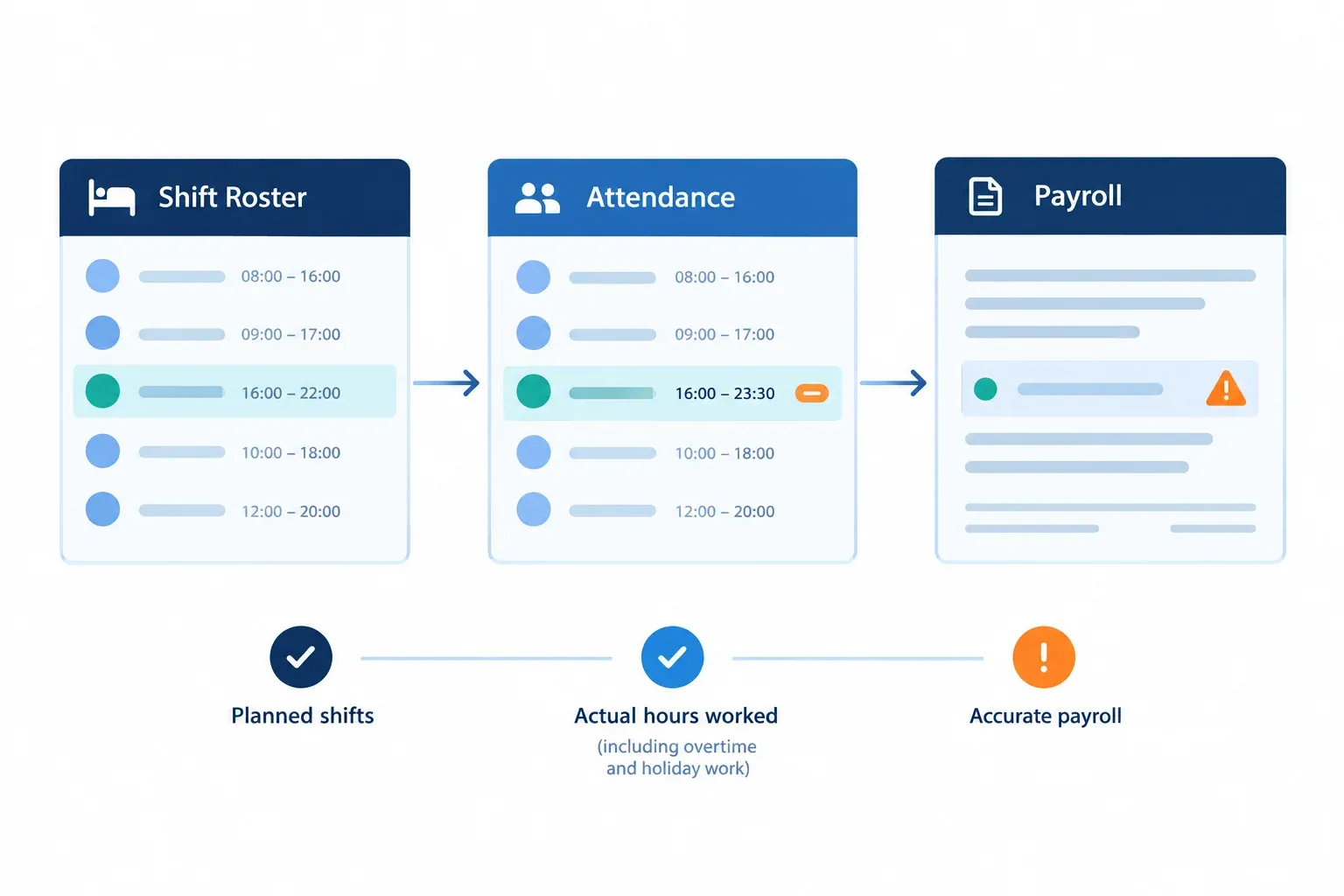
Most hospitality payroll errors come from the gap between the roster, what actually happened and how pay was calculated.
- Holiday work paid as ordinary overtime. Holiday hours and holiday overtime carry different multipliers from weekday overtime.
- Monthly and daily-paid staff treated the same. The same holiday shift attracts a different rate for each group.
- The 36-hour cap missed in peak weeks. Overtime and holiday work build up across departments, and no single supervisor sees the total.
- Rosters that do not match attendance. Shift swaps and extended shifts happen on the floor, not in the system.
- Seasonal hires set up late. Staff who start work before their records are complete create gaps in attendance, pay and statutory registration.
- Different practices at each property. Without one system, the same rule is applied three different ways.
How MiHCM supports Thai hotels and resorts
MiHCM Enterprise brings rostering, attendance, leave and payroll into one platform, so a change on the floor becomes the right figure on the payslip.
Time and attendance built for shifts
MiHCM's Time and Attendance module manages shifts and overtime and gives HR a clear view of time across the workforce. Attendance can be captured through biometric devices, RFID, barcodes, mobile clock-in and GPS-based check-ins, which suits teams spread across a resort, a beach club and a back-of-house kitchen.
Payroll that follows the roster
MiHCM Payroll runs automated calculations and localised statutory requirements in one system. The Advanced Formula Builder lets each property configure its own pay elements and rules. A built-in payroll checklist confirms that attendance, loans and increments are covered before salaries are processed. Reports on overtime, absence without leave and daily absenteeism show where the hours went.
MiA ONE for frontline staff
Hotel staff rarely sit at a computer. MiA ONE, MiHCM's AI-powered personal assistant, lets employees check in, request leave and receive notices and reminders by conversation on their phones. Requests are validated against policy before they reach a supervisor.
Syntra for owners and general managers
Syntra answers workforce questions in plain language. A general manager can ask about attendance, overtime or turnover across properties and see the answer in one view, then export it to PowerPoint, Excel or PDF for the next owners' meeting.
One structure across every property
MiHCM's Core HR manages employee profiles, organisation structures and leave in one place, so a group can see every property, department and shift pattern side by side.
MiHCM already supports hospitality groups in the region. Sri Lanka's Teardrop Hotels, which features among MiHCM's customers, has described its move to MiHCM as a seamless implementation, with deadlines met and support continuing after go-live.
An illustrative scenario: a resort group heading into high season
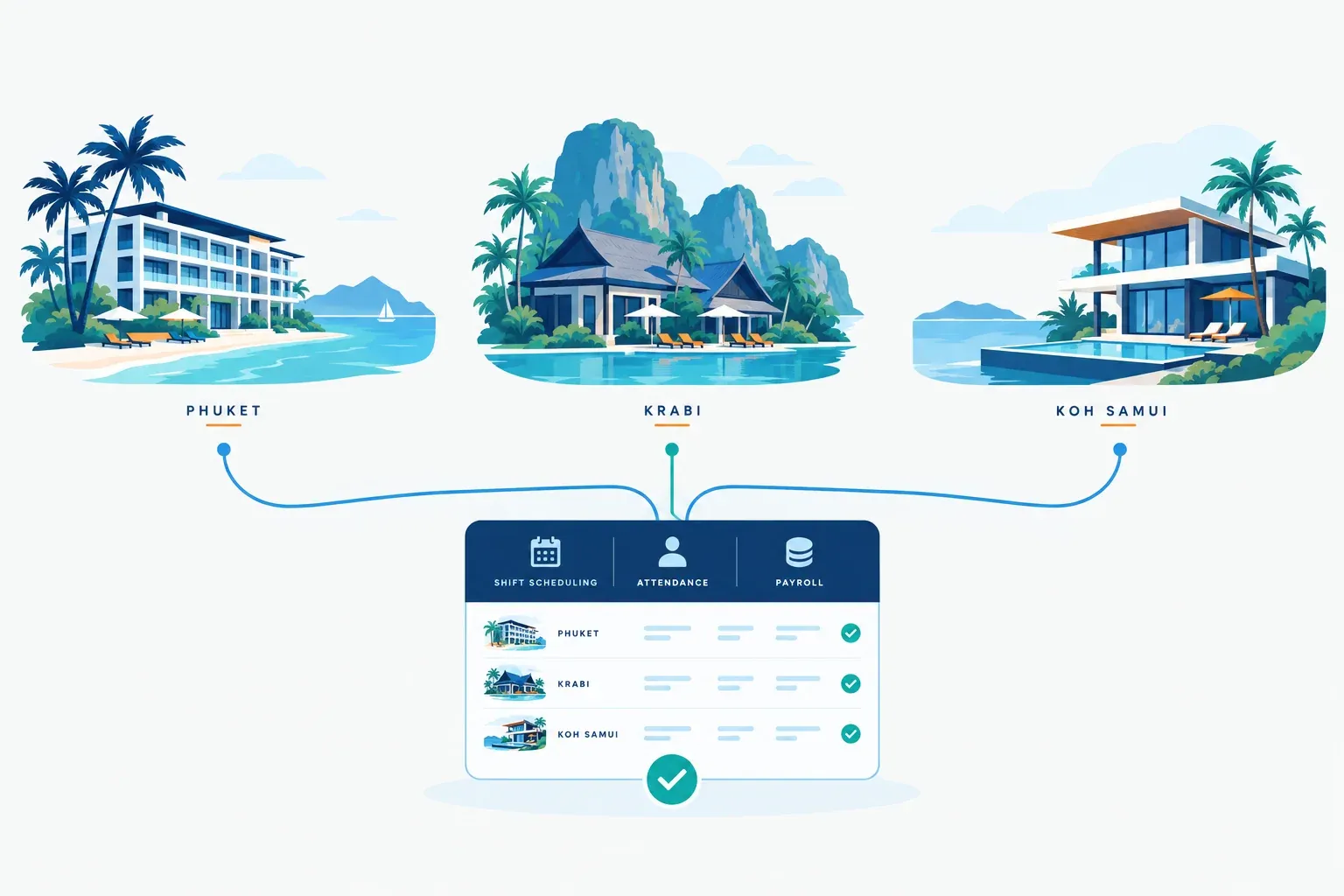
Consider a Thai resort group with three properties: one in Phuket, one in Krabi and one on Koh Samui. The scenario is illustrative.
Six weeks before high season, HR adds seasonal staff to MiHCM so records, shift patterns and pay rules are ready before day one. Each property's roster sits in the same system.
During the peak, supervisors approve shift swaps and overtime as they happen. Attendance flows into payroll. Overtime and holiday-work hours are tracked against the weekly limit for every employee, not just for each department.
At month end, the payroll checklist confirms that attendance is complete. Holiday hours are paid at the right rate for monthly-paid and daily-paid staff. The group's general manager asks Syntra which property ran the most overtime and why, and takes the answer to the owners' meeting.
A checklist for the season ahead
- Confirm the traditional holiday calendar for the year and announce it at every property.
- Classify each employee as monthly-paid, or daily or hourly-paid, so holiday work is paid correctly.
- Set up seasonal hires in the HR system before their first shift.
- Configure shift patterns, overtime rules and approval routes for each property.
- Track overtime and holiday work against the 36-hour weekly cap for every employee.
- Reconcile rosters with actual attendance before every payroll run.
- Review overtime by property and department after each peak.
The bottom line
In Thai hospitality, the roster is the payroll. When shifts, attendance and pay sit in separate places, errors are inevitable and the busiest weeks become the riskiest. One platform that carries each change from the floor to the payslip makes high season manageable.
Book a demo to see how MiHCM supports hospitality rosters and payroll.