
A Malaysian hotel group does not run one workforce. It runs dozens of small ones: front office, housekeeping, banquets, kitchens, an all-day dining outlet, a rooftop bar. Each has its own hours, its own peaks and its own way of running late.
Add several properties, staff shared between outlets and a calendar full of public holidays, and workforce management becomes the hardest part of the business to get right.
This blog sets out the Employment Act rules behind every hospitality roster, the service charge question, the problem of running many outlets at once, and how MiHCM helps enterprise hotel and F&B groups manage it all.
What makes hospitality workforce management hard
- Every outlet keeps different hours. Breakfast service, banquets and late-night bars all need cover at different times.
- Shifts change daily. Events, occupancy and absences reshape the roster at short notice.
- Staff move between outlets. A server may work the café at lunch and a banquet at night.
- Public holidays are peak days. The busiest days of the year are the most expensive to staff.
- Pay has extra layers. Overtime, rest-day pay, holiday pay and service charge all sit on top of basic salary.
The Employment Act rules behind every roster
For employers in Peninsular Malaysia and Labuan, the Employment Act 1955 sets the baseline. The Employment (Amendment) Act 2022, in force since 1 January 2023, reduced maximum working hours to 45 a week. Sabah and Sarawak have their own labour ordinances.
The statutory payment formulas in sections 60A and 60D apply to employees covered by the First Schedule, including employees whose wages do not exceed RM4,000 a month and specified categories regardless of wages. Rest-day pay also depends on whether the employee is monthly/weekly-rated, daily/hourly-rated or piece-rated, and on the hours worked.
Rule | What the Act requires | What it means for a hospitality roster |
|---|---|---|
Working hours | A maximum of 45 hours a week | Double shifts and extended events need checking against the weekly limit. |
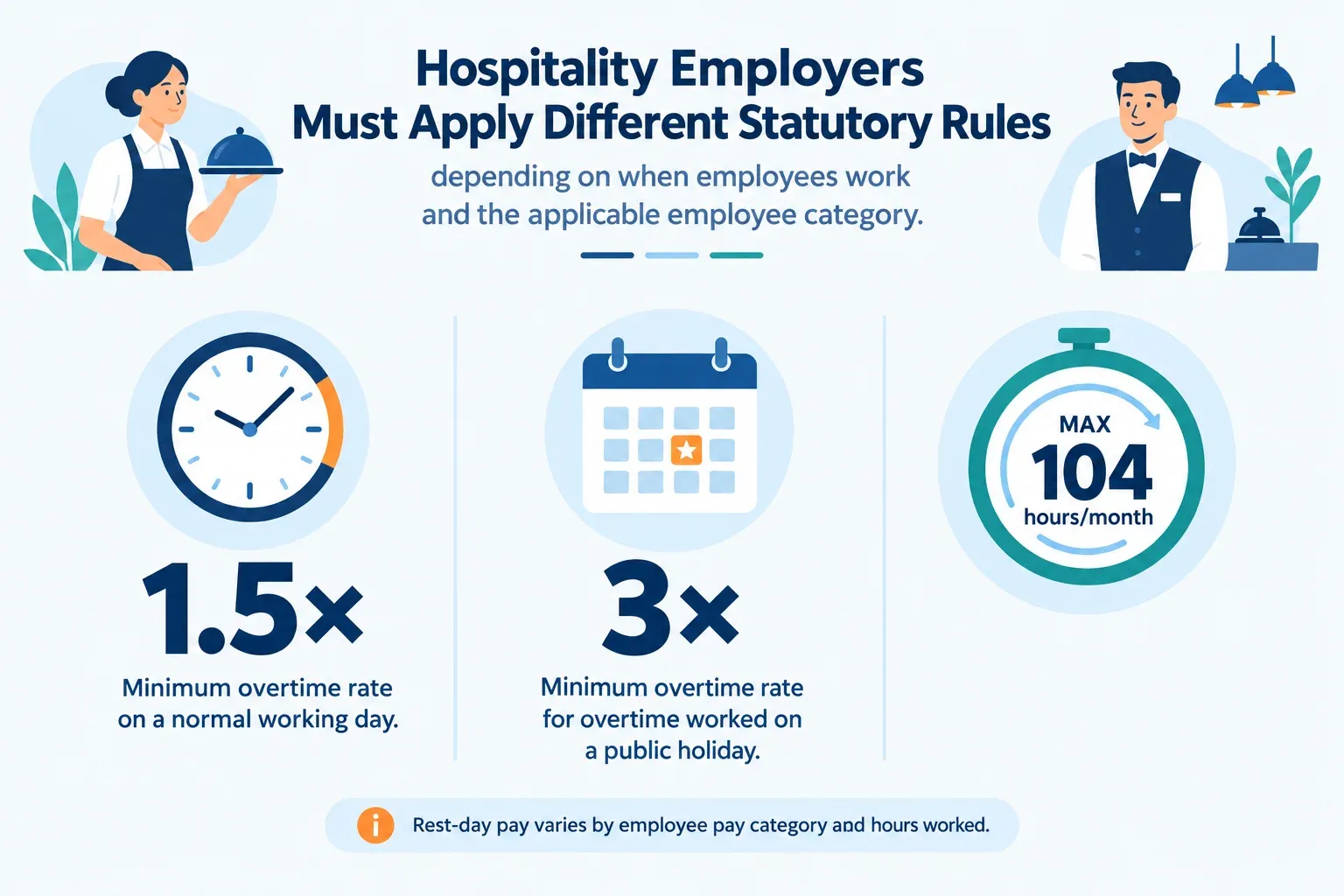
Overtime on a normal working day | At least 1.5 times the hourly rate of pay | Every extended shift carries a premium. |
Rest day | At least one rest day a week. Pay for rest-day work depends on how the employee is rated (monthly or weekly, daily or hourly, or piece-rated) and the hours worked; work beyond normal hours is paid at least 2 times the hourly rate | Rest days must be rostered, and rest-day work priced for each employee's pay category. |
Public holidays | 11 paid gazetted public holidays a year, 5 of them compulsory | Holiday calendars need to be set and announced for every property. |
Work on a public holiday | Two days' wages at the ordinary rate, on top of holiday pay, for work within normal hours | The same shift costs far more on a public holiday. |
Overtime on a public holiday | At least 3 times the hourly rate of pay | Long holiday shifts are the most expensive hours of the year. |
Overtime limit | 104 hours a month | Busy months can breach the limit without anyone noticing. |
The five compulsory public holidays are National Day, the Yang di-Pertuan Agong's birthday, the birthday of the Ruler or Federal Territory Day, Labour Day and Malaysia Day. Employers choose the remaining six.
The statutory overtime, rest-day and holiday rates apply to employees earning RM4,000 a month or less, and to those in the categories listed in the First Schedule of the Act. For employees above that level, these terms follow the employment contract.
Service charge: not the hotel's money
Many Malaysian hotels add a service charge to customers' bills and distribute it to staff. In March 2021, the Federal Court ruled that service charge collected from customers does not belong to the hotel. The hotel holds it as a trustee for eligible employees, and it cannot be used to meet minimum wage obligations.
For payroll, that means service charge must be tracked, pooled and distributed separately from basic wages, on the basis set out in employment contracts or collective agreements.
The multi-outlet problem
Running one outlet well is a rostering challenge. Running twenty is a data challenge.
When each outlet keeps its own rosters, the group loses sight of the whole. Staff who work in two outlets in one week may have their hours counted twice, or not at all. Overtime that looks reasonable in each outlet can breach the 104-hour monthly limit in total. Holiday calendars can drift between properties in different states.
The answer is a single source of truth: one roster, one attendance record and one payroll for every outlet and property.
How MiHCM helps Malaysian hotel and F&B groups
MiHCM Enterprise is built for medium and large organisations. It brings rostering, attendance, leave and payroll into one platform for every outlet and property.
Shifts and overtime in one place
MiHCM's Time and Attendance module manages shifts and overtime and gives HR a clear view of time across the workforce. Attendance can be captured through biometric devices, RFID, barcodes, mobile clock-in and GPS-based check-ins, so outlets, kitchens and banquet halls all feed the same record.
Leave alongside the roster
Leave and Absence Management keeps leave entitlements and requests in one system, alongside each employee's roster, so supervisors see who is available before they plan a shift.
Payroll that knows the rules
MiHCM Payroll runs automated calculations and localised statutory requirements in one system. The Advanced Formula Builder lets HR configure pay elements such as overtime, rest-day and holiday rates, and service charge distribution rules. The payroll checklist confirms that attendance, loans and increments are covered before salaries are processed, and reports on overtime, absence without leave and daily absenteeism show where the hours went.
MiA ONE for staff on the floor
Hospitality staff rarely sit at a desk. MiA ONE, MiHCM's AI-powered personal assistant, lets them check in, request leave and receive notices by conversation on their phones. Requests are validated against policy before they reach a supervisor.
Syntra for operations leaders
Syntra answers workforce questions in plain language. An operations director can compare overtime, attendance and turnover across outlets and properties in one view, ask follow-up questions and export the answer to PowerPoint, Excel or PDF.
MiHCM already supports hospitality operators in the region. Sri Lanka's Teardrop Hotels, which features among MiHCM's customers, has described its move to MiHCM as a seamless implementation, with deadlines met and support continuing after go-live.
An illustrative scenario: a hotel group across two states
Consider a hotel group with properties in Kuala Lumpur and Penang, each with several F&B outlets. The scenario is illustrative.
Before each month starts, outlet managers build rosters in MiHCM. Staff who work across outlets appear once, with all their shifts in one place.
On a public holiday, banquet staff work a long event. Attendance records the hours, and payroll applies holiday pay and holiday overtime rates.
Mid-month, HR sees that a group of kitchen staff is approaching the 104-hour overtime limit across two outlets. Rosters are adjusted before the limit is reached.
At month end, the service charge pool is distributed through payroll, separately from basic wages. The group's operations director asks Syntra which outlets ran the most overtime and takes the answer into the monthly review.
A checklist for hospitality HR teams
- Map every outlet, department and shift pattern into one organisation structure.
- Confirm the public holiday calendar for each property and announce it to staff.
- Identify which employees fall under the statutory overtime and holiday rates.
- Configure overtime, rest-day, holiday and service charge rules in payroll.
- Track overtime across outlets against the 104-hour monthly limit for every employee.
- Reconcile rosters with actual attendance before every payroll run.
- Review overtime and labour cost by outlet every month.
The bottom line
In hospitality, the roster is the payroll. Every outlet, every shift swap and every public holiday ends up on a payslip. One platform that follows each shift from the floor to the payroll run turns that complexity into something HR can manage.
Book a demo to see how MiHCM manages shifts, overtime and multi-outlet teams.