Kuala Lumpur has become a natural base for regional headquarters. The talent pool is deep, the time zone works for the region, and the infrastructure is strong. But the moment a Malaysian HQ takes responsibility for payroll in neighbouring markets, it inherits a problem that no amount of central control can simplify away.
Every country has its own rulebook. The task is to run one platform without flattening them.
Three countries, three rulebooks
Take three markets a Malaysian regional HQ commonly oversees.
Malaysia. EPF is charged at 13% from the employer on monthly wages of RM5,000 or below, and 12% above that, with 11% from the employee. EPF has no wage ceiling. SOCSO and EIS, by contrast, stop at RM6,000 a month. Since October 2025, foreign workers contribute to EPF at 2% from each side. Contributions and monthly tax deductions are due by the 15th of the following month.
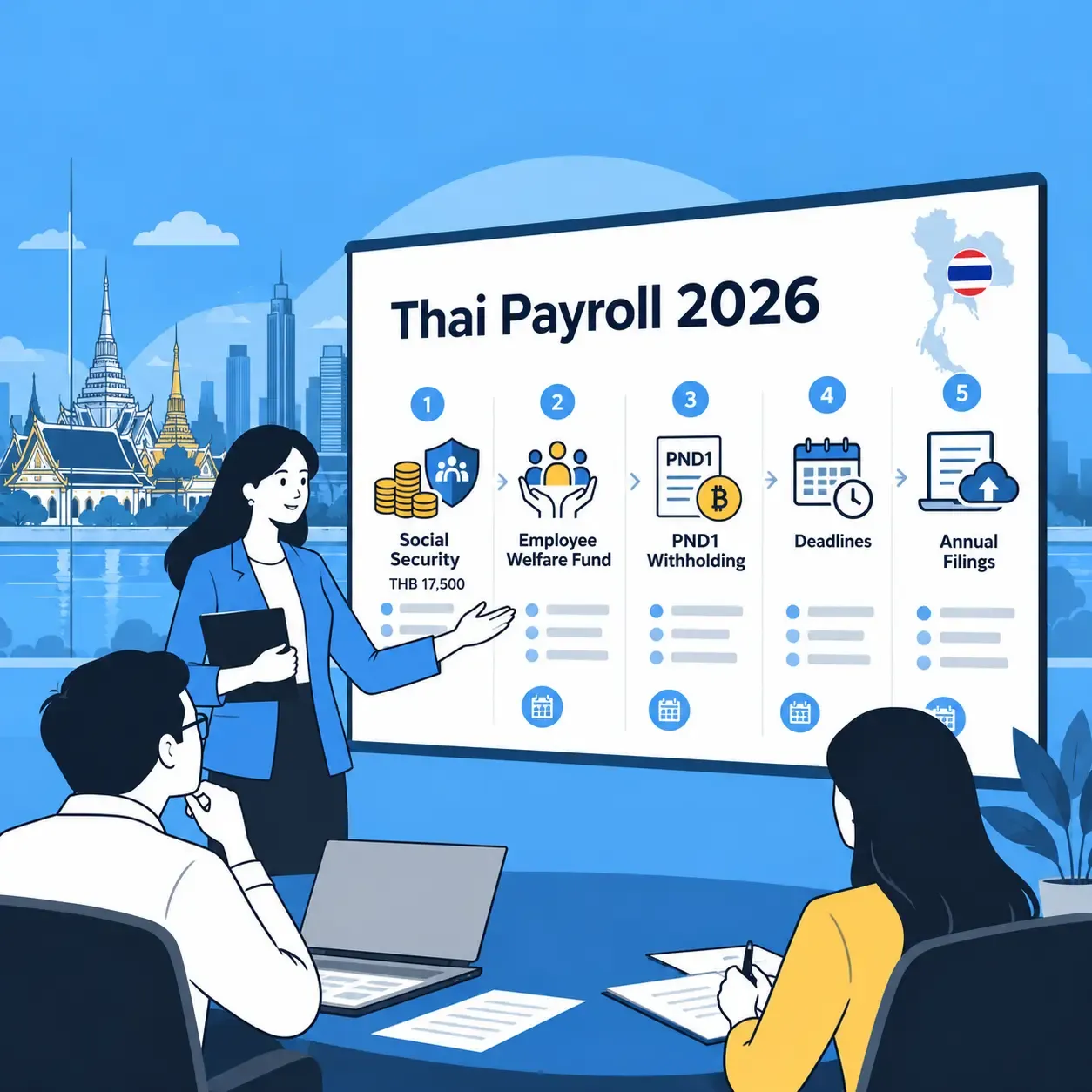
Thailand. Social security is 5% from each side, but only up to a wage ceiling of THB 17,500 a month from 1 January 2026. Withholding tax is a projection of annual liability, filed on PND1 by the 15th through e-filing. And from 1 October 2026, employers without a provident fund contribute to the new Employee Welfare Fund.
Cambodia. Tax on salary must be withheld and paid to the General Department of Taxation by the 20th of the following month. For the first five years of the National Social Security Fund pension scheme, contributions are 2% from the employer and 2% from the employee, alongside employer-only occupational risk and healthcare contributions. Seniority pay is paid in June and December, based on average wages over the preceding six months.
Why central teams get it wrong
These are not variations on a theme. They are different logics.
One country caps contributions; another does not. One calculates tax on the month; another on a projected year. One pays a statutory benefit twice a year on a rolling average. Deadlines fall on different days. Currencies differ. So do languages, holidays and filing portals.
A central team that applies one country’s assumptions to another is likely to introduce recurring compliance and payroll-calculation errors, often undetected until an audit or an employee query.
Six design principles
1. One employee record, many local rules. Keep a single source of truth for people data, and attach country-specific rule sets to it.
2. Local rules maintained locally. Statutory rates change every year. Each country’s rules need an owner who tracks the gazette, not a regional team reading summaries.
3. A regional calendar. Map every filing and payment date across all countries in one view, with owners and a check before each submission.
4. Consolidated reporting. Finance needs regional cost in one currency. Payroll must still file in local currency and local format.
5. Data protection by design. Payroll data is personal data. Where it is stored and who in the region can see it should follow each country’s law. Bangladesh’s Personal Data Protection Act, 2026, for example, requires the Authority to be notified of cross-border transfers of large volumes of sensitive personally identifiable data, which the Act defines to include national ID, passport and taxpayer identification numbers.
6. Partners where they add value. In some markets, a local partner provides the statutory knowledge and language support that a central team cannot.
The expatriate layer
Regional HQs also employ mobile talent. In Malaysia, Employment Pass salary floors rose sharply on 1 June 2026, and succession plans for Category II and III passes apply from 1 January 2027. Regional payroll and mobility planning now depend on the same data: salary history, pass dates and successor readiness.
Where systems help
The operating model only works if the platform supports it. MiHCM Enterprise runs country-specific payroll rules across multiple Asian markets from one employee record, with local statutory configuration and regional reporting. MiHCM’s regional headquarters is itself in Kuala Lumpur.
One platform does not mean one rulebook. It means every rulebook, applied correctly, in one place.
Frequently Asked Questions
Can one payroll system handle several ASEAN countries?
Yes, if it keeps a single employee record while applying separate, locally maintained statutory rules for each country, including contribution bases, ceilings, tax methods and filing formats.
What are the main payroll differences between Malaysia and Thailand?
Malaysian EPF has no wage ceiling, while Thai social security is capped at a wage of THB 17,500 a month. Thailand also projects annual tax for monthly withholding and introduced the Employee Welfare Fund in October 2026.
When are payroll taxes due in Cambodia?
Tax on salary must be paid to the General Department of Taxation by the 20th of the month following payment.
Do foreign workers contribute to EPF in Malaysia?
Yes. Since October 2025, foreign workers contribute 2% and their employers 2%, excluding domestic workers.
Should regional payroll be fully centralised?
The employee record and reporting can be central, but statutory rules should be owned by people who track each country’s law, sometimes through local partners.
Sources
• Access Financial, EPF Employer Guide 2026 – Malaysian EPF rates and foreign worker contributions
• Second Talent, Malaysia Payroll, Benefits and Tax Regulations in 2026 – SOCSO and EIS ceiling
• Baker McKenzie, Thailand: Higher wage base for SSF contributions
• MiHCM, PND1 filing in Thailand
• GoGlobal, Tax and Social Security Information for Employers in Cambodia
• MiHCM, Cambodia Payroll Guide 2026
• Bangladesh Personal Data Protection Act, 2026 (Act No. 63 of 2026, Bangla text) – Section 29(6)