
For a Bangladeshi garment exporter, a social compliance audit is not paperwork. It decides whether orders keep coming.
Auditors do not take a factory's word for anything. They sample records, interview workers and compare the two. When attendance logs, overtime sheets and payslips tell one story and workers tell another, the finding writes itself.
This blog sets out what social compliance auditors look at, where workforce records most often fail, and how an HR system that keeps attendance, overtime and pay in one place makes audits survivable.
What a social compliance audit looks at
Buyers assess suppliers against their own codes of conduct and through third-party programmes. Well-known programmes include amfori BSCI, the Sedex Members Ethical Trade Audit (SMETA), SA8000 from Social Accountability International, and WRAP. Programmes such as SMETA and amfori BSCI provide standardised audits that buyers can use and share.
Across programmes, the core themes are similar. Audits in the garment sector examine safety, health, wages, working hours and freedom of association.
The workforce part of an audit usually rests on three sources of evidence:
- Documents: recent employment records, attendance records, payroll records and overtime payments. Audit sampling periods vary by programme, buyer and audit type.
- Interviews: private conversations with workers about hours, pay, leave and treatment.
- Observation: what the auditor sees on the floor, from start and stop times to how breaks are taken.
The test is consistency. A factory passes when all three line up.
Where audits are won or lost: hours and overtime
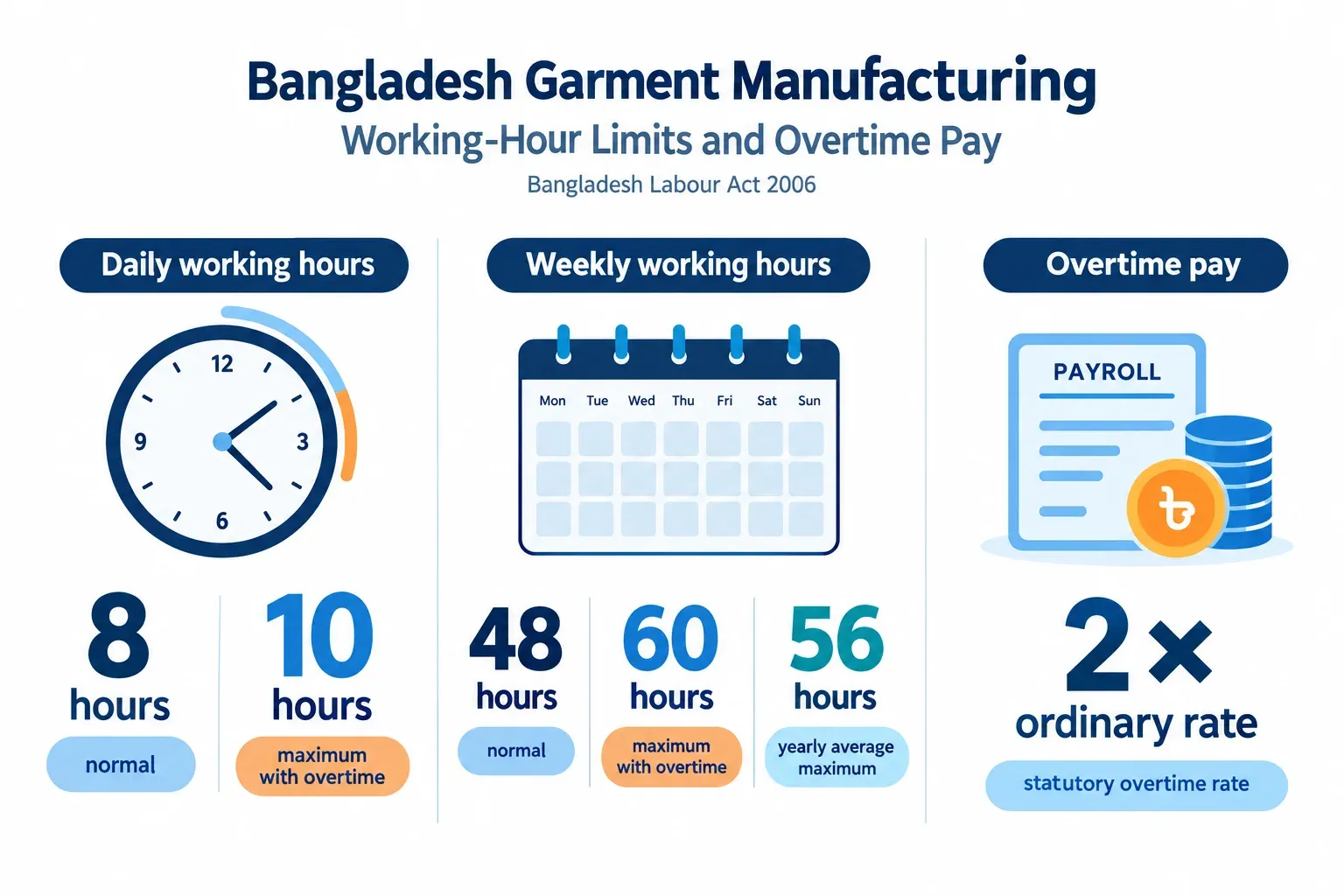
Working hours and overtime pay are where records are tested hardest, because the rules are specific and the evidence is detailed. The Bangladesh Labour Act 2006 sets the baseline.
Rule | What the Act and Rules provide | What auditors check |
|---|---|---|
Daily hours | Ordinarily no more than 8 hours a day; up to 10 hours, subject to the overtime provisions (section 100) | Daily start and stop times against the 10-hour limit |
Weekly hours | Ordinarily no more than 48 hours a week; up to 60 in a week with overtime, and an average of no more than 56 a week over a year (section 102) | Weekly totals, peak weeks and the yearly average |
Overtime pay | Twice the ordinary rate of basic wage, dearness allowance and any ad hoc or interim wage (section 108) | Whether overtime is paid on the right base, at the right rate, for every hour |
Hourly rate | For monthly-paid workers, secondary English-language summaries describe the hourly rate as one 208th of the relevant monthly wage under rule 102. Confirm the current official rule and the wage components included before publication. | Whether the hourly rate behind each overtime payment is correct |
Auditors trace individual workers through the records. They take the hours on a time card, check them against the payroll, then ask the worker what they actually worked and what they were paid.
The record failures that cause findings
Most findings are not about intent. They come from records that cannot prove what happened.
- Handwritten attendance that cannot be verified. Manual registers are easy to question and hard to defend.
- Attendance and payroll in separate systems. When attendance is captured in one system and payroll processed in another, with no reconciliation between them, the numbers drift.
- Overtime on the wrong base. Overtime calculated on gross pay, or on basic pay alone when dearness and ad hoc components should be included.
- Peak weeks nobody saw. Hours build up across lines and shifts until a worker passes 60 in a week, or the yearly average passes 56.
- Edits without a trail. Corrections made by hand, with no record of who changed what, when or why.
- Gaps in the employee file. Missing employment details or proof-of-age documents for some workers.
What audit-ready workforce data looks like
Audit-ready does not mean a folder prepared the week before the auditor arrives. It means every record the auditor might ask for already exists, matches the others and can be produced quickly.
What the auditor asks for | The record that answers it | How MiHCM supports it |
|---|---|---|
Daily start and stop times | Electronic attendance records | Time and Attendance with biometric and card-based capture |
Overtime hours and approvals | Overtime records with prior authorisation | Overtime management with authorisation rules and overtime reports |
Overtime and wage payments | Payroll records reconciled to attendance | MiHCM Payroll, with the payroll checklist run before every pay cycle |
Absence and leave | Leave records and absence reports | Leave and Absence Management, with reports on absence without leave and daily absenteeism |
Employment history | Employee profile and lifecycle records | Employee Profile and Employee Dynamics |
How MiHCM supports audit readiness
MiHCM Enterprise is built for medium and large organisations in Bangladesh, from 250 to more than 20,000 employees, and is localised to Bangladeshi labour laws and regulations.
Attendance that starts at the device
MiHCM connects to automated biometric devices, including fingerprint attendance machines and face scanners. Attendance can also be captured through RFID, barcodes and mobile clock-in, so every entry starts as an electronic record rather than a line in a register.
Overtime that follows the rules
MiHCM supports customisable grace periods and handles late arrivals and early-in overtime with prior authorisation. It supports single, double and triple overtime policies, with custom rates for different job categories, so the overtime rules a factory applies are configured once and used every pay cycle.
Payroll that reconciles with attendance
MiHCM Payroll runs automated calculations and localised statutory requirements in one system with attendance. The payroll checklist confirms that attendance, loans and increments are covered before salaries are processed.
Reports an auditor can follow
HR can build pay-related reports and use existing attendance and leave reports to analyse overtime, absence without leave and daily absenteeism. Attendance analytics show overtime, late hours and absenteeism trends across the workforce.
Answers before the auditor asks
Syntra, MiHCM's AI-powered HR intelligence solution, lets HR ask questions about attendance and overtime in plain language across lines, units and sites. That makes it faster to find the weeks, departments and workers that need attention before an audit, not during one.
For more on the payroll side, see MiHCM's guide to payroll for the ready-made garment industry in Bangladesh.
An illustrative scenario: six weeks before a buyer audit
Consider a knitwear exporter in Gazipur with three units and several thousand workers. The scenario is illustrative.
Six weeks before a scheduled buyer audit, HR pulls twelve months of attendance and payroll from MiHCM. Because both sit in one system, the overtime paid each month can be traced back to the hours recorded at the gate.
HR then asks Syntra which departments came closest to the 60-hour weekly limit during the last peak season. The finishing section stands out. HR reviews the rosters for that section and tightens overtime authorisation before the next peak.
On audit day, the auditor samples twenty workers. For each one, HR produces attendance, overtime approvals and payslips in minutes. The records match each other. The interviews match the records.
A checklist for audit readiness
- Capture attendance electronically at every gate and unit.
- Configure overtime rules, rates and authorisation by job category.
- Calculate overtime on basic wage, dearness allowance and any ad hoc or interim wage, using the correct hourly divisor.
- Track weekly hours against the 60-hour limit and the yearly 56-hour average for every worker.
- Reconcile attendance with payroll before every pay run.
- Keep employee files, including proof-of-age documents, complete and current.
- Review overtime and absence reports monthly, not just before an audit.
The bottom line
A social compliance audit is a consistency test. Factories pass when their attendance, overtime and pay records agree with each other and with what workers say. That consistency is hard to achieve across paper registers and separate systems. It is far easier when every hour and every payment sits in one HR system.
Book a demo to see how MiHCM keeps workforce records audit-ready.
Sources
- WRAP: How Many Social Audits Are Enough? (October 2023)
- The Daily Star: Proper audits can ensure social compliance in the RMG industry
- QIMA: Social compliance audit
- Bangladesh Labour Act 2006, Chapter IX: working hours and leave
- MiHCM Enterprise for Bangladesh
- MiHCM: Payroll for the ready-made garment industry in Bangladesh