Every year brings a list of HR trends. Most of them describe the world. Few of them tell an HR leader what to do on Monday.
This article is different in one respect: it is written for HR leaders in Asia who have to turn trends into a plan. It draws on global research, on the statutory changes already scheduled across the region for 2027, and on what we see in organisations running HR and payroll across many countries at once.
The picture is consistent. AI is moving from experiment to everyday work, and someone has to be accountable for it. Skills are replacing job titles as the unit of planning. HR is being asked to deliver value faster. And the statutory calendar across Asia is getting busier, not quieter.
Here are the seven trends that matter most for 2027, what each means in practice, and how to prepare.
The global view
Two pieces of research frame the year.
Gartner's priorities for CHROs in 2027 centre on four areas: accelerating HR's speed to value, reinforcing human accountability for AI, investing in differentiated workforce skills and preparing leaders to drive disruption. Its analysts argue that business needs are evolving faster than HR's delivery model can keep up, and that humans must remain the gatekeepers of AI.
The World Economic Forum's Future of Jobs Report 2025 adds the scale. Employers expect about 39% of the key skills required in the job market to change by 2030. They expect structural change to create 170 million jobs and displace 92 million, a net gain of 78 million. Skill gaps are the biggest barrier to transformation, cited by 63% of employers.
For HR leaders in Asia, these global themes arrive alongside very local pressures: new minimum wages, new data protection regimes, revised labour codes and workforces that are often frontline, multilingual and spread across several countries.
Trend 1: AI moves from pilots to accountability
The first wave of AI in HR was about trying things. The next wave is about owning the results.
Gartner's research makes the gap clear. In a July 2026 survey of 297 CHROs, 78% said their leaders had no alignment on where AI creates value. Without that alignment, organisations cannot decide where to put AI to work, how to prepare the workforce, or how to measure the return.
Accountability is the other half. As employees increasingly co-create outcomes with AI, someone must remain answerable for each decision: the shortlist, the policy answer, the pay calculation, the forecast.
What this means for HR in 2027
- Agree, with business leaders, the few places where AI will create the most value, and start there.
- Name a human owner for every AI-assisted decision, and keep sensitive decisions with people.
- Prefer AI that works inside your own systems and data, with clear security credentials.
How MiHCM approaches it
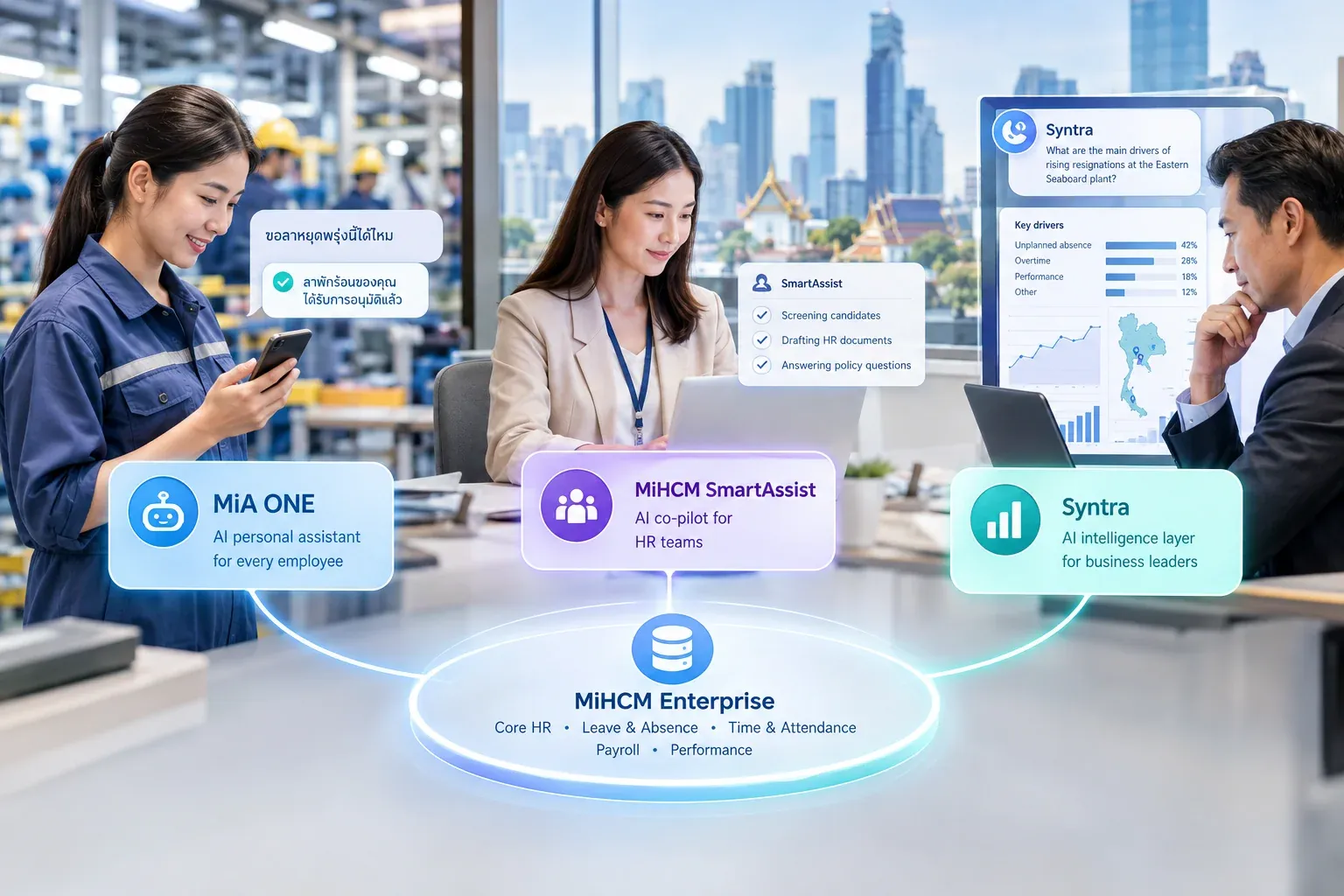
MiHCM keeps each AI product to a clear job. MiA ONE, the AI-powered personal assistant, handles everyday employee requests such as leave, check-ins and policy questions, and validates each request against policy before it is submitted. MiHCM SmartAssist, the AI-powered HR co-pilot, supports HR teams: SmartAssist for Core streamlines routine HR tasks, and SmartAssist for Recruitment screens candidates against criteria HR sets, leaving the hiring decision with people. Syntra answers leaders' workforce questions in plain language.
At MiHCM Connect 2026 in Kuala Lumpur, MiHCM described Syntra as enabling secure analysis of each client's private data. The principle is simple: the organisation's data stays the organisation's, and people stay accountable for what is done with the answers.
Trend 2: Skills become the unit of planning
Job titles describe where people sit. Skills describe what they can do. In 2027, more organisations will plan around the second.
The challenge is focus. Gartner argues that organisations are investing heavily in skills without much return, and that the answer is to concentrate on fewer, differentiated skills: the capabilities that set the business apart.
What this means for HR in 2027
- Identify the handful of capabilities that drive your competitive advantage, and the skills that underpin each.
- Link performance reviews to development plans, so skills gaps turn into training, not just ratings.
- Track mandatory and continuing development by role, so competence can be evidenced, not assumed.
How MiHCM approaches it
MiHCM Performance Management links appraisals to learning, succession planning and compensation planning, so an improvement plan becomes a training need automatically. Learning Administration organises required and competency-based training by designation and tracks CPD hours. MiHCM Learning Management delivers the learning itself, with courses, assessments, certificates and reporting.
Trend 3: HR must deliver speed to value
Most HR functions have spent a decade becoming more efficient. Gartner's point for 2027 is that efficiency is no longer enough: HR has become faster at execution, but not faster at delivering value. Leading organisations, it says, are adopting product principles to close the gap.
In practice, speed to value starts by removing the routine work that consumes HR's time.
What this means for HR in 2027
- Measure how much of HR's week goes on routine requests, corrections and report compilation.
- Move high-volume, low-risk work to self-service and automation first.
- Reinvest the time in the work the business is asking for: workforce planning, manager support and change.
How MiHCM approaches it
MiA ONE moves leave requests, check-ins and policy questions out of HR's inbox and into a conversation. MiHCM Payroll runs automated calculations with a payroll checklist before every run, so fewer corrections land on HR after payday. Syntra exports board-ready answers to PowerPoint, Excel or PDF, so reporting stops being a monthly project.
Trend 4: The statutory calendar gets denser
For HR and payroll teams in Asia, 2027 is already full. The table shows a selection of changes across the region. The Status column separates rules already in force from future effective dates, proposals and items still awaiting confirmation.
Market | Change | Timing | Status |
|---|---|---|---|
Sri Lanka | Key provisions of the Personal Data Protection Act come into operation | 1 January 2027 | Gazetted/future effective date |
Sri Lanka | Monthly tax-free threshold for employment income proposed to rise to Rs. 162,500 | Effective date to be confirmed | Budget proposal |
Bangladesh | Labour Act revised by the 2025 Ordinance and the Bangladesh Labour (Amendment) Act 2026 | Amendments in force | In force |
Bangladesh | New minimum wage for ready-made garment workers under review by the wage board | To be confirmed by official order | Pending verification |
Thailand | Social security wage ceiling of THB 17,500, rising to THB 20,000 | 17,500 for 2026 to 2028; 20,000 from 2029 | In force |
Vietnam | New Personal Income Tax Law, with five tax brackets and higher family deductions | From 1 July 2026, with salary provisions applying from the 2026 tax year | In force |
Malaysia | Monitor the official Minimum Wages Order and Budget 2027 tax measures | Add detail only after gazettal or formal guidance | Pending verification |
Each change is manageable on its own. Together, across several countries, they make the statutory calendar a standing risk rather than an annual task.
What this means for HR in 2027
- Keep a single regional calendar of statutory changes, with an owner for each country.
- Test rate and threshold changes in payroll before the effective date, not after.
- Communicate changes to employees early, especially where take-home pay moves.
How MiHCM approaches it
MiHCM Payroll runs localised statutory requirements for each country on one platform. The Advanced Formula Builder lets each entity configure its own pay elements, and real-time notifications keep pay dates and deadlines in view. For Bangladesh, MiHCM has published a guide to what the amended Labour Act changed.
Trend 5: Data protection becomes an HR discipline
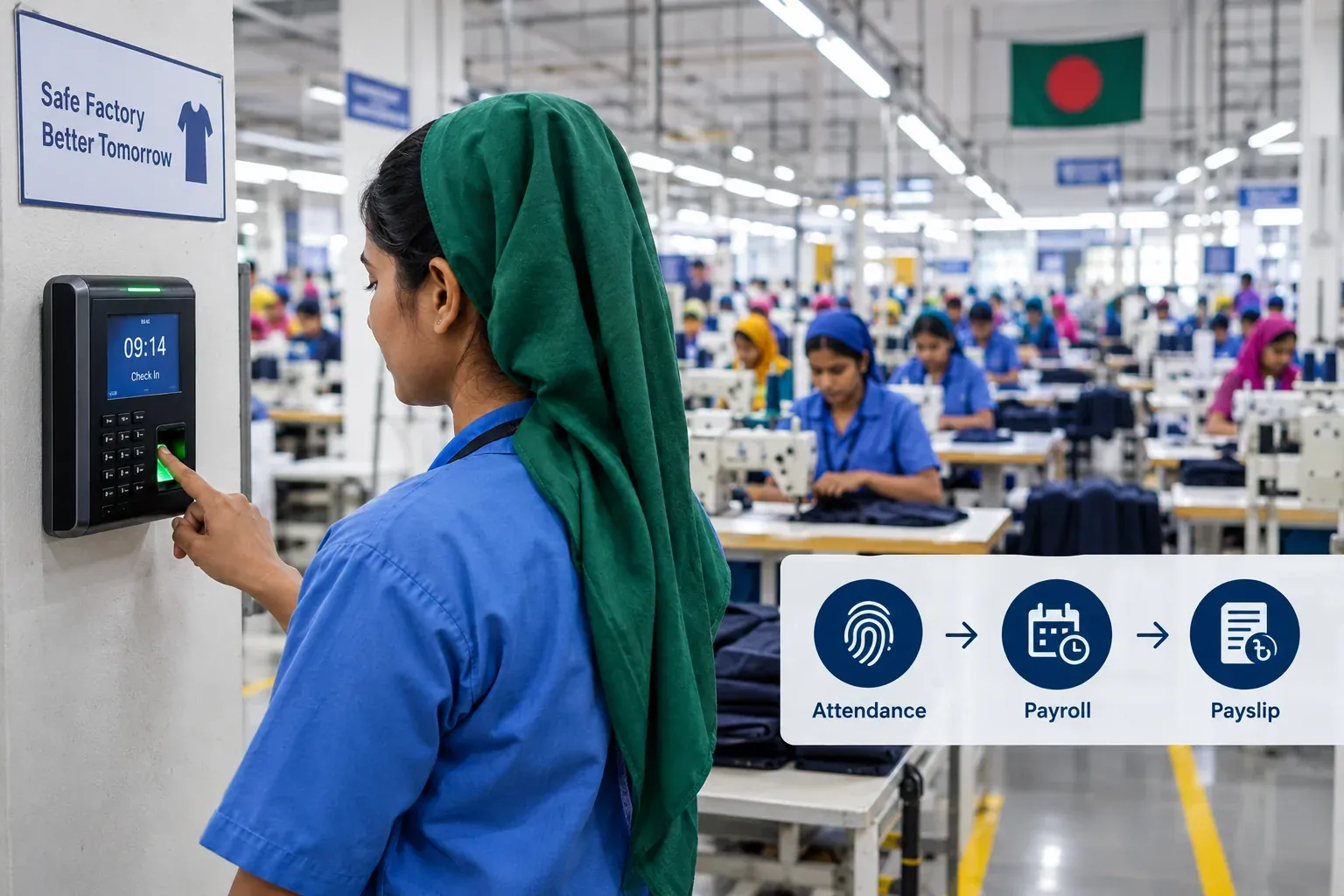
HR holds more personal data than almost any other function: identity numbers, bank details, salaries, medical certificates and, increasingly, biometric attendance records.
Regulators are catching up. Sri Lanka's core data protection compliance framework, covering lawful processing, data protection officers, breach notification, impact assessments, processor contracts and cross-border transfers, becomes operational on 1 January 2027. Elsewhere in the region, established regimes continue to tighten.
What this means for HR in 2027
- Map where employee data comes from, where it goes and who can see it.
- Review contracts with every vendor that processes employee data, including payroll and HR software providers.
- Treat biometric and health data with particular care, and limit access to what each role needs.
How MiHCM approaches it
MiHCM is SOC 2 Type II certified and holds ISO/IEC 27001 and ISO/IEC 27701:2025 certifications, with details on the MiHCM Trust Portal. Employee self-service lets people see and update their own information, which helps keep records accurate.
Trend 6: Leaders and managers carry more weight
Gartner describes today's workforce as more "load-bearing": organisational decisions have left fewer people carrying more of the work. Managers feel it first. They approve requests, coach performance, manage change and absorb the impact of AI on their teams.
What this means for HR in 2027
- Take administrative load off managers so they have time to lead.
- Give managers the data they need to make decisions without waiting for HR.
- Build leadership development around the disruption leaders are actually facing.
How MiHCM approaches it
With MiA ONE, requests reach managers already checked against policy, and managers approve them in the conversation. Syntra lets managers and leaders ask workforce questions directly. Performance Management gives managers a complete view of their team's goals, competencies and potential.
Trend 7: The frontline gets a better employee experience
Across Asia, a large share of the workforce never sits at a desk: factory operators, hotel staff, retail teams, drivers and field engineers. For years, HR technology was built for the office.
That is changing. Conversation is becoming the interface. Employees can ask for leave, check in or get a policy answer the way they would message a colleague.
What this means for HR in 2027
- Design HR processes for a phone first, not a desktop.
- Plan for the languages and channels each group of employees actually uses.
- Make sure frontline staff receive policy updates and notices, not just office staff.
How MiHCM approaches it
MiA ONE works on the web and on iOS and Android, by chat or by voice. Geo-based check-ins record attendance wherever people work, and notices and reminders reach every employee in the flow of work.
Trends in practice: three sectors
Manufacturing
A regional manufacturer faces revised wage structures, overtime pressure and a frontline workforce that rarely uses email. In 2027, its priorities are statutory readiness in payroll, conversational self-service for operators and supervisors, and a clear view of overtime and absence by plant. The skills question is about maintaining technical competence as automation grows.
Banking and insurance
A financial institution faces regulator expectations on accountability, fit and proper evidence and succession. Its priorities are skills and CPD records that stand up to scrutiny, succession for key roles and responsible use of AI in recruitment and analysis, with clear human ownership.
Hospitality
A hotel group runs round-the-clock shifts, seasonal headcount and holiday work across several properties. Its priorities are rosters and payroll that stay aligned, a better experience for deskless staff, and data protection for the large volumes of employee data it handles.
The examples are illustrative, but the pattern holds: the seven trends show up in every sector, in a different order.
Mapping the trends to capabilities
Trend | The question HR must answer | Where MiHCM helps |
|---|---|---|
Accountable AI | Who owns each AI-assisted decision? | MiA ONE, SmartAssist and Syntra, each with a clear job |
Skills as the unit of planning | Which skills matter most, and who has them? | Performance Management, Learning Administration, Learning Management, Succession Planning |
Speed to value | Where does HR's time go? | MiA ONE, MiHCM Payroll automation, Syntra exports |
A denser statutory calendar | Are we ready for each effective date? | MiHCM Payroll localisation, Advanced Formula Builder, notifications |
Data protection | Where is employee data, and who can see it? | Security certifications, Trust Portal, employee self-service |
Load-bearing managers | How do we free managers to lead? | MiA ONE approvals, Syntra, Performance Management |
Frontline experience | Can every employee reach HR from a phone? | MiA ONE by chat and voice, geo-based check-ins |
Technology is only part of the answer. MiHCM also launched MiHCM Consulting at Connect 2026 to deliver end-to-end HR transformation, change management and advisory services across South and Southeast Asia, because process and people change matter as much as the system.
Five planning mistakes to avoid
Most HR plans do not fail on ambition. They fail on execution.
- Buying AI before agreeing where it adds value. A tool without a use case becomes shelfware. Start with the business question, not the product.
- Treating skills as a catalogue exercise. A list of 500 skills helps no one. Focus on the few that differentiate the organisation.
- Leaving statutory changes to payroll alone. A new minimum wage or tax threshold affects budgets, offers, communications and contracts, not just the pay run.
- Designing for head office only. If frontline employees cannot use a process from their phone, they will not use it at all.
- Measuring activity, not outcomes. Logins and course enrolments are easy to count. Faster approvals, fewer payroll corrections and filled critical roles matter more.
A quarter-by-quarter view
Spreading the work across the year keeps the plan realistic. The sequence below is a starting point, not a prescription.
Quarter | Focus | Typical outcomes |
|---|---|---|
Q1 | Statutory readiness and data protection | Payroll tested for 1 January changes, employee data mapped, vendor contracts reviewed |
Q2 | Self-service and manager load | Routine requests moved to conversation, approval turnaround measured, wage changes tracked |
Q3 | Skills and succession | Differentiated skills defined, development plans linked to appraisals, successors named for critical roles |
Q4 | AI value and 2028 planning | AI use cases reviewed against agreed value, human ownership confirmed, next year's statutory calendar built |
The order will differ by organisation. A Malaysian employer, for example, will want to track any new Minimum Wages Order closely. A Sri Lankan employer will want data protection work finished before the year begins.
A 2027 planning checklist
- Agree with business leaders where AI will create the most value, and name an owner for each use.
- Identify the differentiated skills your strategy depends on.
- Link appraisals to development plans, succession and pay.
- Measure the routine work in HR and move the highest-volume tasks to self-service.
- Build a regional statutory calendar for 2027, with an owner per country.
- Test every rate and threshold change in payroll before it takes effect.
- Map employee data flows and review vendor contracts.
- Take administrative load off managers.
- Design at least one core HR process for a phone first.
- Review progress every quarter, not once a year.
The bottom line
The HR trends for 2027 are not about new ideas. They are about doing familiar things under more pressure: putting AI to work responsibly, building the skills that matter, moving faster, and keeping up with a statutory calendar that never stops.
HR leaders who start planning now, with clear owners, clean data and the right platform, will spend 2027 leading change rather than reacting to it.
Book a demo to see how MiHCM helps HR teams across Asia plan for 2027.
Sources
- Gartner: CHROs' top priorities for 2027, 6 October 2026
- Gartner: 2027 HR Trends, Top CHRO Priorities and Strategic Insights
- IT-Online: Three actions HR must take to realise growth from AI, reporting Gartner research
- World Economic Forum: The Future of Jobs Report 2025
- Daily FT: Data protection compliance regime takes effect on 1 January 2027
- KPMG Thailand: Tax News Flash, Issue 157
- Viet Nam News: Higher family deductions to ease financial burden for taxpayers
- MiHCM: MiA ONE goes live at MiHCM Connect Malaysia