
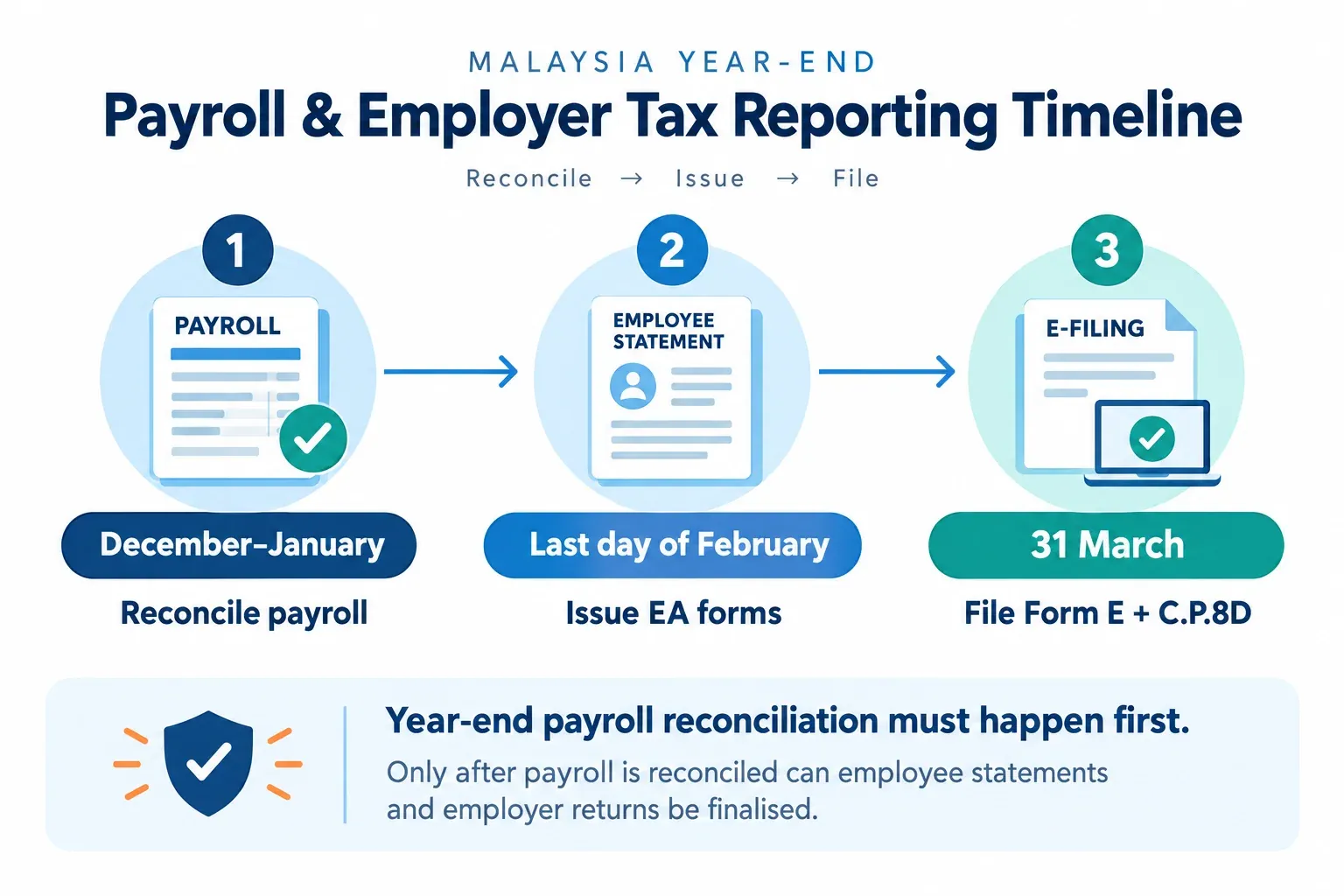
Year-end payroll in Malaysia does not end in December. It ends on 31 March, when the employer's return is filed.
In between sit two deadlines that every employer must meet: each employee's EA form by the last day of February, and Form E with C.P.8D by 31 March. Both depend on one thing being right first: twelve months of payroll, reconciled.
This blog explains what each form is, what must be reconciled before you issue it, and a checklist from December to March.
The EA form, Form E and C.P.8D at a glance
Form | What it is | Who receives it | Deadline |
|---|---|---|---|
EA form (C.P.8A) | The annual statement of remuneration for each employee: earnings, benefits and monthly tax deductions for the year | Each employee | On or before the last day of February of the following year |
Form E | The employer's annual return to the Inland Revenue Board of Malaysia (LHDN) | LHDN | On or before 31 March of the following year |
C.P.8D | The return of employees' remuneration information, submitted with Form E | LHDN | With Form E, by 31 March |
Government employers issue the equivalent EC form.
The EA form
The EA form is the statement of remuneration an employer must prepare and give to each employee for each year, under section 83(1A) of the Income Tax Act 1967. It lists the employee's earnings, benefits and the monthly tax deductions (MTD, also known as PCB) made during the year. Employees rely on it to complete their own tax returns.
The total MTD shown on each EA form should equal the total the employer actually remitted to LHDN for that employee. Employers can check their MTD remittances through e-Lejar on MyTax before issuing the forms.
Late or missing EA forms may expose the employer to enforcement and penalties under the Income Tax Act 1967.
Form E and C.P.8D
Form E is the employer's annual return. Every employer must furnish it. For the current filing cycle, employers should submit Form E and C.P.8D electronically through MyTax using the method prescribed by HASiL. Confirm the 2027 Return Form Filing Programme before publication.
Form E is only complete when C.P.8D, the detailed return of employees' remuneration, is submitted on or before the due date. Employers who have already uploaded employee remuneration through e-Data Praisi within the period LHDN sets do not need to complete and submit C.P.8D separately.
What must be right before any form is issued
EA forms and Form E are only as accurate as the payroll behind them. Before December closes, reconcile:
- Earnings: basic pay, allowances, overtime, bonuses and commissions for every month.
- Benefits: benefits in kind and perquisites that belong on the EA form.
- MTD: monthly deductions against the amounts actually remitted to LHDN.
- Statutory contributions: EPF, SOCSO and EIS deductions against what was paid.
- Movements: joiners, leavers and transfers between entities during the year.
- Personal details: names, identity numbers and tax reference numbers.
Leavers deserve special attention. Employees who left during the year still need an EA form, and they are the easiest to miss.
Common EA form mistakes
- Missing leavers: employees who left during the year are not issued a statement.
- Mismatched MTD: the tax deducted on the EA form does not match what was remitted to LHDN.
- Benefits left out: benefits in kind or perquisites are not reported.
- Payment timing: December pay or bonuses paid in January recorded in the wrong remuneration year.
- Wrong personal details: identity or tax reference numbers that do not match LHDN's records.
- Entity mix-ups: in groups, employees who moved between companies receive one statement instead of one from each employer.
Your year-end payroll checklist
When | What to do | Why it matters |
|---|---|---|
December | Run the final payroll of the year, including bonuses and year-end payments | Capture remuneration in the correct remuneration year based on the applicable tax treatment and payment date. Review December payroll paid in January carefully before finalising EA and C.P.8D data |
December to January | Reconcile earnings, benefits, MTD and contributions for every employee | Errors found now are corrections; errors found later are amendments |
January | Check MTD remittances on MyTax e-Lejar against payroll | The MTD on each EA form should match what LHDN received |
January to February | Generate EA forms, including for employees who left during the year | Every employee who received remuneration needs a statement |
By the last day of February | Issue EA forms to all employees | Statutory deadline under section 83(1A) |
Before the LHDN cut-off for e-Data Praisi | Upload employee remuneration data through e-Data Praisi, if used | Removes the need to submit C.P.8D separately |
By 31 March | Submit Form E electronically through MyTax, with C.P.8D if not already provided | Form E is incomplete without C.P.8D |
How MiHCM Payroll handles year end in Malaysia
MiHCM Payroll for Malaysia is built for enterprises, with end-to-end processing for PCB, EPF, SOCSO, EIS, HRDF and Zakat in one system.
- EA and EC forms generated automatically. Year-end statements are produced from the same payroll records used every month, so they reflect what was actually paid.
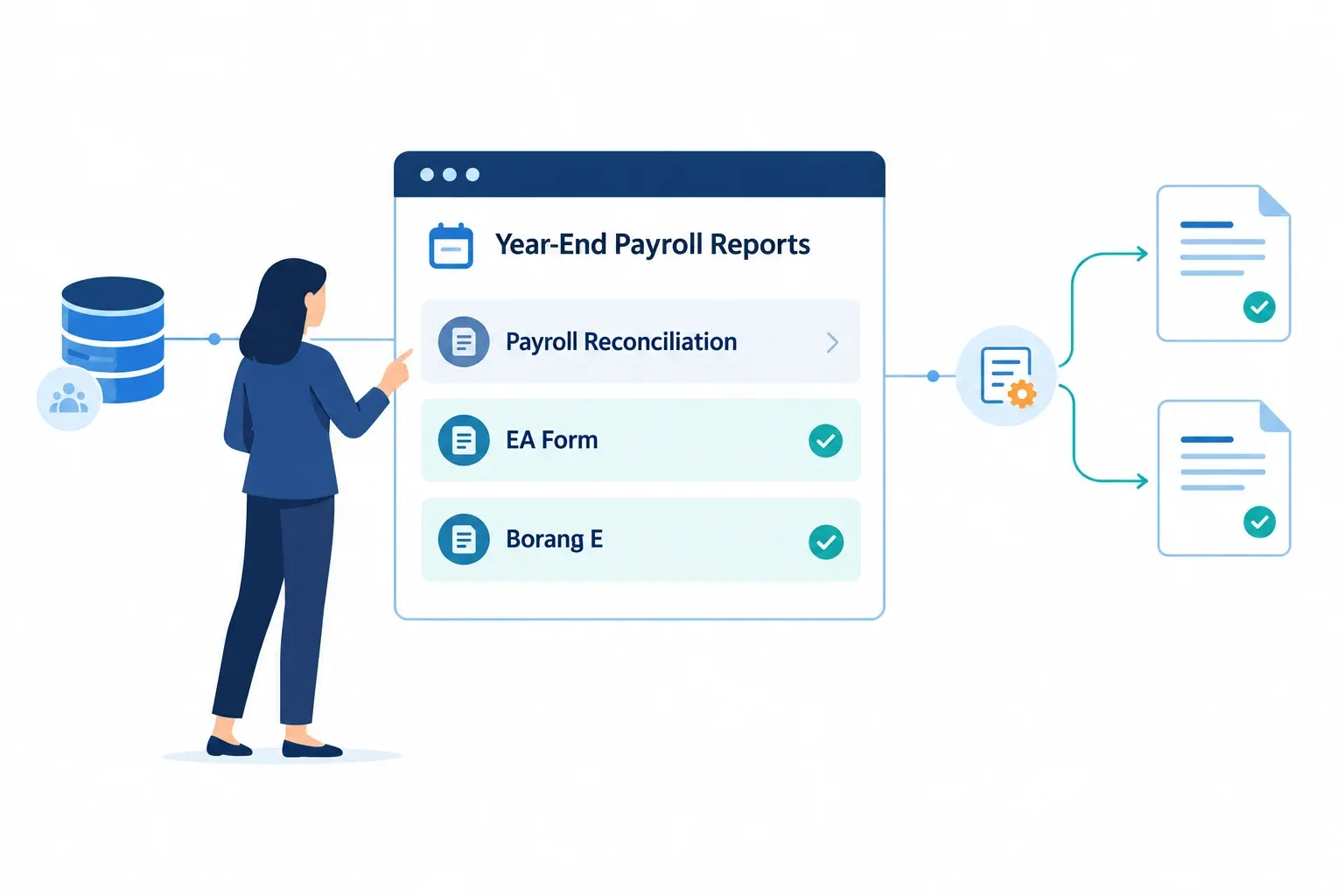
- Form E and statutory files. Borang E, CP39, CP21, CP22, CP22A and e-Data PCB output in LHDN's prescribed format are among more than 35 ready-made reports.
- Payroll reconciliation. A payroll reconciliation report, alongside pay summaries and transaction lists, supports the year-end checks before forms go out.
- Checks before every run. The payroll checklist confirms that attendance, loans and increments are covered before salaries are processed.
- Configured to your rules. The no-code formula engine gives full control over salary definitions and calculations, including complex and multi-tier pay structures.
- Multi-entity support. MiHCM Payroll is configured around complex organisation structures and multi-entity payroll requirements.
For HR teams fielding employee questions about the year-end process, MiA ONE, MiHCM's AI-powered personal assistant, brings policies and guidance to employees in the flow of work. MiHCM's Malaysia payroll guide covers the wider statutory calendar.
An illustrative scenario: a group closing the year
Consider a Malaysian group with three companies and staff across Peninsular Malaysia. The scenario is illustrative.
In December, payroll runs the final cycle with year-end bonuses. In early January, the payroll reconciliation report flags two employees whose MTD differs from the amounts remitted. HR checks e-Lejar, corrects the records and moves on.
In February, MiHCM generates EA forms for every employee across the three companies, including the forty who left during the year. All are issued well before the deadline. In March, Form E and the supporting data are filed for each company from the same reconciled records.
The bottom line
EA forms and Form E are the last step of the payroll year, not a separate project. If every month's payroll is accurate and reconciled, February and March are routine. If it is not, they become a scramble against a statutory deadline.
Book a demo to see MiHCM Payroll's year-end processing for Malaysia.