
Malaysian payroll runs on one date: the 15th. Five statutory payments fall due on it every month. Around that rhythm sit the annual returns, the employee notifications and, in 2027, a higher minimum wage.
This is the full calendar for 2027. Monthly obligations first. Then the annual milestones. Then the event-driven filings that catch even well-run payroll teams.
The monthly rule: everything by the 15th
For each month’s wages, five payments are due by the 15th of the following month.
Payment | Who pays | Rate or basis | Authority |
EPF (KWSP) | Employer and employee | Malaysian employees: 11% employee; 13% employer on wages of RM5,000 and below, 12% above. Non-Malaysian employees: 2% each | EPF |
SOCSO | Employer and employee | Contribution table; wage ceiling RM6,000 | PERKESO |
EIS | Employer and employee | Contribution table; wage ceiling RM6,000 | PERKESO |
PCB / MTD | Deducted from employee | Schedule of MTD or computerised calculation | LHDN (HASiL) |
HRD Corp levy | Employer | Compulsory registration and 1% levy for employers with 10 or more Malaysian employees; optional registration and 0.5% levy for 5 to 9; HRD Corp decides eligibility | HRD Corp |
The deadlines are set by each authority. LHDN requires monthly tax deductions to be remitted on or before the 15th of the following month. (LHDN) PERKESO requires contributions for any month to be paid no later than the 15th of the next, and charges interest of 6% a year on late payments. (PERKESO) The HRD Corp levy follows the same 15th-of-the-month deadline. (Malaysian Institute of Accountants)
Two details matter most for 2027 payroll. First, EPF has been mandatory for non-Malaysian employees since the October 2025 wage month, at 2% from both employer and employee. (Bernama) Second, the SOCSO and EIS wage ceiling is RM6,000, not the old RM5,000.
The EPF position for non-Malaysian employees is set out in KWSP’s own employer guidance and its 1 October 2025 media release: employer and employee each contribute 2% of monthly wages, for employees holding a valid passport and work pass, excluding domestic servants.
HRD Corp coverage is not one rule for every employer. Registration is compulsory for employers with 10 or more Malaysian employees, at a levy of 1% of monthly wages; employers with 5 to 9 Malaysian employees may register voluntarily, at 0.5%. (HRD Corp) Coverage also depends on whether the employer’s activities fall under the PSMB Act 2001, and HRD Corp, not the employer, decides eligibility. (HRD Corp support centre)
The 2027 calendar, month by month
Month (2027) | Deadline | What is due |
Every month | 15th | EPF, SOCSO, EIS, PCB and HRD Corp levy for the previous month’s wages |
January | First payroll | Apply LHDN’s 2027 PCB specification once issued, reflecting Budget 2027 reliefs |
February | 28 February | Issue Form EA to every employee for 2026 remuneration |
March | 31 March | File Form E with CP8D for 2026 (check LHDN’s 2027 filing programme for any e-filing grace period) |
June | June 2027 (proposed) | Proposed, subject to gazette: Budget 2027 proposes RM2,000; RM1,700 remains the statutory minimum until a new order takes effect |
December | Year-end close | Reconcile 2027 EPF, SOCSO, EIS and PCB totals before Form EA and Form E for 2028 |
Annual milestones explained
Form EA by 28 February 2027. Employers must prepare and give each employee a statement of remuneration (Form EA) on or before the last day of February of the following year. (LHDN)
Form E by 31 March 2027. The employer’s return, Form E, must be submitted with CP8D on or before 31 March. LHDN treats Form E as complete only if CP8D is submitted within the deadline. (LHDN) Companies must file electronically. LHDN publishes any grace period in its annual Return Form Filing Programme; the 2025 programme allowed one month for Form e-E. (LHDN RF Filing Programme 2025) Confirm the 2027 programme before relying on it.
PCB changes from Year of Assessment 2027. Budget 2027, tabled on 9 October 2026, proposes revised personal tax reliefs from Year of Assessment 2027. (EY) Do not change PCB settings until LHDN issues the updated specification.
Proposed minimum wage of RM2,000. Budget 2027 proposes a rise from RM1,700 to RM2,000 from June 2027; the current statutory minimum remains RM1,700 until a new order takes effect. The announced proposal reportedly includes an exemption for qualifying MSMEs; confirm the final eligibility test in the gazetted order before publication. (Human Resources Online) Enterprise employers may wish to model the potential cost now, including the knock-on effect on EPF, SOCSO and EIS.
Event-driven filings: the ones calendars miss
Some obligations are triggered by people, not dates.
• New joiner: Form CP22 within 30 days of the start of employment, submitted online through e-CP22 on MyTax. (LHDN)
• Leaver: Form CP22A not less than 30 days before cessation of employment. (LHDN)
• Leaving Malaysia: Form CP21 not less than 30 days before an employee leaves Malaysia for more than three months. (LHDN)
• Withholding: In these cessation and departure cases, withhold any money payable to the employee for 90 days or until LHDN issues a tax clearance letter. (LHDN)
These filings depend on HR telling payroll in time. A resignation accepted on the 20th, with a 30-day notice period, leaves no room for a week’s delay.
Five checks before the first payroll of 2027
1. Confirm every non-Malaysian employee is set up for 2% EPF.
2. Confirm SOCSO and EIS are capped at RM6,000, not RM5,000.
3. Check the EPF employer rate switches correctly at the RM5,000 threshold, including in bonus months.
4. Prepare to load LHDN’s 2027 PCB specification as soon as it is issued.
5. List every employee paid below RM2,000 and model the cost of the proposed increase.
Why a calendar alone is not enough
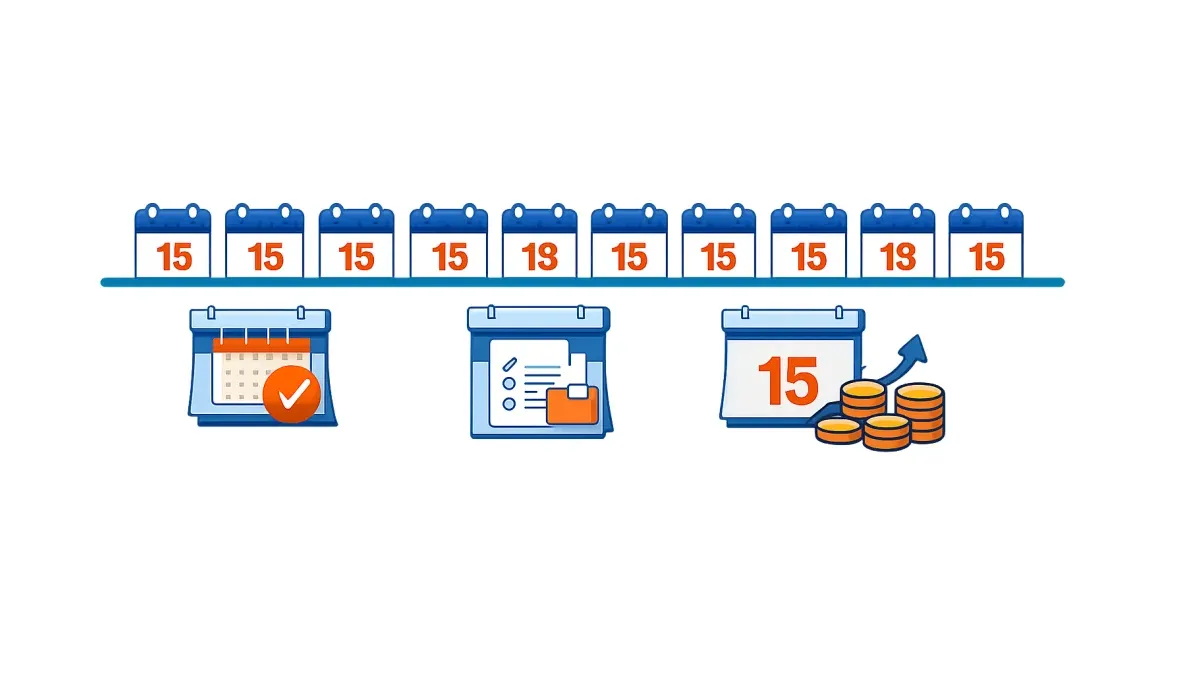
A calendar tells you when. It does not tell you whether the numbers are right. Most Malaysian payroll penalties trace back to configuration: a ceiling not updated, a foreign worker left off EPF, a leaver’s CP22A filed late because HR and payroll sit in different systems.
That is the case for running HR and payroll on one record, where a resignation logged by HR starts the CP22A clock in payroll automatically. It is the problem an event-driven HR and payroll workflow is designed to remove.
FAQs
When are EPF, SOCSO, EIS and PCB due in Malaysia? By the 15th of the month following the wage month.
When must Form EA be issued in 2027? On or before 28 February 2027, covering 2026 remuneration.
What is the Form E deadline in 2027? 31 March 2027, filed with CP8D. Check LHDN’s 2027 filing programme for any e-filing grace period.
Is EPF mandatory for foreign workers? Yes. Since the October 2025 wage month, employers and non-Malaysian employees each contribute 2% of monthly wages.
What is the SOCSO and EIS wage ceiling? RM6,000 a month.
Is Malaysia’s minimum wage rising to RM2,000? Budget 2027 proposes RM2,000 from June 2027. The current statutory minimum remains RM1,700 until a new order takes effect.
When must Form CP22 be submitted? Within 30 days of a new employee starting work.
Sources
• LHDN (HASiL), Employers’ responsibilities
• LHDN (HASiL), Return Form Filing Programme for the Year 2025
• PERKESO, Contribution payment
• Bernama, Mandatory EPF contributions for foreign workers to begin in October
• Malaysian Institute of Accountants, Circular MF10/2021 on HRD levy coverage
• Skrine, Minimum Wages Order 2024 gazetted
• EY, Malaysia Budget 2027 Take 5
• Human Resources Online, Malaysia Budget 2027: what employers need to know
• KWSP, Contribution for non-Malaysian citizen employees
• KWSP, EPF begins mandatory contributions for non-Malaysian citizen employees, 1 October 2025
• HRD Corp, Registered employers
• HRD Corp, New employer registration FAQs
• Editorial note: this article is general information, not legal or tax advice.