Every Sri Lankan employer pays into two statutory funds every month. The Employees' Provident Fund (EPF) is a retirement fund built from employer and employee contributions. The Employees' Trust Fund (ETF) is funded by employers alone.
The rates are well known. What trips employers up is everything around them: what counts as earnings, when each payment is due, how returns must be filed and what happens when a payment is late. ETF's move to mandatory electronic payment adds one more thing to get right.
This blog sets out what employers owe to each fund, and when.
EPF and ETF at a glance
Fund | Employee contribution | Employer contribution | Due date | Administered by |
|---|---|---|---|---|
EPF | 8% of total monthly earnings (minimum) | 12% of total monthly earnings (minimum) | On or before the last working day of the following month | EPF Department, Central Bank of Sri Lanka |
ETF | None | 3% of total monthly earnings | On or before the last working day of the following month (general guidance); electronic contribution and monthly return by the last day of the following month for employers with 15 or more employees | Employees' Trust Fund Board |
EPF: rates, earnings and deadlines
The rates
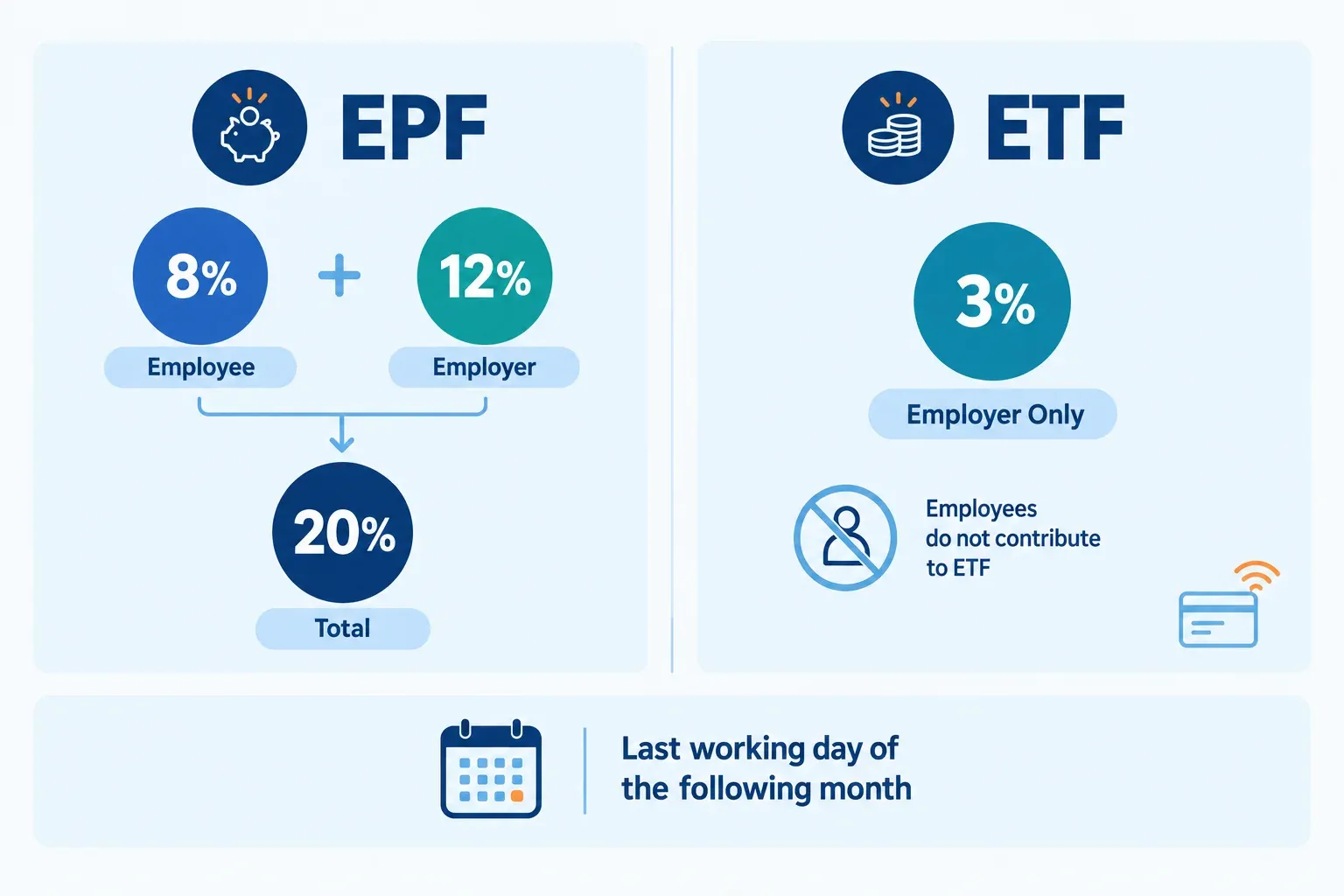
The employee contributes 8% of total monthly earnings, deducted from salary. The employer contributes an amount equal to 12% of the employee's total monthly earnings, paid entirely by the employer. That makes a total of 20% for each employee.
These are minimums. The employer remits both shares to the EPF Department and remains responsible for paying them, even if an employee is unwilling to contribute.
What counts as total earnings
The EPF Department lists the components that go into total earnings:
- salary, wages or fees
- cost of living allowances, special living allowances and other similar allowances
- payments for holidays
- the cash value of cooked or uncooked food supplied by the employer
- food allowances
- any other remuneration that may be specified
- payments in the form of commissions, piece-rate payments and contract-basis payments
It also lists what is excluded:
- overtime payments
- reimbursable travelling expenses
- incentive and bonus payments
Getting this split right is the most important EPF control. Leave out an allowance that should be included and every month's contribution is short.
When EPF is due
Contributions for each month must reach the EPF Department on or before the last working day of the following month. Contributions for November, for example, are due by the last working day of December.
Any employer can pay online through one of nine licensed commercial banks. Electronic returns (e-returns) are mandatory for employers with at least 50 employees, and the direct debit option is open only to those employers.
Surcharges for late EPF payments
Late payments and underpayments attract a surcharge based on the length of the delay.
Period of delay | Surcharge |
|---|---|
1 to 10 days | 5% |
11 days to 1 month | 15% |
1 to 3 months | 20% |
3 to 6 months | 30% |
6 to 12 months | 40% |
More than 12 months | 50% |
The EPF Department also applies a 2% surcharge on the total payment where contribution details, such as Form C or the text file, are incomplete.
Registration
An employer must register with EPF within 14 days of recruiting its first employee, using Form D. Each employee must be assigned a membership number and registered within 14 days of recruitment. Employee details must match the National Identity Card, because mismatches stop contributions reaching members' accounts.
ETF: rate, deadlines and the move to electronic payment
The rate
Employers contribute 3% of each employee's total monthly earnings to the ETF every month. Employees contribute nothing.
Mandatory electronic payment
The ETF Board has announced that, under a regulation published in Extraordinary Gazette No. 2311/39 of 22 December 2022, every employer with 15 or more employees must remit ETF contributions and submit monthly returns electronically, on or before the last day of the month after the contribution month.
From contributions for July 2026, payable on or before 31 August 2026, the Board no longer accepts cheques, money orders, cash or manual returns from these employers. Employers with fewer than 15 employees may also use the electronic channels, and the Board encourages them to do so.
Contributions can be remitted through e-banking at nine designated commercial banks, or by direct debit through other banks.
Surcharges for late ETF payments and returns
Late ETF contributions attract a surcharge under Section 27 of the Employees' Trust Fund Act No. 46 of 1980, on the same scale as EPF: from 5% for a delay of up to 10 days to 50% for a delay of more than 12 months.
Late, incorrect or incomplete returns attract a separate surcharge under Section 37A: 1% of the relevant contribution for every completed month or part of a month, from the due date until a correct return is received.
A note on ETF deadlines
ETF's general payment guidance says monthly contributions should reach the ETF Board on or before the last working day of the following month. For employers with 15 or more employees, the 2026 electronic-payment notice requires the electronic contribution and monthly return by the last day of the following month. To avoid ambiguity, process both EPF and ETF by the last working day.
A worked example
Here is an illustrative calculation for one employee in one month.
Earnings component | Amount (LKR) | Counted in total earnings? |
|---|---|---|
Basic salary | 120,000 | Yes |
Cost of living allowance | 10,000 | Yes |
Overtime | 15,000 | No |
Reimbursable travel | 5,000 | No |
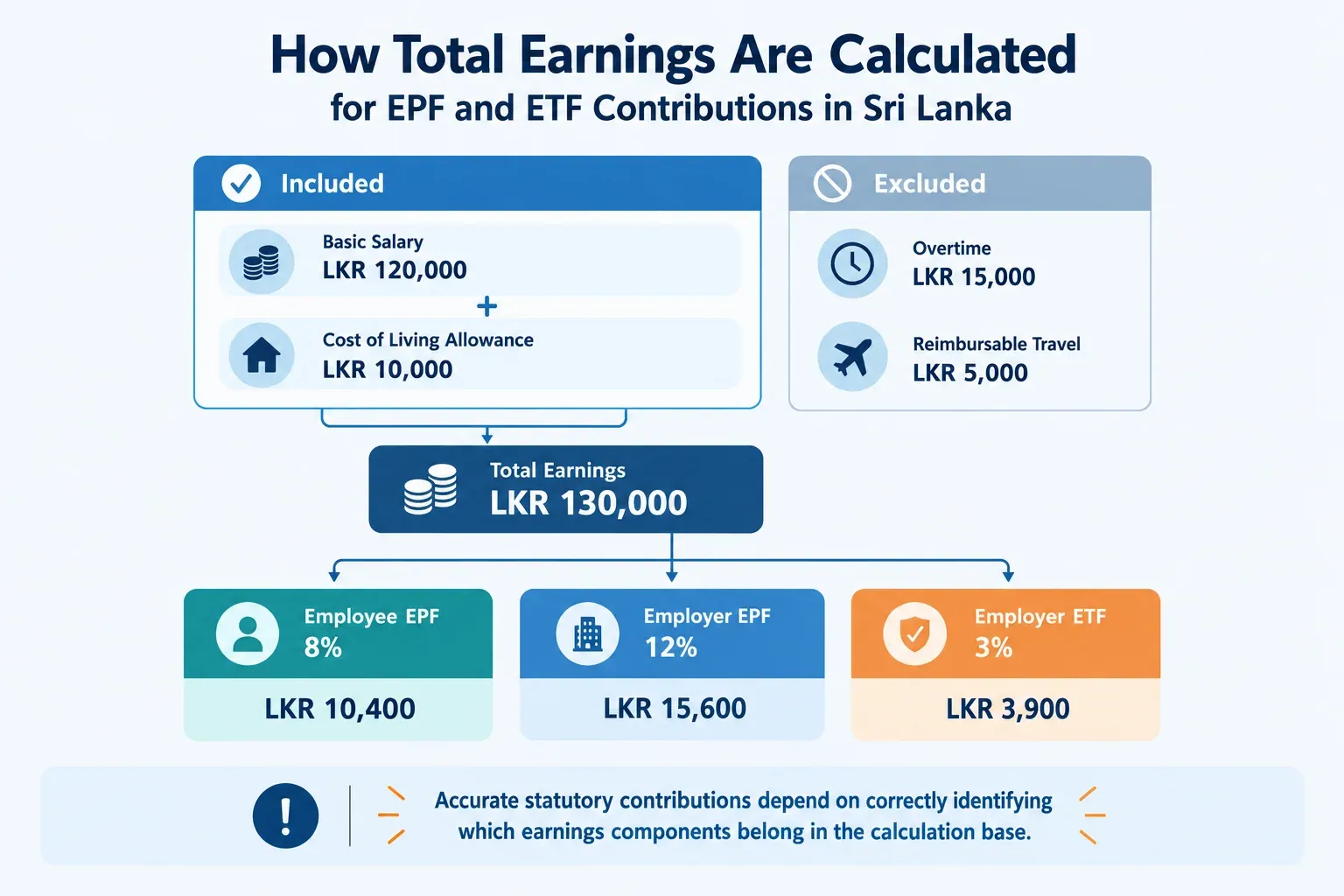
Total earnings for EPF and ETF purposes come to LKR 130,000.
- Employee EPF (8%): LKR 10,400, deducted from salary
- Employer EPF (12%): LKR 15,600
- Total remitted to EPF: LKR 26,000
- Employer ETF (3%): LKR 3,900
Include the overtime and the base rises to LKR 145,000, overpaying both funds. Leave out the allowance and the base falls to LKR 120,000, underpaying both, with surcharges to follow.
Common EPF and ETF mistakes
- Calculating contributions on basic salary only and leaving out allowances that count as earnings.
- Including overtime, bonuses or reimbursable travel in the base.
- Missing the cash value of food supplied to employees.
- Registering new employees late, so their first contributions have nowhere to go.
- Name or NIC mismatches that leave contributions unallocated.
- Sending ETF contributions to the EPF by mistake.
- Continuing to pay ETF by cheque after the move to electronic payment.
How MiHCM Payroll handles EPF and ETF
MiHCM Payroll runs automated calculations and localised statutory requirements in one system, so EPF and ETF are calculated in every payroll run rather than in a separate spreadsheet.
- Earnings set up once. Each pay element is configured as part of total earnings or not, using the Advanced Formula Builder, so allowances, overtime and bonuses are treated correctly every month.
- Checks before processing. The payroll checklist confirms that attendance, loans and increments are covered before salaries are processed.
- Deadlines in view. Real-time notifications flag pay dates and important deadlines.
- Data that moves. Payroll data can be exported to external systems, and pay-related reports support reconciliation.
- Answers for employees. MiA ONE, MiHCM's AI-powered personal assistant, brings policies and guidance into the flow of work, so employees get answers without raising a query.
- A group-wide view. For groups with several companies, Syntra brings workforce data from across entities into one view.
MiHCM's Sri Lanka payroll guide covers EPF and ETF alongside gratuity and APIT.
Your monthly EPF and ETF checklist
- Confirm which pay elements count as total earnings, and review the list whenever a new allowance is introduced.
- Register every new employee with EPF within 14 days of recruitment.
- Run payroll and reconcile EPF and ETF contributions against total earnings.
- Check employee names and NIC numbers against the contribution file.
- Remit EPF on or before the last working day of the following month.
- Remit ETF and, if you employ 15 or more people, submit the monthly return electronically, aiming for the last working day of the following month.
- Keep payment acknowledgements and resolve any underpayment notices promptly.
The bottom line
EPF and ETF are simple in principle: 8% and 12% to one fund, 3% to the other. The risk sits in the detail of earnings, deadlines and filing. Build those rules into payroll once, and every month runs on time.
Sources
- Employees' Provident Fund Department, Central Bank of Sri Lanka: FAQs for Employers
- Central Bank of Sri Lanka: Employees' Provident Fund
- Employees' Trust Fund Board: Notice on Mandatory Electronic Payment of Contributions and Submission of Monthly Returns
- Employees' Trust Fund Board: Payment of Contributions
- Employees' Trust Fund Board: Employers FAQ