Thailand’s leave rules sit in the Labour Protection Act B.E. 2541 (1998). For most of the past decade they changed little.
Then, on 7 December 2025, the Labour Protection Act (No. 9) B.E. 2568 came into force and rewrote family leave: maternity leave rose to 120 days, and private-sector employees gained paternity leave for the first time.
This reference covers the statutory minimum. Employers can, and often do, offer more.
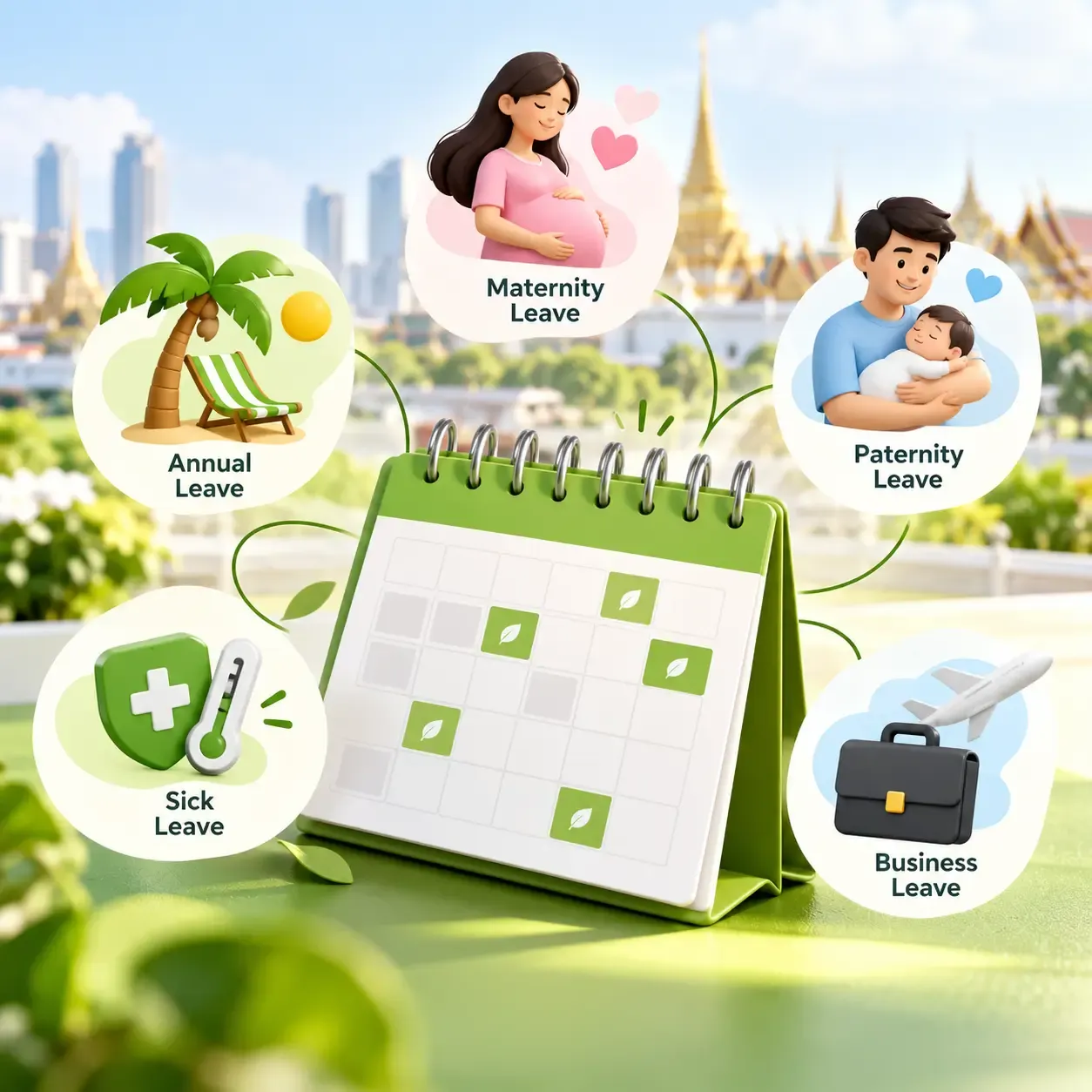
The core entitlements at a glance
| Leave type | Statutory entitlement | Paid by employer |
| Public holidays | At least 13 a year | Yes |
| Annual leave | At least 6 working days after one year of service | Yes |
| Sick leave | As long as actually sick | Up to 30 working days a year |
| Personal business leave | At least 3 working days a year | Yes, up to 3 days |
| Military service leave | For military inspection, training or readiness testing | Up to 60 days a year |
| Maternity leave | 120 days per pregnancy | Up to 60 days |
| Paternity (spousal) leave | 15 days | Yes |
| Child-care leave | 15 days, where the newborn has a medical condition | At 50% of wages |
Annual leave
An employee who has worked continuously for one full year is entitled to at least six working days of annual leave. The employer may schedule it in advance. Unused leave can be carried forward by agreement, and leave owed at termination must be paid.
Annual leave is for personal rest only. It cannot be used to absorb sick or personal business leave.
Sick leave
Employees may take sick leave for as long as they are actually sick. The employer pays wages for up to 30 working days a year. For absences of three working days or more, the employer may ask for a medical certificate.
Personal business leave
Employees are entitled to at least three working days a year of paid leave for necessary personal business, such as family emergencies or official matters. Once granted, it cannot be deducted from annual leave.
Family leave after December 2025
Maternity leave is now 120 days per pregnancy, including antenatal visits, up from 98 days. The employer pays full wages for up to 60 days, up from 45 (Sections 41 and 59). The entitlement applies to every pregnant employee, whatever her nationality or contract type, including employees on probation.
Child-care leave of up to 15 days, taken straight after maternity leave, is available to a mother whose newborn has an illness with a risk of complications, an abnormality or a disability. She must provide a medical certificate, the days can be taken in blocks, and the employer pays 50% of wages (Section 41, paragraph 4, and Section 59/1).
Paternity leave, or spousal leave, gives an employee up to 15 days of fully paid leave to support a legally married spouse who gives birth, taken within 90 days of the birth (Sections 41/1 and 59/2).
Employers should update work rules, contracts and handbooks: policies written before December 2025 rarely include a paternity clause.
Military and other leave
Employees called for military inspection, training or readiness testing may take leave with pay for up to 60 days a year. The Act also provides for leave for sterilisation and for approved training, under conditions set out in the Act.
What HR and payroll should do now
1. Update leave rules in the system: 120 days’ maternity with 60 paid, 15 days’ paternity, 15 days’ child-care at 50%.
2. Separate leave types cleanly so annual leave is never used to cover sick or business leave.
3. Track paid caps for sick leave (30 days) and military leave (60 days).
4. Coordinate with Social Security, which provides benefits that interact with employer-paid maternity and sick leave.
5. Pay out unused annual leave correctly at termination.
Where systems help
MiHCM Enterprise, delivered in Thailand with our partner iOperation, applies all the leave rules and feeds leave directly into payroll, in Thai and English.
Frequently Asked Questions
How many days of annual leave are required in Thailand?
At least six working days a year for employees who have worked continuously for one full year.
How much paid sick leave do Thai employees get?
Employees may take sick leave for as long as they are actually sick, and the employer pays wages for up to 30 working days a year.
How long is maternity leave in Thailand?
120 days per pregnancy since the December 2025 amendments, with the employer paying full wages for up to 60 days.
Is there paternity leave in Thailand?
Yes. Since 7 December 2025, private-sector employees are entitled to up to 15 days of fully paid leave to support a legally married spouse who gives birth, taken within 90 days of the birth.
How much personal business leave is there in Thailand?
At least three working days a year, with pay.
Sources
• DFDL, Thailand: Amendment of Labour Protection Act on Family-Related Leave
• Rajah & Tann Asia, Thailand Labour Law Update: New Maternity and Family-Related Leave Benefits
• Tilleke & Gibbins, Annual Leave in Thailand
• Multiplier, Thailand Labour Law Guide – sick leave and public holidays