Employees now expect the same instant access at work that they get everywhere else: checking a bank balance in seconds, tracking a food delivery in real time, booking a cab in minutes.
When that same employee has to email HR and ‘wait’ for a leave balance or a payslip, the gap feels larger than it used to¹. That expectation shift is real, but 2026 data shows something HR leaders may not expect: self-service hasn’t kept pace, and simply buying a portal isn’t closing the gap.
The uncomfortable truth about HR system rollouts

For years, organisations invested in portals, FAQs and automation and expected self-service adoption to climb steadily.
A 2026 report based on a survey of 1,000 UK employees at organisations with 2,000+ staff found instead that self-service has plateaued: a quarter of employees self-serve very little, completing only 0–25% of their HR needs independently, and only around one in five feel they can self-serve almost everything².
The gap is uneven across the workforce, too. Hospitality workers self-serve at just 33%, and frontline employees are far more reliant on colleagues and managers than office-based staff².
“Employees aren’t avoiding self-service because they dislike it.” — The 2026 State of HR Service Report, Applaud
Why the gap matters commercially, not just experientially
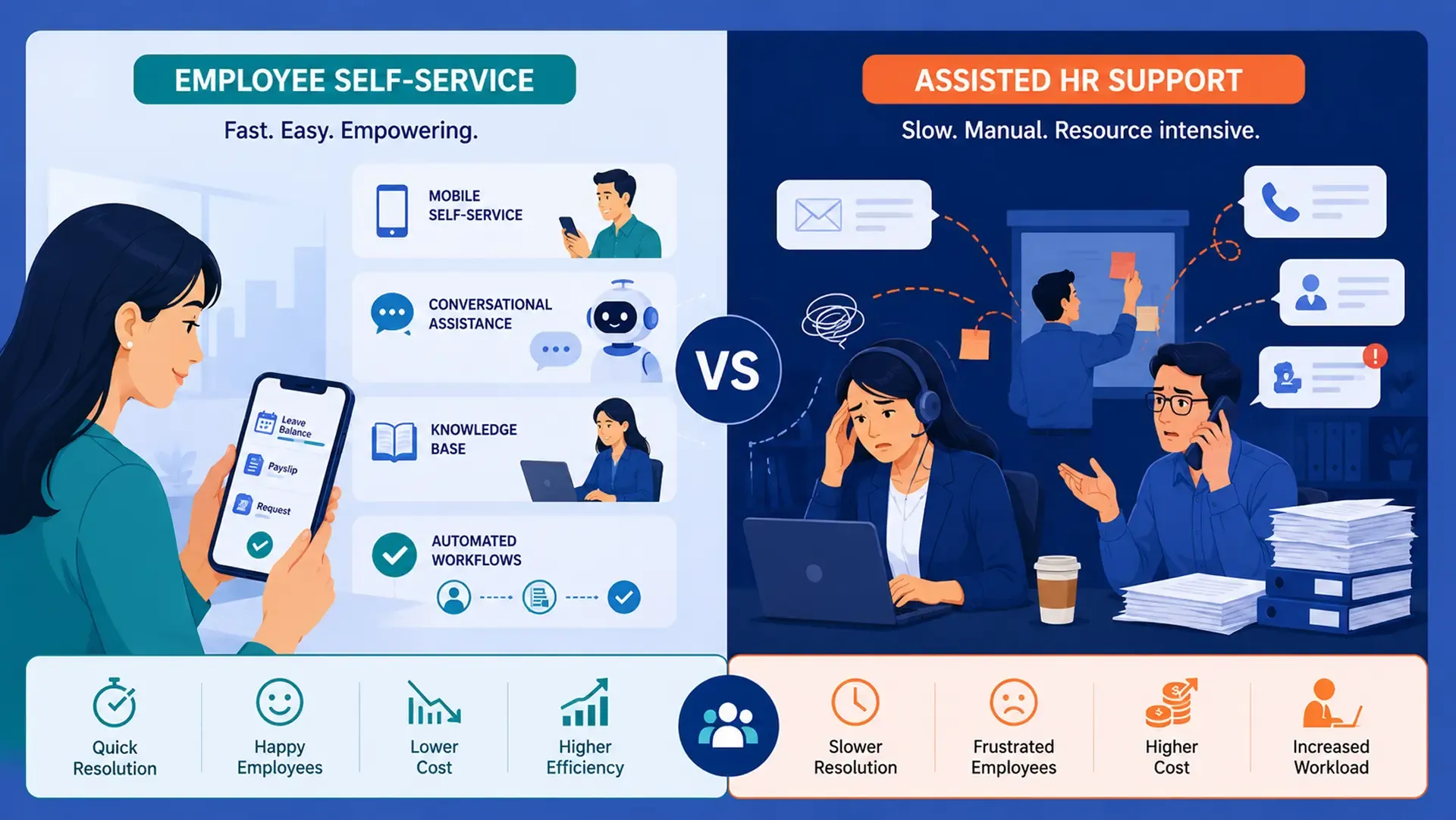
Self-service isn’t only about employee satisfaction; the cost difference is significant.
Analysis of HR help desk economics puts the cost of a self-service interaction at around $1.84, against $13.50 for an assisted channel, a 7.3x multiplier³. Other research finds an even wider range, from $1–4 for self-service up to $17–25 for phone support³.
Top-performing HR functions now deflect 65–75% of routine requests through self-service, but reaching that benchmark requires more than a static portal: it needs comprehensive documentation and a knowledge base intelligent enough to match employee questions with the right answer³.
Rising expectations, rising pressure

Nearly three-quarters of HR professionals, 72%, believe workers have higher expectations of employers today than in previous years, and employee experience is one of the top priorities workers want HR to focus on in 2026⁴.
At the same time, 76% of HR leaders acknowledge that managers are overwhelmed by expanding responsibilities, a strain that cascades directly into how quickly employee requests get resolved³.
Employees who feel their organisation is ineffective at addressing their needs report markedly lower satisfaction and higher intent to leave, which makes self-service performance a retention issue as much as an efficiency one⁵.
What HR must deliver in 2026

1. Meet employees where they already work:A separate portal that employees have to remember to log into is a barrier in itself. The strongest self-service experiences bring HR knowledge and workflows into the tools employees already use daily, whether that’s a mobile app, a chat channel, or a single unified employee dashboard.
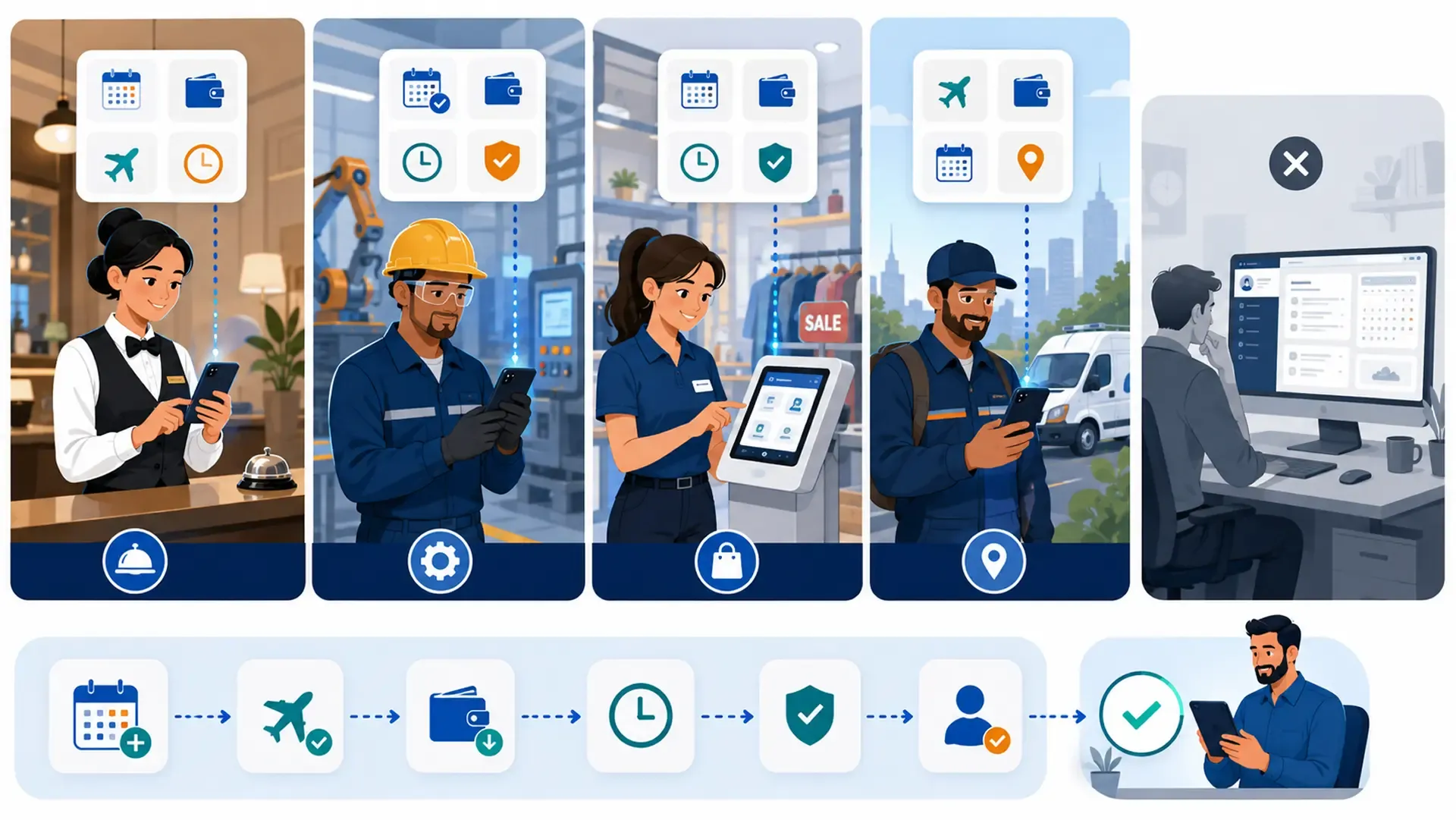
2. Close the frontline gap deliberately:Frontline and hospitality employees consistently self-serve at lower rates than office-based staff². That calls for interfaces designed for shared devices and shift patterns, not a scaled-down version of the desk-based experience.

3. Build a self-learning knowledge base:Documentation that goes stale is a leading cause of repeat tickets. Self-learning knowledge bases that automatically draft articles from resolved tickets shorten the path to strong deflection rates and reduce the current 5.4% reopen rate seen across the industry³.

4. Use AI deliberately, not as a buzzword:AI adoption in HR is accelerating but is still concentrated: current estimates suggest 46% of organisations will use some form of AI in HR in 2026, most commonly in recruiting, HR technology, learning and development, and employee experience⁶. Separately, 80% of HR leaders say they plan to implement additional AI-based HR tools by 2026, signalling that AI-supported self-service is quickly becoming table stakes rather than a differentiator³.
Where MiHCM fits in

MiA ONE, MiHCM’s personal AI agent, and SmartAssist, MiHCM’s AI HR co-pilot, are built to close exactly this gap: giving employees a single, conversational way to check leave balances, request documents, or ask policy questions, without needing to know which system or which HR contact to approach.
Because these tools sit across MiHCM Enterprise and MiHCM Lite, the same self-service experience scales from a single-country operation to a multi-country group, with the local compliance and policy detail embedded rather than bolted on.
Human judgement remains central to how these tools are designed: MiA ONE is built to support employees and HR teams, not to replace the human oversight that keeps HR decisions fair and compliant.
The bottom line
Self-service has hit a ceiling because most organisations built it around what HR wanted to offer, not around how employees actually behave. Closing that gap in 2026 means designing for real employee journeys, particularly the frontline workforce, and using AI to keep documentation fresh and answers accurate, rather than adding another portal nobody opens.
This article references third-party survey and market research current as of publication. Adoption rates, cost benchmarks and AI usage figures evolve quickly; readers are encouraged to verify current figures against the original sources listed below.
References
- HR HUB, ‘Why Employee Self-Service Is the New HR Standard in 2026’ — hrhub.app
- Applaud, ‘The 2026 State of HR Service Report: Five shifts and the statistics behind them’, based on Applaud/Censuswide research — applaudhr.com
- Unthread, ‘HR Help Desk Statistics 2026: SLA & Resolution Benchmarks’ — unthread.io
- SHRM, ‘2026 State of the Workplace: Insights to Shape the Future of Work’ — shrm.org
- SHRM, ‘State of the Workplace 2026 | Emerging Challenges’ — shrm.org
- SHRM, ‘The State of AI in HR 2026 Report’ — shrm.org