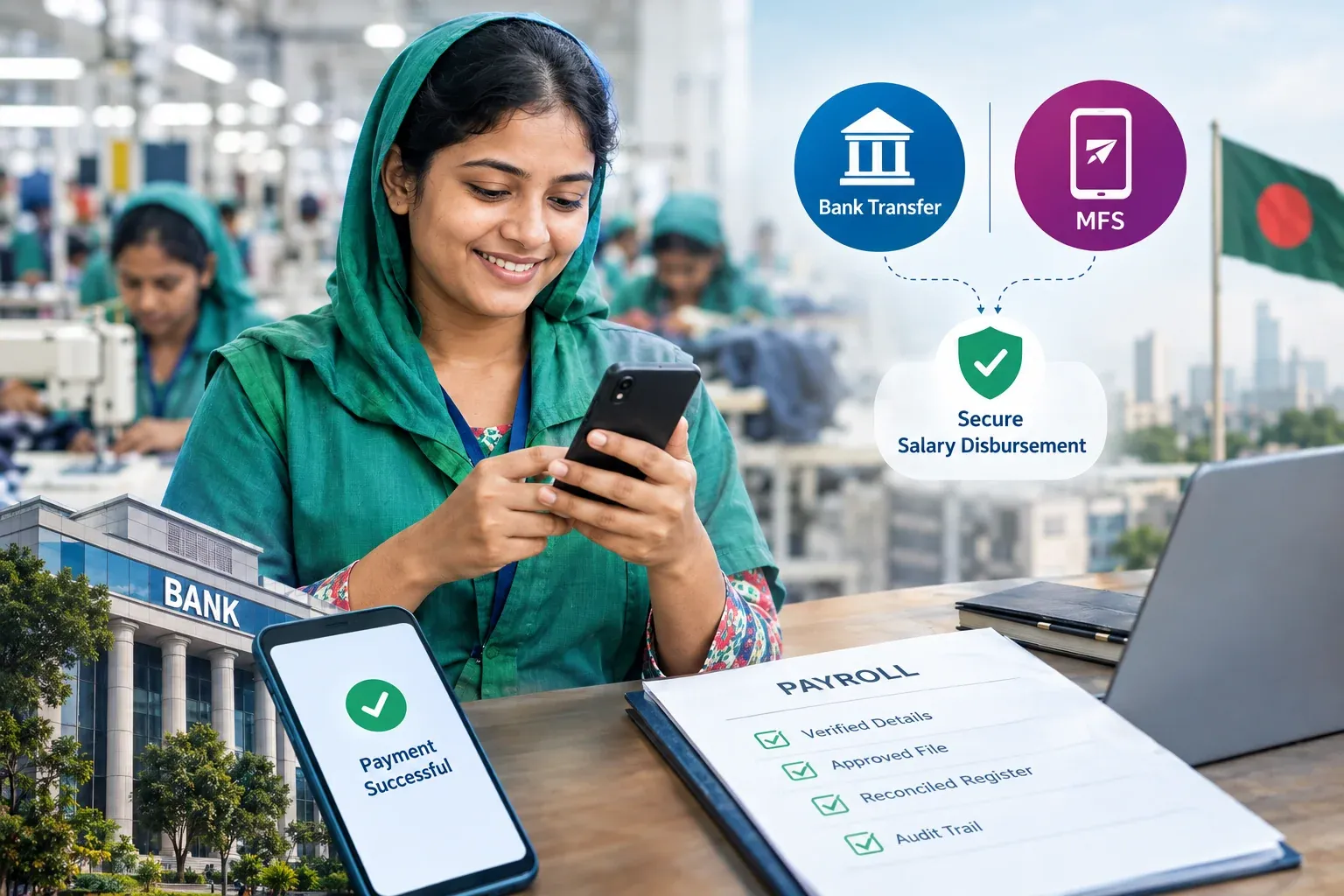
For decades, payday in a Bangladeshi factory meant envelopes of cash. That is changing fast. Wages now move by bank transfer and through mobile financial services (MFS), and the volumes are large. According to Bangladesh Bank data reported by The Financial Express, salaries worth Tk 291.62 billion were paid through MFS in 2021, rising to Tk 346.41 billion in 2022.
Going digital solves old problems: cash handling, security and long payday queues. It also creates new ones. A wrong wallet number is a failed payment. An unapproved file is an unapproved payroll. And a missed deadline is a breach of the Labour Act, whether the money moved by cash or by phone.
This blog covers the legal frame, the choice between bank and MFS, and the payroll controls that keep digital disbursement safe.
What the law requires
The Labour Act
The Bangladesh Labour Act 2006 sets the rules on when and how wages are paid.
- Timing. The maximum wage period is one month. Wages must be paid before the end of the seventh working day after the last day of the wage period.
- Final settlement. When employment ends, all wages due must be paid before the end of the thirtieth working day from the date of termination.
- Method. Wages are paid in legal tender or by cheque, or, where the worker requests it, by electronic transfer to the worker's bank account or through another digital medium.
- Working days. Wages must be paid on a working day, and no deductions may be made except those the Act allows.
The Act was substantially revised by the Bangladesh Labour (Amendment) Ordinance 2025 and the Bangladesh Labour (Amendment) Act 2026 (Act No. 43 of 2026). MiHCM's guide to what the amended Act changed sets out the wider implications for HR.
Tax law
The Income Tax Act 2023 also rewards banked payments. Eligibility for reduced corporate tax rates and deductibility can depend on using banking channels for receipts and specified payments. Confirm the current thresholds with Bangladesh tax counsel. For most employers, the payroll is the largest expense line, so how wages are paid matters to the tax position as well as to HR.
When a new wage order is gazetted
When a new sector wage order is gazetted, payroll teams must update grades, effective dates and any arrears, then complete payment within the statutory wage-payment window. Digital disbursement makes every revised payment traceable.
Bank transfer or MFS?
Most employers use both. The choice depends on the workforce.
Factor | Bank transfer | MFS |
|---|---|---|
Reach | Employees with bank accounts, typically office and management staff | Workers with a mobile phone and an MFS wallet, including factory floor staff |
Onboarding | Account opening and verification can take time | Wallets are quicker to open, but numbers must be verified carefully |
Cost to the worker | Depends on the bank and account type | Cash-out charges reduce take-home pay unless the employer absorbs them |
Evidence | Bank statements and transaction references | Provider reports and transaction references |
Best for | Higher earners and staff who already bank | Large frontline workforces moving from cash |
Cash-out charges deserve attention. The Financial Express reported in 2023 that charges on MFS cash-outs were eating into low-paid workers' wages, and that tax analysts were urging the regulator to bring them down. Employers moving to MFS should decide who bears the charge and explain it clearly to workers.
The payroll controls that matter
Digital payment is only as reliable as the payroll behind it. These are the controls that matter most.
Control | What it prevents | How to apply it |
|---|---|---|
Verified payment details | Failed or misdirected payments | Check account and wallet numbers at onboarding, and re-verify every change |
Recorded worker request | Disputes over the payment method | Keep the worker's request for electronic payment on file |
Approval before release | Unauthorised or incorrect payments | Separate the person who prepares the file from the person who approves it |
File-to-register reconciliation | Missing, duplicated or altered lines | Match the disbursement file to the approved payroll register, line by line |
Failed-payment handling | Late wages and Labour Act breaches | Track rejected payments and pay them inside the statutory window |
Audit trail | Gaps in evidence for inspectors and buyers | Keep transaction references against each employee's payslip |
The most common failure is the simplest: a payment detail entered once, never checked, and wrong. Get master data right, and most other problems disappear.
Moving a factory from cash to digital: an illustrative scenario
Consider a knitwear exporter with 4,000 workers, most paid in cash. The scenario is illustrative.
- Prepare. HR explains the change, collects workers' requests for electronic payment and helps them open wallets or accounts.
- Verify. Payment details are captured in each employee's record and verified before the first digital run.
- Pilot. One production unit moves first. Payroll compares the disbursement file with the payroll register and resolves every exception.
- Scale. The remaining units follow. Failed payments are tracked daily until the seventh working day.
- Evidence. Transaction references are linked to payslips, ready for the next inspection or buyer audit.
How MiHCM supports digital disbursement
MiHCM Payroll runs automated calculations and localised statutory requirements in one system, so the figures that leave the payroll are the figures that were approved.
- Clean master data. Each MiHCM Enterprise digital employee profile holds the employee's details in one record, so payment information is captured once and maintained in one place.
- Checks before release. The payroll checklist confirms that attendance, loans and increments are covered before salaries are processed.
- Files that move. Payroll data can be exported to external systems, and pay-related reports support reconciliation of each disbursement against the approved payroll.
- Rules for revisions. The Advanced Formula Builder handles wage grades and structures, which matters when a new minimum wage structure brings arrears.
- Deadlines in view. Real-time notifications flag pay dates and important deadlines.
- Answers for workers. MiA ONE, MiHCM's AI-powered personal assistant, lets employees get policy answers and notices by conversation, which reduces payday queries.
For the wider picture of high-volume garment payroll, see MiHCM's guide to payroll for the ready-made garment industry, and our step-by-step guide to running payroll in Bangladesh.
A checklist for digital salary disbursement
- Record each worker's request for electronic payment.
- Verify every bank account and MFS wallet number before the first payment.
- Decide who bears MFS cash-out charges, and tell workers.
- Separate preparation and approval of every disbursement file.
- Reconcile the file to the approved payroll register before release.
- Track failed payments and settle them before the seventh working day.
- Link transaction references to payslips for audits and inspections.
The bottom line
Digital pay is safer than cash only when the payroll behind it is controlled. Verified details, approved files, reconciled registers and a clear audit trail turn a bank or MFS payment from a convenience into evidence.
Book a demo to see how MiHCM supports payroll and disbursement in Bangladesh.