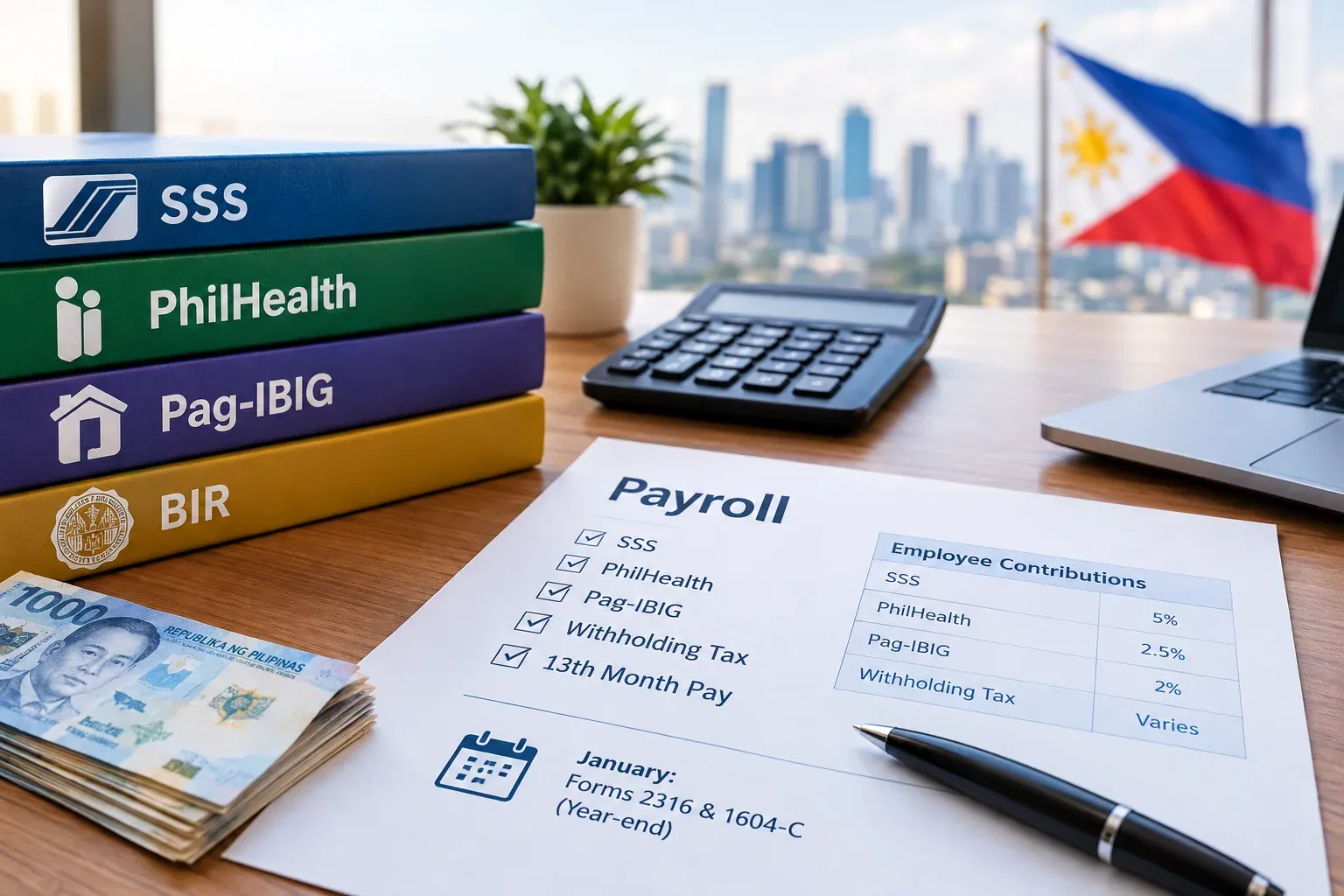
Payroll in the Philippines looks simple from a distance. Three government contributions, one income tax and a bonus at Christmas.
Up close, each one has its own base, its own ceiling and its own deadline. The SSS works on a salary credit, PhilHealth on basic salary, Pag-IBIG on a capped fund salary. Tax is withheld on what is left. And the whole year is reconciled in January.
This guide sets out how to run Philippine payroll step by step, with a worked example. It is written for regional employers adding a Philippine entity to an existing payroll.
Before the first pay run
Every employer needs four registrations in place before salaries are paid:
- Social Security System (SSS) for social security and employees' compensation.
- PhilHealth for national health insurance.
- Pag-IBIG Fund, formally the Home Development Mutual Fund (HDMF), for savings and housing.
- Bureau of Internal Revenue (BIR) for withholding tax on compensation.
Each employee also needs a Tax Identification Number and membership numbers for SSS, PhilHealth and Pag-IBIG. Collect them at onboarding. Missing numbers are the most common reason contributions fail to reach an employee's record.
Step 1: Set the pay cycle
Most Philippine employers pay twice a month. Fix the cycle, the cut-off dates and the pay dates before the first run, and decide which pay elements count as basic salary. That decision drives PhilHealth and 13th month pay, so it needs to be right from day one.
Step 2: Calculate the three contributions
The three agencies use three different bases. The table summarises the rates in force for 2026.
Contribution | Base | Employee share | Employer share |
|---|---|---|---|
SSS | Monthly Salary Credit, from ₱5,000 to ₱35,000 | 5% | 10%, plus Employees' Compensation of ₱10 or ₱30 |
PhilHealth | Monthly basic salary, with a ₱10,000 floor and a ₱100,000 ceiling | 2.5% | 2.5% |
Pag-IBIG | Monthly compensation, with the fund salary capped at ₱10,000 | 2% (1% at ₱1,500 a month or less) | 2% |
SSS
The SSS contribution is 15% of the Monthly Salary Credit (MSC). The employer pays 10% and the employee 5%. The MSC is a bracketed figure set from actual pay, from a floor of ₱5,000 to a ceiling of ₱35,000. Once pay reaches the top bracket, the contribution stops rising.
The employer also pays an Employees' Compensation premium of ₱10 a month for an MSC below ₱15,000, and ₱30 from ₱15,000. The part of the MSC above ₱20,000 is credited to the employee's mandatory provident fund account, at the same split.
PhilHealth
PhilHealth premiums are 5% of monthly basic salary, shared equally. The base has a floor of ₱10,000 and a ceiling of ₱100,000, so contributions run from ₱500 to ₱5,000 a month in total.
Pag-IBIG
Pag-IBIG contributions are 2% from the employer. Employees pay 2%, or 1% if they earn ₱1,500 a month or less. The monthly fund salary is capped at ₱10,000, so the usual maximum is ₱200 each.
Step 3: Withhold tax on compensation
Tax is withheld on taxable compensation, after the employee's mandatory contributions are taken out. Under the graduated rates in force since 2023, annual taxable compensation of ₱250,000 or less is not taxed.
Annual taxable compensation | Tax due |
|---|---|
Up to ₱250,000 | Nil |
Over ₱250,000 up to ₱400,000 | 15% of the excess over ₱250,000 |
Over ₱400,000 up to ₱800,000 | ₱22,500 plus 20% of the excess over ₱400,000 |
Over ₱800,000 up to ₱2,000,000 | ₱102,500 plus 25% of the excess over ₱800,000 |
Over ₱2,000,000 up to ₱8,000,000 | ₱402,500 plus 30% of the excess over ₱2,000,000 |
Over ₱8,000,000 | ₱2,202,500 plus 35% of the excess over ₱8,000,000 |
Withholding is spread across the year and trued up at year end. In December, annualise each employee's compensation and adjust the final withholding so the year's total matches the tax due.
Step 4: Plan the 13th month pay
Rank-and-file employees are entitled to 13th month pay of at least one-twelfth of the basic salary earned in the year, paid by 24 December. The 13th month and other benefits are tax-exempt up to ₱90,000 a year in total.
Accrue it monthly, so December does not surprise anyone. Employees who leave during the year are owed a pro-rated amount in their final pay.
Step 5: Remit and file
Obligation | Deadline | What it covers |
|---|---|---|
BIR Form 1601-C | Monthly, by the deadline that applies to the employer's filing channel and taxpayer classification under the current BIR calendar | Tax withheld on compensation |
SSS, PhilHealth and Pag-IBIG remittances | Monthly, on each agency's schedule | Employee and employer shares |
BIR Form 2316 | To each employee by 31 January | Certificate of compensation and tax withheld |
BIR Form 1604-C with alphalist | By 31 January | Annual return of tax withheld on compensation |
January is the pressure point. December payroll, the year-end tax true-up, every employee's Form 2316 and the annual return all land at once.
A worked example
Here is one employee with a basic salary of ₱30,000 a month and no other pay. The figures are illustrative.
Item | Employee | Employer |
|---|---|---|
SSS (MSC ₱30,000) | ₱1,500 | ₱3,000, plus ₱30 Employees' Compensation |
PhilHealth (5% of ₱30,000) | ₱750 | ₱750 |
Pag-IBIG (capped) | ₱200 | ₱200 |
Total contributions | ₱2,450 | ₱3,980 |
Taxable compensation is ₱30,000 less ₱2,450, or ₱27,550 a month. Annualised, that is ₱330,600. Tax is 15% of the ₱80,600 above ₱250,000, which gives an annual tax of ₱12,090. The actual withholding per pay period should follow the applicable BIR withholding table, with a year-end adjustment.
As a simple annual-average illustration only, that is about ₱1,007.50 a month, giving net monthly pay of about ₱26,542.50. The employer's monthly cost is ₱33,980, before the 13th month accrual of ₱2,500.
Where Philippine payroll goes wrong
- Using gross pay instead of the Monthly Salary Credit for SSS.
- Applying PhilHealth to allowances that are not part of basic salary, or missing the floor and ceiling.
- Forgetting the Employees' Compensation premium.
- Taxing the mandatory contributions instead of deducting them first.
- Skipping the year-end annualisation, so December withholding is wrong.
- Treating the 13th month as fully taxable, or leaving it out of final pay.
- Leaving Forms 2316 to the last week of January.
Running a Philippine entity alongside the rest of Asia
For a regional employer, the Philippines rarely stands alone. The same finance team may also run Malaysian, Thai and Sri Lankan payrolls, each with different bases, ceilings and calendars.
That is the problem MiHCM Payroll is built for. It is designed for multi-country, multi-currency payroll processing on one platform, so each entity runs its own statutory rules while HR and finance work from one set of records.
- Rules configured once. The Advanced Formula Builder lets each entity define its own pay elements and formulas, such as which elements count as basic salary, how contribution bases are derived and how the 13th month accrues.
- Checks before processing. The payroll checklist confirms that attendance, loans and increments are covered before salaries are processed.
- Deadlines in view. Real-time notifications flag pay dates and important deadlines, including the January peak.
- Data that moves. Payroll data can be exported to external systems, and pay-related reports support remittance and year-end reconciliation.
- One regional view. Syntra answers payroll and workforce questions across entities in plain language, so a regional CFO can compare employment cost by country without waiting for a consolidated spreadsheet.
An illustrative scenario
Consider a Kuala Lumpur-headquartered group that opens a Manila office with 80 employees. The scenario is illustrative.
HR adds the Philippine entity to the group's MiHCM set-up, with its own pay cycle, pay elements and approval routes. Employee records carry TIN and agency numbers from day one. Each month, payroll runs for Manila alongside Kuala Lumpur, with the checklist confirming attendance before processing. In December, the team runs the year-end annualisation and the 13th month together. In January, Forms 2316 are ready before the deadline, and the regional CFO compares employment cost across both countries in one view.
Your Philippine payroll checklist
- Register the employer with SSS, PhilHealth, Pag-IBIG and the BIR.
- Collect each employee's TIN and agency numbers at onboarding.
- Define basic salary and every other pay element before the first run.
- Calculate SSS on the Monthly Salary Credit, PhilHealth on basic salary and Pag-IBIG on the capped fund salary.
- Withhold tax on compensation after mandatory contributions.
- Accrue the 13th month monthly and pay it by 24 December.
- File BIR Form 1601-C and remit agency contributions every month.
- Annualise in December, then issue Forms 2316 and file Form 1604-C by 31 January.
The bottom line
Philippine payroll is a set of small, precise rules: three contribution bases, one tax table, one bonus and one very busy January. Build those rules into payroll once, and every month runs on time.
Book a demo to see how MiHCM runs Philippine payroll alongside the rest of your region.
Sources
- Social Security System: Circular No. 2024-006 and contribution table
- PhilHealth: Advisory No. 2026-0042
- PhilHealth: CY 2025 advisory for direct contributors
- Pag-IBIG Fund: Circular No. 460
- Bureau of Internal Revenue: BIR Form 1604-C guidelines
- Memorandum Order No. 28 (1986) on Presidential Decree No. 851
- MiHCM Payroll
- MiHCM: Syntra