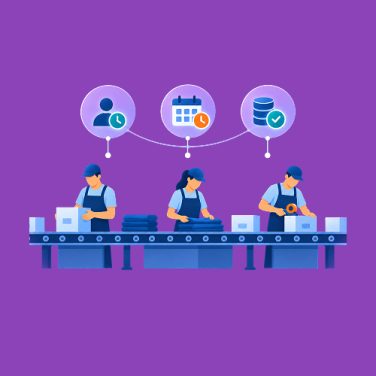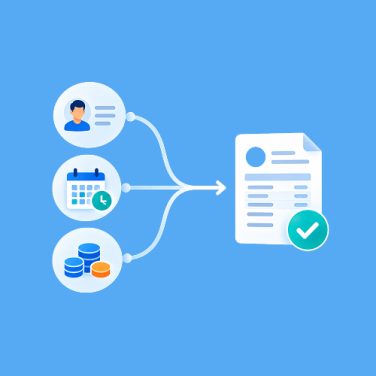
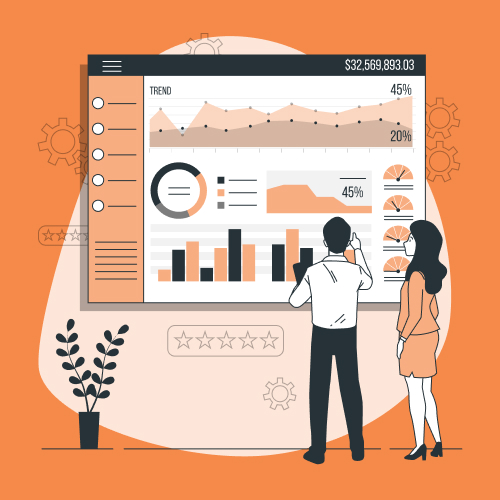
AI in performance management has shifted from proof-of-concept experiments to operational capability that speeds decision-making, scales personalised coaching and enables continuous evidence-based feedback.
HR teams face pressure to retain high performers, reduce manager overhead and show measurable development outcomes; applied correctly, AI helps achieve these goals by automating low-value work and surfacing timely signals that enable earlier interventions.
AI is presented here as an augment to managers, not a substitute for human judgment. Systems that synthesise multi-source feedback, draft review narratives and recommend focused development actions free managers to spend more time coaching. That augmentation scales personalised attention across larger teams while preserving managerial accountability.
Strategic HR priorities align with AI capability in three ways: retention of top talent through early risk detection, improved manager effectiveness by reducing admin and improving feedback quality, and measurable competency growth via personalised learning recommendations. These outcomes support business KPIs such as reduced voluntary churn among top performers and faster internal mobility.
Risks exist. Bias, privacy breaches and poor instrumentation can erode trust or create legal exposure. Governance and clear data purpose are required before models interact with employee decisions. Practical safeguards include documented permitted uses, human-in-the-loop gates for high-impact outputs and audit trails for decisions.
What to expect from this pillar guide: strategy and use-cases, minimum data instrumentation, governance and fairness templates, a pilot-to-scale roadmap and ROI metrics HR teams can use immediately. It includes actionable product mappings to MiHCM components so organisations can move from concept to a safe, measurable pilot.
Key takeaways on AI in performance management
AI adds most value when it automates admin, synthesises multi-source feedback and suggests evidence-based coaching prompts. Start with a single, measurable use-case and validate quickly with managers in a time-boxed pilot.
- Automate low-value tasks (drafting, aggregation) so managers focus on coaching.
- Begin small: pilot feedback drafting, risk-flagging or skills gap detection with human review.
- Implement governance: document permitted data, explanation standards and escalation pathways.
- Measure both technical (accuracy, fairness) and business KPIs (manager hours saved, development-plan completion).
- Adopt a staged roadmap: instrument signals, pilot with managers, validate outcomes and scale.
Quick starter checklist: 1) Identify a measurable use-case; 2) Ensure the minimal dataset is available; 3) Run an 8–12 week pilot with clear success metrics and manual review. Evidence from implementation guides suggests an 8–12 week pilot window is appropriate for validating early outcomes and risks (PMISCC, 2025).
Why AI in performance management matters: strategic value
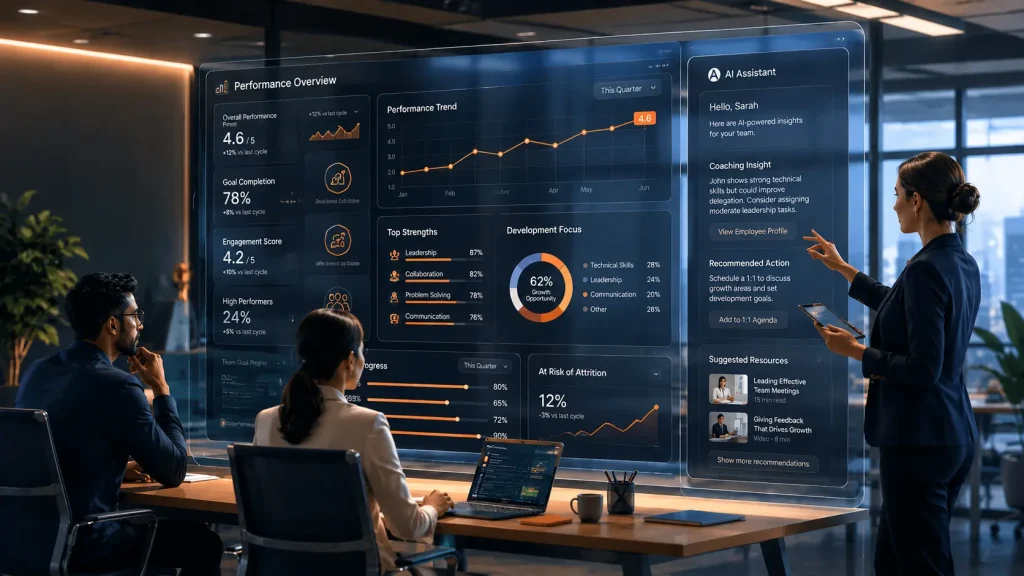
AI delivers strategic value by shifting manager time from administrative tasks to coaching, enabling continuous feedback cycles, surfacing predictive signals for early intervention and focusing L&D investment where it will move the needle.
- Reduce manager admin: Automated synthesis and drafting cut preparation time for reviews and 1:1s, increasing time available for developmental conversations. Research on generative tools shows measurable productivity improvements in drafting tasks (HBR, 2025).
- Continuous feedback: Move away from infrequent reviews toward stitched-together evidence from goals, peer feedback and output metrics so feedback is timely and actionable.
- Early risk detection: Predictive models flag attrition or performance risk earlier than traditional signals, enabling targeted retention or performance interventions (NIH/PMC).
- Skills prioritisation: AI-based skills gap analysis helps L&D prioritise content and measures competency growth by linking learning completions to observed performance changes.
- Improve fairness through data: When combined with routine fairness testing and human oversight, data-driven insights can reduce subjective bias in reviews.
Business KPI
How AI helps
Manager productivity
Reduce prep time via drafting and synthesis
Retention of top talent
Early risk flags and targeted interventions
L&D efficiency
Personalised recommendations and measured uplift
Decision consistency
Standardised feedback templates and explainable signals
Top AI use-cases that improve reviews, coaching and development
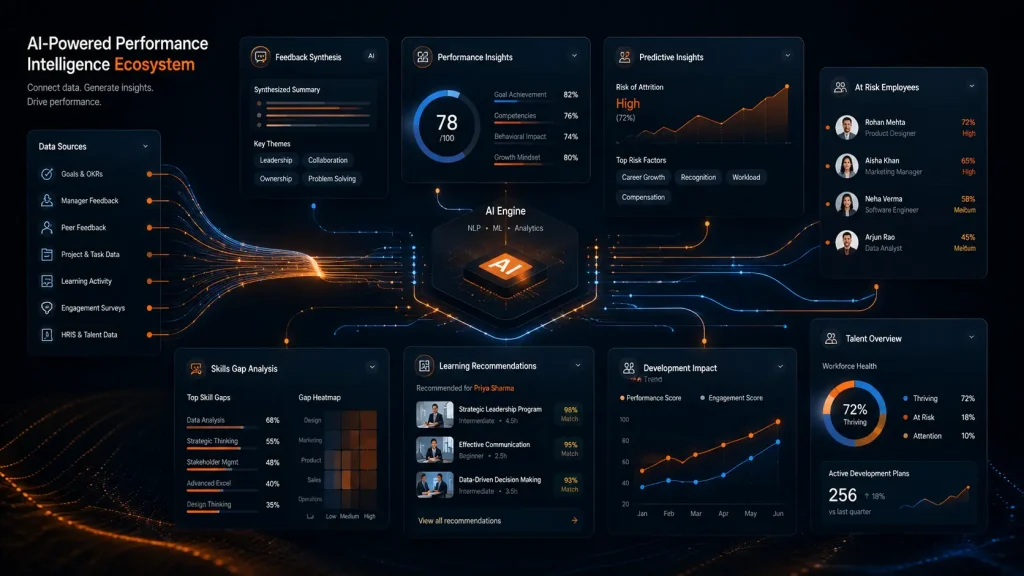
- Feedback synthesis: Use NLP to aggregate manager, peer and customer feedback into concise summaries and evidence bullets for managers. Implementation tip: enforce controlled feedback forms and controlled vocabularies to improve NLP precision.
- Smart drafting: GenAI drafts review narratives, competency-based assessments and SMART goals that managers edit. Tip: provide templated prompts and require manager sign-off; track override rates to monitor quality.
- Real-time coaching prompts: Surface conversation starters and evidence before 1:1s via SmartAssist. Tip: surface only concise, context-linked prompts and allow one-click insertion into agendas.
- Predictive attrition & performance risk: Models combining HRIS, engagement and behavioural signals flag at-risk employees for early outreach. Tip: use rule-based fallbacks and human review for any high-impact recommendation; predictive performance has empirical support in HR research (NIH/PMC).
- Skills gap and career pathing: Match observed behaviours and learning completions to internal roles and learning recommendations to create personalised career maps.
- Automated measurement: Continuous dashboards surface trends in productivity, absenteeism and competency growth; use A/B tests to attribute changes to interventions.
Actionable implementation tips for each use-case
- Start with templates and controlled vocabularies for feedback to improve NLP accuracy.
- Enforce explicit human sign-off for drafted narratives and promotion-related recommendations.
- Track manager override rates and time savings as primary adoption metrics.
- Use conversational assistants (MiA) for one-click draft generation and walkthroughs.
Product notes: MiHCM SmartAssist and MiA support the drafting and in-flow assistance use-cases; combine with Analytics and MiHCM Data & AI for measurement and prediction.
Data requirements & instrumentation: The signals that matter
Design instrumentation to capture only signals tied to the pilot hypothesis. The minimal viable dataset typically includes:
- HRIS master records (employee IDs, role, grade, hire date)
- Goals and OKRs with timestamps and completion status
- Objective output metrics (sales, code commits, deliverables) where available
- Learning records (course completions, micro‑learning events)
- Standardised feedback forms (manager, peer, customer)
- Pulse survey results and sentiment indicators
Do not over-collect. Map every data field to a processing purpose and legal basis. Jurisdictions vary; where collaboration metadata (calendar, messages) is valuable, obtain clear consents and limit access. Use pseudonymisation for modelling and restrict identifiable data to approved data science environments.
Data quality checklist
- Unique employee identifiers across systems
- Consistent role and team taxonomy
- Timestamps and timezone-normalisation
- Documented transformations and derivations
Labelling and ground truth
For supervised models, build a controlled ground-truth set: balanced examples of high and low performance outcomes, annotated by subject-matter experts. This improves model validity and fairness testing.
Privacy-preserving approaches such as role-based views, field-level encryption and logging of access reduce exposure. Instrument feedback flows with controlled vocabularies and structured response options to increase NLP accuracy and reduce bias.
Designing governance, privacy and fairness for HR AI
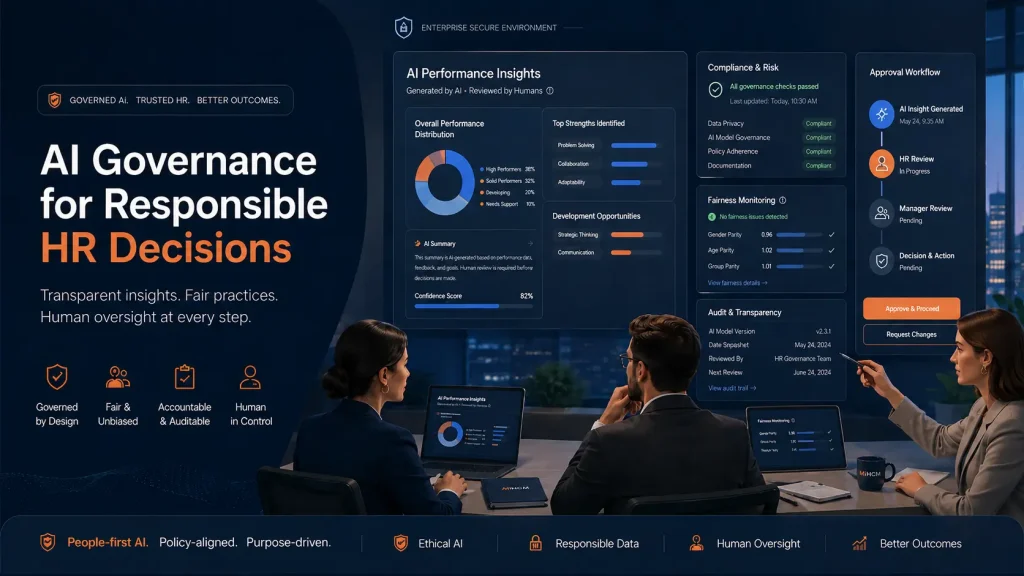
Establish a cross-functional governance board including HR, Legal, Data Science and Compliance. Key responsibilities include policy approval, monthly model output reviews and escalation protocols.
- Document permitted and forbidden use-cases; explicitly forbid fully automated termination or promotion decisions without human review.
- Require impact assessments before deployment and on material changes to models.
- Define explainability standards: for high-impact recommendations, provide a human-friendly rationale and the top contributing features.
- Implement an appeals process and employee communications explaining data use and recourse.
- Maintain audit trails logging model inputs, outputs and human overrides for compliance and learning.
Run group fairness tests and disparate impact analyses prior to release and on a scheduled cadence. Practical governance guidance from privacy and workplace AI experts recommends transparency, human-in-the-loop checks and documentation as baseline controls (FPF, 2024).
Operational mechanics: assign data owners, set retention windows, require vendor risk assessments and include rollback criteria in the runbook. Human reviewers must intervene on flagged or contested recommendations; automate only within strictly defined bounds.
Pilot-to-scale roadmap: a practical 6-step plan
- Define hypothesis & success metrics: e.g., reduce review prep hours by 30% and increase development-plan completion by 20% within the pilot cohort.
- Identify pilot cohort: choose a business unit with clean data, engaged managers and a representative mix of roles.
- Instrument & validate data: build ETL pipelines, validate mappings and create a labelled ground truth for model training; add rule-based fallbacks.
- Run a time-boxed pilot (8–12 weeks): deploy with manual review and weekly manager feedback loops to capture qualitative signals.
- Evaluate outcomes: compare technical metrics (precision/recall, fairness tests) and business KPIs (hours saved, dev-plan completion) and collect manager qualitative feedback.
- Iterate and scale: address fairness or accuracy issues, expand cohorts, integrate with HRIS/Workflows and roll out manager enablement at scale.
Use an 8–12 week pilot window to validate initial effects and discover integration challenges; implementation guidance and program management frameworks commonly recommend this duration for early testing (PMISCC, 2025).
Include a rollback plan, manual backstops for contested outputs and a structured manager feedback form to capture usability and trust signals during the pilot.
Measuring ROI & KPIs for AI-enabled performance management
Split ROI into time-savings, productivity gains, retention impact and L&D efficiency. A simple calculation uses annual manager hours saved and retention delta to estimate net benefit.
Metrik | Example calculation |
Manager hours saved | (Average prep time saved per review × reviews per year × number of managers) × fully loaded hourly cost |
Retention savings | Number of high-performer exits prevented × average replacement cost |
L&D efficiency | Reduced cost per skill uplift from personalised recommendations |
Technical metrics: track precision/recall for risk flags, false positive rate, fairness metrics across protected groups and model drift indicators. For business attribution, use A/B tests or staggered rollouts to isolate the AI effect from confounders.
Example: if a pilot saves 2 hours per manager per review, 4 reviews per year, for 50 managers at $80 fully-loaded/HR, the annual time-savings approximate $32,000; retention improvements amplify ROI and justify infrastructure and vendor costs.
Use dashboards to present Review prep hours saved, quality of manager feedback (surveyed), development-plan completion rate and retention of flagged high performers. Monitor both short-term targets (40–50% reduction in prep time) and medium-term goals (20% boost in development-plan completion) while treating retention gains as longer-term outcomes.
MiHCM Analytics and MiHCM Data & AI provide the reporting primitives to measure these KPIs and connect model outputs to business outcomes.
Integration: connecting AI to HRIS, ATS and collaboration tools
Integration priorities are HRIS for master records, ATS for mobility signals and calendar/email/Slack for collaboration patterns when permitted. Secure APIs, scheduled ETL jobs and consistent schemas preserve referential integrity.
- Data mapping: align role titles, grades and team hierarchies across systems.
- Secure credentials: use service accounts, field-level encryption and role-based access control.
- Test/dev environment: validate mappings and run end-to-end tests including semantic checks on mapped fields.
- Sync cadence: choose near-real-time for coaching prompts and daily/weekly batches for modelling workloads.
- Fallbacks: define behaviour for outages (queued processing, UI notices, manual overrides).
Vendor selection should prioritise platforms supporting role-based access, exportable explainability artifacts and standard data export formats to avoid lock-in. Best practice: standardise on canonical export schemas so models and analytics can be re-hosted if needed. Correlating disparate HR data yields richer talent insights (SHRM, 2019).
Reducing bias and ensuring fairness in AI-driven reviews
Langkah | Tindakan |
Pre-deployment audit | Check label imbalance and systemic differences in historical data; apply mitigation (reweighting). |
Feature review | Identify proxy features that correlate with protected attributes and consider removal or transformation. |
Fairness dashboards | Track model performance by gender, ethnicity, tenure and grade; set alert thresholds. |
Human gates | Require manager review for promotion, role change or termination recommendations. |
Appeals | Provide transparent recourse and logging so employees can contest outcomes. |
Continuous monitoring is mandatory: schedule periodic re-evaluation, drift detection and replay fairness checks on new cohorts. Practical mitigation techniques include reweighting, adversarial de-biasing and controlled feature engineering. Human-in-the-loop requirements keep high-impact decisions under manager control and preserve legal defensibility.
Manager enablement and change management for adoption
- Pilot briefings: explain objectives, data used and success metrics before launch.
- Role-specific workshops: demonstrate how to read outputs, edit drafts and apply coaching prompts in 1:1s.
- Feedback channels: weekly check-ins, in-product feedback and an escalation route for contested recommendations.
- Coaching clinics: practice using AI suggestions paired with human coaching scripts to build confidence.
- Ongoing support: playbooks, short tutorials and manager champions to surface real-world examples.
Track adoption with usage metrics: suggestion acceptance rates, override rates, and qualitative manager satisfaction. Consider recognising AI-informed coaching in manager scorecards to encourage responsible use where appropriate.
Implementation checklist and templates
- Decision checklist: sponsor, data owner, legal sign-off, pilot cohort and timeline.
- Technical checklist: data mapping, test/dev environment, API credentials, retention policy and security review.
- Pilot design template: hypothesis, cohort size, length, success metrics, fairness test plan, manager training plan.
- Communications: employee FAQ, pilot invite, manager briefing slides and feedback forms ready before launch.
- Risk mitigation: manual review backstops, rollback criteria and appeals processes for contested outputs.
Use the template to shorten time-to-experiment and reduce implementation risk. Tie success metrics to both technical thresholds (e.g., precision > X%) and business outcomes (hours saved, development-plan completion). Include a vendor risk checklist when third-party models or data processors are used.
Responsible scaling of AI in performance management
AI offers measurable benefits: improved manager effectiveness, earlier interventions for at-risk employees and personalised development at scale. These gains depend on correct signals, disciplined instrumentation and governance that enforces transparency and human oversight.
Recommended next steps: select a single pilot use-case, validate instrumentation, assemble a governance board and define ROI metrics. Use MiHCM components—Data & AI, SmartAssist, MiA and Analytics—to operationalise, measure and scale safely.
Pertanyaan yang Sering Diajukan
Will AI replace managers?
No. AI reduces admin and surfaces evidence; managers remain responsible for decisions.
How do we prevent bias?
Pre-deployment audits, fairness metrics, human-in-the-loop gates and transparent appeals are required.
What data is required?
Start with HRIS master data, goals, learning records and consented collaboration signals where permitted.
How quickly can we see impact?
Early signals such as reduced manager prep time and improved feedback quality are measurable in an 8–12 week pilot; retention outcomes take longer to materialise (PMISCC, 2025).
How do we prove ROI?
Combine time-savings, retention deltas for high performers and L&D efficiency into a simple business case and use A/B testing or staggered rollouts for attribution.