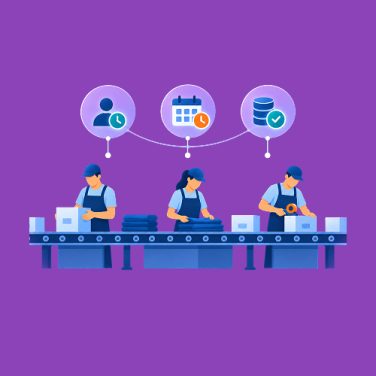

An attendance management system tracks employee work hours, absences, and leave across manual, biometric, and cloud platforms.
Historically, businesses used punch cards and spreadsheets. Cloud-based and AI-enabled solutions now offer automated validations, geofencing, and anomaly detection to ensure accuracy and compliance. Modern systems integrate with payroll, HRIS, and ERP, providing a single source of truth for workforce data.
This guide covers definitions, system types, key features, integration best practices, and implementation guidelines. It also highlights advanced functionalities such as geofencing and predictive analytics, delivered via MiHCM’s unified platform, which integrates attendance, payroll, leave, and AI-driven insights.
What is an attendance management system?
An attendance management system centralises the capture, validation, and reporting of employee time and presence. Unlike basic time tracking, it includes:
- Data capture: fingerprint scanners, facial recognition, mobile apps, desktop clocks.
- Processing rules: overtime thresholds, shift differentials, leave accrual.
- Reporting: real-time dashboards, exportable timesheets, audit trails.
Why is attendance management important for businesses?
Effective attendance management drives business performance by:
- Ensuring payroll accuracy and reducing errors by up to 25% through automated time capture.
- Maintaining compliance with labour laws, simplifying audits via audit-ready records and automated alerts.
- Providing workforce insights: absenteeism patterns, overtime spikes, productivity metrics.
- Improving morale: transparent attendance policies and self-service leave requests foster equity.
By capturing precise attendance data, organisations optimise staffing, control labour costs, and enhance employee satisfaction, supporting strategic workforce planning and operational efficiency.
Types of attendance management systems
| System Type | အဓိကအင်္ဂါရပ်များ | အားသာချက်များ | က, ခ, ဂ, ဃ, င |
|---|---|---|---|
| Manual/Spreadsheet | Excel timesheets, manual entry | Low cost, easy setup | Prone to errors, no real-time data |
| Biometric | Fingerprint, facial recognition | High accuracy, prevents buddy punching | Privacy concerns, hardware cost |
| Cloud/Mobile | GPS, geofencing, offline mode | Remote work support, real-time visibility | Requires internet, subscription fees |
| Integrated HRIS | Native payroll & leave integration | Streamlined workflows, single source data | Vendor lock-in, higher investment |
Choose systems based on workforce size, remote needs, and integration requirements. Standalone solutions suit small teams, while integrated HRIS modules scale for enterprise environments.
Key features of attendance management systems
- Real-time clock-in/out with GPS-enabled check-in/out
- Shift scheduling, overtime rules, and flexible adjustments
- Employee Self-Service for timesheets and leave applications
- Automated leave management and approval workflows
- Analytics dashboard: trends, absenteeism prediction, reporting
These features reduce payroll errors by up to 25%, empower employees, and provide actionable insights into workforce patterns.
Integration with payroll and HRIS
Native integration with payroll ensures seamless data flow: clock-in/out records feed automatically into timesheet calculations and payslip generation. HRIS integration centralises employee records, leave balances, and performance data. Key integration options include:
- APIs: real-time bi-directional data exchange.
- Middleware: batch uploads, transformation rules.
- Pre-built connectors: plug-and-play modules for major HRIS and ERP platforms.
A unified platform like MiHCM captures location-verified time logs, applies shift and overtime rules, and populates payroll and HRIS modules, reducing data redundancy and manual reconciliation.
Best practices for implementing an attendance management system
- Stakeholder alignment: Engage HR, payroll, IT, and operations to define requirements.
- ပြောင်းလဲမှု စီမံခန့်ခွဲမှု: Communicate benefits, deliver role-based training, and use a phased rollout.
- ဒေတာ ပြောင်းရွှေ့ခြင်း Validate legacy records before import; reconcile discrepancies.
- Policy review: Update attendance, leave, and compliance regulations to reflect new workflows.
- Ongoing governance: Establish monitoring, conduct regular audits, and refine rules based on analytics.
Adhering to these practices reduces implementation risk, drives user adoption, and maximises ROI from your attendance management investment.
Advanced functionalities: Biometrics, GPS, and AI-driven analytics
Next-gen attendance systems leverage advanced technologies:
- Biometric multi-modal authentication: Combine fingerprint, facial, and voice recognition to prevent fraud.
- Geofencing and geotagging: Define work zones; enforce location-based clock-ins for mobile teams.
- AI-driven anomaly detection: Identify absenteeism trends, unauthorised overtime, and burnout indicators before they escalate.
Supporting remote and hybrid workforces
- Mobile app: Offline clock-in/out, instant sync when online, GPS verification.
- ဒေတာလုံခြုံရေး: End-to-end encryption, GDPR-compliant storage, role-based access controls.
- Flexible scheduling: Shift swaps, flexible hours, automated reminders via push notification.
- User experience: Intuitive UI, quick check-ins, and real-time status dashboards.
By supporting remote and hybrid teams, modern attendance management software ensures accurate time capture, transparent policies, and seamless integration with payroll and HRIS.
မကြာခဏမေးလေ့ရှိသောမေးခွန်းများ
What is an attendance management system?
How do biometric and GPS features improve accuracy?
Can attendance software handle multiple time zones?
How does integration with payroll ensure compliance?
What pricing models are available?
Subscription, per-employee, and enterprise licenses with modular feature tiers.