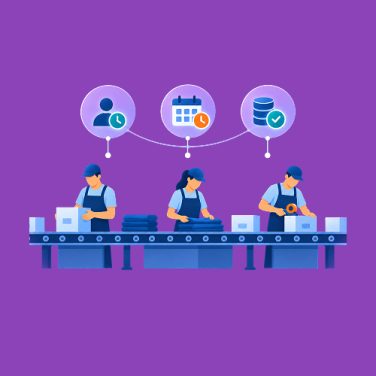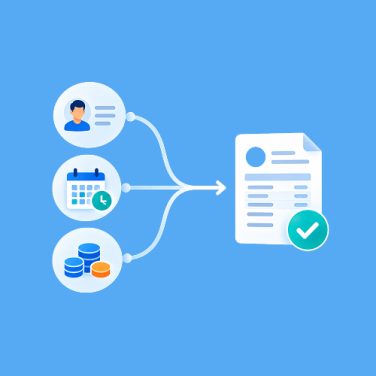
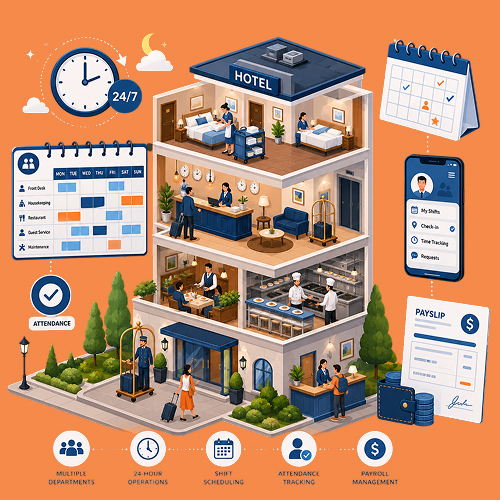
Hospitality is a 24-hour industry. Hotels do not close at 5 p.m. Restaurants do not operate on a single shift. Event venues do not run to predictable staffing levels. The workforce is inherently variable – across shifts, departments, locations, and seasons – and the payroll that flows from it is one of the most complex in any industry.
For HR and operations leaders in hotels, resorts, restaurants, and food and beverage chains, managing this complexity without the right systems means constant manual effort, regular payroll errors, and persistent compliance risk. This guide explains what makes hospitality payroll distinctly challenging – and what a modern HR platform must provide to manage it well.
The structural complexity of hospitality payroll
Rotating shifts across departments
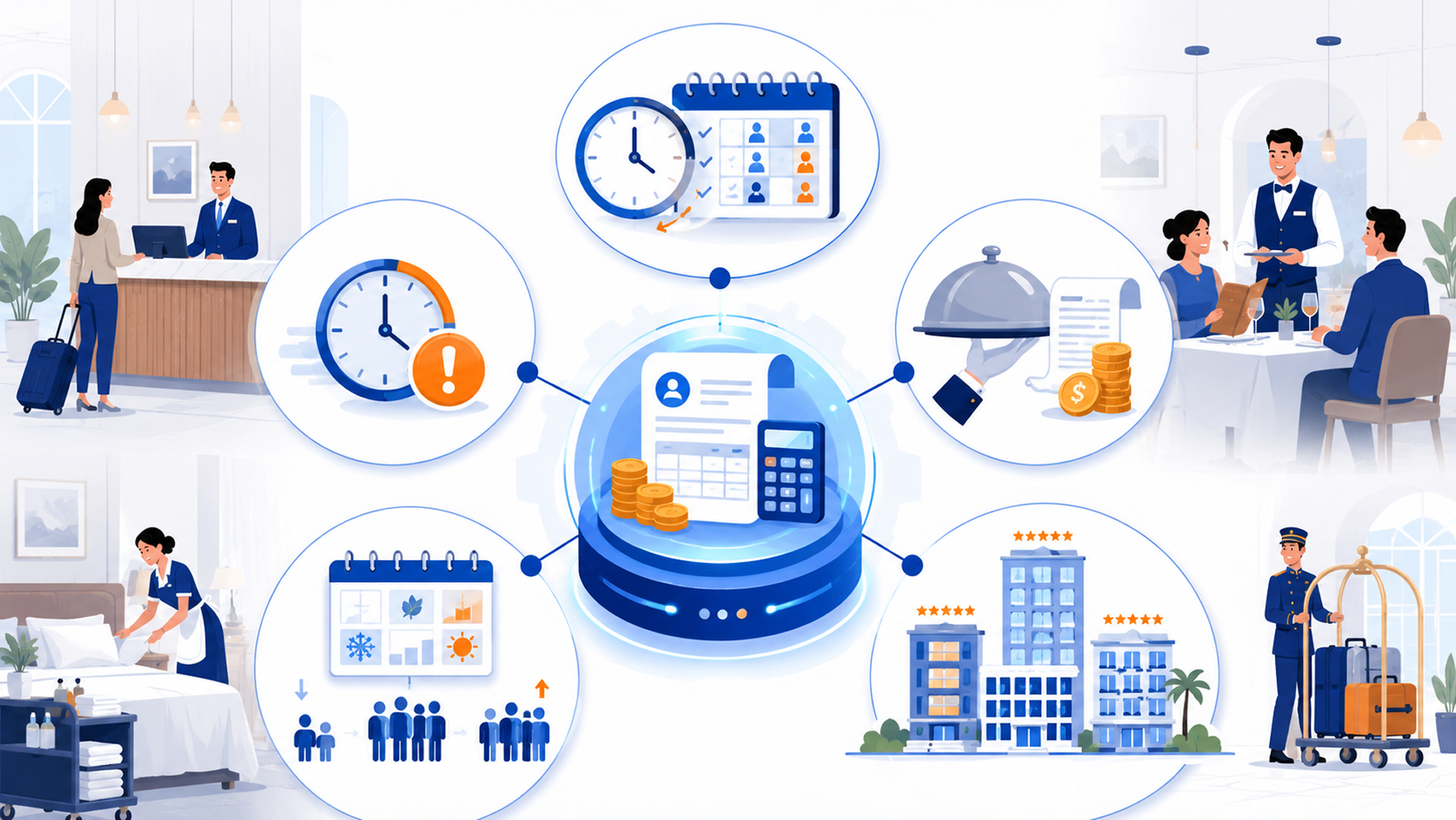
Hospitality businesses operate continuous service across multiple departments – front office, housekeeping, food and beverage, kitchen, maintenance, security, and spa, among others. Each department runs on its own shift pattern. Shift types typically include day, afternoon, and night rotations, with different pay rates applying to each. Weekend and public holiday work typically attracts a premium rate.
When an employee works across multiple departments in a single pay period – covering a housekeeping shift and a food and beverage shift, for example – payroll must accurately record the hours worked in each role and apply the correct rate for each. Doing this manually, at scale, across a property with hundreds of employees, is both time-consuming and error-prone.
Overtime: triggers, rates, and compliance
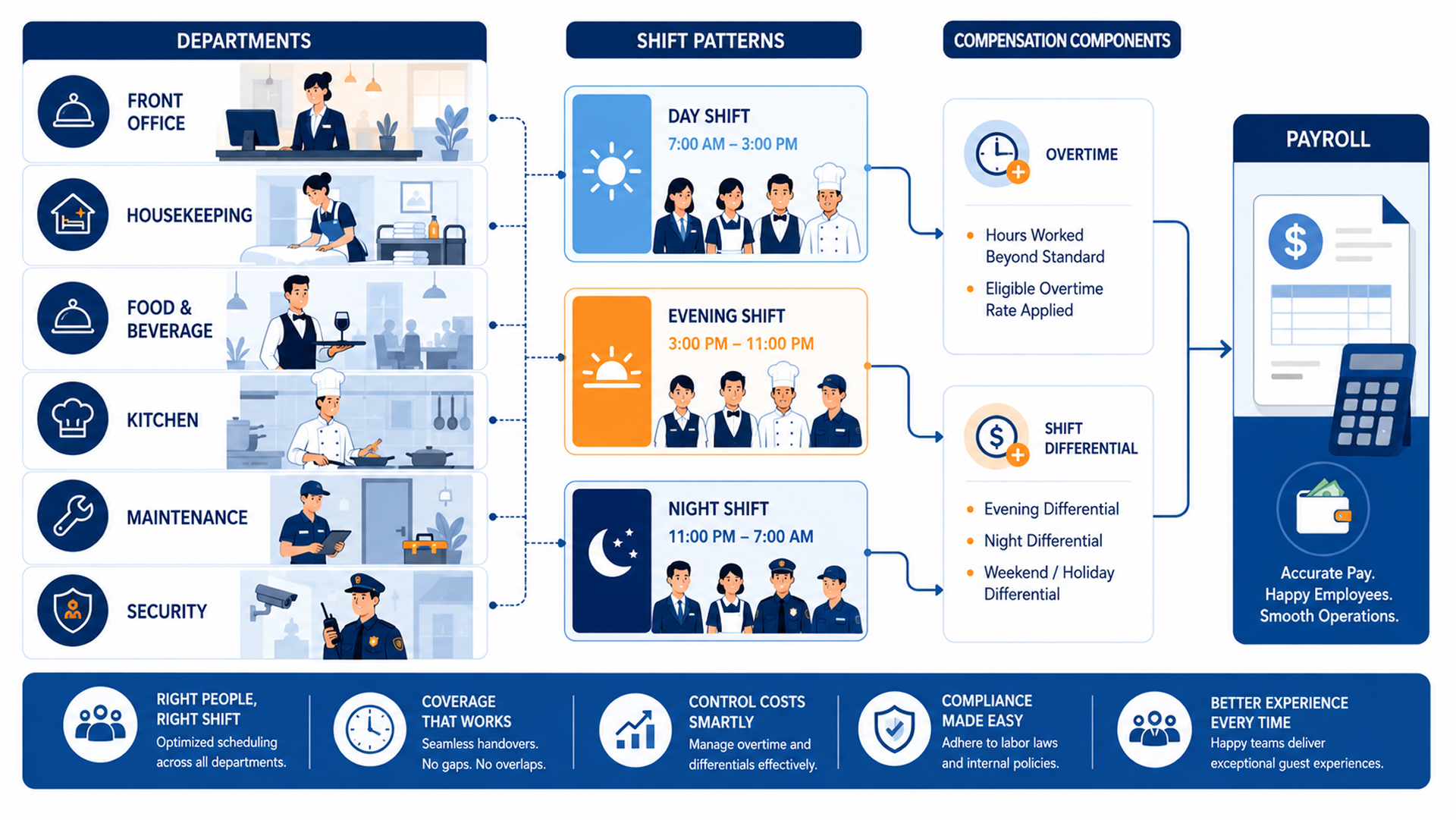
Overtime in hospitality is not exceptional; it is structural. Weekends, public holidays, special events, banquets, conferences, and peak check-in or dining periods regularly push staffing beyond standard hours. Each of these triggers overtime obligations that vary by jurisdiction and employment classification.
Overtime calculations in hospitality are complicated further when employees work in different roles or at different pay rates within the same pay period. An integrated system that links shift schedules directly to payroll – and automatically applies the correct overtime rates based on actual hours and role – is essential for accuracy and compliance.
Service charges and tip distribution
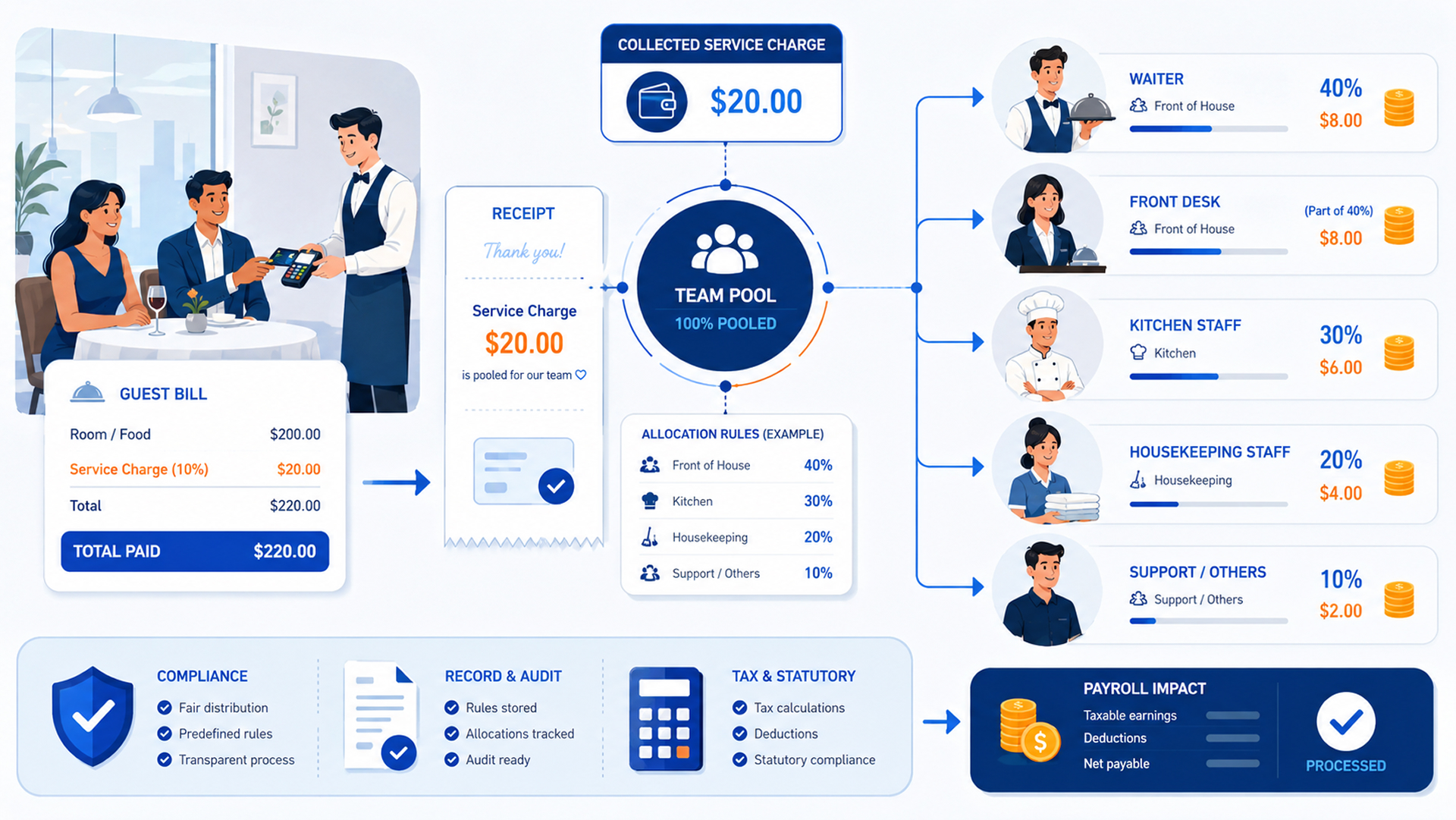
In many hospitality markets, service charges collected from guests are distributed to staff according to predefined rules – either as a direct addition to wages or pooled and shared across a team or department. The mechanics of service charge allocation vary by property and by market.
Regardless of the allocation model, payroll must handle service charges accurately: tracking the amounts collected, applying the distribution rules, processing the resulting additions to individual pay, and ensuring the correct tax treatment is applied. Manual calculation of service charge distribution across large teams is a significant administrative burden.
Seasonal workforce fluctuations
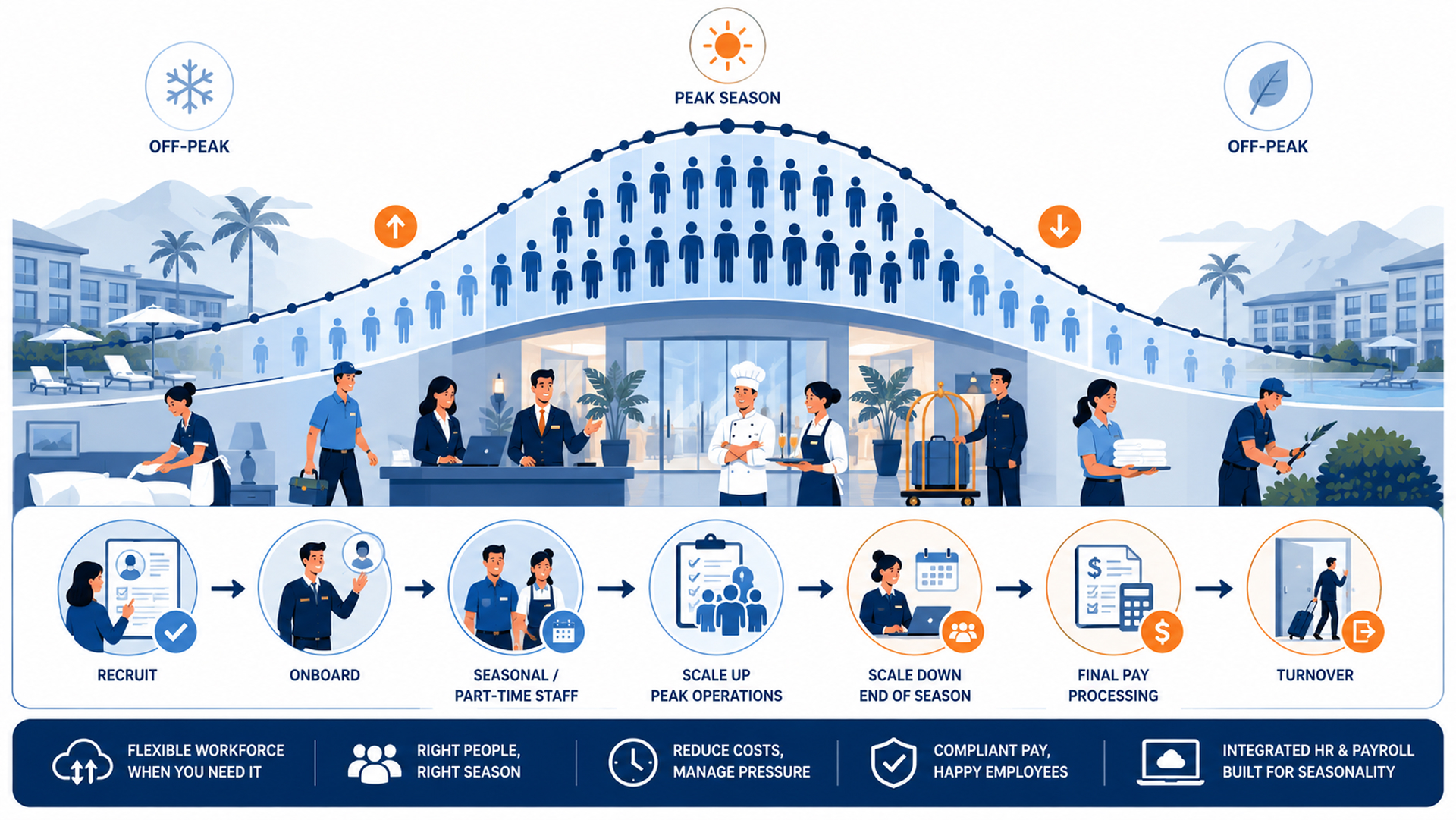
Resort and seasonal hospitality operations face a recurring challenge: staffing levels that vary significantly between peak and off-peak periods. Managing a surge in headcount during peak season – hiring large numbers of seasonal or part-time workers quickly, onboarding them, and ensuring they are paid accurately from their first shift – requires processes and systems that can scale rapidly.
High workforce turnover, which is a persistent characteristic of the hospitality sector, compounds this. Frequent onboarding and offboarding creates ongoing payroll administration workload and increases the risk of errors in final pay calculations.
Multi-outlet and multi-property operations
For hospitality groups operating multiple properties or outlets – whether a hotel chain, a restaurant group, or a resort with multiple food and beverage venues – payroll must function consistently across all entities while remaining configurable for any differences in local pay structures, roles, or statutory requirements.
Centralised reporting that gives management a consolidated view of labour costs, shift coverage, and overtime trends across the group is a critical capability for controlling costs at scale.
What your HR and payroll system must handle
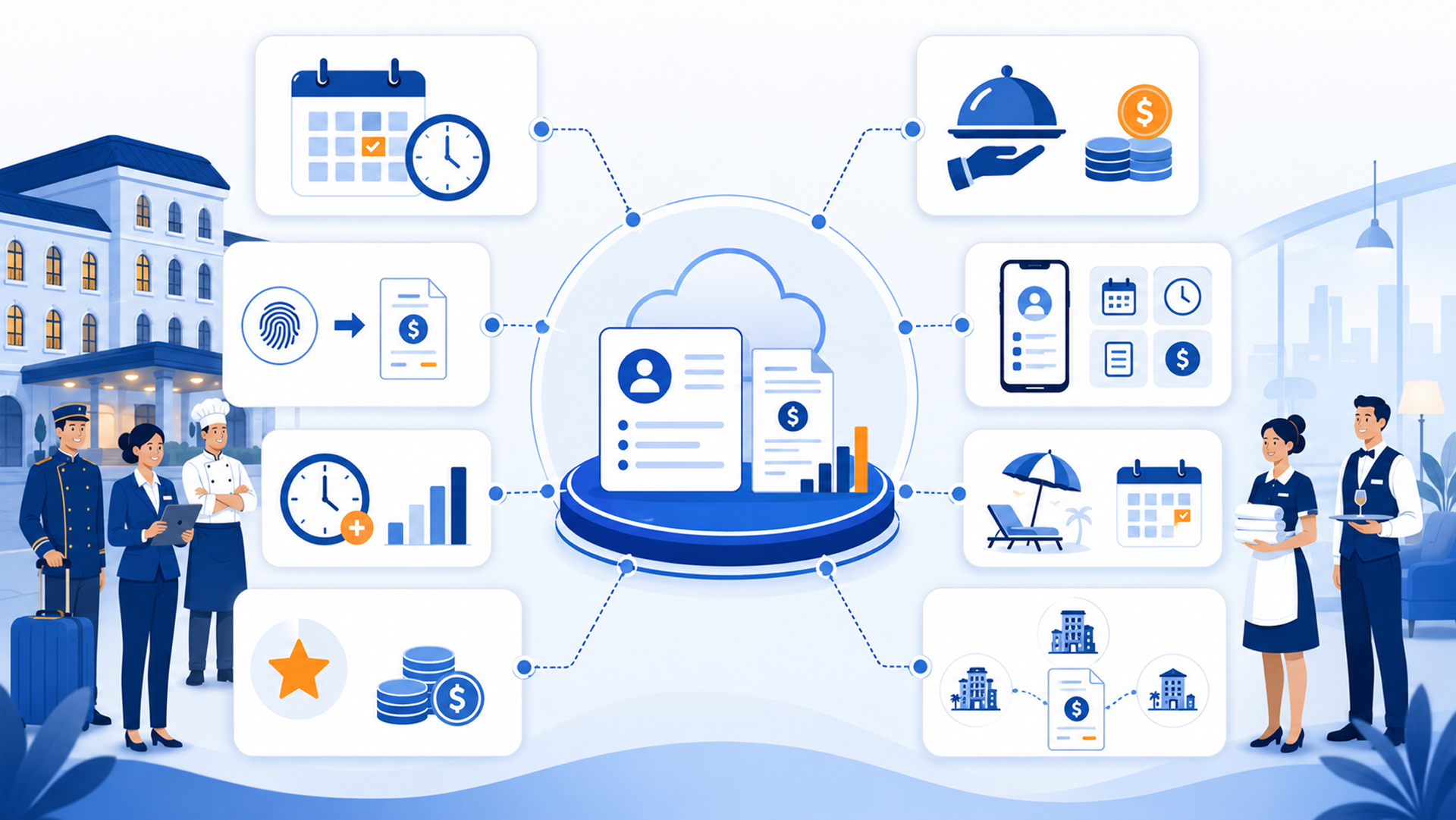
For hospitality operators, a basic payroll system is insufficient. The following capabilities are the baseline requirement for managing payroll complexity in a multi-shift, multi-department hospitality environment.
Automated shift scheduling with conflict detection. The system must support creation and management of rotating schedules across departments, flag scheduling conflicts before they occur, and allow supervisors to manage last-minute changes – including shift swaps – without creating payroll errors.
Direct attendance-to-payroll integration. Attendance data from clock-in systems – whether biometric, mobile GPS, or other methods – must flow directly into payroll calculations. Manual re-entry of attendance data is the single largest source of payroll errors in hospitality operations.
Shift differential and premium pay automation. Night shift rates, weekend premiums, public holiday pay, and role-based differentials must be applied automatically based on the shift type recorded, without manual intervention per pay cycle.
Overtime calculation and compliance enforcement. The system must calculate overtime automatically based on actual hours worked, apply the correct statutory multiplier, and alert managers when employees approach daily or weekly overtime thresholds.
Service charge processing. The platform should support configuration of service charge distribution rules and automate the calculation and payment of service charge allocations within the payroll run.
Mobile self-service for a shift-based workforce. In an environment where most employees are not at a desk, mobile access to schedules, payslips, shift swap requests, and leave applications is not optional. It is the only practical way for employees to manage their HR needs.
Leave and absence management integrated with scheduling. Leave approvals must automatically update the scheduling view, and last-minute absences must trigger alerts and enable rapid cover management – all without creating gaps in the payroll record.
Multi-entity payroll for groups. For hospitality groups, the system must run simultaneous payroll across multiple properties or entities, with consolidated group-level reporting and the ability to apply different rules per entity.
MiHCM for hospitality operators
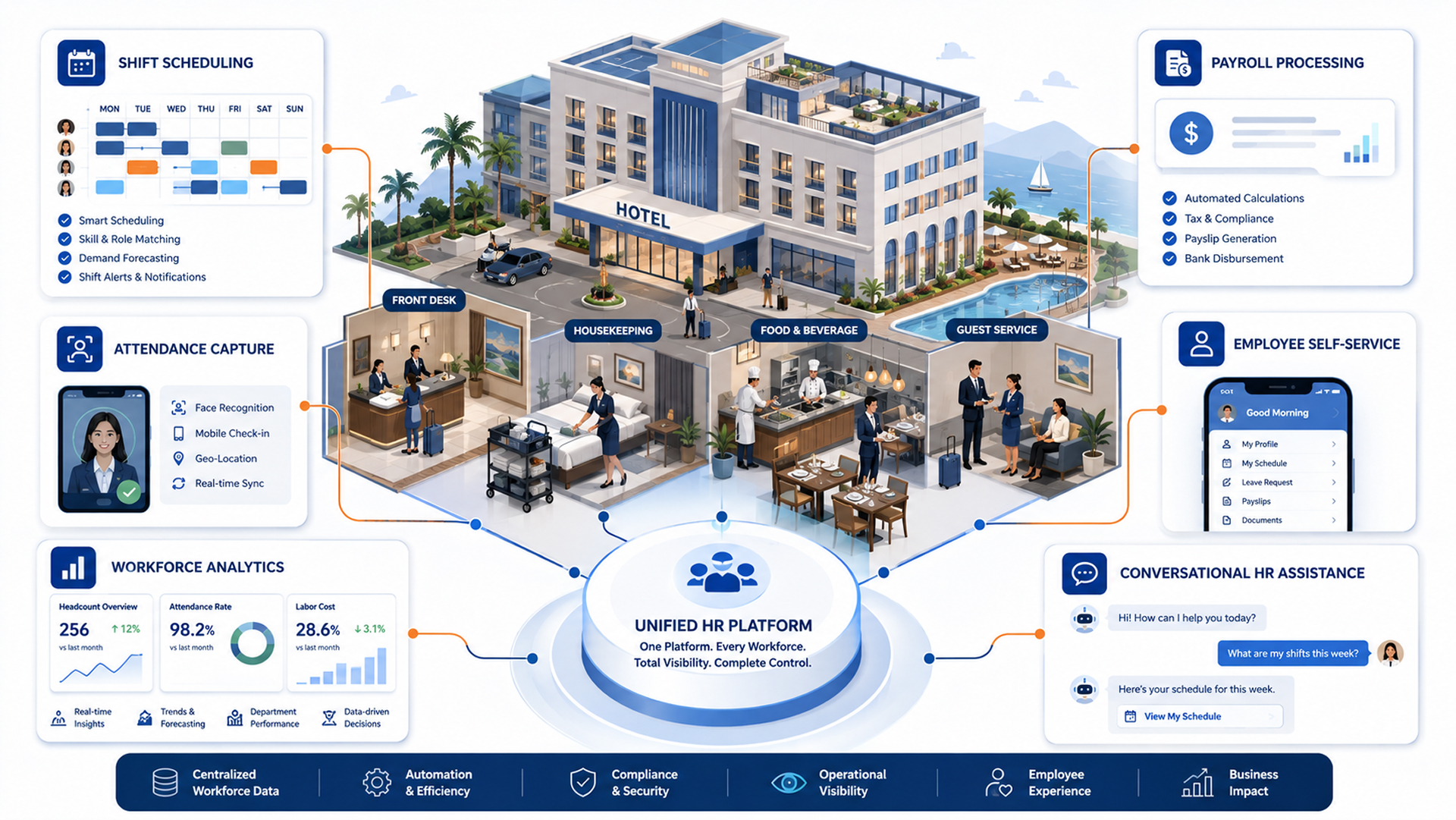
MiHCM Enterprise provides the full range of capabilities required to manage shift-based, multi-department hospitality workforces – from schedule creation through attendance capture to payroll processing and analytics.
Key capabilities include:
- Time and Attendance with flexible shift scheduling, automated shift differential rules, and overtime calculation built into the payroll engine
- Biometric, RFID, facial recognition, and GPS-based mobile clock-in – capturing accurate attendance data from the point of entry, eliminating manual timesheet errors
- MiHCM Payroll with customisable payment schedules, flexible salary formulas, and multi-currency support for hospitality groups operating across markets
- Employee self-service via the MiHCM mobile app – enabling shift swap requests, leave applications, and payslip access from any device
- MiHCM Lite for smaller hospitality properties requiring a streamlined HR and payroll platform without the complexity of a full enterprise deployment
- MiHCM Analytics with custom dashboards for labour cost visibility, shift coverage analysis, and overtime trend monitoring
- MiA ONE, MiHCM’s personal AI agent, enabling employees to access schedules, submit requests, and get HR answers through a conversational interface
MiHCM’s shift management and payroll capabilities are available across its supported markets in Asia, including Malaysia, Thailand, Singapore, Cambodia, and Sri Lanka. Visit mihcm.com/solutions/time-and-attendance/to learn more.
The bottom line
Hospitality payroll is not a standard problem. Its complexity – variable shifts, overtime rules, service charge distributions, seasonal fluctuations, and multi-outlet operations – requires a platform specifically designed to handle it. Operators that manage this complexity well do not just reduce payroll errors. They gain the real-time labour cost visibility that allows them to staff intelligently, control overtime spend, and run a more profitable operation.
To find out how MiHCM supports hospitality operators, visit mihcm.com or book a demo.