

For decades, EPF contributions for foreign workers in Malaysia were voluntary. That ended with the October 2025 wage cycle. Mandatory contributions now extend to all non-Malaysian citizen employees holding a valid pass, excluding domestic servants, and both employer and employee contribute 2% of monthly wages.1
For payroll teams, this is not a rate change. It is a new population, a new schedule, a new set of registration dependencies, and a new class of exceptions that has to be tracked every month against immigration records.
Organisations running large non-citizen headcounts in manufacturing, plantations, construction, logistics, and hospitality have felt it most, but the obligation applies to a company hiring a single Employment Pass holder just as firmly.
This article sets out what the rules actually say, where payroll teams are most likely to get caught out, and what a payroll system needs to do to keep the process clean.
What changed, and from when
The expansion was announced in Budget 2025 and given effect through an amendment to the Employees Provident Fund Act 1991. It took effect from wages for October 2025, which corresponds to the contribution month of November 2025. The first payment was due no later than 15 November 2025.1,2
The distinction between wage month and contribution month matters more than it looks. It is the single most common source of misalignment when teams reconcile payroll registers against EPF submission records, because the two systems are labelling the same money differently.
The wage month is the month the salary relates to. The contribution month is the month the payment is made. October wages are paid under the November contribution month, due by 15 November.
Who is in scope and who is excluded?
Mandatory contribution applies where all of the following are true:1
- The employer is registered or incorporated in Malaysia.
- The employee holds a valid passport and a valid work pass.
- The individual is employed under a contract of service or apprenticeship.
- Wages are paid in the form of money.
- The employee has not yet reached 75 years of age.
The minimum contributing age is 14 and the maximum is 75.1 Short-term contracts of under three months, part-time engagements and casual employment are all in scope — if the person is legally employed in Malaysia and receives wages, the obligation applies.1
The following pass types attract mandatory contribution:1
- Visitor’s Pass (foreign workers, excluding foreign domestic helpers)
- Employment Pass
- Professional Visitor Pass
- Student Pass
- Residence Pass
- Long-Term Social Visit Pass
Work permission for the Professional Visitor Pass (Specialised) and the Student Pass must be obtained in advance from the Immigration Department of Malaysia.1
Exclusions are as follows:
- Domestic servants. Excluded from mandatory contribution, though the employer and employee may elect to contribute voluntarily. The definition follows Section 3 of the Workmen’s Compensation Act 1952 and covers maids, cooks, gardeners, cleaners, babysitters, and drivers, among others.1
- Malaysian Permanent Residents. Not part of the 2% regime. PRs already contribute at the same rates as Malaysian citizens.1
- Employees of embassies, high commissions, consulates and foreign governments. Under the Second Schedule of the EPF Act 1991, these bodies are not classified as employers unless gazetted by the Minister, so neither citizen nor non-citizen employees contribute.1
- Non-citizens aged over 75. Not required to register or contribute.1
Contribution treatment: three categories, not one

The most frequent configuration error is treating every non-Malaysian employee as a flat 2% case. The rules distinguish three categories, and two of them sit outside the new rate entirely.
Category | Below 60 years | Aged 60 and above |
Non-citizens who are Malaysian permanent residents | Status quo — employer 13% or 12%, employee 11% | Status quo — employer 6.5% or 6%, employee 5.5% |
Non-citizens who became EPF members before 1 August 1998 | Status quo — employer 13% or 12%, employee 11% | Status quo — employer 6.5% or 6%, employee 5.5% |
Non-citizens who became EPF members on or after 1 August 1998 | Employer 2%, employee 2% | Employer 2%, employee 2% |
Source: EPF employer guidance on contributions for non-Malaysian citizen employees.
The 1 August 1998 membership date is a genuine data problem. It cannot be derived from a passport, a pass type, or a hire date. It has to be captured from the employee’s EPF membership record and held as a payroll attribute, because it determines whether that person sits at 2% or at 11%. Long-tenured foreign employees who opted into EPF voluntarily years ago are precisely the population most likely to be misclassified.
Employees who had voluntarily opted in before 1 October 2025 do not need to re-register and keep their existing member number, but employers must contribute at 2% for them from the October 2025 salary cycle unless the employee has formally elected to maintain a higher rate.1 That election is made using Form KWSP 17A (AHL) or KWSP 18A (AHL), submitted to the employer, who then enters the application through i-Akaun (Employer). The employer retains the form; it is not submitted to EPF.1
Calculation and rounding
Contributions for non-citizen employees are calculated under the Third Schedule, Part F, introduced specifically for this group. It uses a direct calculation method at a fixed 2% employer share and 2% employee share, rather than the wage-band tables that apply to citizens.1
Any amount with cents is rounded up to the next whole ringgit, and contributions are paid in ringgit denominations only.1 EPF’s worked example: monthly wages of RM1,751 give RM1,751 × 2% = RM35.02, rounded up to RM36 for each of the employer and employee shares, a total of RM72.1
Rounding up rather than to nearest is a small rule with a wide blast radius. A payroll engine that applies standard commercial rounding will under-remit on a large share of the population, and under-payment is treated as late payment.
One further point that is easy to miss: for EPF purposes, the contribution for non-citizen employees (excluding domestic helpers) must be calculated on at least the minimum wage rate prescribed under the prevailing Minimum Wages Order.1
Registration: mostly automatic, but not entirely
Employers already registered with EPF do not need a new employer number. The existing one covers both citizen and non-citizen employees.1
For member registration, EPF introduced Direct Registration, which verifies identity through database integration with the Immigration Department of Malaysia using passport and valid work pass information. This applies to holders of the Visitor’s Pass – Temporary Employment (PLKS) and the Employment Pass, and happens without the employee attending an EPF office.1 Employers receive a physical notice of the registration outcome at the address registered with the Immigration Department.1
Two outcomes require follow-up:
- Registration successful. The employee should visit any EPF office to update personal information and complete thumbprint verification. No appointment is needed.1
- Registration unsuccessful. The employee must attend an EPF office to complete member registration.1
Holders of other pass types register through i-Akaun (Employer), a Self-Service Terminal or an EPF office. Employers can verify registration status through i-Akaun (Employer).1 An expired work permit is not accepted as a supporting document.1
Registration status is a payroll dependency, not an HR administrative detail. Contributions cannot be submitted accurately without a confirmed EPF membership number, and EPF has asked employers to submit complete worker details — names, passport numbers and membership numbers — to prevent contribution errors.
Passport changes: For PLKS and Employment Pass holders, new passport details are updated automatically from Immigration Department records. For other pass types, the employee must update details at an EPF office. Employers must use the latest passport number in all payroll records and contribution payments.1 A passport renewal that is not reflected in the payroll master file will surface as a submission mismatch, not as a warning.
Exception tracking: when the obligation stops
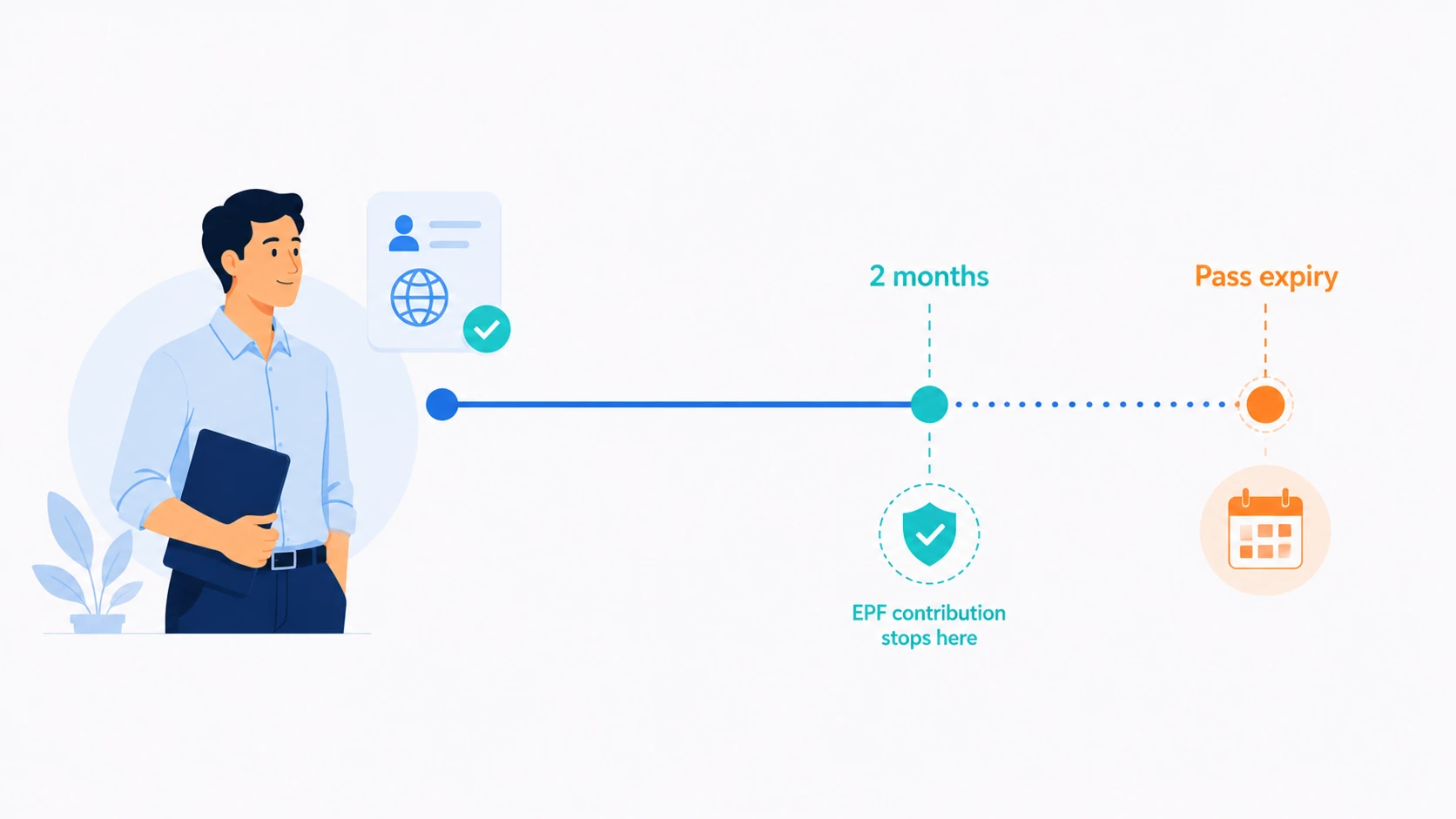
This is the part that creates the most sustained operational load, because it runs on the immigration calendar rather than the payroll calendar.
The mandatory contribution obligation ceases in any of the following circumstances:1
Trigger | Effect on contribution |
Death of the employee | Obligation ceases in the month of death |
Employee reaches age 75 | Obligation ceases |
Work pass expiring with no extension | Obligation ceases two months before expiry |
Extended work pass expiring | Obligation ceases two months before expiry of the extended pass |
Source: EPF employer guidance on contributions for non-Malaysian citizen employees.
The two-month rule is the awkward one. It requires payroll to stop contributing for an active, working, wage-earning employee two months ahead of a date held in an immigration record. Nothing in the payroll cycle itself signals it. If pass expiry dates are not held as structured payroll data with an automated look-ahead, the only defence is a manual spreadsheet — and manual spreadsheets fail quietly at scale.
The same rule works in the employee’s favour: a Leaving Country Withdrawal can be applied for within two months before work permit expiry, so the cessation window and the withdrawal window align.
Resignations, transfers and absconding: Where a non-citizen employee resigns, absconds or transfers to another employer, the employer must notify the Immigration Department of Malaysia immediately for direction on the work pass, and must ensure EPF contributions are paid up to the last month the employee was in service.1 Absconding cases are the hardest to handle cleanly, because the payroll record and the immigration record stop agreeing at the point the employee disappears.
The monthly deadline and the cost of missing it

Contributions for a given wage month are due on or before the 15th of the following month.1 The employer pays both shares and may deduct the employee’s share from wages.1 Payment channels are i-Akaun (Employer), internet banking, bank agent counters and EPF offices, with EPF offices accepting outstanding contributions only.1
Late payment attracts a Late Payment Charge, imposed where payment for a month is made after the 15th. Where payment slips into the month after the contribution month, a Dividend charge is imposed as well. Both overdue contributions and underpaid contributions count as late payment.3 The EPF Act 1991 also provides for prosecution of employers who fail to register employees or fail to pay contributions on time.3
Under-payment is treated the same as non-payment. A rounding rule applied incorrectly across a few hundred non-citizen employees is a compliance exposure, not a rounding difference.
What this asks of a payroll system

EPF has been explicit that payroll systems must be updated to record non-Malaysian citizen employee information and to calculate contributions at the required rates.1 In practice, that means a system has to handle the following without manual intervention:
- A distinct non-citizen contribution group, calculated under Third Schedule Part F, running alongside the citizen wage-band schedules in the same pay run.
- Category-level differentiation between PRs, pre-1998 members and post-1998 members, so the 2% rate is not applied indiscriminately.
- Round-up-to-next-ringgit logic applied at the individual contribution line, not at the total.
- A minimum wage floor check for contribution calculation purposes.
- Structured storage of passport number, pass type, pass expiry date, extension status and EPF membership number as payroll-relevant fields.
- An automated look-ahead that flags employees entering the two-month pre-expiry window and suspends contribution accordingly.
- Age-based cessation at 75, and correct handling of the month of death.
- Voluntary excess elections held at employee level for those who opted to remain at 11%.
- Submission files and reports that reconcile to i-Akaun (Employer) records by wage month and contribution month.
Every one of these is achievable with a spreadsheet and a diligent payroll officer. None of them is safely repeatable that way, month after month, across a workforce where pass dates move constantly.
How MiHCM Payroll handles it
MiHCM Payroll is built to run multiple statutory contribution groups within a single payroll cycle, which is what this change actually demands. Non-citizen employees are configured as their own contribution group with their own calculation basis and rounding rule, rather than being forced through the citizen schedule with manual adjustments layered on top.
That gives Malaysian payroll teams a few practical things:
- A separate non-citizen contribution group. The 2% employer and 2% employee treatment, with round-up-to-next-ringgit logic, applied automatically to the employees assigned to it — no post-run adjustment files.
- Category-aware configuration. Permanent residents and pre-1998 members remain on their existing rates while post-1998 members sit at 2%, all within the same pay run.
- Work pass data held where payroll can act on it. Passport number, pass type and expiry dates sit in the employee record, so the two-month cessation window can be surfaced ahead of the cycle rather than discovered after it.
- Exception visibility before submission. Employees approaching pass expiry, reaching age thresholds, or missing an EPF membership number are flagged as part of the pre-run review.
- Auditable output. Contribution registers that reconcile by wage month and contribution month, so payroll can evidence what was paid, for whom, and why someone was excluded.
The aim is straightforward: a payroll team should be able to onboard a non-citizen employee, have the correct statutory treatment applied on the first cycle, and have the system tell them when that treatment needs to stop.
A practical checklist
- Confirm every non-Malaysian employee has a verified EPF membership number recorded in payroll.
- Classify each one as PR, pre-1998 member or post-1998 member, and apply the correct rate.
- Capture pass type and pass expiry date as structured payroll fields, and set a two-month look-ahead alert.
- Verify that the payroll engine rounds contributions up to the next ringgit at line level.
- Check that contribution calculation respects the prevailing minimum wage floor.
- Record any KWSP 17A/18A (AHL) elections to contribute above the statutory rate, and retain the forms.
- Reconcile the monthly submission to i-Akaun (Employer) before the 15th, not after it.
- Establish a standing process for passport renewals to reach payroll, not just HR.
The rules themselves are not complicated. The difficulty is that they depend on data payroll has not traditionally owned, and they change on a calendar payroll does not traditionally watch. Getting the system right once is considerably cheaper than reconciling it every month.
Transparency and sources
All statutory figures, rates, dates and procedural requirements in this article are drawn from official Employees Provident Fund (EPF) guidance and announcements, referenced below. Statutory requirements are subject to revision. This article is provided for general information and does not constitute legal, tax or compliance advice. Employers should confirm their obligations with EPF or a qualified adviser before acting.
References
- Employees Provident Fund (EPF), “Contribution For Non-Malaysian Citizen Employees”, employer guidance and FAQ. https://www.kwsp.gov.my/en/employer/responsibilities/non-malaysian-citizen-employees
- Employees Provident Fund (EPF), “EPF Begins Mandatory Contributions For Non-Malaysian Citizen Employees Effective October 2025”, media release, 1 October 2025. https://www.kwsp.gov.my/en/w/news/epf-begins-mandatory-contributions-for-non-malaysian-citizen-employees-effective-october-2025
- Employees Provident Fund (EPF), “Employer Mandatory Contribution”, responsibilities and late payment guidance. https://www.kwsp.gov.my/en/employer/responsibilities/mandatory-contribution
- Employees Provident Fund (EPF), “EPF Ramps Up Readiness Measures for Expansion of Mandatory Contribution Coverage to Non-Malaysian Citizen Employees”, media release, 25 June 2025. https://www.kwsp.gov.my/en/w/news/epf-expands-mandatory-contribution-to-non-malaysians