The conversation in boardrooms has changed. Where workforce decisions were once guided by instinct, precedent, and periodic headcount reports, a new discipline is taking hold: workforce intelligence. It is the practice of gathering, analysing, and applying people data to drive decisions at the highest levels of an organisation.
This is not simply a technology story; it is a leadership story. The organisations getting ahead are those whose boards and C-suites have embraced the idea that their people data is as strategically valuable as their financial data — and have invested accordingly in the platforms, processes, and skills to act on it.
Why people data is now a board-level concern
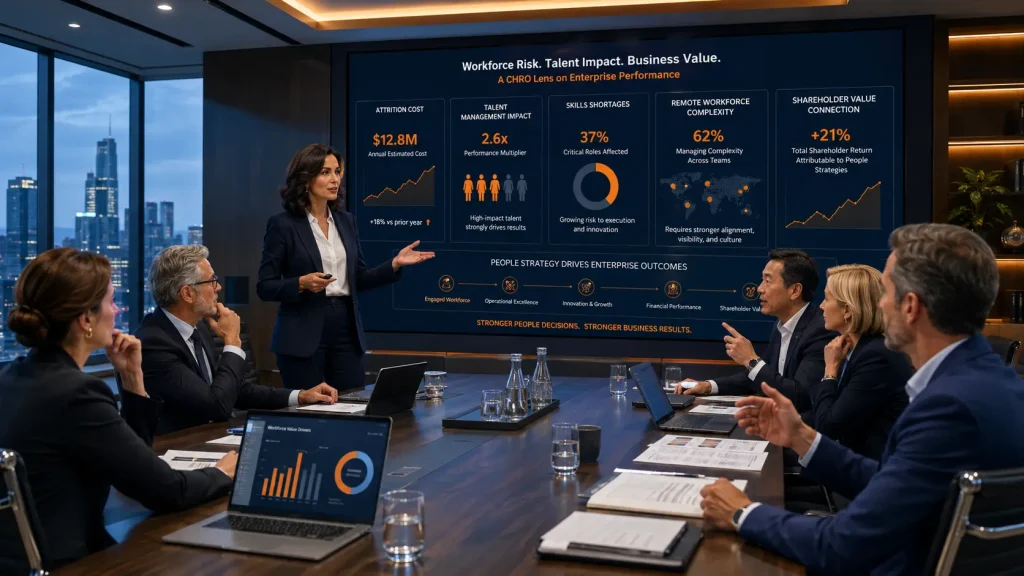
For most of the last century, workforce management was the domain of HR departments operating beneath the strategic tier of organisations. Hiring, training, and performance management were operational functions, not boardroom priorities.
That position is no longer tenable.
According to McKinsey & Company, organisations in the top quartile for talent management outperform their industry peers on total returns to shareholders by 22 percentage points.¹ The talent agenda, once considered a support function, is now a competitive differentiator that directly affects shareholder value.
Meanwhile, the consequences of poor workforce decisions have become increasingly visible and costly. The Society for Human Resource Management (SHRM) estimates that the average cost to replace an employee is approximately six to nine months of that employee’s salary.² At scale, retention failures translate into material financial risk — exactly the kind of risk that boards are expected to understand and mitigate.
Add to this the growing complexity of workforce composition — remote and hybrid teams, contingent workers, multi-generational workforces, skills shortages in key markets — and it becomes clear why workforce data has moved from the HR dashboard to the boardroom agenda.
From reporting to intelligence: understanding the shift
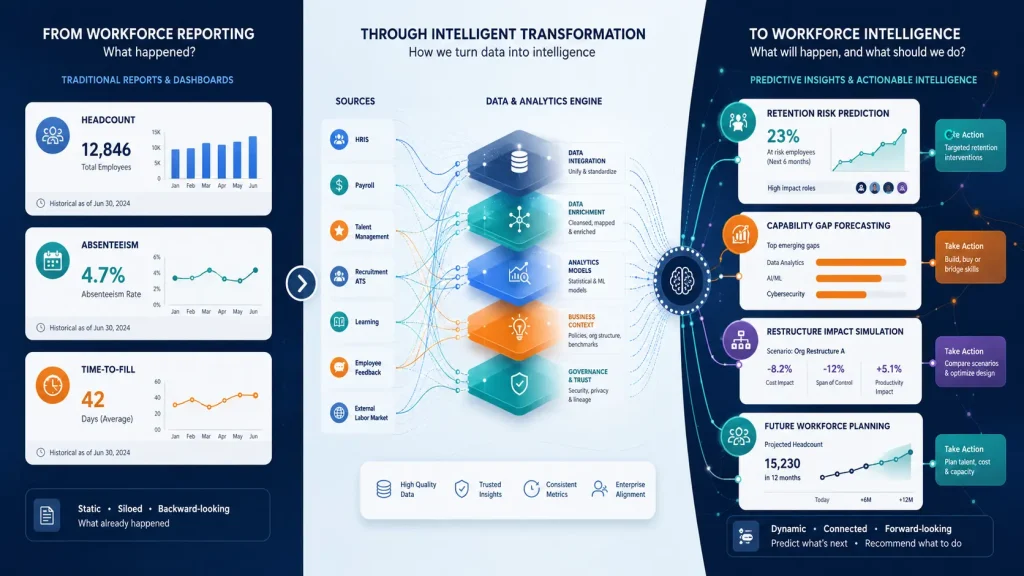
There is an important distinction between workforce reporting and workforce intelligence.
Workforce reporting tells you what happened: headcount by department, absenteeism rates, time-to-fill for open positions. These metrics are useful but backward-looking. They describe a situation after it has already occurred.
Workforce intelligence is forward-looking. It uses historical data, machine learning models, and predictive analytics to answer questions such as: Which employees are at risk of leaving in the next six months? Where are capability gaps likely to emerge as the business scales? How will a proposed restructure affect productivity and morale?
Gartner has noted that the use of people analytics to inform decisions has expanded significantly, with 77% of HR leaders reporting that people analytics has become more important to their organisation over the past three years.³
This shift from descriptive to predictive analysis is where HR technology platforms have become indispensable — not as administrative tools, but as strategic enablers.
The CHRO’s evolving role
One of the most significant structural changes in recent years has been the elevation of the Chief Human Resources Officer (CHRO) into the strategic core of the organisation.
The World Economic Forum’s Future of Jobs Report 2023 identified Human Resources as one of the fastest-growing functional roles in terms of strategic importance, driven largely by the complexity of managing talent in a period of rapid technological change.⁴
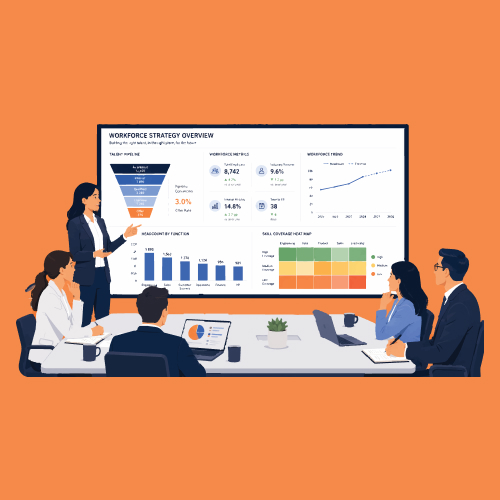
For CHROs to operate effectively at the board level, they need to be able to do something that has historically been difficult: translate people data into business outcomes. Rather than presenting HR metrics in isolation, the modern CHRO presents workforce intelligence in the language of the boardroom — risk, return, capability, and competitive advantage.
This requires technology platforms capable of aggregating, contextualising, and visualising people data in ways that are meaningful to non-HR leaders. It also requires HR leaders who can bridge the gap between data science and business strategy.
What workforce intelligence looks like in practice
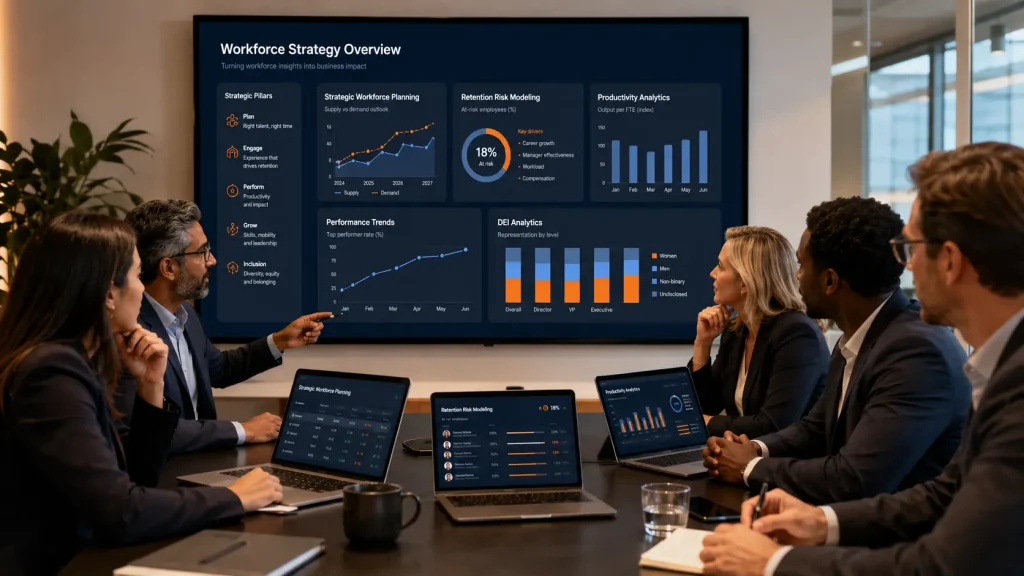
Workforce intelligence manifests in a range of practical applications across the business cycle:
Strategic Workforce Planning
Rather than hiring reactively to fill vacancies, organisations using workforce intelligence build dynamic models of their future capability requirements. These models integrate business growth projections, anticipated attrition, skills development timelines, and market availability of talent to produce a forward-looking view of workforce supply and demand.
This kind of planning allows boards and executive teams to make proactive decisions: whether to develop skills internally or acquire them externally, where to invest in talent infrastructure, and which markets offer the best labour pool for expansion.
Retention Risk Modelling
One of the most commercially valuable applications of people analytics is the identification of employees at risk of leaving before they hand in their notice.
By analysing patterns in engagement survey responses, performance data, leave records, internal mobility activity, and even tenure milestones, AI-powered HR platforms can assign flight risk scores to individuals and alert managers to act.
IBM’s Institute for Business Value has reported that organisations using AI-powered retention analytics can reduce voluntary attrition by up to 25%. In industries where specialist talent is expensive and scarce, this represents a substantial return on technology investment.
Productivity and Performance Analytics
Workforce intelligence platforms can surface patterns in how work gets done across teams and functions — identifying high-performing units, diagnosing underperformance, and connecting workforce behaviours to business outcomes such as customer satisfaction, revenue per employee, or project delivery rates.
This enables leaders to make evidence-based decisions about team structures, management approaches, and investment in learning and development.
Diversity, Equity, and Inclusion (DEI) Analytics
Boards are under increasing pressure from investors, regulators, and employees to demonstrate progress on workforce diversity and inclusion.
Workforce intelligence provides the data infrastructure to track representation across levels and functions, identify pay equity gaps, and measure the impact of DEI initiatives over time.
Without reliable data, DEI commitments remain aspirational. With it, they become accountable.
The role of AI in advancing workforce intelligence
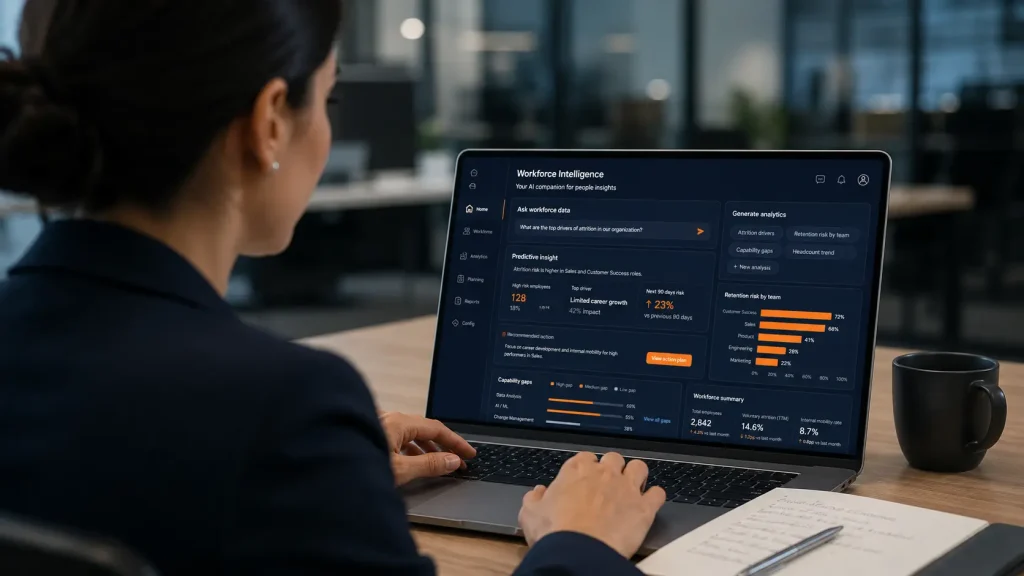
The emergence of artificial intelligence has transformed the ceiling of what workforce intelligence can deliver. Where earlier HR analytics relied on static reports and manually defined queries, AI-powered platforms can identify patterns in large and complex datasets that no human analyst would surface unaided.
Natural language processing allows platforms to analyse unstructured data — employee feedback, survey responses, exit interview transcripts — and extract sentiment and themes at scale. Predictive models improve over time as they are trained on richer historical data. And AI-generated recommendations allow HR leaders to move quickly from insight to action.
MiHCM’s Syntra is an example of this shift in practice.
Syntra enables HR leaders and managers to query workforce data using natural language, surface predictive insights, and take action – from raising HR tasks to generating analytics – without navigating complex report configurations. The goal is to reduce the time between data and decision.
Syntra unlocks the power of each client’s MiHCM private tenant data, combines it with the same organisation’s enterprise data lakes, business systems, and uploaded documents, and generates real-time insights and visualisations. Transforming raw data into interactive insights that guide decisions and reveal deeper workforce patterns and seamlessly blends private, structured, and unstructured data, it delivers contextual intelligence while keeping customer data completely secure and isolated.
As a Microsoft Data and AI Solutions Partner, MiHCM builds its AI capabilities on a trusted and enterprise-grade technology foundation, enabling organisations across Southeast Asia and beyond to deploy workforce intelligence at scale with appropriate data governance and security standards.
Data governance: the foundation of trustworthy intelligence
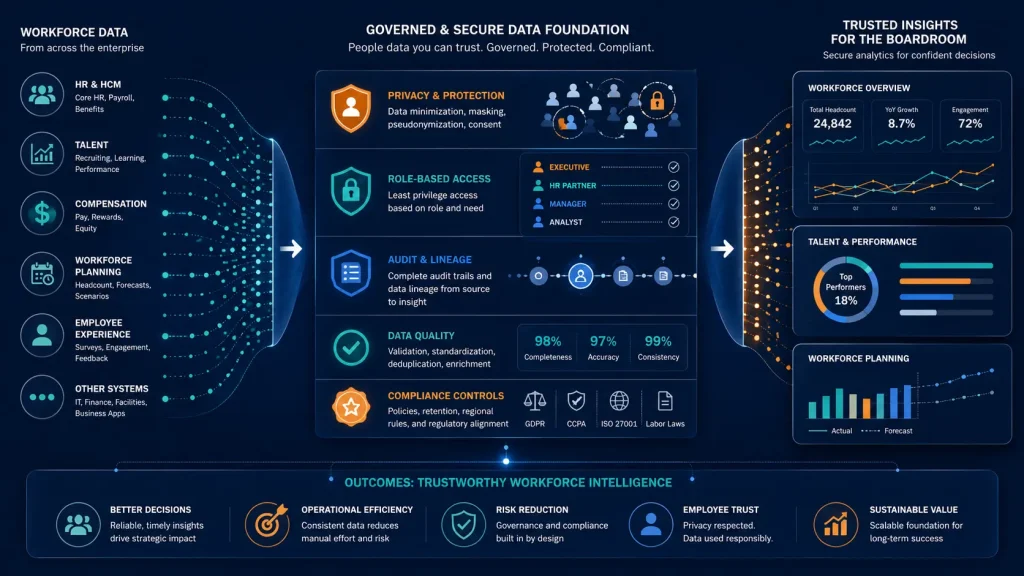
The value of workforce intelligence is directly dependent on the quality, accuracy, and governance of the underlying data. Boards and CHROs must ensure that the people data informing strategic decisions is not only current and complete, but managed in accordance with applicable data privacy regulations.
Across the Asia-Pacific region, this means navigating a complex patchwork of legislation: Malaysia’s Personal Data Protection Act, Thailand’s Personal Data Protection Act (PDPA), Sri Lanka’s Personal Data Protection Act (passed in 2022), and equivalent frameworks in other markets.
Organisations that invest in robust data governance frameworks — defining who can access workforce data, for what purpose, and under what controls — are better positioned to act on their intelligence with confidence, and to demonstrate compliance when scrutinised by regulators or board audit committees.
HR technology platforms that embed compliance controls, audit trails, and role-based data access into their architecture remove a significant barrier to broader adoption of workforce analytics at the strategic level.
Barriers to adoption — and how to overcome them
Despite the clear commercial case, many organisations have been slow to operationalise workforce intelligence at the board level. The barriers are well documented.
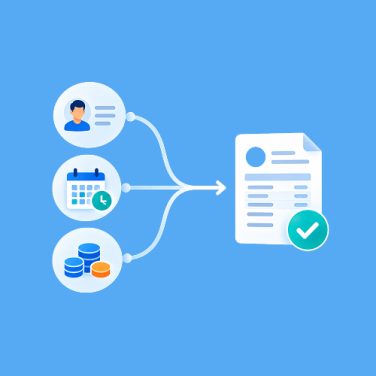
Fragmentasi data is one of the most common. When employee data lives across disconnected systems — a legacy payroll platform, a standalone learning management system, a spreadsheet-based performance process — it is almost impossible to build a coherent picture of the workforce. Integration becomes the first investment priority.
Capability gaps are another persistent challenge. Deloitte’s Global Human Capital Trends research has consistently highlighted that while most HR leaders recognise the importance of people analytics, fewer than half feel their organisations have the skills and tools to act on data effectively.⁶
Organisational culture also plays a role. In organisations where decisions have historically been made on experience and instinct, introducing data-driven frameworks can encounter resistance. The CHRO’s role in communicating the business case for workforce intelligence — and demonstrating early wins — is critical to building momentum.
Cloud-based HR platforms that reduce the technical overhead of analytics deployment, combined with intuitive dashboards designed for non-specialist users, have helped lower these barriers considerably. The democratisation of workforce data — making insights accessible not just to HR analysts but to line managers and business partners — is a key trend in enterprise HR technology.
Building the business case for the board
For HR leaders seeking to elevate workforce intelligence as a board priority, the business case must be constructed in the language of financial and strategic risk — not HR metrics.
Frame the conversation around three things:
Risk mitigation. Workforce risks — attrition spikes, skills gaps, regulatory non-compliance — are operational and financial risks. Boards have a governance duty to understand and manage them.
Competitive positioning. The quality of an organisation’s talent strategy is a material driver of long-term performance. Data-informed talent decisions compound over time.
Return on investment. Workforce intelligence platforms are not overhead — they generate measurable returns through reduced attrition costs, improved hiring quality, faster time-to-productivity for new employees, and better allocation of learning and development investment.
When HR leaders can present workforce intelligence in these terms, the case for investment becomes part of the broader strategic agenda — not a line item in the HR budget.
Kesimpulan
The gap between organisations that treat workforce data as a strategic asset and those that treat it as administrative output is widening. As competitive pressures intensify, skills markets tighten, and boards face growing accountability for workforce-related risks, the adoption of workforce intelligence is shifting from a differentiator to a baseline expectation.
The technology to support this shift exists. Platforms like MiHCM — built around AI, predictive analytics, and deep integration across the employee lifecycle — are enabling HR leaders across Southeast Asia and beyond to translate their people data into the strategic currency that boards understand.
The opportunity for CHROs is clear: step into the boardroom with data and redefine the role of HR in organisational strategy.
References
- McKinsey & Company. Winning the ‘20s: Talent and Leadership in the Next Decade. mckinsey.com
- Society for Human Resource Management (SHRM). The Real Costs of Recruitment. shrm.org
- Gartner. HR Leaders Survey: The State of People Analytics. gartner.com
- World Economic Forum. Future of Jobs Report 2023. weforum.org
- IBM Institute for Business Value. Rethinking the Talent Equation. ibm.com/thought-leadership/institute-business-value
- Deloitte. Global Human Capital Trends. deloitte.com/global/en/insights/focus/human-capital-trends.html