

For a regional HR leader, there is rarely such a thing as “Asian payroll”.
There is Singapore payroll. Malaysia payroll. Thailand payroll. Sri Lanka payroll. Bangladesh payroll. And every other jurisdiction in which the organisation employs people.
Each comes with its own tax rules, statutory contributions, employment requirements, reporting schedules, employee classifications, and regulatory authorities.
That distinction matters more than ever in 2026. Companies are increasingly operating across multiple Asian markets while HR teams are expected to provide employees with a consistent experience. But underneath that experience sits a regulatory environment that remains profoundly local.
How do you operate regionally while remaining compliant locally?
The compliance landscape keeps moving
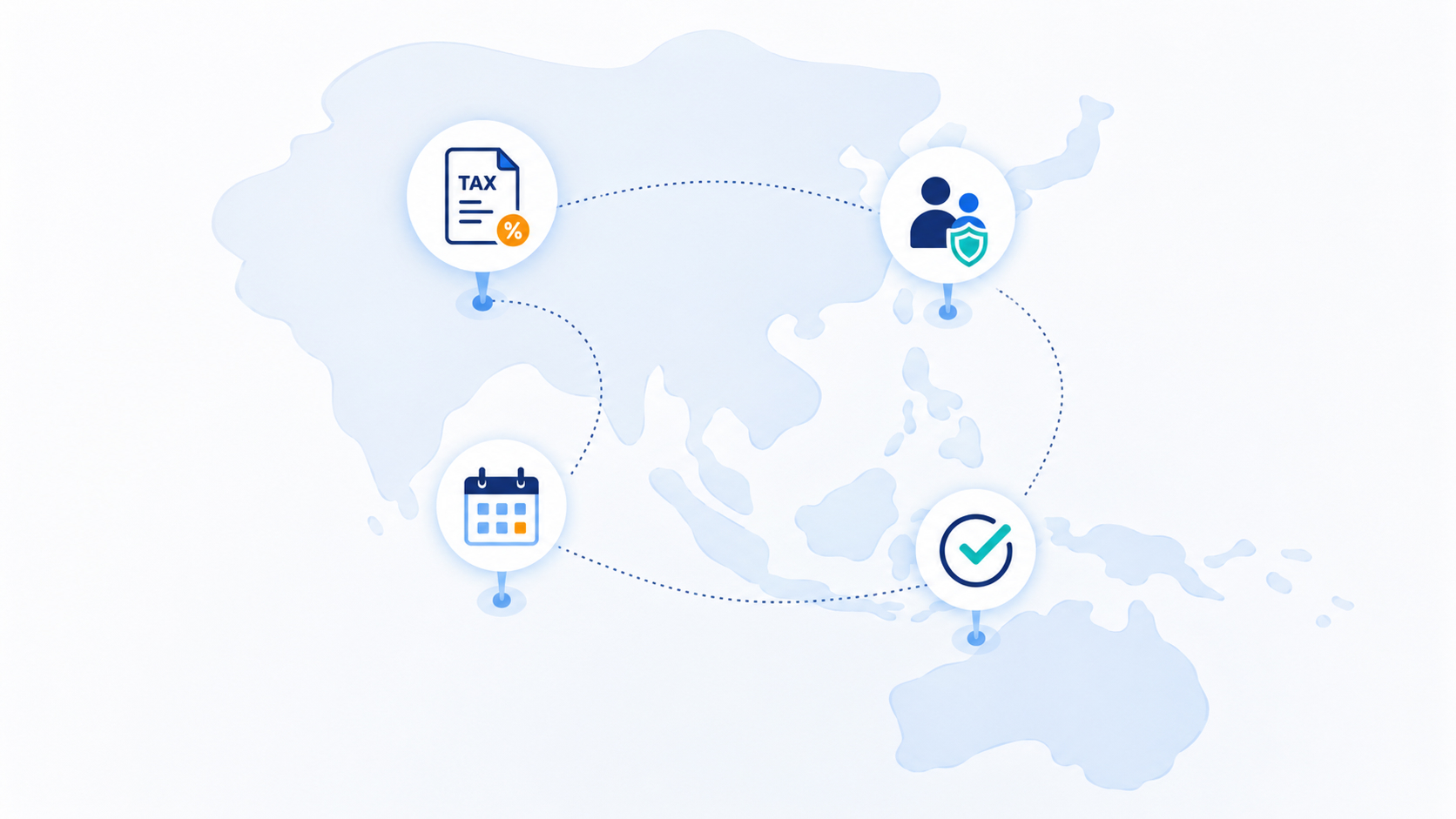
Payroll compliance is not static configuration. Parameters change. Contribution rules change. Thresholds change. Employee categories change. Tax tables change. Reporting procedures change.
Three recent examples from the region illustrate how varied those changes can be.
Singapura
From 1 January 2026, CPF contribution rates for employees aged above 55 to 65 increased, with the additional contributions allocated to the Retirement Account up to the Full Retirement Sum. The CPF Ordinary Wage ceiling also rose to S$8,000 per month, completing the multi-stage adjustment that began in September 2023. Contribution rates continue to vary by age, citizenship or permanent-resident status and wage level.
Malaysia
Mandatory EPF contributions were extended to non-Malaysian citizen employees with effect from October 2025 wages, corresponding to the November 2025 contribution month. Employer and employee shares are each set at 2% of monthly wages for the relevant non-Malaysian category, with domestic servants excluded.
Sri Lanka
Advance Personal Income Tax continues to be deducted through employer payroll, supported by official tax tables, schedules and payment calendars. The Inland Revenue (Amendment) Act, No. 2 of 2025 raised the annual tax-free threshold to LKR 1.8 million, with revised progressive rates applying from 1 April 2025.
Individually, each change is manageable. The difficulty emerges when one payroll function is responsible for five, ten, or more jurisdictions — each with its own effective date, transition rule, and reporting consequence.
Cross-border payroll is not just a calculation problem

It is tempting to think of regional payroll as a larger version of domestic payroll. It is not. The challenge is not simply salary minus deductions equals net pay. Cross-border payroll introduces multiple dimensions of compliance.
Tax residency
Where an employee lives is not always the same as where they work. Where they work may not be the same as where their employer is incorporated. Remote and internationally mobile employees can therefore create payroll and tax questions that were less common when the workforce was geographically fixed.
Social security
Statutory contribution systems differ significantly between jurisdictions. Eligibility can depend on citizenship, age, residency, salary and employment status — as the Malaysian and Singaporean examples above both demonstrate.
Employment regulation
Overtime, statutory leave, termination benefits, minimum wages, and working-time requirements are generally determined locally. A regional employment policy does not override local labour legislation.
Payroll reporting
Authorities may require different submission formats, registration processes, payment references and deadlines.
The result is a growing operational problem: regional HR wants standardisation. Compliance demands localisation. Successful payroll architecture has to support both.
The spreadsheet problem becomes a governance problem
Many multi-country payroll processes evolve gradually. One market uses one spreadsheet. Another has a separate payroll vendor. Another depends on a local HR administrator. Changes arrive through emails. Someone updates a formula. Someone else maintains a compliance calendar.
This approach can work — until scale exposes it. The weakness is not necessarily the spreadsheet itself. It is the absence of controlled configuration.
When statutory payroll logic is scattered across files and individuals, organisations struggle to answer fundamental questions:
- Which rule is currently configured?
- When was it updated?
- Who approved the change?
- Which employees were affected?
- Can we reproduce last month’s calculation?
Compliance therefore becomes partly a technology-governance challenge. The organisations that handle audits comfortably are usually not the ones with the most sophisticated calculations. They are the ones that can show what changed, when, and on whose authority.
Payroll localisation needs to go deeper than currency
A multi-country system should not simply allow different currencies. True payroll localisation means supporting the statutory logic of each jurisdiction.
- Country-specific tax calculations
- Social security contributions
- Employer contributions
- Employee deductions
- Statutory leave
- Overtime rules
- Gratuity or termination calculations
- Local calendars
- Country-specific employee classifications
- Statutory reports
- Local filing requirements
At the same time, HR leadership still needs regional visibility. That means bringing local payroll outputs into a common management layer without forcing every country’s payroll rules into one generic formula.
Compliance teams need a regulatory-change operating model
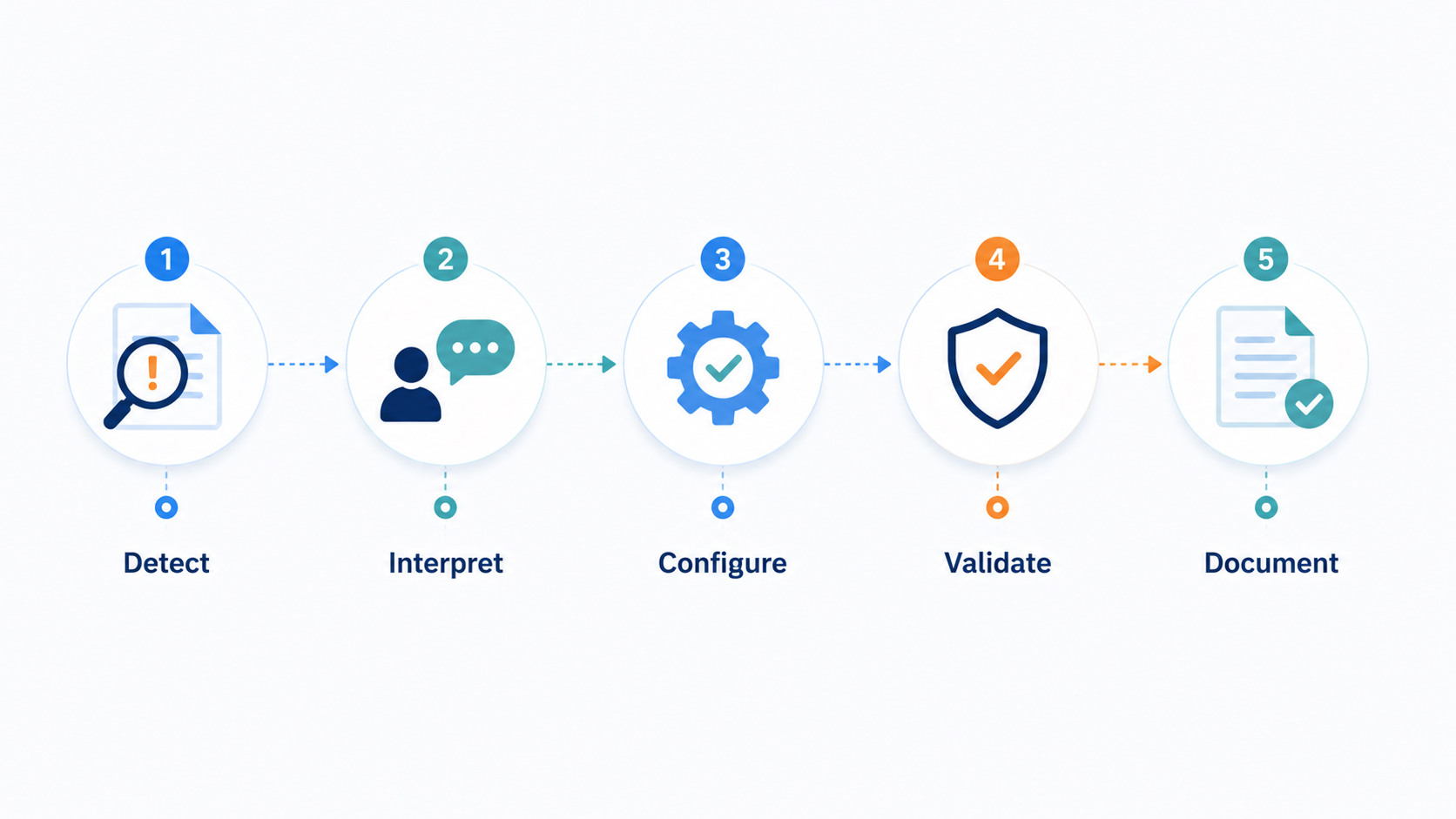
A strong payroll system alone does not solve regulatory change. Organisations also need a process.
- Detect — identify regulatory changes from authoritative sources.
- Interpret — determine how the rule affects employees, payroll parameters, processes and reporting.
- Configure — update the payroll system.
- Validate — test calculations against representative employee scenarios before the change reaches production.
- Document — record what changed, when it changed and why.
This creates a controlled compliance lifecycle rather than relying on last-minute payroll fixes. It also gives the organisation a defensible record if a calculation is later questioned.
Standardise the platform. Localise the rules.

For multinational employers, complete centralisation and complete decentralisation both create problems. A fully decentralised environment produces fragmented data, inconsistent controls, and limited regional visibility. A completely standardised regional payroll model risks overlooking local regulatory requirements.
The stronger model sits between the two.
Standardise
- Employee master-data structures
- Access controls
- Approval workflows
- Reporting architecture
- Integration standards
- Audit processes
- Management visibility
Localise
- Taxation
- Statutory contributions
- Payroll calculations
- Leave
- Overtime
- Reporting
- Regulatory workflows
That combination gives the organisation governance without removing the local intelligence required for compliant payroll.
Build compliance into payroll instead of checking it afterwards
Historically, many organisations have treated payroll compliance as a review activity: run payroll, check the output, and fix anything unusual. That model is becoming harder to sustain as regional complexity increases.
A stronger approach embeds statutory logic into payroll configuration, so compliance becomes part of the calculation process itself. Technology can then support payroll teams with validation, controlled rule changes, exception identification, and consistent calculations.
This does not eliminate the need for payroll professionals. It changes where they spend their time: less effort reconstructing calculations, more effort reviewing exceptions, understanding regulation, and managing risk.
How MiHCM supports multi-country payroll
MiHCM Payroll is built for exactly this balance — a common platform with statutory logic configured to each market, so regional teams gain visibility without local teams losing accuracy.
MiHCM Enterprise provides the shared master data, access controls, and approval workflows that make that governance possible, while Syntra brings payroll and workforce data into a single analytical view for regional leadership.
MiHCM also publishes country payroll compliance guides covering Malaysia, Thailand, Cambodia, Bangladesh and Sri Lanka, with further markets in preparation. They are available at mihcm.com/resources/guides/.
Regional payroll needs both technology and local knowledge
There is no single ASEAN payroll rulebook. Nor is there one South Asian payroll framework. Employers must continue complying with the legislation that applies in each jurisdiction.
The future of regional payroll is therefore unlikely to be one universal calculation engine running identical rules everywhere. Instead, it will be a common digital foundation capable of applying different local rules accurately.
For HR leaders expanding across ASEAN and South Asia, the objective is not to make every country’s payroll the same. It is to make the way the organisation manages payroll complexity more consistent, visible, and controlled. That is what regional payroll transformation should deliver.
Transparency disclaimer: This article is intended as general guidance for HR, payroll and business leaders. It does not constitute legal, tax or payroll advice. All statutory figures, rates and effective dates cited were taken from the official sources listed below and were current at the time of writing. Statutory parameters change frequently; organisations should verify the current position with the relevant authority or their own advisers before configuring payroll.
Sources:
- Singapore CPF Board: CPF contribution rate changes from 1 January 2026 — https://www.cpf.gov.sg/service/article/what-are-the-changes-to-the-cpf-contribution-rates-for-senior-workers-from-1-january-2026
- Singapore CPF Board: CPF contribution rate table from 1 January 2026 — https://www.cpf.gov.sg/content/dam/web/employer/employer-obligations/documents/CPFcontributionratesfrom1Jan2026.pdf
- Malaysia EPF: Mandatory contributions for non-Malaysian citizen employees, effective October 2025 — https://www.kwsp.gov.my/en/w/news/epf-begins-mandatory-contributions-for-non-malaysian-citizen-employees-effective-october-2025
- Malaysia EPF: Contributions for non-Malaysian citizen employees — https://www.kwsp.gov.my/en/employer/responsibilities/non-malaysian-citizen-employees
- Sri Lanka Inland Revenue Department: APIT tax tables — https://www.ird.gov.lk/en/publications/sitepages/apit_tax_tables.aspx