By Anwar Parves
Payroll in Bangladesh has changed more in the past 12 months than in the preceding decade. The Bangladesh Labour (Amendment) Ordinance 2025 and the Bangladesh Labour (Amendment) Act 2026 together introduced roughly 90 changes to the Bangladesh Labour Act 2006. The Finance Act 2026, gazetted on 30 June 2026, reset the individual income tax structure from 1 July 2026. Between them, they touched almost every line of a Bangladeshi payslip.
Most employers understand the rules. What breaks is the sequence — the order in which registrations, classifications, calculations, deposits and filings have to happen, and the dependencies between them. Miss one, and the error compounds quietly across twelve months of payroll runs.
This guide sets out that sequence. Eleven steps, from registration to record-keeping, with the statutory anchor for each.
Before you startThis article is written for general information and does not constitute legal or tax advice. Section numbering, figures and thresholds should be verified against the gazetted text and current National Board of Revenue circulars before you configure payroll. Several provisions of the 2026 amendment still await subsidiary regulation, and published commentary on them is uneven.
Bangladesh payroll: the key figures
For readers who need the numbers immediately, the position as at September 2026:
ItemPositionGoverning lawsBangladesh Labour Act 2006, as amended in 2025 and 2026; Bangladesh Labour Rules 2015, as amended February 2026; Income Tax Act 2023; Finance Act 2026Pay frequencyMaximum wage period of one monthWage payment deadlineSeventh working day after the last day of the wage periodFinal settlement deadlineThirtieth working day from the date of terminationIncome tax-free thresholdTk 400,000 for general taxpayers, assessment years 2026–27 and 2027–28Income tax ratesSix bands from nil to 30%; the 5% entry band has been removedSalary tax withholdingMonthly, using the average rate methodWithholding returnQuarterly; separate from the deposit obligationOrdinary working hoursEight per day, 48 per weekOvertime rateTwice the ordinary rateMaternity benefit120 days, split 60 days pre-delivery and 60 days post-deliveryFestival holidays13 daysMinimum wageSector-specific, set by the Minimum Wage Board; no national rate. Ready-made garment entry grade is Tk 12,500 from 1 December 2023Profit participation5% of net profit in an 80:10:10 ratio, within nine months of year end, for qualifying companies
Step 1: Put your registrations and identifiers in place
Payroll cannot be run compliantly by an entity that is not properly registered. Before the first salary run, confirm all of the following are current:
- Company registration with the Registrar of Joint Stock Companies and Firms (RJSC).
- Trade licence from the relevant city corporation or municipality, renewed annually.
- Electronic Taxpayer Identification Number (e-TIN) for the entity. This is what makes you a withholding agent — every salary payment you make carries a deduction obligation attached to it.
- Business Identification Number (BIN) for VAT. The Finance Act 2026 widened mandatory BIN linkage considerably: bank and non-bank financial institution accounts, loans, trade licence renewal, mobile financial service merchant accounts, trade association membership, utility connections and vehicle registration now all require it.
- Establishment registration with the Department of Inspection for Factories and Establishments (DIFE) under the Bangladesh Labour Act.
- Employee e-TINs. Collect these at onboarding, not at year end. Without a verified TIN you cannot issue a compliant salary certificate, and the employee cannot claim credit for tax you have already deducted on their behalf.
Watch itemThe 2026 amendment lowered several registration and coverage thresholds. Confirm the establishment registration threshold that applies to your headcount against the gazetted text — published summaries of this point contradict one another.
Step 2: Classify the workforce before you configure anything
This is the step most often skipped, and it determines almost everything downstream.
The amended definition of “worker” under Section 2(65) focuses on the nature of the work performed rather than job title. Persons performing skilled, unskilled, manual, technical, promotional or clerical work may qualify as workers regardless of designation, while persons genuinely exercising managerial, administrative or supervisory functions fall outside the definition.
Worker status drives leave entitlement, end-of-service compensation, overtime eligibility and trade union rights. Classify on actual duties and responsibilities, not on whether someone is called an “officer”, an “executive” or a “manager”. Organisations with large populations of nominally senior titles carry the most exposure here.
In a payroll system, worker status should be a field that drives entitlement logic automatically — not a judgement remade case by case at settlement time.
Step 3: Build the salary structure around basic wage

In Bangladesh, basic wage is not one component among several. It is the multiplier that the rest of payroll keys off.
Overtime, festival bonus, provident fund contributions, gratuity and most end-of-service calculations are all computed on basic — or on last drawn basic — rather than on gross. A structure that loads pay into allowances to suppress basic will understate every one of those liabilities, and the shortfall accumulates year on year.
Minimum wage
Bangladesh hasno single national minimum wage. Rates are set sector by sector by the Minimum Wage Board under the Ministry of Labour and Employment. Check the gazette for your sector; do not assume a figure from another industry applies.
The ready-made garment structure is the most widely referenced. It took effect on 1 December 2023 and set the entry-level monthly minimum at Tk 12,500, a 56% increase on the Tk 8,000 fixed in 2018. Its component breakdown:
ComponentAmount (Tk)Basic wage6,700House rent allowance3,350Medical allowance750Transport allowance450Food allowance1,250Total (entry grade)12,500
The 5% increment trapThe RMG gazette provides for an annual increment of 5% after one year of service. That increment applies to basic wage, not gross. Applying it to gross overstates cost; applying it to the wrong base in a manual run produces cumulative underpayment across successive years — one of the most common findings in Bangladesh wage audits.
Note also that the 2026 amendment shortened the wage revision cycle from five years to three. As of August 2026, trade unions and labour alliances had publicly urged the Government to reconstitute the Minimum Wage Board for the garment sector. Treat the current figure as a live number, not a settled one.
Step 4: Fix the wage period and the payment deadline
The maximum wage period under the Labour Act is one month. Section 123(1) requires wages to be paidbefore the expiry of the seventh working dayfollowing the last day of the wage period.
Where employment ends — by retirement, retrenchment, discharge, removal, dismissal or otherwise — Section 123(2) requires all wages payable to be settledbefore the expiry of the thirtieth working dayfrom the date of termination. Older commentary still circulates the pre-2013 “seventh working day” wording for final settlement; the thirtieth-working-day period is the one currently in force.
Wages must be paid on a working day. Payment may be made in legal tender, by cheque, or by electronic transfer to the worker’s bank account or another digital medium where the worker so requests. Deductions from wages are permitted only where authorised by the Act.
Step 5: Capture time, overtime and leave accurately
Ordinary working hours are eight per day and 48 per week. The day may extend to ten hours and the week to 60 hours, with overtime paid attwice the ordinary rate.
Three leave and holiday entitlements changed in 2026 and need to be reconfigured in the system rather than only in the policy document:
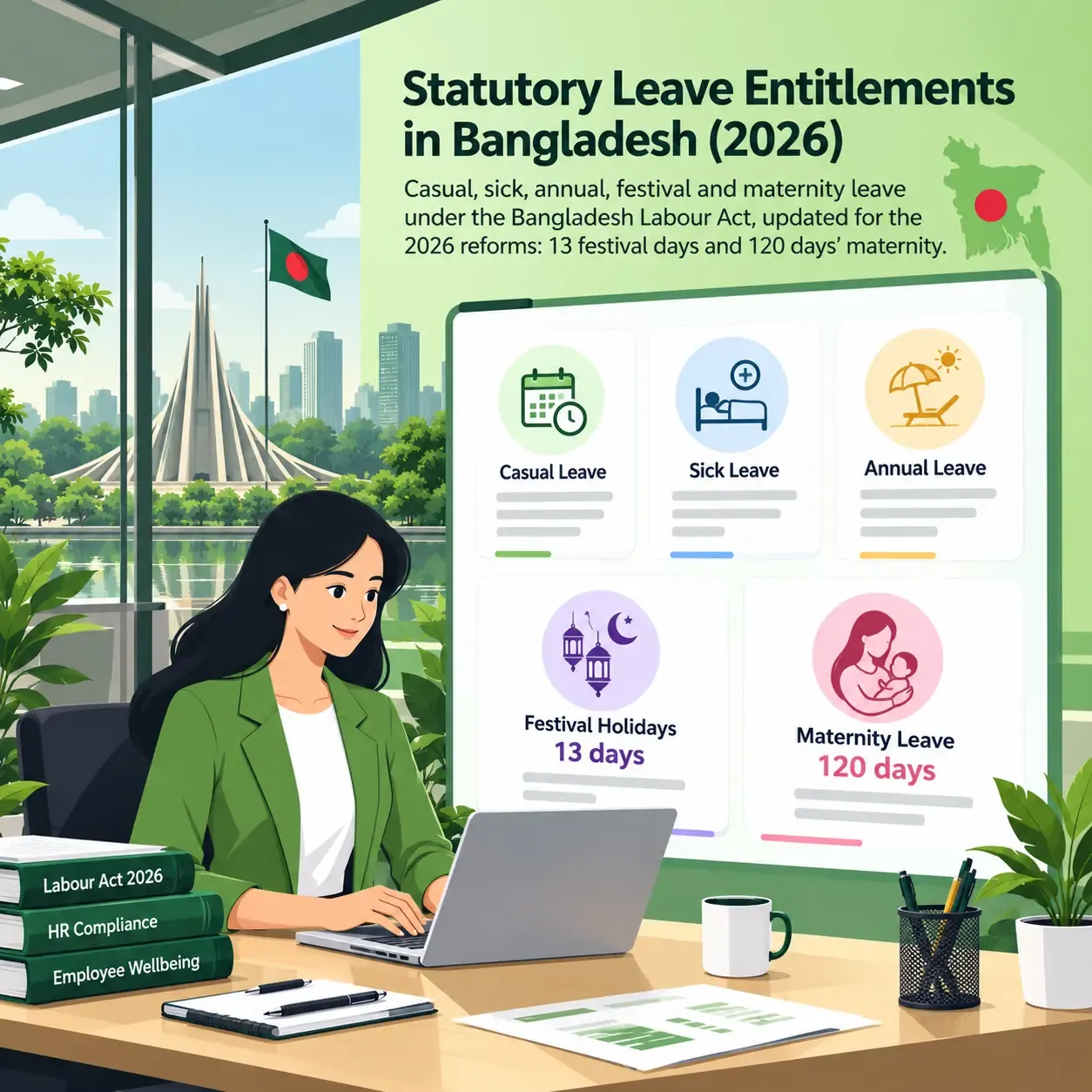
- Maternity benefit under Section 46 rose from 112 days to 120 days, structured as 60 days pre-delivery and 60 days post-delivery.
- Festival holidays under Section 118(1) increased from 11 days to 13 days.
- Lay-off eligibility under Section 16 fell from one year of continuous service to three months.
Casual leave of ten days on full wages in a calendar year is non-accumulating and cannot be carried forward.
Verify before configuringThe annual leave accrual rate for factory workers is disputed in published commentary — some sources report a move from one day per 18 days worked to one day per 14, others do not. Confirm the current rate for your establishment type against the gazetted text before changing accrual logic.
Step 6: Apply statutory funds and authorised deductions
Provident fundThe provident fund position shifted between the 2025 Ordinance and the 2026 Act, and this is currently the least settled area of Bangladeshi payroll.The Ordinance required employers with 100 or more permanent workers to establish a provident fund, with participation in the Government’s Progoti universal pension scheme available as an alternative, and set worker contributions at a minimum of 7% of basic pay (up to 8%) with employer matching. Reporting on the final Act is inconsistent: some accounts state the mandatory provision was removed, others that fund formation now requires written application from a specified proportion of workers.
Highest-priority verificationDo not configure provident fund logic from secondary commentary. Confirm the application threshold, the contribution rates and the effect of Progoti participation against the gazetted text of the Bangladesh Labour (Amendment) Act 2026 and its implementing rules before you act.
Progoti universal pension schemeProgoti is the Universal Pension Scheme package for employees and owners of private sector institutions, administered by the National Pension Authority. Contributions are structured on a 50:50 basis between employer and employee. Enrolment is open to citizens aged between 18 and 50, with benefits commencing at 60. Where a private employer does not participate, employees may still join independently.Workers’ Profit Participation FundUnder Chapter XV of the Labour Act, a company must establish participation and welfare funds where, on the last day of an accounting year, either its paid-up capital is at least Tk 1 crore or the value of its permanent assets is at least Tk 2 crore.Qualifying companies contribute5% of net profit, distributed in an 80:10:10 ratio between the Workers’ Profit Participation Fund, the Workers’ Welfare Fund and the Bangladesh Workers’ Welfare Foundation Fund. Payment must be made within nine months of the close of each year, and the funds are subject to annual audit. Separate rules apply to wholly export-oriented and wholly foreign-investment companies.Trade union check-offUnder Section 204, employers must deduct subscriptions for members ofany registered trade union— not only the collective bargaining agent — and deposit the full amount within fifteen days. This needs a verifiable audit trail, not an assertion.Fines imposed on a worker cannot exceed one-tenth of the wages payable in a wage period, and must be recorded in the prescribed register.
Step 7: Calculate tax deducted at source on salary

Employers deduct income tax from salary monthly using theaverage rate method: estimate the employee’s total income for the year, apply exemptions and allowable deductions, compute annual tax using the applicable slabs, then spread that liability across the pay periods. Recalculate at the start of the income year, after every salary change, and again at year end.
The Finance Act 2026 reset the slab structure with effect from 1 July 2026. For assessment years 2026–27 and 2027–28:
Income bandRateUp to the applicable tax-free thresholdNilNext Tk 300,00010%Next Tk 400,00015%Next Tk 500,00020%Next Tk 2,000,00025%Balance of total income30%
The previous 5% entry slab has been removed, which raises the effective burden for some lower and middle-tier earners despite the higher threshold.
Tax-free thresholds for assessment years 2026–27 and 2027–28:
Taxpayer categoryTax-free threshold (Tk)General taxpayers400,000Women and senior citizens aged 65 or above450,000Persons with disabilities525,000Third-gender taxpayers525,000War-wounded gazetted freedom fighters and July gazetted fighters550,000
Three further changes affect salary payroll directly:
- Non-residents. A non-resident taxpayer in Bangladesh who is not a company, firm or association of persons — excluding non-resident Bangladeshis — is taxed at 30%.
- Investment rebate. The qualifying amount was reduced from 15% to 10% of actual investment, and the ceiling from Tk 1 million to Tk 750,000. Critically for payroll: recognition of the provident fund is now required for the investment tax rebate on provident fund contributions.
- Minimum tax. The previous location-based minimum tax has been replaced by a flat Tk 5,000 applying nationwide to taxpayers whose total income exceeds the tax-free threshold. Confirm the current position against NBR guidance before applying it.
Step 8: Process festival bonus and off-cycle payments
Festival bonus is a standard feature of Bangladeshi payroll rather than a discretionary gesture. Under the Bangladesh Labour Rules 2015, workers are entitled to two festival bonuses in a year, each not exceeding basic wage, subject to the qualifying service condition.
Three points matter operationally. Festival bonus is calculated on basic, so any error in Step 3 propagates here. It falls within the statutory definition of wages for the purposes of Chapter X, which means the payment timing rules apply to it. And because the two payments are tied to religious festivals rather than to calendar quarters, they move year to year — the payroll calendar has to move with them.
Verify before publicationConfirm the current rule reference and the qualifying service condition for festival bonus against the Bangladesh Labour Rules 2015 as amended in February 2026, since the implementing rules were revised alongside the 2026 Act.
Step 9: Deposit the tax and file the returns

Depositing tax and filing the return aretwo separate obligations with different deadlines. Meeting one does not discharge the other, and this is among the most common compliance failures among otherwise well-run finance functions.
ObligationWhat it involvesDeposit of tax deductedDeducted tax must be paid into the Government Treasury within the period prescribed under the withholding tax rules. Late or short deposit attracts simple interest at 2% per month, subject to a maximum of 24 months, on the amount concerned.Withholding tax returnFiled quarterly rather than monthly, following the amendment effective from assessment year 2025–26. Each return is due within the prescribed date after the quarter end.Annual salary statementA detailed statement of annual salary payments to each employee, including tax deducted, furnished together with the quarterly withholding return for the October quarter.Salary certificateIssued to each employee, setting out total salary paid, tax deducted and deposited, challan number and date, income year and employee details.
Failure to deposit deducted tax is an offence under the Income Tax Act 2023 and carries exposure beyond financial penalty. The employer, as withholding agent, bears primary liability for any shortfall.The employee’s own filing has changedThe Finance Act 2026 replaced the fixed “Tax Day” model for individuals with a filing window carrying incentives and penalties. Returns may now be filed at any time during the tax year, with the following consequences for an income year ending 30 June:
Filing periodEffect1 July – 30 SeptemberRebate of 5% of tax liability, capped at Tk 25,0001 October – 31 DecemberNo rebate and no additional tax1 January – 31 MarchAdditional tax of 2%, minimum Tk 3,0001 April – 30 JuneAdditional tax of 5%, minimum Tk 5,000
The NBR’s power to extend the return filing date by one month has been repealed. Payroll teams that issue salary certificates late now impose a direct, quantifiable cost on their employees — worth communicating internally before the first cycle under the new rules.
Step 10: Get end-of-service calculations right

End-of-service is where classification errors, basic wage errors and accrual errors all surface at once — usually in front of a Labour Court or a buyer’s auditor.
EventEntitlementTermination by the employer under Section 26Notice of 120 days for a monthly-rated permanent worker, or 60 days for others; compensation of 30 days’ wages for every completed year of service, or gratuity where payable, whichever is higher.Resignation under Section 27(4), as amendedGraduated by service length: 7 days’ wages per completed year at 3 years of continuous service; 15 days’ wages per completed year above 3 but below 10 years; 30 days’ wages per completed year at 10 years or more, or gratuity where applicable, whichever is higher.DismissalNewly introduced: workers with at least one year of service who are dismissed are entitled to 15 days’ wages for each completed year of service.RetrenchmentCompensation at 30 days’ wages for each completed year of service, with notice as prescribed.Death in serviceEligibility threshold fell from two years of service to one year.
Each of these lands in provisioning, not only in policy. Accrual methodology and reserve calculations need reworking against the amended formulas — and the resignation tiering in particular cannot be approximated with a single flat rate.
Step 11: Keep records that can be produced on demand
The 2026 amendment changed the character of labour penalties in Bangladesh. The general residual penalty under Section 307 rose from Tk 5,000 to a range of Tk 25,000 to Tk 50,000, with up to three months’ imprisonment. Non-payment of minimum wage under Section 289(1) attracts Tk 50,000 to Tk 100,000 or up to one year’s imprisonment, and the court may direct that the fine be paid to the affected worker. The same range applies to unfair labour practices under Section 291(1).These are no longer amounts that can be absorbed as a predictable operating cost.What that means practically: wage registers, attendance and overtime records, deduction registers, fine registers, challans, salary certificates and fund audit reports need to be retrievable as records rather than reconstructed after the fact. When an inspector, a buyer or a court asks what was paid and when, the answer should come from a system, not from a spreadsheet rebuilt from memory.The recurring payroll calendar at a glance
FrequencyObligationMonthlyRun payroll; pay wages by the seventh working day after the wage period ends; deduct tax at source; deposit deducted tax within the prescribed period; deduct and deposit union subscriptions within fifteen days.QuarterlyFile the withholding tax return within the prescribed date after the quarter end.October quarterFile the annual statement of salary payments and tax deducted for each employee alongside the quarterly return.AnnuallyIssue salary certificates; apply the 5% annual increment on basic where the sector gazette provides for it; audit participation and welfare funds.Within 9 months of year endContribute 5% of net profit to the participation and welfare funds in the 80:10:10 ratio, where the company qualifies.On terminationSettle all wages payable before the expiry of the thirtieth working day from the date of termination.
Five mistakes that cost the most
- Treating job titles as classification. A payroll built on titles rather than actual duties will misstate leave, overtime and end-of-service for every misclassified employee, and the error is only discovered at settlement.
- Applying the annual increment to gross. The RMG gazette increment runs on basic. Applied to the wrong base, the gap compounds every year and shows up as systematic underpayment in audit.
- Depositing tax and assuming the return is filed. Two obligations, two deadlines. Late deposit attracts 2% per month; a missed return is a separate default.
- Configuring provident fund from news summaries. The position moved between the 2025 Ordinance and the 2026 Act and published accounts contradict each other. This one requires the gazetted text.
- Provisioning resignation benefits at a flat rate. Section 27(4) is now tiered at three, ten and above-ten years. A single rate will be wrong for most of the workforce, in both directions.
Turning a compliance sequence into an operating capability
- Nothing in this guide is conceptually difficult. The difficulty is holding eleven steps consistently across every employee record, every pay period and every audit request, while the rules underneath them continue to develop.That is a systems question rather than a knowledge question. Worker classification needs to be a field that drives entitlement logic. Basic wage needs to be the single source for every derived calculation. Deposit and filing deadlines need to be tracked separately. End-of-service needs to reflect the amended tiering automatically. And the evidence needs to exist as a record, not a reconstruction.MiHCM works with employers across Bangladesh and more than 20 other markets in Asia, the Middle East and Africa, supporting HR and payroll teams through exactly this kind of regulatory transition. MiHCM Enterprise is built to absorb statutory change without disrupting operations — so that payroll teams can spend their attention on the judgement calls the law now demands, rather than on the arithmetic.Talk to the MiHCM Bangladesh team about aligning your payroll operations with the 2026 framework.

Anwar ParvesCountry Manager for MiHCM in Bangladesh
(Anwar Parves is the Country Manager for MiHCM in Bangladesh, overseeing operations and client relationships. With a focus on strategic direction and project implementation, he drives growth and ensures successful delivery of HR solutions. Known for his leadership and industry expertise, Anwar excels in optimising processes and building strong client partnerships)
.faq-accordion { max-width: 900px; margin: 0 auto; font-family: inherit; } .faq-item { border-bottom: 1px solid #e5e5e5; } .faq-question { width: 100%; background: transparent; border: 0; padding: 20px 0; display: flex; align-items: center; justify-content: space-between; gap: 20px; text-align: left; cursor: pointer; font-size: 18px; font-weight: 600; color: #111827; transition: color 0.25s ease; } .faq-question:hover { color: #5BC0EB; } .faq-icon { flex: 0 0 34px; width: 34px; height: 34px; border: 1px solid #d8d8d8; border-radius: 50%; display: inline-flex; align-items: center; justify-content: center; font-size: 24px; font-weight: 400; line-height: 1; transition: all 0.25s ease; } .faq-question:hover .faq-icon { border-color: #5BC0EB; color: #5BC0EB; } .faq-answer { max-height: 0; overflow: hidden; opacity: 0; transition: max-height 0.35s ease, opacity 0.25s ease, padding 0.25s ease; padding: 0; } .faq-answer p { margin: 0; padding: 0 55px 20px 0; font-size: 16px; line-height: 1.7; color: #4b5563; } .faq-item.active .faq-answer { max-height: 700px; opacity: 1; } .faq-item.active .faq-icon { background: #5BC0EB; border-color: #5BC0EB; color: #fff; } .faq-item.active .faq-question { color: #5BC0EB; } @media (max-width: 767px) { .faq-question { font-size: 16px; padding: 17px 0; } .faq-answer p { padding-right: 0; font-size: 15px; } .faq-icon { width: 30px; height: 30px; flex-basis: 30px; font-size: 21px; } } How often must wages be paid in Bangladesh? + The maximum wage period is one month, and wages must be paid before the expiry of the seventh working day following the last day of the wage period. Payment must be made on a working day. What is the income tax-free threshold in Bangladesh for 2026–27? + Tk 400,000 for general taxpayers for assessment years 2026–27 and 2027–28, under the Finance Act 2026. Higher thresholds apply to women and senior citizens (Tk 450,000), persons with disabilities and third-gender taxpayers (Tk 525,000), and war-wounded gazetted freedom fighters and July gazetted fighters (Tk 550,000). Is there a national minimum wage in Bangladesh? + No. Bangladesh sets minimum wages sector by sector through the Minimum Wage Board. The most widely cited figure — Tk 12,500 for entry-level ready-made garment workers, effective 1 December 2023 — applies to that sector only. The wage revision cycle was shortened from five years to three under the 2026 amendment. How is overtime calculated in Bangladesh? + Ordinary hours are eight per day and 48 per week, extendable to ten hours per day and 60 hours per week. Overtime is paid at twice the ordinary rate. How long is maternity leave in Bangladesh? + Maternity benefit under Section 46 is 120 days, structured as 60 days before delivery and 60 days after, following the Bangladesh Labour (Amendment) Act 2026. It was previously 112 days. Do employers in Bangladesh have to provide a provident fund? + The position changed between the Bangladesh Labour (Amendment) Ordinance 2025 and the Bangladesh Labour (Amendment) Act 2026 and is currently reported inconsistently. The Ordinance required employers with 100 or more permanent workers to establish a fund, with Progoti universal pension scheme participation as an alternative. Employers should confirm the final position against the gazetted text of the Act and its implementing rules rather than relying on secondary commentary. When must the Workers’ Profit Participation Fund be paid? + Qualifying companies must contribute 5% of net profit within nine months of the close of each accounting year, distributed in an 80:10:10 ratio between the Workers’ Profit Participation Fund, the Workers’ Welfare Fund and the Bangladesh Workers’ Welfare Foundation Fund. The obligation applies where paid-up capital is at least Tk 1 crore or permanent assets are at least Tk 2 crore. How often is the withholding tax return filed in Bangladesh? + Quarterly, following the amendment effective from assessment year 2025–26. Depositing the deducted tax and filing the return are separate obligations with separate deadlines. document.querySelectorAll('.faq-question').forEach(function(button) { button.addEventListener('click', function() { const item = this.closest('.faq-item'); const icon = this.querySelector('.faq-icon'); const isOpen = item.classList.contains('active'); document.querySelectorAll('.faq-item').forEach(function(otherItem) { otherItem.classList.remove('active'); const otherIcon = otherItem.querySelector('.faq-icon'); if (otherIcon) { otherIcon.textContent = '+'; } }); if (!isOpen) { item.classList.add('active'); icon.textContent = '−'; } }); });
Transparency and sources
This article is written for general information and does not constitute legal or tax advice. The Bangladesh Labour (Amendment) Act 2026 and its implementing rules remain subject to ongoing development, and several provisions await subsidiary regulation. Section numbering and figures are drawn from the sources below and should be verified against the gazetted text and current NBR guidance. Employers should seek qualified local counsel before acting on any provision discussed here.
Sources consulted:
- Bangladesh Labour Act 2006, as amended by the Bangladesh Labour (Amendment) Ordinance 2025 (17 November 2025) and the Bangladesh Labour (Amendment) Act 2026 (in force from 10 April 2026).
- Bangladesh Labour Rules 2015, as amended by SRO 53-Law/2026, gazetted 16 February 2026.
- PwC Bangladesh, “Finance Act, 2026: Key Amendments — Stability, Reform, and Inclusive Prosperity”, June 2026.
- Bloomberg Tax, “Bangladesh Gazettes 2026 Finance Act”, reporting publication in the Official Gazette on 30 June 2026.
- The Daily Star, “Finance Bill passed, tax-free income threshold set at Tk 4 lakh for FY2026-27”.
- The Daily Star, Taslima Akhter, “A closer look at Bangladesh’s new labour law: Gains and gaps”, April 2026.
- Income Tax Act 2023 and the withholding tax rules made under it, National Board of Revenue.
- Minimum Wage Board, Ministry of Labour and Employment — ready-made garment minimum wage gazette, effective 1 December 2023.
- WTW, “Bangladesh: New mandate for provident funds for large employers”, March 2026.
- National Pension Authority and the Universal Pension Scheme portal — Progoti scheme structure.
- The Legal Circle, “The Rules Have Changed — Bangladesh’s 2025–2026 Labour Law Reforms And What It Means For Businesses”, via Mondaq, 11 June 2026.
- MiHCM, “The Bangladesh Labour (Amendment) Act 2026: What changed and what HR must do now”, 26 August 2026.