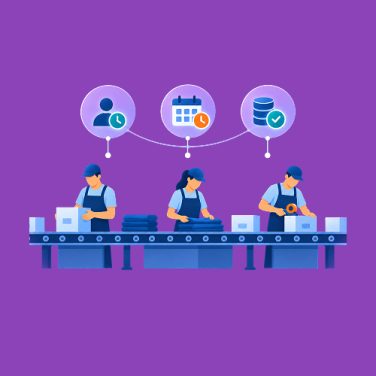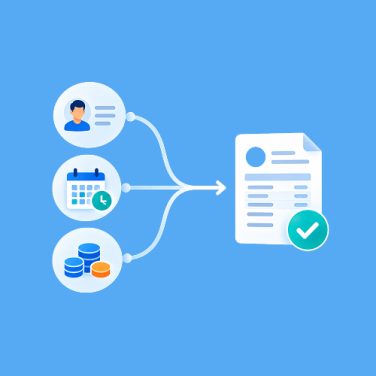
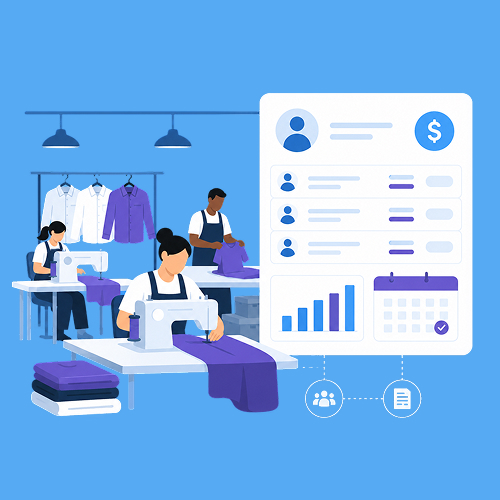
The garment and apparel industry runs on precision. Fabric cut to fractions of a millimetre. Stitch counts per centimetre. Delivery schedules down to the hour. But when it comes to payroll, many manufacturers still operate with systems and processes that cannot keep up with the complexity their own operations demand.
For a single-site operation with a standard salary structure, that might be manageable. For a manufacturer with thousands of workers across multiple plants, multiple countries, piece-rate pay structures, production bonuses, variable shifts, and different statutory frameworks in every market — it is not.
This blog examines the specific payroll challenges that define the garment and apparel sector, and what manufacturers need from their HR and payroll systems to handle them at scale.
Why apparel payroll is uniquely complex
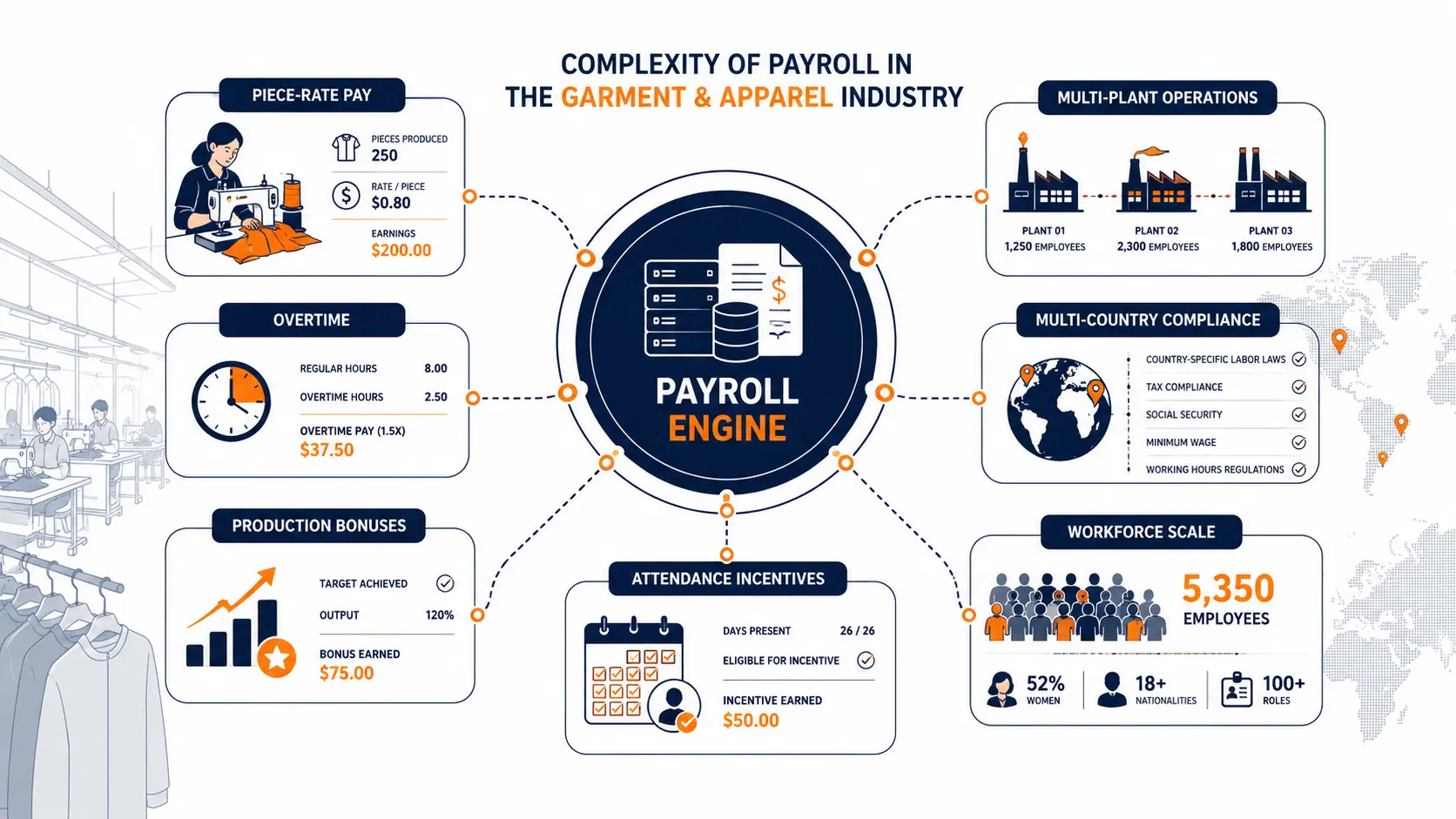
Most payroll systems are built for salaried or standard hourly workforces. Garment and apparel manufacturing is neither. The complexity stems from several structural features of the industry that interact in ways that quickly overwhelm manual processes.
Piece-rate pay structures
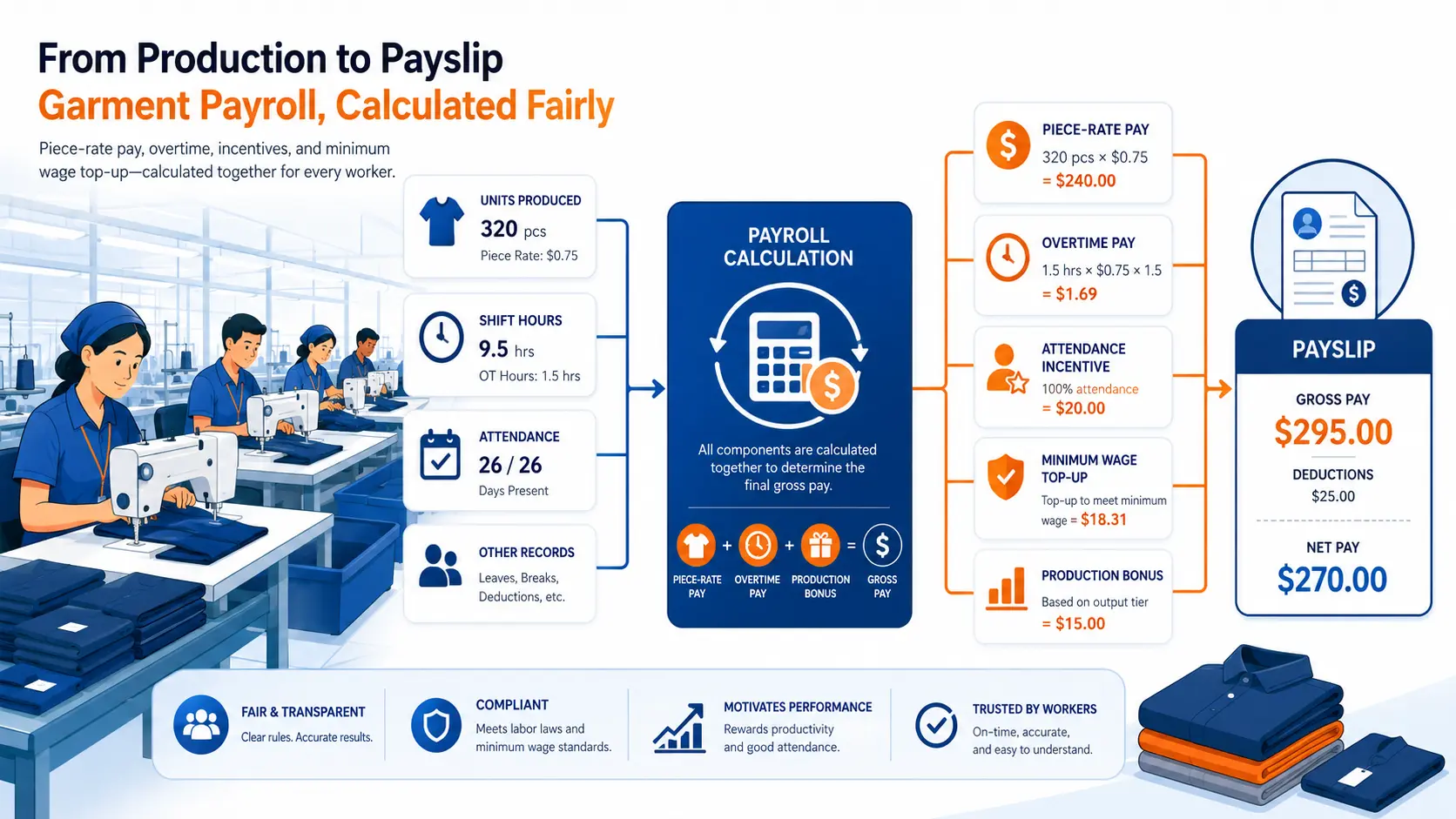
Across much of the garment industry in Asia and beyond, workers are paid by the piece — a set rate per unit produced rather than a fixed hourly or monthly salary. The International Labour Organisation has documented piece-rate pay as the dominant model in garment factories across Vietnam, Indonesia, Cambodia, and Bangladesh.
Piece-rate pay creates payroll complexity that hourly systems are not designed to handle. Each pay run requires accurate counts of units produced per worker, per line, per shift. Those counts must be reconciled against production records, overtime hours, and minimum wage floors — because in most jurisdictions, piece-rate workers must be guaranteed at least the applicable minimum wage regardless of how many units they produce.
Where piece-rate earnings fall below the minimum wage threshold for hours worked, employers have a statutory obligation to top up the difference. Getting this wrong — even unintentionally — creates legal exposure.
Overtime: legal limits and production pressure
Overtime is endemic in the garment sector. The ILO’s research on working hours in major garment-exporting countries shows that a significant proportion of workers in the sector regularly work beyond the standard 48-hour week. Managing overtime payroll accurately requires systems that can track exact hours worked per shift, apply the correct multiplier (which varies by jurisdiction — typically 1.5 to 2 times the base rate), and flag when legal daily or weekly overtime limits are being approached or exceeded. In markets such as Malaysia, Vietnam, Cambodia, and Sri Lanka, overtime rules are governed by specific labour law provisions, and annual caps apply. A payroll system that cannot automatically enforce these rules — and generate audit records to demonstrate compliance — puts manufacturers at regulatory risk.
Production bonuses and attendance incentives
Beyond base pay and overtime, most garment manufacturers use production bonuses linked to output targets and attendance incentives to manage workforce reliability and productivity. These add a further layer of variable calculation to every pay run: bonus thresholds must be checked, attendance records validated, and the resulting amounts calculated and applied correctly across potentially thousands of workers.
When this is done manually or across disconnected systems, errors accumulate. Payslips become difficult to verify. Worker trust erodes.
Multi-plant and multi-country operations
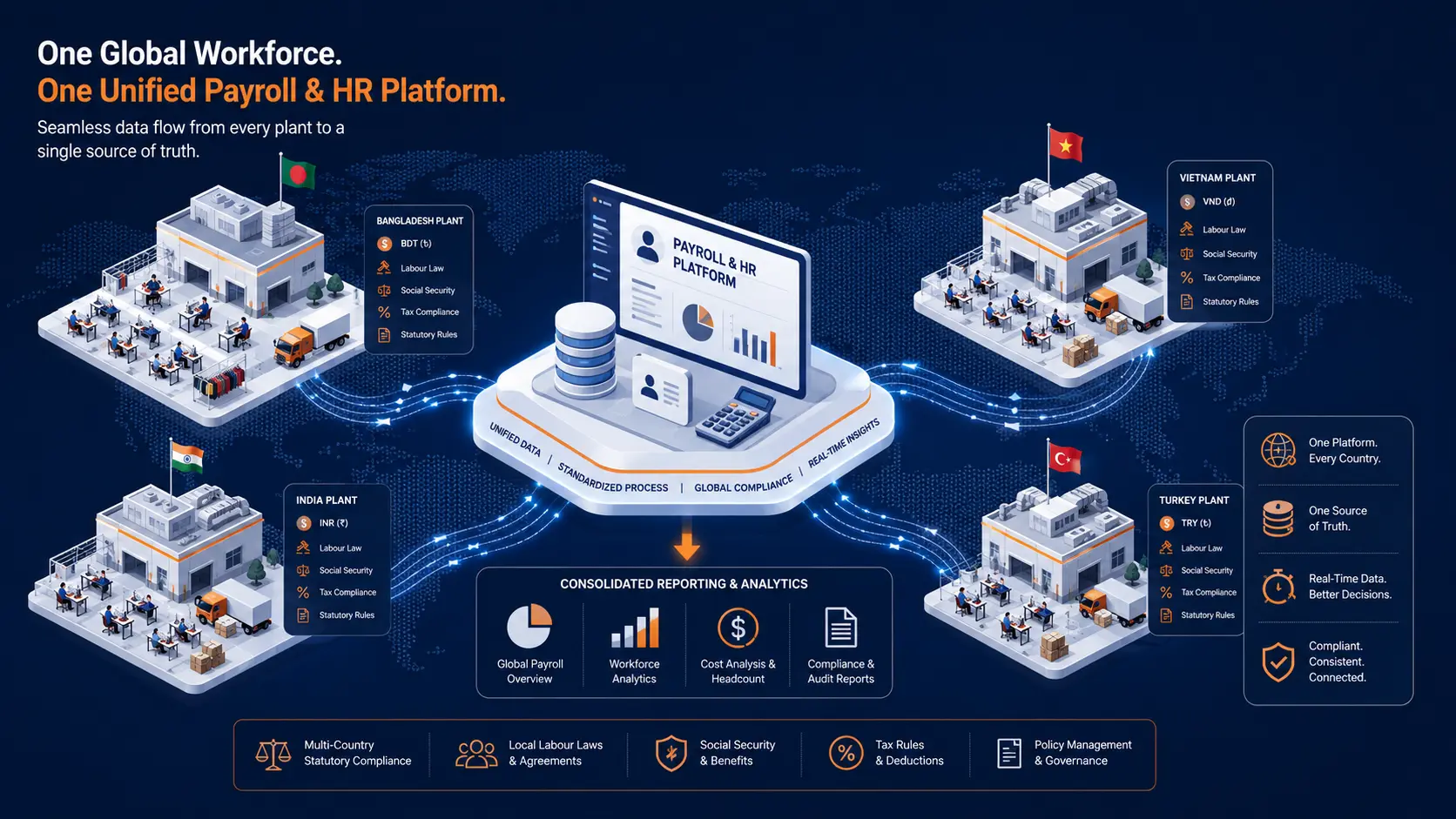
Large apparel manufacturers typically operate across multiple facilities — often in different countries, each with distinct statutory frameworks. Contributions to social security, pension, health insurance, and income tax vary by market. Pay frequencies may differ. Local minimum wage rates are updated at different times in different jurisdictions.
Managing this in a unified system — with consolidated reporting, consistent data standards, and the ability to apply different rules to different entities — requires an enterprise platform built for multi-entity, multi-country deployment.
Integration with the factory floor
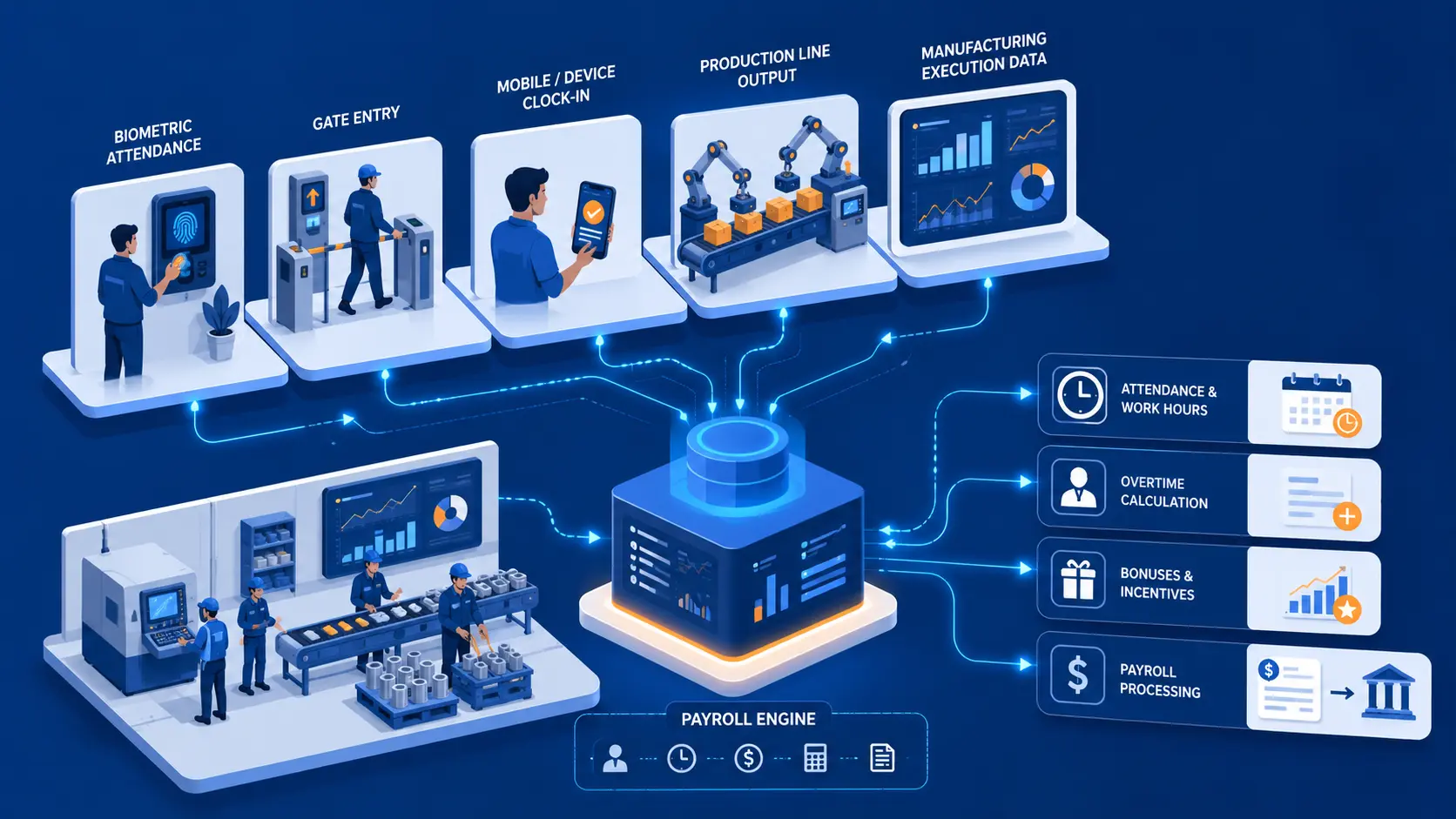
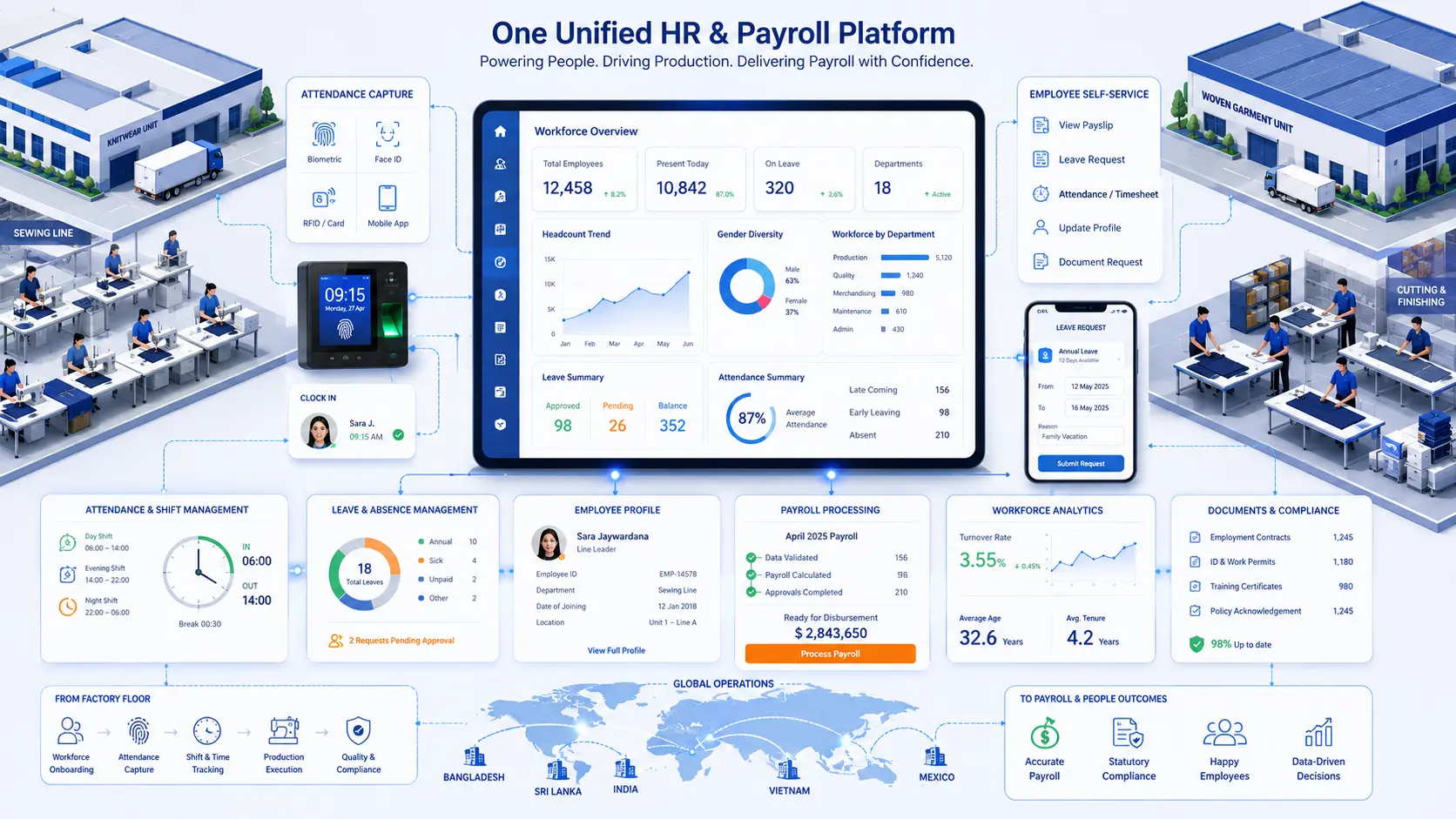
In a well-run garment factory, payroll data and production data are inseparable. The number of units produced per worker feeds into piece-rate calculations. Attendance recorded at the factory gate feeds into overtime and bonus calculations. A payroll system that cannot connect to production management and attendance systems forces HR teams to rely on manual data reconciliation — a time-consuming process that introduces errors at every handoff.
What manufacturers need from their HR and payroll platform
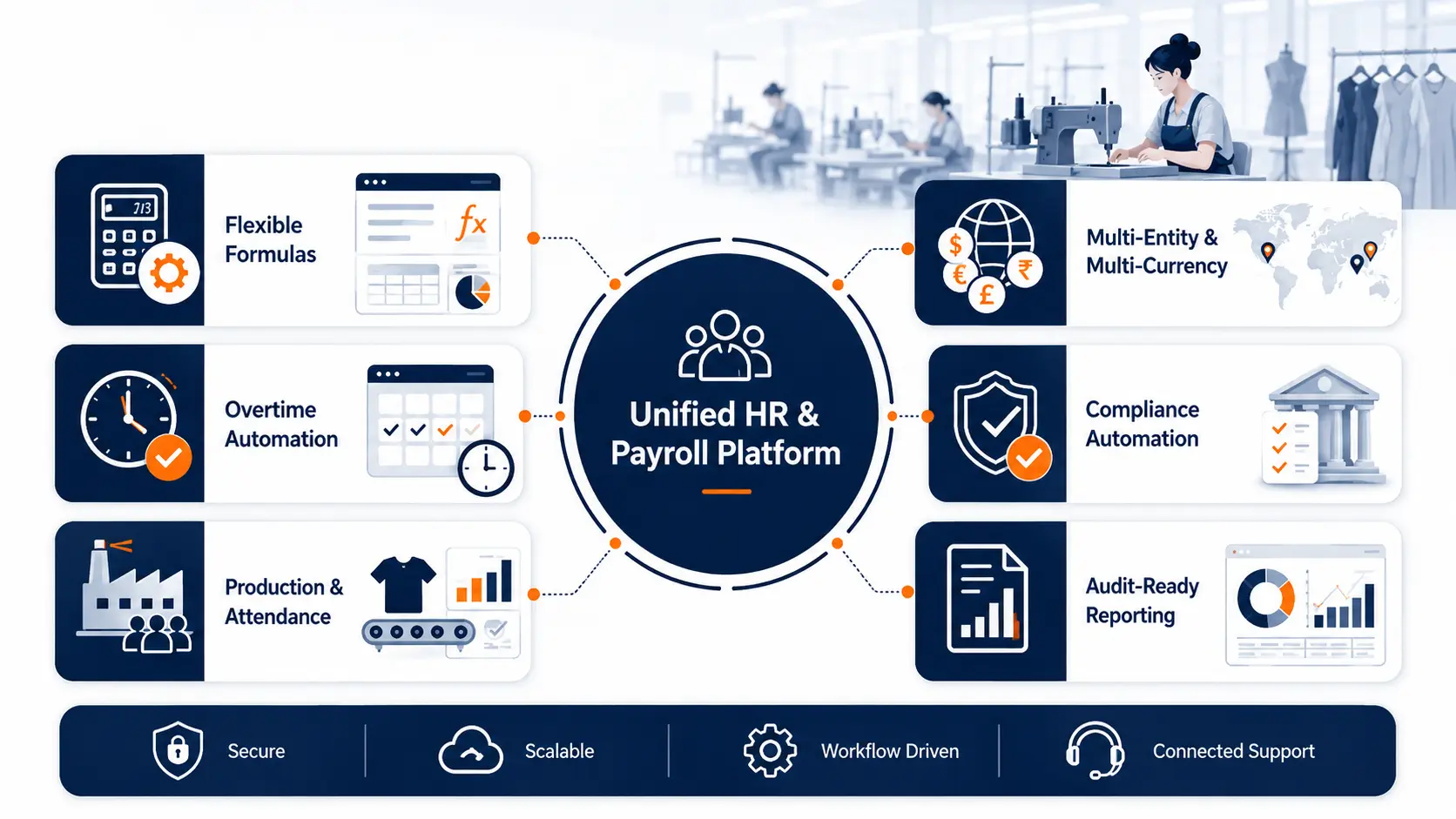
Addressing the payroll complexity of a garment or apparel operation requires a platform designed for it. Standard off-the-shelf payroll tools built for white-collar, or retail workforces, do not provide the right architecture. The following capabilities are the minimum requirement for a manufacturer operating at any meaningful scale.
Flexible salary formula configuration. The platform must allow employers to configure multiple pay types — fixed salary, hourly, piece-rate, or hybrid — within a single system, with the ability to apply different formulas to different worker categories within the same payroll run.
Automated overtime calculation with statutory rule enforcement. Overtime must be calculated automatically based on actual hours worked, with the system applying the correct rate multiplier and flagging where legal limits are at risk of being exceeded. This should be configurable by country and entity.
Production and attendance integration. The payroll engine must be able to receive attendance and production data directly — whether from biometric devices, mobile clock-in, or a manufacturing execution system — without requiring manual re-entry. This eliminates reconciliation errors and speeds up the pay run.
Multi-entity, multi-currency payroll. For manufacturers operating across borders, the platform must support simultaneous payroll processing for multiple legal entities in multiple currencies, with separate statutory rule sets and reporting for each.
Statutory compliance automation. Social security contributions, income tax deductions, pension fund payments, and other statutory obligations must update automatically as regulations change, with built-in compliance checks before each pay run is finalised.
Audit-ready reporting. Every pay run must generate a complete audit trail — from input data through to final payment — with exportable reports for internal review, labour inspections, and brand compliance audits.
MiHCM for garment and apparel manufacturers
“We first implemented the Payroll and Attendance modules for Sri Lanka, and we were able to go live within just three months. Thereafter we implemented them in Ethiopia, Egypt, and Kenya. Having experienced the stability of these modules, we started rolling out the Talent Management, Performance Appraisal, and Recruitment modules. MiHCM Enterprise is a single solution, so once you have set up the core, you can easily expand it to the remaining modules.”
— Hela Apparel Holdings PLC
“Timex Garments has been operating in the apparel industry since 1967. We chose MiHCM because I know how it is built and how it works.”
— Timex Garments
- MiHCM Payroll with customisable salary formulas, automated calculations, and flexible payment schedules
- Time and Attendance with biometric, RFID, barcode, and mobile clock-in support — including facial recognition, fingerprint, and GPS-based attendance capture
- Integration with manufacturing execution systems and third-party production management tools
- Multi-entity, multi-currency payroll supporting operations across Asia, with statutory compliance for markets including Malaysia, Sri Lanka, Bangladesh, Cambodia, Thailand, and beyond
- MiHCM Analytics with custom Power BI dashboards for workforce and productivity insights
- Employee self-service via the MiHCM mobile app for payslip access, leave requests, and work activity submissions
- MiA ONE, MiHCM’s personal AI agent, for conversational HR support and workflow automation
The bottom line
Apparel payroll is complex by design. The structure of the industry — variable pay, shift-based work, multi-plant operations, and tight labour compliance requirements — means that general-purpose payroll tools will always fall short. Manufacturers that invest in a platform purpose-built for this complexity do not just reduce errors. They build the data foundation for operational visibility, compliance confidence, and the kind of workforce insight that drives better decisions at scale.
To find out how MiHCM supports apparel and garment manufacturers, visit mihcm.com or book a demo.