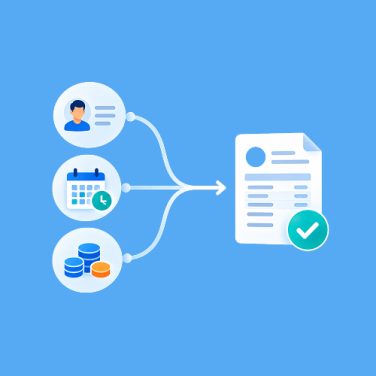

This guide presents 11 pragmatic AI performance management examples HR teams can copy: tactical use-cases across goal‑setting, feedback, coaching, review automation, skills detection and wellbeing monitoring. Read with the intent to run short, measurable pilots that show value quickly.
- Scope: practical, tactical examples across goal‑setting, feedback, coaching, review automation, skills detection and wellbeing monitoring.
- Why examples matter: executives need replicable, measurable pilots rather than theory—each example below maps to outcomes and next steps.
- Who this guide is for: CHROs, People Analytics, HR Ops, L&D and line managers who will implement or sponsor pilots.
- What success looks like: measurable outcomes such as reduced manager admin time, increased % goals on‑track, and earlier interventions that reduce voluntary exits in targeted cohorts.
Quick wins, biggest risks and what to pilot first
- Top quick wins: feedback drafts, SMART goal templates, manager nudges, skill-gap alerts.
- Primary risks: data quality, manager over-reliance on AI, privacy exposures and model bias—mitigate with human review, guardrails and transparency.
- Pilot recommendation: pick a single, measurable use-case (for example, reduce manager time on reviews) and run a focused 6–12 week pilot to get rapid learning. Industry guidance recommends short pilots to validate UX and data assumptions before wider rollout (SHRM, 2024 and sector governance templates suggest 4–8 week initial pilots).
- Early success metrics: time saved on admin, % managers using AI recommendations, % goals on‑track, pilot NPS from managers.
- Call to action: assemble a small cross-functional team (People, Analytics, IT, Legal) before piloting and use the buyer’s guide to assess vendors.
How AI is used across the performance management lifecycle
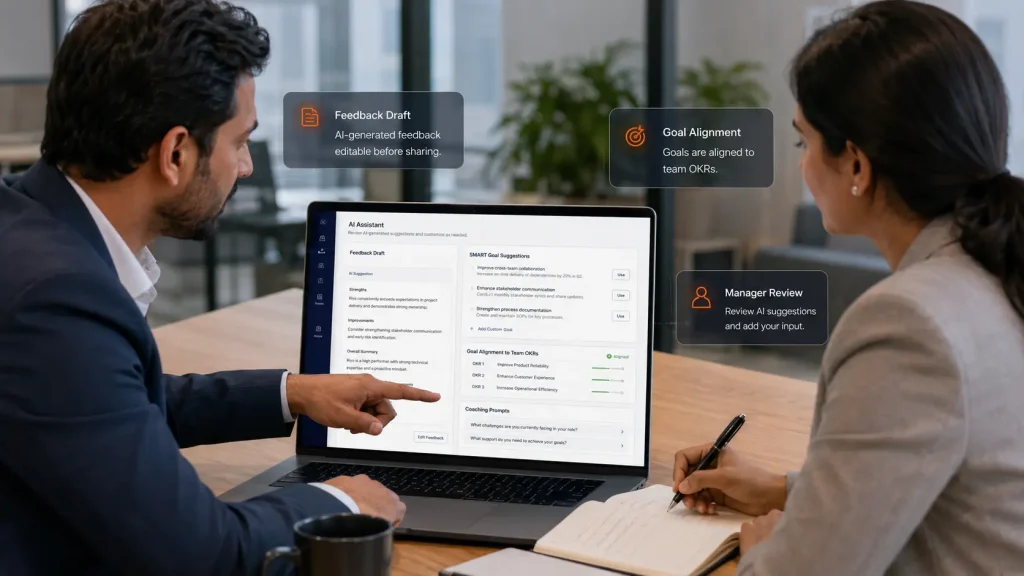
AI touches multiple stages of the performance lifecycle by aggregating signals, summarising inputs and surfacing action. Key patterns:
- Data aggregation: combine LMS, ATS, time & attendance, project metrics and 360 inputs into a unified performance signal for analysis and alerts.
- Continuous feedback: NLP extracts highlights from 1:1 notes and peer comments and drafts suggested feedback items for managers to edit.
- Goal‑setting: generative models propose SMART goals from job descriptions and past outcomes and map them to team/company OKRs.
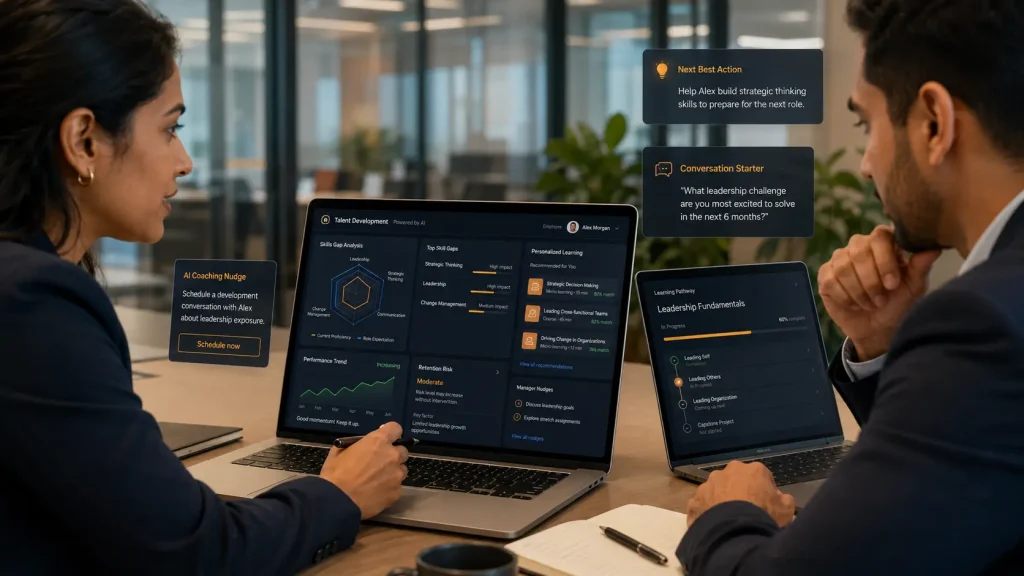
- Coaching & nudges: models detect slipping skills or performance signals and trigger micro‑learning or manager prompts integrated in workflows.
- Review automation: AI synthesises multi-source inputs into editable appraisal drafts, reducing repetitive writing and standardising language.
- Predictive analytics: risk scoring (turnover, absenteeism) and productivity forecasts help prioritise interventions.
- Wellbeing monitoring: combining absence records, survey sentiment and workload metrics produces confidential wellbeing flags for human review.
Where AI adds the most value (and where it doesn’t): AI scales timely, personalised coaching and routine drafting tasks but should not replace human judgment on evaluation, compensation or promotion decisions. Use interpretable models and clear human‑in‑loop gates for high‑impact decisions.
11 real-world examples of AI in performance management
Below are 11 mini case studies framed as Problem → AI approach → Plausible outcome → Recommended next steps. Use each as a template for a short pilot.
1) Automated feedback generation (drafting reviews)
- Problem: Managers spend hours writing similar appraisal comments leading to inconsistent tone and delays.
- Approach: Use NLP to summarise peer, manager and performance data; generate editable feedback drafts with suggested strengths and areas to improve.
- Outcome: Organisations and vendors report time savings and higher completion rates when managers edit AI drafts rather than writing from scratch—treat reported percentages as illustrative and measure in your context.
- Next steps: Pilot with one department; require manager edits and track time saved, completion rates and qualitative manager NPS.
2) AI-assisted goal setting and alignment
- Problem: Goals are often vague, misaligned and hard to measure.
- Approach: GenAI proposes SMART goals from role profiles and past outputs and maps them to team OKRs for consistency.
- Outcome: Pilots typically show more measurable goals and better alignment; treat reported uplift ranges from vendors as directional and validate with a baseline measurement.
- Next steps: Provide SMART templates, require manager approval and measure % of goals that meet measurability criteria pre/post pilot.
3) Personalised development pathways (learning + career mapping)
- Problem: L&D offers generic content with low uptake.
- Approach: Match skills inventory and role profiles to curated learning content; recommend micro‑learning and stretch assignments personalised by AI.
- Outcome: Higher course completion and clearer promotion readiness signals when recommendations are tightly scoped to role requirements.
- Next steps: Start with high‑value roles (e.g., sales engineers), measure course completion and pre/post skill assessments.
4) Skills-gap detection for team planning
- Problem: Aggregated team skill shortfalls are hard to surface.
- Approach: Cluster skills from CVs, project histories and learning records to map strengths and gaps across teams.
- Outcome: Targeted hiring or upskilling reduces project delays and training inefficiencies when paired with measurable KPIs.
- Next steps: Run quarterly skill-gap reports and pilot a targeted training program for one delivery team.
5) Real-time performance alerts (proactive manager interventions)
- Problem: Managers learn about performance issues late.
- Approach: Define thresholds on quantitative and qualitative signals (sales drops, negative peer feedback) and push alerts to managers with suggested conversation starters.
- Outcome: Faster remediation conversations and fewer escalations when alerts are accurate and reviewed by humans first.
- Next steps: Define thresholds, test false-positive rates and require human review before any formal action.
6) Predictive turnover & retention modelling
- Problem: Voluntary exits are often obvious only after patterns emerge.
- Approach: Predictive models score flight risk using engagement, compensation, tenure and role signals; prioritise high‑value cohorts for outreach.
- Outcome: Vendor pilots report variable reductions in voluntary turnover for targeted cohorts; treat percentage ranges as vendor‑reported and validate with your cohort A/B tests.
- Next steps: Start with critical roles, measure outreach impact and iterate on intervention design.
7) AI coaching nudges (micro-learning & manager prompts)
- Problem: Coaching is inconsistent and depends on manager bandwidth.
- Approach: Surface short, role‑specific micro‑lessons and nudge managers with specific coaching prompts based on observed behaviour gaps.
- Outcome: Increased coaching frequency and improved skill adoption when nudges are timely and actionable; measure changes in coaching cadence and skill outcomes.
- Next steps: Integrate micro‑lessons into manager workflows and monitor adoption.
8) 360 feedback synthesis and summarisation
- Problem: 360° feedback produces large volumes of text that are hard to action.
- Approach: Use NLP to cluster themes, extract representative quotes and recommend development actions.
- Outcome: Faster, action‑ready summaries that reduce analysis time and produce clearer development plans.
- Next steps: Require human sign‑off and run an accuracy comparison against manual summaries.
9) Bias detection in appraisal language and ratings
- Problem: Appraisals may contain gendered or cultural bias in language and ratings.
- Approach: Statistical audits and NLP flag biased phrases and anomalous rating distributions for review.
- Outcome: More equitable outcomes and higher trust when coupled with remediation training and transparent reporting.
- Next steps: Run regular audits, present anonymised results to leadership and set remediation goals.
10) Wellbeing and burnout risk monitoring
- Problem: Burnout often emerges late and drives sudden attrition.
- Approach: Combine absence patterns, survey sentiment, workload and meeting patterns to generate wellbeing risk scores for confidential follow-up.
- Outcome: Earlier manager check‑ins and targeted workload adjustments where opt‑in dashboards and strict privacy controls are in place.
- Next steps: Implement opt‑in employee dashboards and clear privacy guardrails.
11) Sales/performance optimisation via behavioural patterns
- Problem: It’s hard to scale top‑performer behaviours across teams.
- Approach: Behavioural analytics identify repeatable patterns (e.g., follow‑up cadence) and convert them into playbooks and nudges.
- Outcome: Improved average performance and reduced ramp time when playbooks are tested in small pods.
- Next steps: Pilot with one sales pod, measure conversion and ramp improvements, and codify effective behaviours.
How to design a measurable pilot for performance AI
Design a pilot that isolates one outcome, limits scope and measures impact. Follow these steps:
- Objective: choose a single, measurable metric (time saved, % goals on‑track, drop in voluntary churn for a cohort).
- Population: pick one function or cohort with clean data and a supportive manager sponsor.
- Duration: set a short experiment window for quick‑feedback use‑cases (6–12 weeks is common for feedback/goal‑setting pilots). Industry guidance supports short pilots to validate assumptions (SHRM, 2024).
Success metrics and measurement
- Define baseline and uplift target, sample size and measurement cadence; include qualitative manager/employee feedback (pilot NPS).
- Use an A/B or cohort test where possible to attribute changes to the intervention.
Guardrails and governance
- Decide what AI can suggest versus what it can action. All outputs affecting evaluation or pay must require human review.
- Set privacy limits and pseudonymise signals where possible.
Quick fairness checklist for HR models
- Document protected attributes and proxies.
- Run subgroup metrics (AUC, precision, calibration) and disparate impact tests.
- Apply mitigation and re‑evaluate; require human review for flagged cases.
- Publish an impact statement and maintain a risk register for mitigation and monitoring plans.
Embed human‑in‑the‑loop governance: log decisions, require manager acknowledgement for automated interventions, and keep an appeals route for employees. Use MiHCM’s Workforce Demographics Insights to support auditing and inclusive statistics in regular reports.
Implementation steps
- Data access and mapping (HR master data, performance notes, learning records).
- Model or feature selection and a minimal UX integration (drafts in SmartAssist or read‑only alerts in manager dashboard).
- Pilot run, collect metrics and qualitative feedback, iterate.
Data, inputs and technical requirements for success
Successful performance AI pilots depend on a small set of reliable inputs and operational practices.
Essential data sources:
- HR master data (employee ID, role, manager reporting lines).
- Performance ratings and historical appraisal notes.
- 1:1 meeting notes, LMS/course completion records, project outcomes and time & attendance.
- Engagement surveys and anonymised sentiment signals where available.
Quality over quantity:
- Consistent identifiers, recent timestamps and labelled outcomes improve model accuracy—cleaning and mapping often take most of the pilot time.
- Minimise data surface: only use signals required for the use case and pseudonymise sensitive fields when possible.
Model selection & monitoring:
- Prefer interpretable models (logistic regression, decision trees) for high‑stakes HR decisions or use explainability layers for black‑box models.
- Track performance drift, fairness metrics and human overrides; log decisions and the signals that produced recommendations.
Integration patterns:
- Near‑real‑time pipelines for alerts; batch scoring for quarterly models. Use APIs to embed drafts and nudges into SmartAssist or MiA manager flows.
- Keep a clear data lineage so each recommendation can be traced back to source signals for audit and compliance.
Ethics, bias mitigation and governance for HR AI

Ethics and governance are central. Implementing AI without guardrails exposes organisations to reputational, legal and fairness risks. Practical measures:
Governance structure
- Create a cross‑functional committee (People, Legal, Data Science) to approve use‑cases and review outcomes.
Transparency and employee engagement
- Inform employees about what data is used and how recommendations are surfaced; allow opt‑outs where legally appropriate.
Bias audits and monitoring
- Run regular subgroup tests (gender, ethnicity, tenure) for disparate impact and monitor rating distributions for anomalies.
- Use NLP to flag biased appraisal language and track remediation progress.
Human‑in‑the‑loop
- Require manager review for recommendations that affect appraisal, promotion or pay and store a documented rationale for final decisions.
Data controls
- Strict role‑based access, encryption at rest/in transit and comprehensive audit trails.
Practical monthly bias tests HR teams can run: subgroup model performance (AUC/precision), distributional checks on ratings and automated language audits on newly written appraisal text. If issues arise, pause automated actions and institute remediations before wider rollout.
Integrating AI with your HRIS and workflows
Integration is where value becomes usable. Focus on identity sync, event data and action endpoints.
Integration priorities
- Identity sync: reliable employee and manager IDs across systems.
- Event data: learning completions, project outcomes and time events into an event stream.
- Action endpoints: feedback drafts, nudges and alert delivery (email, Slack/Teams, manager dashboard).
UX placement matters
- Embed AI where managers already work—MiA, manager dashboards or calendar reminders—to reduce context switching.
APIs vs native modules
- If your HRIS lacks native AI modules choose vendors with secure APIs and pre‑built connectors; this reduces engineering time.
Change management
- Train managers with example outputs and create a feedback loop to refine prompts and templates. Start with display‑only summaries before enabling write/act capabilities.
Maintain clear event logs so every AI recommendation is traceable back to source signals for audit and compliance. Use API‑first integration patterns or embedded widgets depending on your platform maturity.
Tools & vendor checklist for buying AI in performance management
Choose vendors that provide strong security, explainability and integration. Key checklist items:
- Data security & compliance: encryption, SOC2/ISO certifications and data residency assurances.
- Explainability & audit logs: human‑readable model explanations, change history and human review controls.
- Integration & extensibility: pre‑built connectors to HRIS (MiHCM), LMS, calendar and Slack/Teams.
- UX: editable drafts, manager nudges that fit workflows and employee opt‑ins for wellbeing features.
- Support & SLAs: vendor support for model tuning, custom KPIs and patchability of models.
- Pricing model: inspect per‑active‑employee vs per‑feature pricing and hidden pipeline costs.
Use the checklist to speed evaluation and reduce integration risk. For help mapping features to MiHCM modules see the MiHCM buyer resources and integration notes.
How MiHCM maps to these examples (features → use cases)
MiHCM components map directly to the case studies above and provide an out‑of‑the‑box integration path for pilots.
- MiHCM Data & AI: runs predictive models for turnover and absenteeism and powers skill‑gap clustering used in examples #4 and #6.
- SmartAssist: drafts feedback (example #1), generates SMART goal suggestions (example #2) and pushes coaching nudges (example #7) into manager flows.
- Analytics & Dashboards: visualises on‑track goals, manager activity and pilot KPIs for measurement and monitoring.
- MiA: gives conversational access for employees to view feedback, accept nudges and see personalised development paths.
- MiHCM Lite/Enterprise: serve as the HR master data source and approvals workflow to ensure human‑in‑loop review before automated actions.
Low-cost and SME-friendly approaches
Small organisations can capture meaningful value without heavy engineering. Recommended low-cost paths:
- Start with feedback drafting, SMART goal templates and simple alerts—these require minimal data and integration.
- Use MiHCM Lite to centralise employee data and MiA for manager/employee access without heavy engineering overhead.
- Leverage third‑party generative models via secure APIs for draft text but keep outputs within an approval workflow.
- Measure quickly: run 6–12 week pilots focused on admin time saved and manager willingness to adopt AI assistance.
- Prefer vendors offering fixed‑price pilots or success‑based pricing to lower upfront costs; if in‑house data science is limited, use off‑the‑shelf models with explainability and conservative action thresholds.
Measuring ROI: metrics, benchmarks and expected outcomes
Define clear KPIs for pilot success and tie them to business outcomes. Common metrics:
Metric | Baseline | Target | Cadence |
Hours saved per manager per review cycle | Measure pre‑pilot | Set % uplift target | Per cycle |
% increase in coaching frequency | Measure 1:1 frequency | Raise by X% | Monthly |
% goals on‑track | Quarterly baseline | Measured uplift | Quarterly |
Voluntary turnover (targeted cohort) | 3‑month baseline | Test cohort uplift | 3–6 months |
Notes on benchmarks: many vendors publish case study numbers for time savings and retention uplift; treat those as directional and validate with your A/B or cohort tests. For quick‑win pilots (feedback drafting, goal templates) expect measurable changes in 6–12 weeks while retention improvements typically require 3–6 months of measurement.
Use a 3‑month pre‑pilot baseline, run an A/B or cohort test and report uplift with confidence intervals. Document both quantitative outcomes and manager/employee qualitative feedback to present a holistic ROI to leadership.
Frequently Asked Questions
Will AI replace managers?
No. The best implementations reduce admin and enable more frequent, higher‑quality coaching.
What minimum data is required?
Basic HR master data plus recent performance notes and learning records; richer signals improve model accuracy.
How long to see results?
Quick wins (feedback drafting) can be observed in 6–12 weeks; retention outcomes typically need 3–6 months for evaluation (SHRM, 2024).
How to handle bias?
Regular audits, human‑in‑the‑loop approvals and employee transparency are essential.
How does MiHCM help SMEs?
MiHCM Lite and MiA centralise data and provide low‑cost access to AI features via SmartAssist and MiHCM Data & AI modules.