
The technology is rarely what fails. The system goes live, the data migrates, the integrations hold. Eighteen months later, managers are still approving leave over email and payroll is still reconciled in a spreadsheet nobody will admit to owning.
Two disciplines decide which way HR digital transformation goes: governance and change management. Most programmes treat both as overhead: a steering committee that reviews slides and a communications plan that ends at go-live. Neither is overhead. Together they are the delivery mechanism.
Here is what each one actually involves, why the evidence says they matter more than the platform choice, and how to build both into a transformation without adding a layer of bureaucracy nobody respects.
Why does HR digital transformation stall after go-live?
Because adoption is a leadership outcome, and leadership is not part of most implementation plans.
Gartner research published in July 2025 found that only one in three (32%) mid-to-senior business leaders said the last change they led achieved healthy change adoption by employees — defined as getting people to act on the change, on time, and in a way that does not damage performance, engagement or wellbeing.
The trust position underneath that number is worse. An April 2025 Gartner survey of more than 2,850 employees found 79% have low trust in change. A parallel April 2025 survey of 141 HR leaders found that organisations experiencing what Gartner calls “ungovernable change” are 1.6 times less likely to report high change trust.
The number that should get the CFO’s attention Gartner reports that organisations with better than average healthy change adoption record two times higher year-on-year revenue growth. For companies with more than 50,000 employees, Gartner puts that at up to USD 2.2 billion annually. |
And in October 2025, Gartner reported that just 45% of employees said they had realised the change goals set by their organisation. Fewer than half.
None of that is a software problem. It is a governance and change problem wearing a software costume.
What does governance mean in an HR digital transformation?
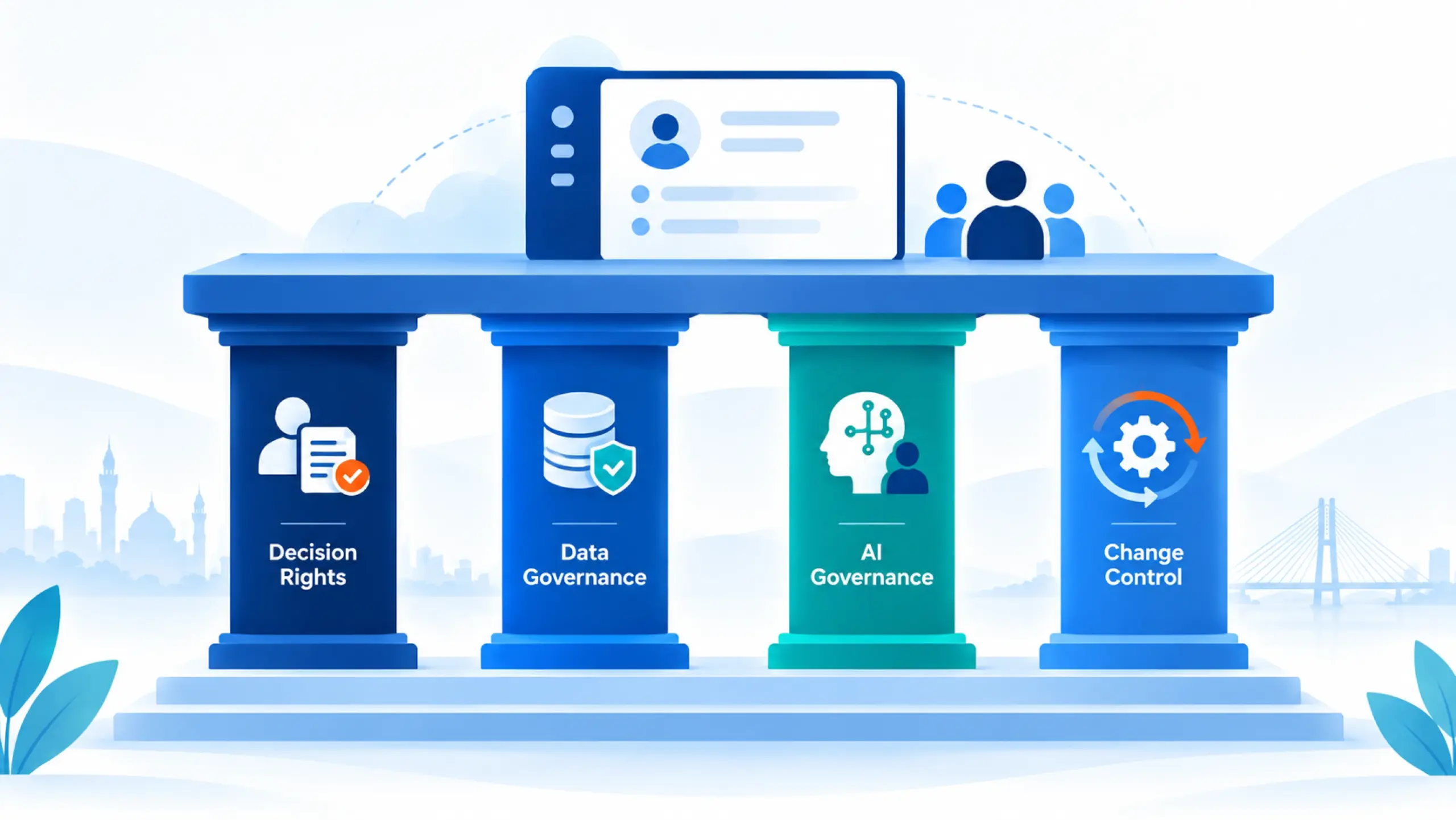
Governance is not a monthly forum that receives a status update. It is the set of written answers to four questions, agreed before configuration begins.
1. Decision rights
Who decides on a process exception? Who is consulted? What is the maximum time an escalation can sit unresolved? Programmes that skip this end up with every disputed configuration item routed to the same overloaded HR director, and a backlog that becomes the critical path.
2. Data governance
One system of record per data domain, with a named owner. Agreed definitions for the terms that will appear on every report — headcount, full-time equivalent, attrition, absence, cost to company. Retention periods set against the statutory requirement in each market, not the longest one. If two systems can both answer “how many people work here”, the number will be wrong in at least one of them.
3. AI governance
An inventory of where AI touches an employment decision — screening, scoring, ranking, scheduling, performance signals, attrition prediction. For each, a record of the intended purpose, the human who reviews the output, and what that human can actually override.
4. Vendor, statutory and change control
Who signs off a configuration change after go-live. Who tracks statutory change across every market you operate in, and how that reaches the payroll configuration before the cycle it affects. In multi-country operations this is the single most commonly unowned responsibility.
When does AI governance in HR become a legal obligation?
Sooner than most HR teams have planned for, and the scope is broader than recruitment.
Under the EU AI Act (Regulation (EU) 2024/1689), employment and worker management is one of eight Annex III domains treated as high-risk. That covers AI used to filter or analyse applications, evaluate candidates, allocate tasks, or support decisions on promotion, termination, monitoring or evaluation.
The timeline moved in 2026. The Digital Omnibus on AI — adopted as Regulation (EU) 2026/1744 — entered into force on 27 July 2026. The European Commission confirms that high-risk obligations for Annex III systems now apply from 2 December 2027, and for AI embedded in regulated products under Annex I from 2 August 2028.
The deferral is not a reprieve from the work. When those obligations land, they require risk management, data governance, technical documentation, record-keeping, transparency to deployers, human oversight, accuracy, robustness and cybersecurity. Those are governance artefacts. They take longer to build than the sixteen months that were added.
For employers headquartered in Asia, the relevance is twofold. The Act reaches providers and deployers whose AI outputs are used in the EU, which captures any organisation with EU-based staff or EU-facing hiring. And separately, the Act has become the de facto template that enterprise procurement teams now apply regardless of jurisdiction.
The parallel standards route is ISO/IEC 42001:2023, the first international standard for an artificial intelligence management system. It is certifiable, and it sets out requirements for AI risk assessment, impact assessment, lifecycle management and third-party supplier oversight — which maps closely onto what a governance forum needs to be able to evidence.
Scale check In a December 2025 Gartner survey of 110 CHROs, 78% agreed that workflows and roles will need to change to get the most out of their AI investments. In the same survey, just over half of organisations had redesigned or redefined roles because of AI in the previous year. |
Why change management is not communications
The standard approach is to appoint change champions, run a town hall, publish a benefits narrative and hope enthusiasm carries the rest. Gartner’s analysis says that approach only works when change trust is already high — and it is not. When trust is low, Gartner’s model predicts that only a quarter of changes led by inspirational leaders will achieve healthy adoption.
The alternative Gartner puts forward is routinisation: making change adoption instinctive rather than exceptional. Three shifts sit underneath it.
- Clarify the leader’s change role. Leaders acknowledge progress on interim goals rather than restating an ever-shifting future vision. Constant change is the operating condition, not an event to be survived.
- Equip leaders to regulate emotion. Resistance is usually discomfort that nobody has named. Leaders need practical techniques to help people identify and cope with their reaction, not a script that talks past it.
- Build change reflexes. Identify the handful of core change skills that matter, then find moments inside ordinary work to practise them. Reflexes are built by repetition, not by briefing.
Gartner’s model predicts that when leaders routinise change, employees are three times more likely to adopt changes on time and in a healthy way — even when change trust is low.
One more finding is worth building into the plan directly. A July 2025 Gartner survey of 313 senior-level respondents found that organisations which continuously or regularly adapt change plans based on employee responses are four times more likely to achieve change success. A change plan that survives contact with the workforce unchanged is not a sign of good planning. It is a sign that nobody listened.
How do governance and change management reinforce each other?
Separately, each one fails in a predictable way.
- Governance without change management produces a technically compliant system with clean data and almost no users. Every control is documented. Nobody logs in.
- Change management without governance produces a strong launch followed by eighteen months of drift. Exceptions accumulate, local workarounds harden, and the single source of truth quietly forks.
Three interlocks connect them in practice.
- Every configuration decision carries a named owner and a communication consequence. If a decision changes what a manager does on a Monday morning, the decision is not closed until that manager has been told.
- Adoption data goes to the governance forum, not just to the project manager. A forum that reviews milestones but never reviews usage will approve a successful project and an unused system.
- The escalation path has a service level. An unresolved exception is a governance failure with a date on it, not a standing agenda item.
Gartner flags one trap specifically for 2026: performative participation, where employees appear to engage with change in order to access opportunity, without genuinely adopting it. The recommended response is to use adoption data to find where people need more support, and pair that with work on psychological safety — so the data reflects behaviour rather than compliance theatre.
A twelve-month operating rhythm
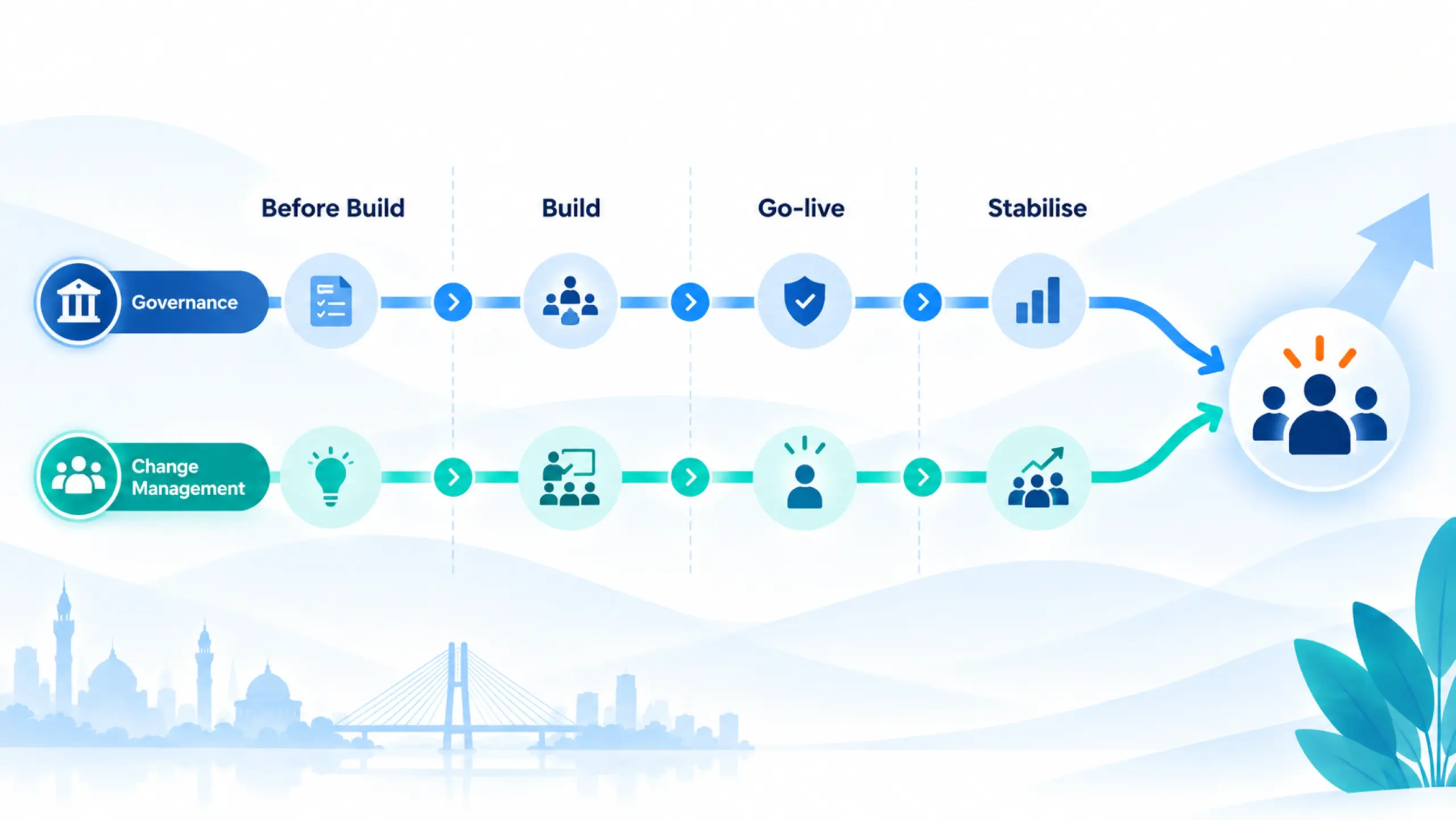
Governance that arrives at go-live has arrived too late. This is a workable sequence for a mid-sized multi-country HR transformation.
Phase | Governance | Change management |
Weeks 1–4 Before build | Decision rights matrix. Data domain owners. AI inventory. Success measures signed off. | Baseline current process reality. Identify the managers whose behaviour has to change. |
Months 2–5 Build and configure | Change control log opens. Statutory ownership assigned per market. Exception register live. | Manager enablement built into the configuration cycle, not bolted on after it. |
Months 6–7 Go-live | Escalation SLA in force. Governance forum reviews adoption from week one. | Support at the point of use. Collect employee response and adapt the plan. |
Months 8–12 Stabilise | Retire parallel processes formally. Audit data definitions against live reports. | Move from support to reflex. Embed the core change skills into routine management. |
What metrics show the transformation is actually working?

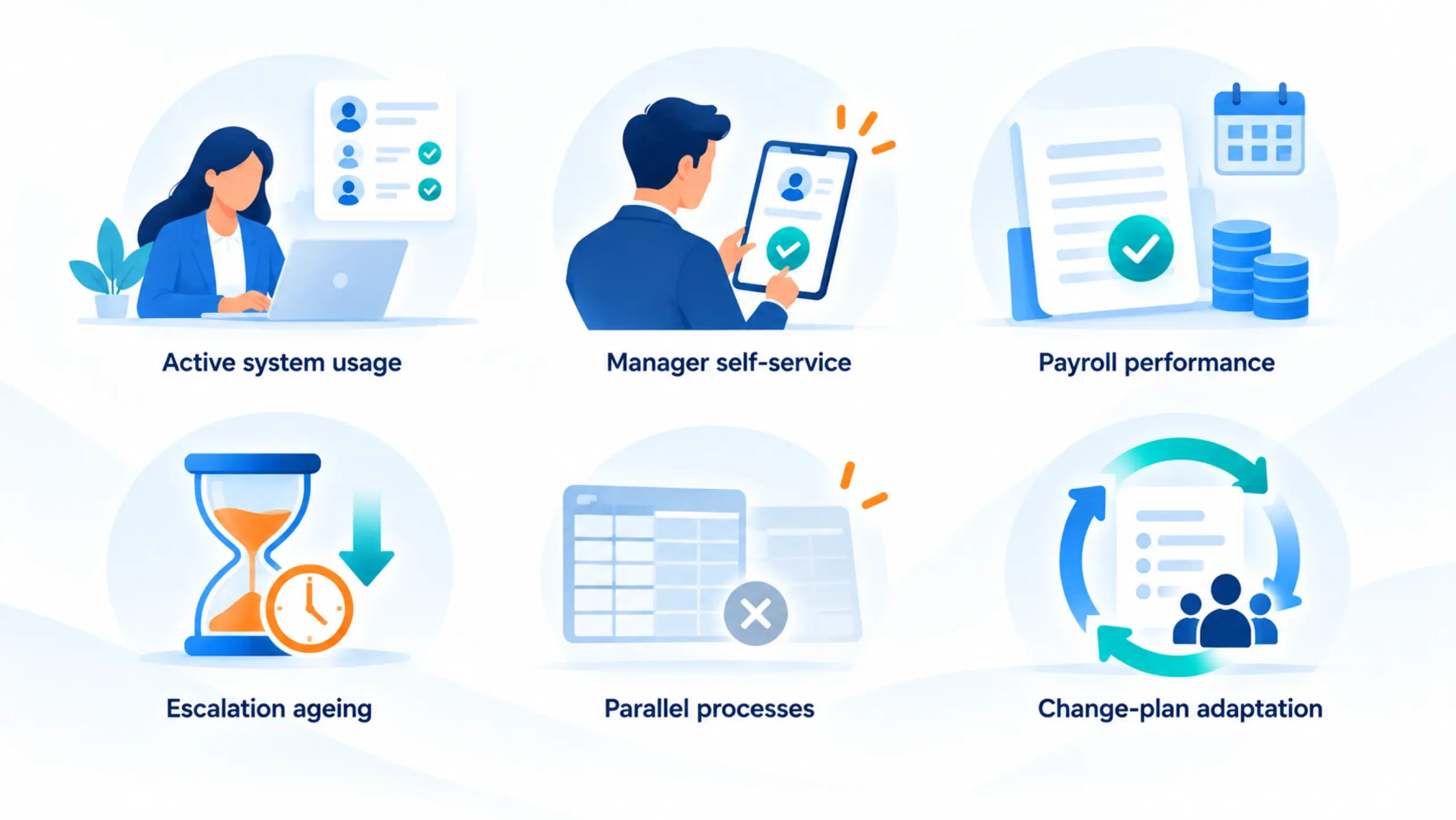
Licences issued is not adoption. Training completion is not adoption. Six measures tell you the truth.
- Active usage by role — particularly line managers, who are the group most likely to revert.
- Manager self-service completion rate, measured against the transactions HR used to absorb on their behalf.
- Payroll cycle time and error rate, tracked per market rather than as a group average.
- Escalation ageing — how long open exceptions have been open, not how many exist.
- Parallel process count — the number of spreadsheets and email workflows still running alongside the system. This number should be falling and eventually reach zero.
- Change plan adaptation frequency — how often the plan has been revised in response to employee feedback.
Five failure patterns worth naming early
- A steering committee with no decision rights. It reviews, it notes, it escalates upward. Decisions still wait.
- A governance forum that never sees adoption data. Green status on delivery, red reality in the business.
- Training treated as an event. One session before go-live, nothing at the moment of use.
- No owner for statutory change across markets. Works until the first mid-year contribution rate change in a market nobody was watching.
- AI pilots outside the governance perimeter. A screening tool procured by a regional team, unlogged, unreviewed, and squarely inside the definition of high-risk employment AI.
Where the platform can carry some of the load
Governance is organisational work, but the system either supports it or fights it.
The questions worth asking a vendor are narrow ones: can it enforce role-based access and approval hierarchies that match the decision rights matrix; does it keep an audit trail of configuration and record changes; does it handle statutory requirements market by market rather than through custom workarounds; and can it report adoption by role so the governance forum has something real to look at?
MiHCM was built for multi-country operations of this kind, with statutory handling maintained per market across Asia, role-based access and approval workflows, and audit trails across HR and payroll records. Its AI capabilities are delivered through MiA ONE, an AI-powered personal assistant, and Syntra, the AI intelligence layer built on Microsoft Azure. MiHCM holds ISO/IEC 27701:2025, ISO/IEC 27001 and ISO 9001 certification from DNV, and operates under SOC 2 Type II, GDPR and PDPA requirements.
Frequently Asked Questions
Governance is the agreed structure of decision rights, data ownership, AI oversight and change control that runs a transformation. In practice it answers four questions in writing: who decides, who owns each data domain, where AI touches employment decisions and who reviews it, and how configuration changes are approved after go-live.
Communications tells people what is happening. Change management changes what people do. Gartner’s research indicates that inspiration-led approaches work only where change trust is already high, and that routinising change — building adoption into ordinary work through repeated practice — makes employees three times more likely to adopt changes on time and in a healthy way when trust is low.
Ownership sits with a cross-functional forum rather than a single function. HR owns process and adoption, IT owns integration and security, Finance owns payroll controls and benefit measurement, and Legal or Compliance owns statutory and AI obligations. Gartner recommends strengthening the relationship between HR and IT specifically, including regular meetings between HR and AI leaders.
Employment and worker management is an Annex III high-risk domain under Regulation (EU) 2024/1689. Following the Digital Omnibus on AI, which entered into force on 27 July 2026, the European Commission confirms that high-risk obligations for Annex III systems apply from 2 December 2027, and for Annex I embedded systems from 2 August 2028.
Active usage by role, manager self-service completion, payroll cycle time and error rate by market, escalation ageing, the number of parallel processes still running, and how often the change plan has been adapted in response to employee feedback. Licences issued and training completion measure activity, not adoption.
At minimum through the stabilisation period — roughly six months after go-live — with adoption data on the agenda from the first week. The forum should only stand down once parallel processes have been formally retired and data definitions have been audited against live reporting.
Sources
Gartner, “Gartner HR Research Finds Just 32% of Business Leaders Report Achieving Healthy Change Adoption by Employees”, 8 July 2025 — https://www.gartner.com/en/newsroom/press-releases/2025-07-08-gartner-hr-research-finds-just-32-percent-of-business-leaders-report-achieving-healthy-change-adoption-by-employees
Gartner, “Gartner HR Research Finds Less Than Half of Employees Achieved the Change Goals Set by Their Organization”, 9 October 2025 — https://www.gartner.com/en/newsroom/press-releases/2025-10-09-gartner-hr-research-finds-less-than-half-of-employees-achieved-the-change-goals-set-by-their-organization
Gartner, “Gartner Identifies the Top Change Management Trends for CHROs in the Age of AI”, 16 March 2026 — https://www.gartner.com/en/newsroom/press-releases/2026-3-16-gartner-identifies-top-change-management-trends-for-chros-in-age-of-ai
European Commission, “AI Omnibus enters into force”, 27 July 2026 — https://digital-strategy.ec.europa.eu/en/news/ai-omnibus-enters-force
EU Artificial Intelligence Act, Annex III: High-Risk AI Systems Referred to in Article 6(2) — https://artificialintelligenceact.eu/annex/3/
ISO, “ISO/IEC 42001:2023 — AI management systems” — https://www.iso.org/standard/42001