

Payroll rarely makes headlines when it works. It only becomes visible the moment it fails – a missed allowance, a miscalculated tax code, a delayed transfer. Each mistake looks small in isolation. Add them up across a year, a department, a region, and the picture changes entirely.
Payroll errors are not a rounding error. They are a systemic drain on cash, compliance standing and employee trust — and most organisations are still measuring only the visible slice of the cost.
What payroll errors actually cost
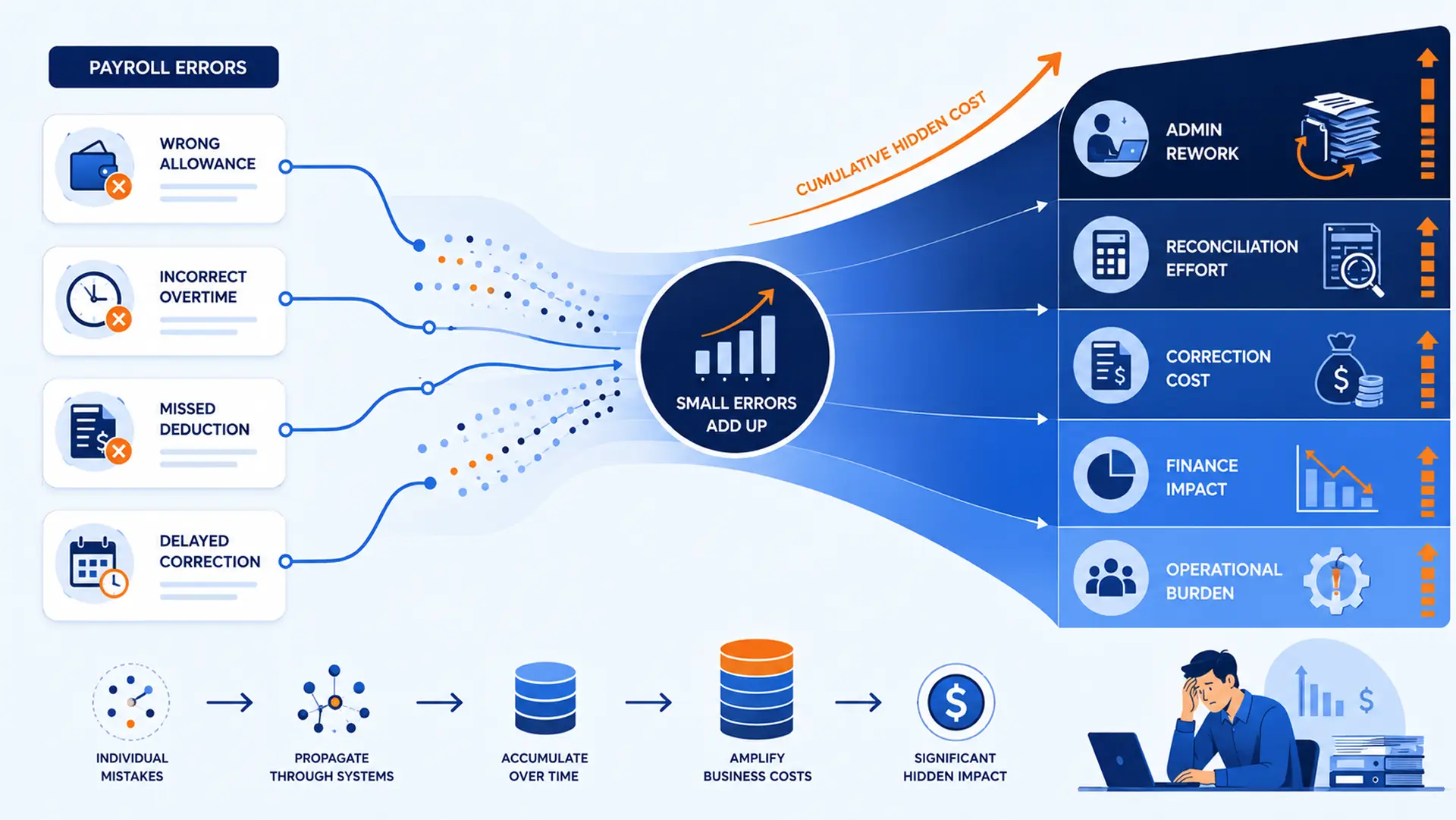
Start with the number that gets quoted most often: a single input error in a traditional payroll system costs an average of $291 to fix, according to nationwide research from EY1. That figure covers only the correction itself — reprocessing, reconciliation, admin time. It doesn’t touch the knock-on cost. Roughly one in five payroll cycles contains some form of error1, and for an organisation with 1,000 employees, the cumulative cost of correcting these mistakes can climb as high as $922,131 a year1.
Separate research from PrimePay puts the picture in relative terms: payroll errors can account for between 2% and 5% of total annual payroll spend2, with the average organisation making around 15 corrections every single pay period2. At enterprise scale, that is not an occasional inconvenience. It is a recurring, budget-eating pattern.
“For a 1,000-employee organisation, correcting payroll errors can cost up to $922,131 a year — and that’s before penalties, legal costs or lost employee trust are added.”
— EY research, cited by Paycom
The compliance bill nobody budgets for
The exposure scales sharply with organisational size. PwC UK found that the average FTSE 100 company loses between £10 million and £30 million a year to payroll errors3. That is enterprise-grade risk sitting inside what many businesses still treat as a routine administrative process.
The trend is not improving on its own. Paylocity’s 2026 State of Payroll research found that 64% of organisations lose at least 1% of total payroll spend every month to errors and inefficiencies — a persistent drain researchers term ‘payroll leakage’4. Almost half, 49%, spend six or more hours a month simply correcting mistakes4 — effectively running an unbudgeted second payroll function alongside the real one.
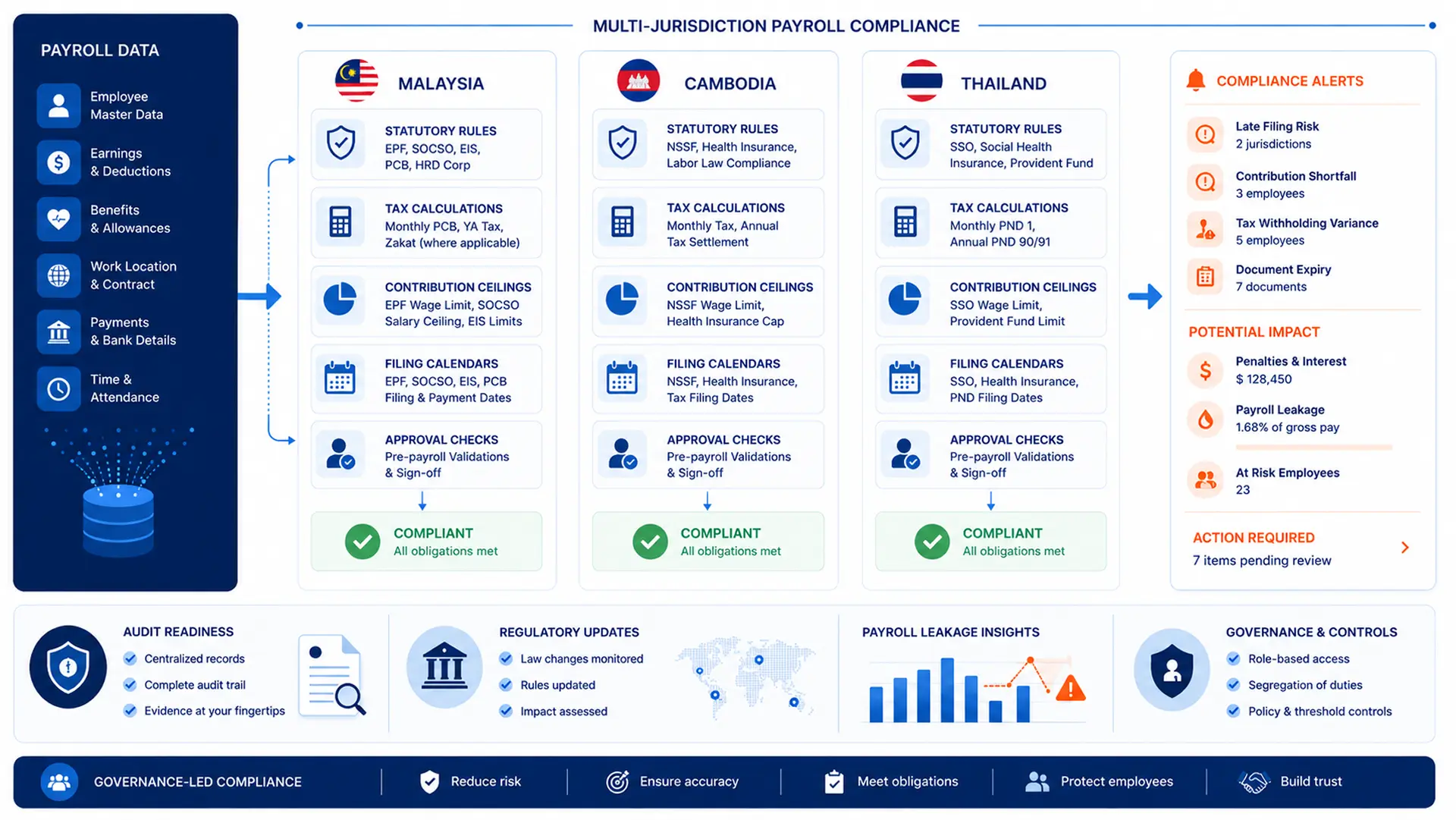
In Asia-Pacific, the shape of the risk is different but no smaller. ADP’s Potential of Payroll 2026 research found that 80% of payroll leaders in the region say keeping pace with local regulation is difficult5, and 71% report experiencing compliance penalties at least once or twice a year5. Dayforce’s Payroll Complexity Survey lists compliance as the leading concern for 45% of respondents, with managing multi-jurisdictional complexity close behind at 33%6.
For organisations running payroll across multiple Asian markets, each additional jurisdiction adds its own tax logic, statutory ceilings and filing calendar — and its own chance for something to go wrong.
The cost that never appears on a spreadsheet

Not every consequence of a payroll error shows up in a ledger. A missed or incorrect payment affects real people’s rent, loans and savings — and it affects how much they trust the organisation that employs them.
Paycom’s own research into payroll fragmentation notes that inaccurate pay ‘fractures the trust an employee has in their company’1, and that trust, once damaged, is expensive to rebuild through recruitment, onboarding and lost productivity while a replacement gets up to speed.
This is precisely why ADP frames payroll not as a back-office task but as a source of workforce intelligence — informing decisions on cost management, workforce planning and compliance risk, not just processing pay on time5. Getting payroll wrong doesn’t only cost money. It costs the credibility payroll needs to do that broader job well.
Why the errors keep happening
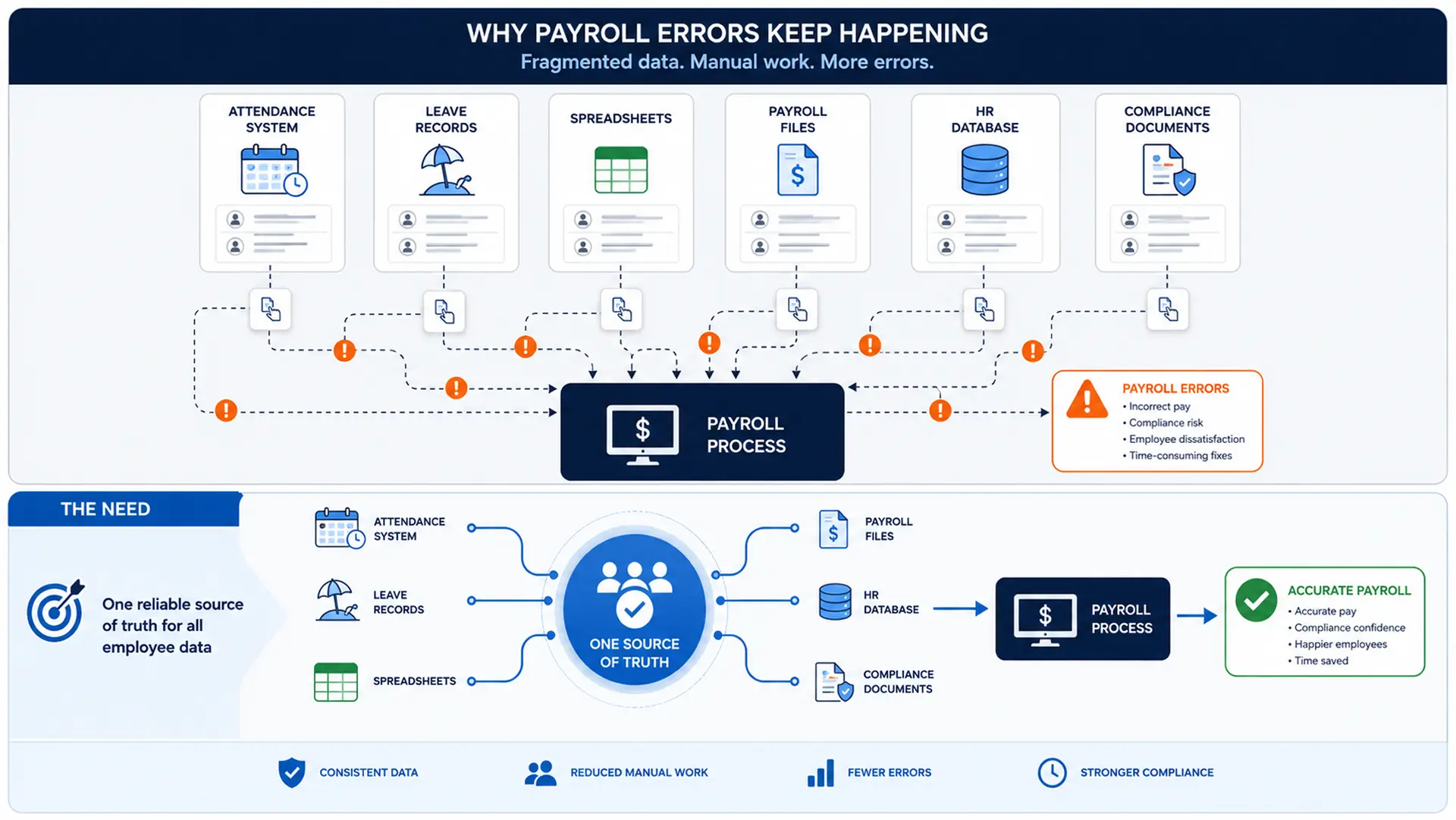
The roots are consistent across markets and company sizes. EY identifies time-tracking and data-entry mistakes as the single most common source of payroll error, occurring more than once per employee per year on average2.
Underneath that sits a structural problem: separate Forrester research found that 77% of organisations store employee information across multiple HCM databases, drawing on six or more systems on average, and 71% say they cannot effectively share employee data between those platforms1. Every manual re-entry between disconnected systems is another opportunity for a figure to be typed, copied or interpreted incorrectly.
Layer statutory complexity on top — shifting contribution ceilings, jurisdiction-specific reporting, frequent regulatory updates — and it becomes clear why payroll error rates stay stubbornly high even in well-resourced HR functions. The issue is rarely a lack of diligence. It is a lack of a single, reliable source of truth for the data payroll depends on.
Eliminating the hidden cost
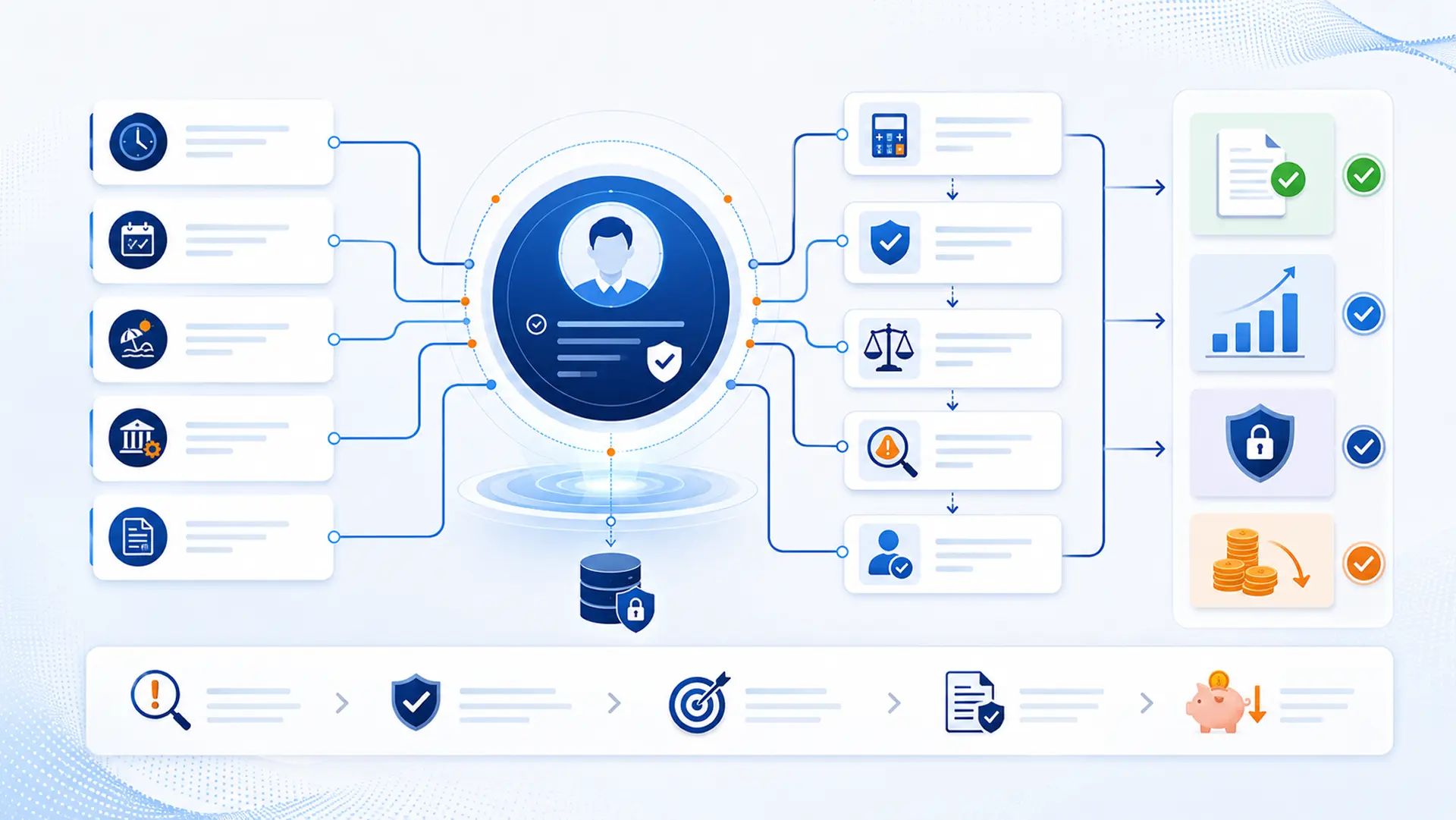
The organisations that bring payroll leakage down share a common approach: they stop treating HR data and payroll data as separate systems that occasionally talk to each other, and start running them from one connected platform. That means:
- One employee record, not several. Time, attendance, leave and statutory changes flow into payroll automatically, removing the manual re-entry step that causes most errors.
- Built-in validation before payroll runs. Automated checks flag anomalies — a missing bank detail, an unfiled tax change, an unusual overtime figure — before they become a costly retroactive fix.
- Jurisdiction-specific compliance logic. Statutory rules, ceilings and filing formats are built in per country, rather than forced through a single global template that fits none of them well.
- Human judgement kept central. Automation should flag and calculate — final sign-off on exceptions, disputes and edge cases stays with people who understand the context AI cannot see.
This is the thinking behind MiHCM Payroll. The goal isn’t to remove people from payroll decisions; it’s to remove the errors that shouldn’t need a person to catch them in the first place.
Payroll accuracy is a strategic asset, not an admin metric

The organisations getting this right are no longer measuring payroll purely by whether pay went out on time.
They are measuring it by how much of that $291-per-error tax, that 1–5% of annual payroll spend, that six-hours-a-month correction cycle, they have managed to remove from the business entirely.
That is the real return on investing in integrated payroll technology — not a smaller finance team, but a smaller list of things that can quietly go wrong.
References
- Paycom, ‘The Real Cost of Payroll Errors in 2026’, citing EY and Forrester Consulting research, 2026. paycom.com/resources/blog/payroll-errors-2026/
- PrimePay, ‘The True Cost of Payroll Errors’, 30 March 2026. primepay.com/blog/cost-payroll-errors/
- PwC UK research, cited in Lano, ‘What Is the True Cost of Payroll Errors?’, 2025. lano.io/blog/what-is-the-true-cost-of-payroll-errors
- Paylocity, ‘2026 State of Payroll: Unified Systems Gap’, survey conducted by Centiment, 2026. paylocity.com/resources/learn/articles/state-of-payroll/
- ADP, ‘Potential of Payroll 2026’ research, cited in HR Executive, ‘How data-driven payroll is redefining workforce intelligence in Asia-Pacific’, 2026. hrexecutive.com
- Dayforce Payroll Complexity Survey, cited in ‘HR and payroll compliance strategies for Asia Pacific leaders’, Dayforce, 2025. dayforce.com/asia/blog/navigating-hr-payroll-compliance-asia-pacific
Transparency note: statistics in this article are drawn from third-party research and industry publications current at the time of writing. Readers should verify figures against original sources before citing or relying on them for business decisions.