Skill gap analysis is the structured comparison between the skills required to meet current and future business needs and the skills employees actually offer.
According to a 2019 Brookings Institution article, this is commonly framed as a mismatch or discrepancy between job requirements and worker capabilities. OECD analysis (2024) similarly treats the gap as the difference between required and available skills.
Strategic importance: a focused skill gap analysis aligns the workforce to product roadmaps, digital initiatives and compliance requirements, and helps prioritise training spend where it creates measurable business outcomes.
This guide supplies practical templates, an Excel workflow, a decision framework (train vs hire vs redeploy) and notes on automating the process with MiHCM.
Who should read this guide?
- HR and People Ops leaders running upskilling programs
- L&D specialists allocating training budgets
- Talent acquisition teams deciding when to hire versus train
- Business leaders linking skills to strategic goals
Expected time-to-value: pilot one team and expect initial insights within a few weeks; organisations often treat a basic pilot as a 2–6 week guideline (not an evidence-based standard).
Skill gap analysis in 5 bullets
- Run a quick 5-step analysis: define scope → map required skills → measure current skills → prioritise gaps → act and measure.
- Use a consistent numeric rating (for example 1–5) and a competency matrix to make comparisons objective; numerical rating scales are commonly used in practical skills-assessment instruments (ERIC).
- Prioritise gaps that block strategic initiatives or have high cost-of-deficit (impact on revenue, compliance or safety).
- Decide train vs hire using a cost/time-to-capability framework; maintain an internal talent pool for redeployment where feasible.
- Automate collection and recommendations: MiHCM Analytics plus SmartAssist can centralise scores, surface gaps and propose remediation paths.
When & why HR should run a skills gap assessment
Run skills gap assessments on a routine cadence—after performance cycles—or when planning major shifts such as digital transformation or reorganisations. Use assessments before large hiring campaigns and when compliance or certifications are introduced.
Stakeholders to involve: business owners, line managers, L&D, finance and HR analytics. Aligning these groups ensures skills map to measurable outcomes, budgets and timelines.
Risk-based prioritisation: target roles where missing skills cause the biggest operational or financial risk—critical product roles, regulated positions, or teams with single-person dependencies.
High-impact scenarios to prioritise a skills gap analysis
| Scenario | Why run | Expected outcome |
|---|---|---|
| Digital product launch | New technology introduces analytics, automation and product operations needs. | Prioritised training programs and hiring plans aligned to release milestones. |
| Regulatory change | Immediate compliance and certification requirements. | Certification roadmap and targeted hiring to close urgent gaps. |
| Restructure or M&A | Role overlap, new job definitions and duplicated skills. | Redeployment roadmap that reduces reliance on external hires. |
Capture both short-term wins (targeted training for an immediate project) and long-term capability building (career paths, certifications). Include finance early to align remediation options with available budget.
Step-by-step skill gap analysis process (with checklist)
Step 1 — Define scope & outcomes: name the roles, business goals and timelines. Specify success metrics (for example reduce time-to-deliver by X% or raise average competency from 2.3 to 3.5 within six months).
Step 2 — Create a skills taxonomy: translate role requirements into measurable competencies (technical, behavioural and leadership). Use standardised IDs for each competency so results aggregate cleanly.
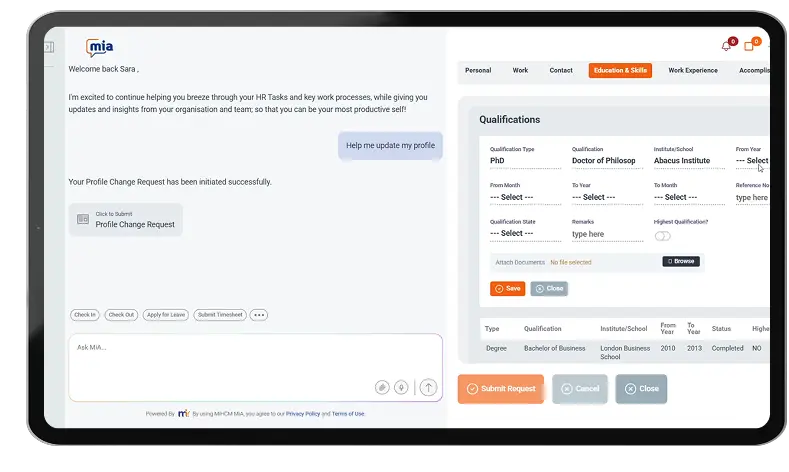
Step 3 — Measure current state: combine employee self-assessments, manager ratings, objective assessments and performance data. Use short surveys and targeted tests where objective measurement is critical; MiA can scale self-assessments and collect responses.
Step 4 — Score and visualise: build a skills matrix using a consistent numeric scale (1–5). Pivot by role, team and competency and flag gaps where required proficiency exceeds current mean score.
Step 5 — Prioritise: apply an impact × effort filter and include replaceability metrics—internal bench strength, time-to-train and cost-to-hire—to rank remediation.
Step 6 — Plan interventions: options include instructor-led training, online courses, stretch assignments, mentorships, short-term contractors or hiring. Assign owners and timelines.
Step 7 — Execute & measure: track competency score changes and business KPIs; run manager calibrations and update role profiles.Operational checklist:
- Create role and competency list (canonical IDs)
- Design short assessments (≤15 competencies per role)
- Collect self and manager scores; run a calibration meeting
- Aggregate into a skills matrix and apply conditional formatting
- Assign remediation owners, timelines and success KPIs
Skills matrix example and scoring guidance
Score Description
- No experience; needs full training
- Basic understanding; requires guided support
- Core competency; can perform with supervision
- Advanced; independent and mentors others
- Expert; sets standards and leads practice
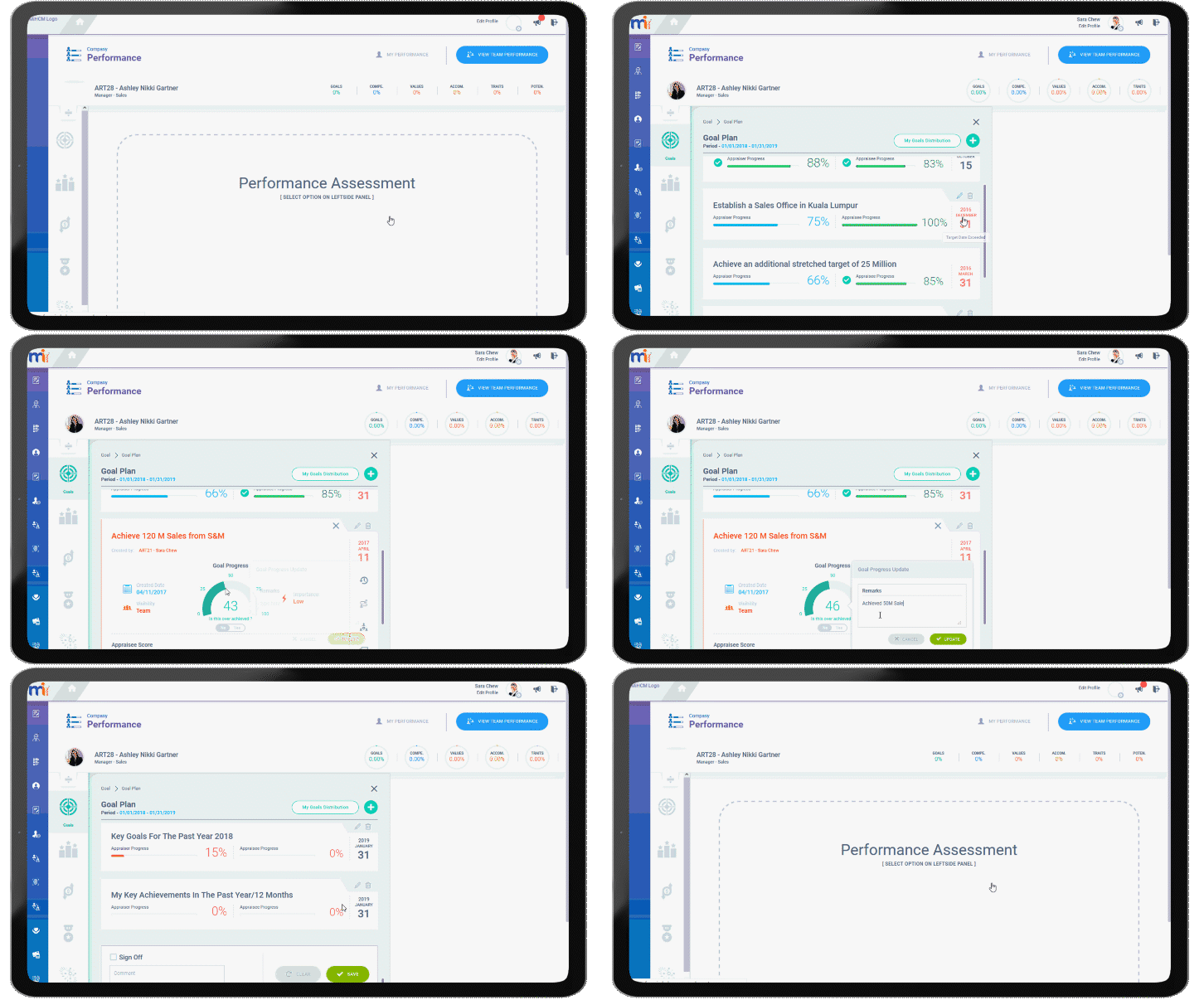
Use Performance Analysis to centralise competency scoring and Employee Self-Service so staff complete self-assessments quickly. Store scores in a central HRIS to automate reporting and longitudinal tracking.
Skill gap analysis example & template
Example — marketing team shifting to digital. Define six competencies: SEO, analytics, content strategy, paid media, marketing automation and measurement. Collect manager and self-scores; calculate the gap (required − current) and time-to-train per competency.
Marketing team example — DEEP DIVE
- Step A: Sheet 1 — competency master list (ID, name, required level for role).
- Step B: Sheet 2 — raw scores (employee ID, manager score, self-score, final calibrated score).
- Step C: Sheet 3 — pivot summary (average current score by role and competency) with conditional formatting to highlight gaps ≥1.0.
- Step D: Add columns: estimated time-to-train (weeks), training cost, cost-to-hire and recommended remediation.
Template guidance: reconcile discrepancies by averaging manager and calibrated self-scores or by weighting manager scores higher for critical competencies. Include columns that compute time-to-capability and cost-to-capability so remediation decisions are quantitative.
Converting results into an L&D plan: for competencies with a gap of ≥1.0 and high impact, recommend a 6–12 week blended learning path, assign an internal mentor and set target KPIs (for instance increase proficiency from 2 to 4 in six months; measure campaign lift or analytics adoption as business KPIs).
Download notes: prepare CSV exports with employee ID, competency ID and score. Import into MiHCM Analytics and map fields to role and competency IDs so dashboards populate automatically.
Train vs hire vs redeploy: a decision framework
Key decision variables: size of the gap, time-to-capability, cost-to-train, availability of internal talent and whether the skill is strategic or temporary.
Decision rubric (scorecard) to pick train vs hire vs redeploy
- Compute Cost-to-Train = training cost + (estimated productivity drag × weeks).
- Compute Cost-to-Hire = recruiting + onboarding + ramp time cost.
- Estimate Time-to-Capability for internal candidates (weeks) and compare to project timeline.
Rule examples: If Time-to-Capability < Project timeline and Cost-to-Train < Cost-to-Hire → Train. If skill is strategic, rare and long-term → Hire. If strong bench exists and redeploying causes minimal disruption → Redeploy.
Include example formula: if training cost = $3,000; productivity drag = $400/week for 8 weeks → Cost-to-Train = $3,000 + ($400×8) = $6,200. If recruiting + onboarding + ramp = $10,000, training is preferred unless skill permanence or certification requirements demand external hire.
Operationalise by building the rubric into SmartAssist so recommendations include both the preferred remediation and the numeric rationale.
Skills gap analysis tools, templates and best practices
Tool selection by scale: use surveys and quizzes for measurement, Excel for small pilots and an HRIS + Analytics for enterprise-scale programmes. Assessment platforms and LMS integrations speed execution.
Excel best practices:
- Normalise rating scales (use the same 1–5 definitions).
- Lock formulas and protect the master competency sheet.
- Use pivot tables for roll-ups and slicers for filters.
- Include time-to-train and cost fields so prioritisation is quantifiable.
- Apply conditional formatting to highlight gaps and colour-code by priority.
Survey tips: keep role assessments to 10–15 competencies, pilot with a small group to validate questions and combine self and manager ratings for a balanced view.
Data hygiene: standardise role titles, competency IDs and job families before importing. Use Visualise competencies with dashboards to share results and preserve historical data when moving from Excel to an analytics platform.
How MiHCM (Analytics, SmartAssist & MiA) automates skills assessments
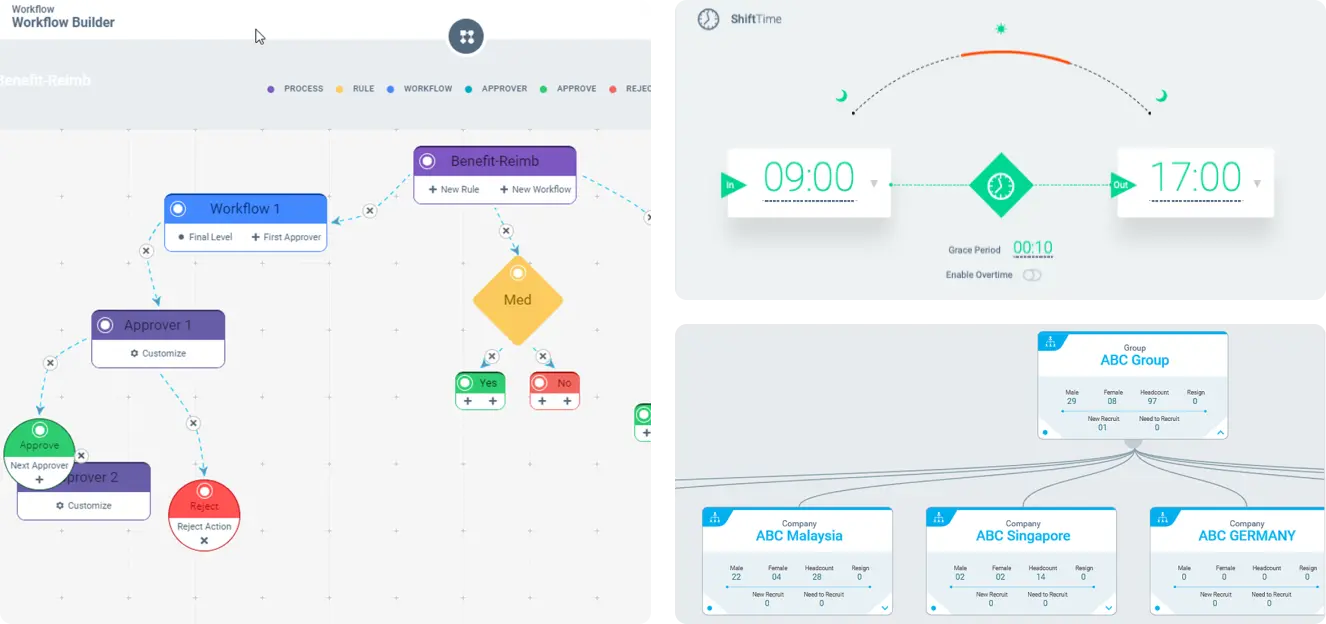
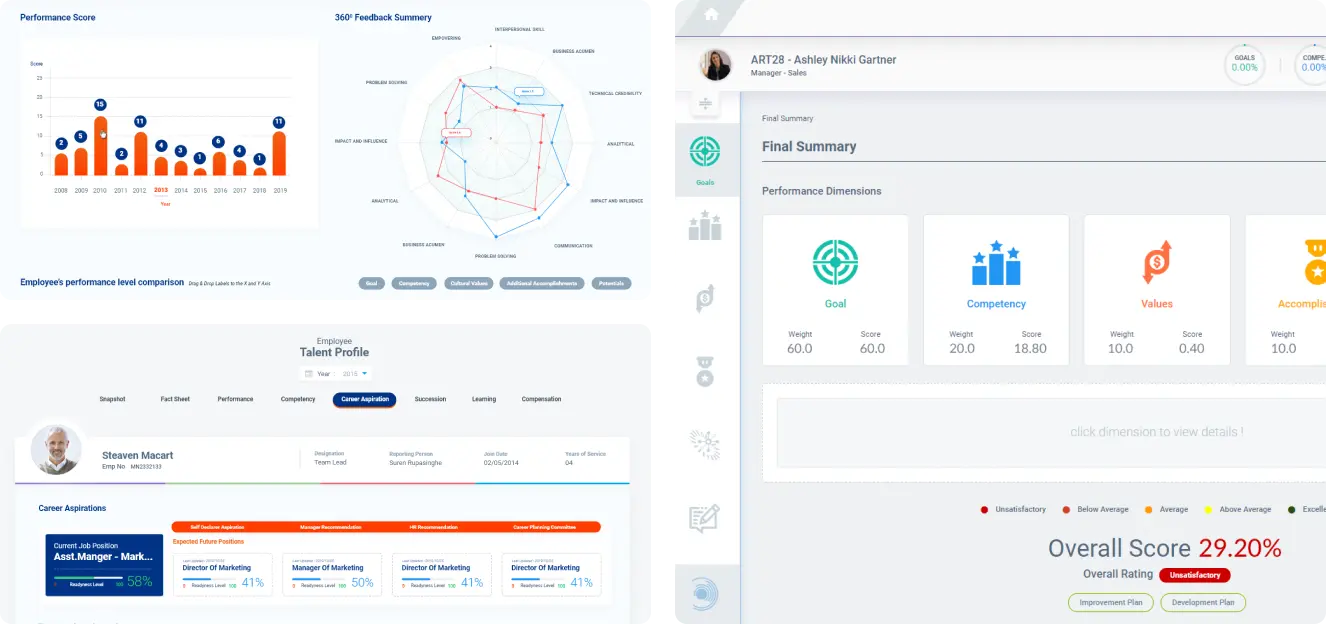
MiHCM centralises role profiles, competency taxonomies and historical scores so teams track capability trends over time. MiA powers employee self-assessments through chat-driven prompts and manager calibration workflows.
Automated collection: MiA collects self and peer inputs; managers approve calibrated scores and SmartAssist flags anomalies or unusually large self-manager discrepancies.
Analytics & forecasting: MiHCM Data & AI forecasts future skill deficits by analysing hiring plans, attrition and planned strategic projects; this helps prioritise where to invest in training versus hiring.
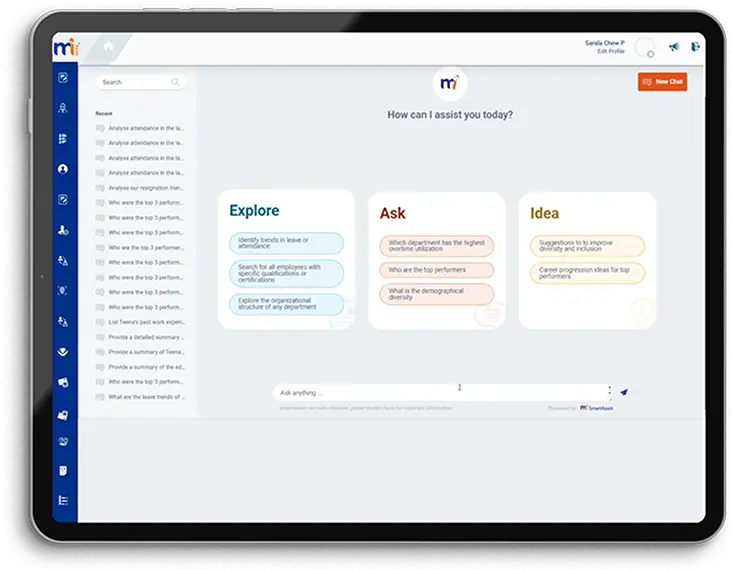
Action recommendations: SmartAssist converts gap analysis into ranked remediation actions—recommended courses, internal candidates for redeployment, or specific hiring requisitions—complete with estimated time and cost impacts.
Typical workflow inside MiHCM: from assessment to action
| Stage | MiHCM feature | Outcome |
|---|---|---|
| Assess | MiA self-assessments | Scored and standardised competency profiles. |
| Analyse | Analytics dashboards | Skill-gap heatmaps and forward-looking forecasts. |
| Recommend | SmartAssist | Prioritised training, redeployment and hiring actions. |
| Execute | Talent Acquisition & Onboarding | Closed skill gaps with tracked ROI and outcomes. |
Benefits: AI-driven remediation recommendations reduce time-to-fill and increase internal mobility while linking training budgets to measurable competency improvements and business outcomes.
Measuring impact, tracking ROI and reporting to leadership
Define outcomes before interventions: examples include improved throughput, fewer escalations, fewer external hires or meeting compliance targets.
Metrics to track:
- Competency score uplift (pre/post)
- Time-to-capability (weeks to reach target level)
- Cost-per-capability (training vs hiring)
- Internal mobility rate and reduced vacancy days
Attribution approach: use cohorts and control groups where possible; measure both competency changes and business KPIs. Reporting cadence: monthly for managers, quarterly for senior leaders and annually for strategic workforce planning.
Continuous improvement: re-run gap analyses after major interventions and feed changes back into hiring and L&D planning so budgets and role profiles stay current.
Next steps to run your first skill gap analysis
Start small: pilot one team with a clear outcome, a short assessment and a simple Excel or MiHCM-driven survey. Use a consistent 1–5 rating scale and involve managers early for calibration.
- Prioritise actions with measurable business impact and iterate every 6–12 months.
- If using MiHCM, import template results into Analytics and enable SmartAssist to get ranked remediation recommendations.
- Next steps: download the template, schedule a two- to six-week pilot for one team and collect baseline scores to report to stakeholders.
Frequently Asked Questions
What is a skills gap analysis?
A structured comparison between required skills and current skills to prioritise training or hiring. See Brookings for definitions and context (Brookings, 2019).
What are the components?
How do you measure current skills?
se self-assessments, manager ratings, objective tests, certifications and performance metrics; national guides recommend inventories and targeted assessments (NIST).
When should hiring be considered?
When the gap is large, the skill is strategic or time-to-train exceeds project timelines; research recommends weighing training, hiring and outsourcing as options (OECD, 2024).