By Rashika Fazali
Every organisation I speak to tells me the same thing, “We need better data.”
What they mean is better dashboards, better reports, better analytics, more visibility, and more KPIs.
But we’re asking the wrong question. Because if we’re honest, most organisations today aren’t suffering from a shortage of data. In fact, they’re drowning in it – sales dashboards, HR analytics, financial reports, customer insights, marketing metrics, operational KPIs, and supply chain reports.
Today, the average organisation has access to more information than at any other point in history. Think about this: around 402.74 million terabytes of data are created every day in the world. 2026 is expected to generate around 221 zettabytes of data.
In perspective, if you started listening to music today and never stopped — not while sleeping, not while working — you would not get through even a single day’s worth of the world’s new data before the sun burned out. Civilisations would rise and fall before you reached the end of the playlist. A single zettabyte is equivalent to roughly 250 billion DVDs.
Yet despite having more data than ever before, decision-making doesn’t seem to be getting any easier. If anything, it has become more complicated.
We mistook information for intelligence
For decades, organisations have invested heavily in collecting information. We built databases, data warehouses, business intelligence platforms, reporting tools, and dashboards.
The assumption was simple: More information leads to better decisions. Sounds logical. But human psychology tells us a different story.
Psychologist and Nobel Prize winner Herbert Simon introduced the concept of bounded rationality, arguing that humans simply cannot process every piece of information available to them, and therefore we make decisions with limited information. We don’t make perfectly rational decisions because we can’t.
Instead, we make decisions that are “good enough” based on the information, time, and mental capacity we have at that moment.
A wealth of information creates a poverty of attention
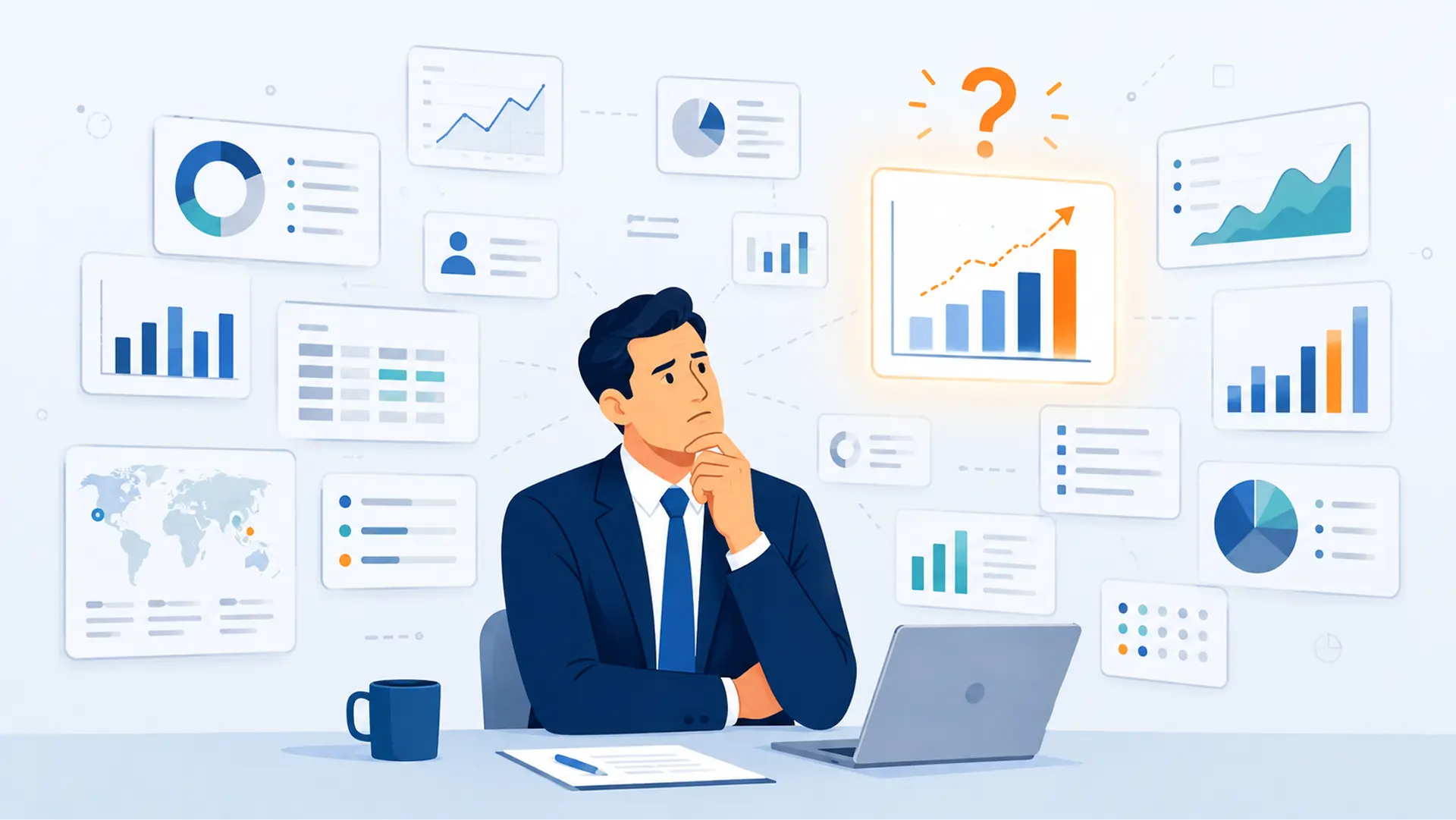
Simon also made an observation that feels even more relevant today than when he first wrote it: “A wealth of information creates a poverty of attention.”
Think about that for a moment.
Every dashboard, report, notification, KPI, and metric – they’re all competing for one finite resource: Our attention. And attention has become one of the scarcest resources in modern business.
Executives don’t wake up wishing for ten more dashboards. They wake up wondering:
“Why is performance declining?”
“Which customers are most at risk of leaving?”
“What’s changing that we haven’t noticed yet?”
Those aren’t data questions. They’re decision questions.
More data doesn’t always mean better decisions
This is one of the great paradoxes of modern business. The more information we have, the harder choosing can become.
Analysis paralysis refers to the idea that when faced with too many options or too much information, our ability to make confident decisions often decreases.
We’ve all experienced it – scrolling endlessly through Netflix or Uber without choosing anything, comparing dozens of products online, and reading review after review until every option feels equally uncertain.
The irony is that organisations rarely fail because they lack information. They often fail because they couldn’t turn information into action quickly enough.
Data doesn’t remove bias
Another common misconception is that data automatically makes decisions objective. Unfortunately, our brains don’t work that way.
One of the most researched cognitive biases is confirmation bias – our tendency to search for, interpret, and remember information that supports what we already believe.
Two executives can look at the same dashboard and walk away with completely different conclusions. Not because the data changed. Because their interpretations did.
Data doesn’t eliminate bias. It simply gives us more evidence to filter through our existing beliefs. The challenge isn’t finding more data. It’s asking better questions.
Decision fatigue is real
Leaders make hundreds of decisions every day. Some are strategic. Some are operational. Many are surprisingly small.
Every decision consumes mental energy, resulting in decision fatigue. As the number of decisions increases, the quality of those decisions often begins to decline. It impacts productivity, work quality, and employee well-being.
That’s why the goal of technology shouldn’t simply be providing more information. It should be reducing the mental effort required to reach meaningful insights.
From business intelligence to decision intelligence
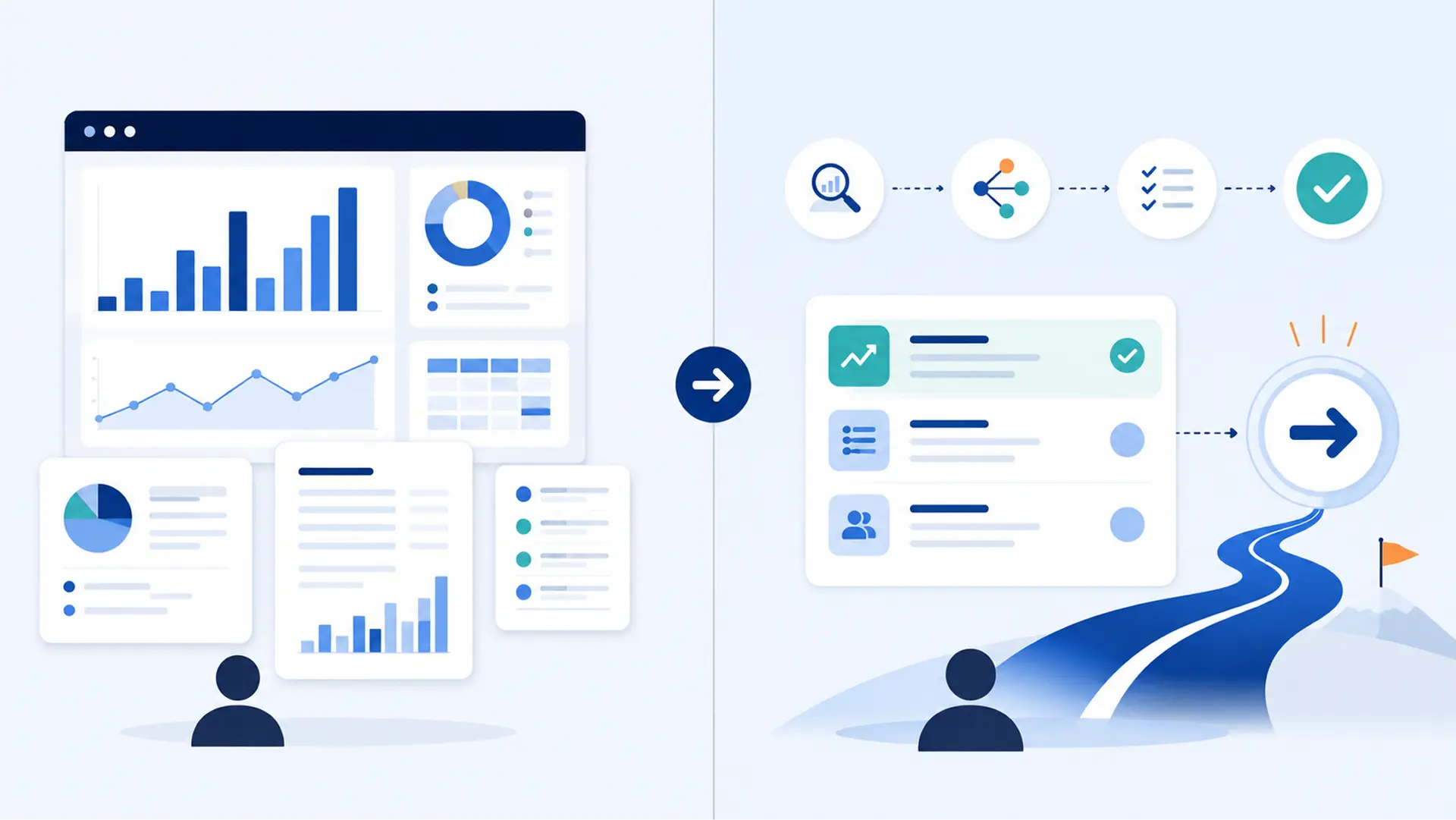
Instead of looking at how many reports and dashboards we’ve created, we need to ask ourselves how many better decisions those dashboards actually helped people make.
For decades, Business Intelligence has focused on helping organisations understand what happened.
Decision Intelligence asks a different question: What should we do next?
That may sound like a subtle shift, but it’s actually a profound one.
Instead of asking people to navigate increasingly complex dashboards, Decision Intelligence enables them to interact with information more naturally.
To ask questions.
Explore possibilities.
Understand context.
Challenge assumptions.
Rather than replacing human judgment, it supports it. Because leadership has never been about having the most information. It’s about making the best decisions with the information available.
AI is changing our relationship with data
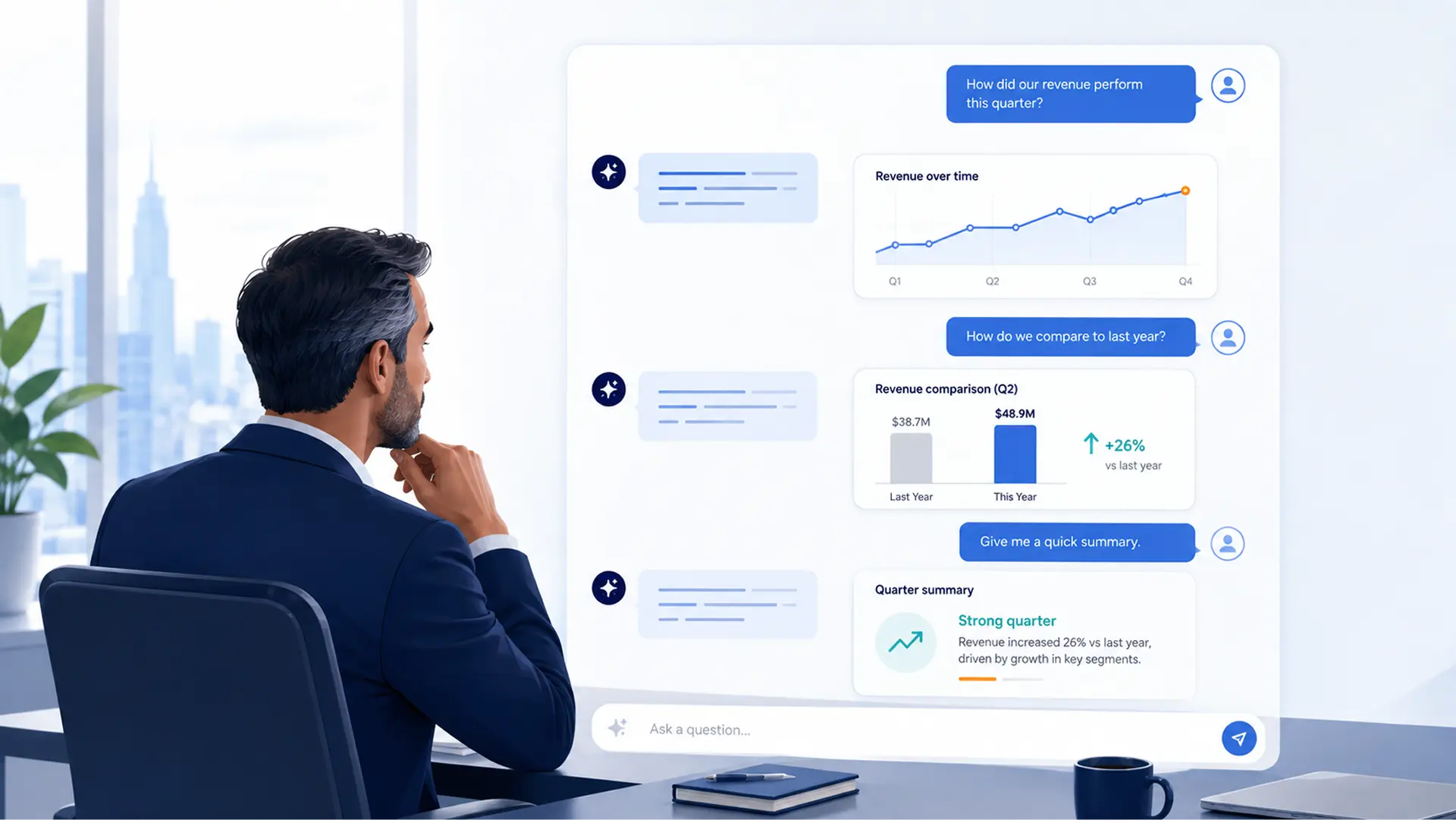
Artificial Intelligence is often described as a tool for automation.
I think something even more interesting is happening. AI is changing how we interact with knowledge itself.
For years, answering a business question often looked like this: Find the analyst. Build the report. Wait for the dashboard. Interpret the results.
Today, leaders can increasingly ask their business a question in natural language: “Which departments have the highest employee turnover?” “What patterns are emerging across employee complaints?” “Why are promotion rates higher in some departments than others?”
That isn’t just faster reporting. It’s a fundamentally different relationship with information. The conversation shifts from searching for data to exploring meaning.
What does this actually mean for an executive?

For an executive, the challenge is rarely accessing information. It’s going from information to understanding quickly enough to make a decision.
A CEO doesn’t necessarily want to open five dashboards to understand why revenue declined. A CFO shouldn’t have to manually compare multiple reports to identify an unusual cost movement. A CHRO shouldn’t have to piece together workforce reports to understand where employee turnover is increasing and what might be contributing to it.
They have questions. And increasingly, AI allows those questions to become the starting point.
This is where Syntra changes the interaction between executives and organisational data. Instead of navigating reports, executives can ask questions in natural language, such as: “Which business units are performing below target?” “Which employee groups have the highest turnover?” “What has changed compared with the same period last year?”
But simply returning a number isn’t enough. The real value comes from helping the executive move from what happened to why it happened, what it means, and eventually what deserves attention next.
Syntra is designed to bring together organisational data, surface relevant patterns and trends, and present insights conversationally so that leaders can explore their business by asking questions rather than searching through reports.
And the conversation doesn’t have to end with the first answer.
An executive might begin with: “Why has employee turnover increased this year?”
Then ask: “Which departments or employee groups are contributing most to the increase?”
Then: “Are there any common patterns among the employees who are leaving?”
And finally: “Is this a recent change, or has the trend been developing over time?”
That changes analytics from something executives consume into something they can interrogate.
It also helps reduce one of the biggest limitations in traditional decision-making: the gap between having a question and getting the evidence needed to explore it.
Syntra doesn’t make the executive’s decision for them. Nor should it. Context, experience, accountability, ethics, and judgment still belong to people.
What Syntra can do is help shorten the distance between question, insight, and decision. Because the executive advantage in the AI era may not come from having access to more information than everyone else. It may come from being able to ask better questions of the information you already have and getting to the answers while they still matter.
The organisations that succeed in the AI era won’t necessarily be the ones with the biggest data lakes or the most sophisticated dashboards.
They’ll be the ones that understand a simple truth: Data informs. People decide.
Maybe we don’t have a data problem after all. Maybe we’ve always had a decision problem.

รายีคา ฟาซาลี
Business Operations Lead – Data & AI
(Rashika Fazali is the Data & AI Business Lead at MiHCM and Deputy General Manager at Futura Tech Labs. She holds a Master’s degree in Business Psychology from London Metropolitan University and brings over 16 years of experience spanning the media, entertainment, and technology industries. From employee engagement and workplace behaviour to consumer decision-making and audience psychology, her work examines the human factors that shape organisations, brands, and communities. Her writing brings together psychology, artificial intelligence, leadership, and broadcasting, combining psychological insights with real-world experience to help organisations build more engaged, productive, and human-centred workplaces.)