

By Bakhtiar Pahroraji
The Malaysia Digital Economy Blueprint (MyDIGITAL), launched in February 2021, is delivered via six strategic thrusts, 22 strategies, 48 national initiatives, and 28 sectoral initiatives, in phases through to 2030. Five of those thrusts concern around Government, Infrastructure, Competitiveness, Inclusion, and Trust. The fourth – build agile and competent digital talent – concerns people.
People are not a procurement commodity. Fibre can be laid on a schedule. Cloud capacity can be bought. But talent cannot be commissioned and will not arrive on a delivery date. It has to be developed within organisations, one role and one team at a time. This means the success of Thrust 4 is not decided in Putrajaya; it is decided in HR departments across Malaysia.
The scale of what the nation is asking for has since become clearer. The 13th Malaysia Plan (13MP), tabled in July 2025 covering 2026 to 2030, targets 1.2 million new jobs over the period – 700,000 in manufacturing and 500,000 in the digital economy – alongside a target to lift employee compensation to 40% of GDP by 2030 and to reduce the ratio of foreign workers in the workforce from 15% to 10%.
Industry 4.0 is a workforce programme wearing an engineering badge

Malaysia’s Industry 4.0 agenda began with Industry4WRD in 2018, which set targets to raise manufacturing productivity by 30%, lift manufacturing’s contribution from RM254 billion to RM392 billion, break into the top 30 of the Global Innovation Index, and increase the share of high-skilled workers in manufacturing from 18% to 35%.
That last target is the whole thing. The New Industrial Master Plan 2030 (NIPM 2030), launched in September 2023, carries the ambition forward with a goal of 3,000 smart factories by 2030 and projected manufacturing GDP growth of 6.5% annually, and folds the earlier Industry4WRD readiness work into ‘Mission 2, Tech Up for a Digitally Vibrant Nation’. Meanwhile, worker productivity in 2024 stood at RM99,265 in value added per worker, up 2.4% on the previous year, according to figures presented by MITI.
I know how this plays out. A company invests in automation, sensors, and an analytics layer. Eighteen months down the road, the machines are running and the productivity gain is a fraction of what the business proposition promised. The gap is almost never in technology. It lies in shift patterns that were never redesigned, supervisors who were never retrained, competency frameworks that still describe 2015, and an HR function that remains static.
Smart factories need smart job architecture. If HR is not in the room when the capex is approved, the organisation will buy Industry 4.0 and operate Industry 3.0.
The upskilling maths is now uncomfortably specific
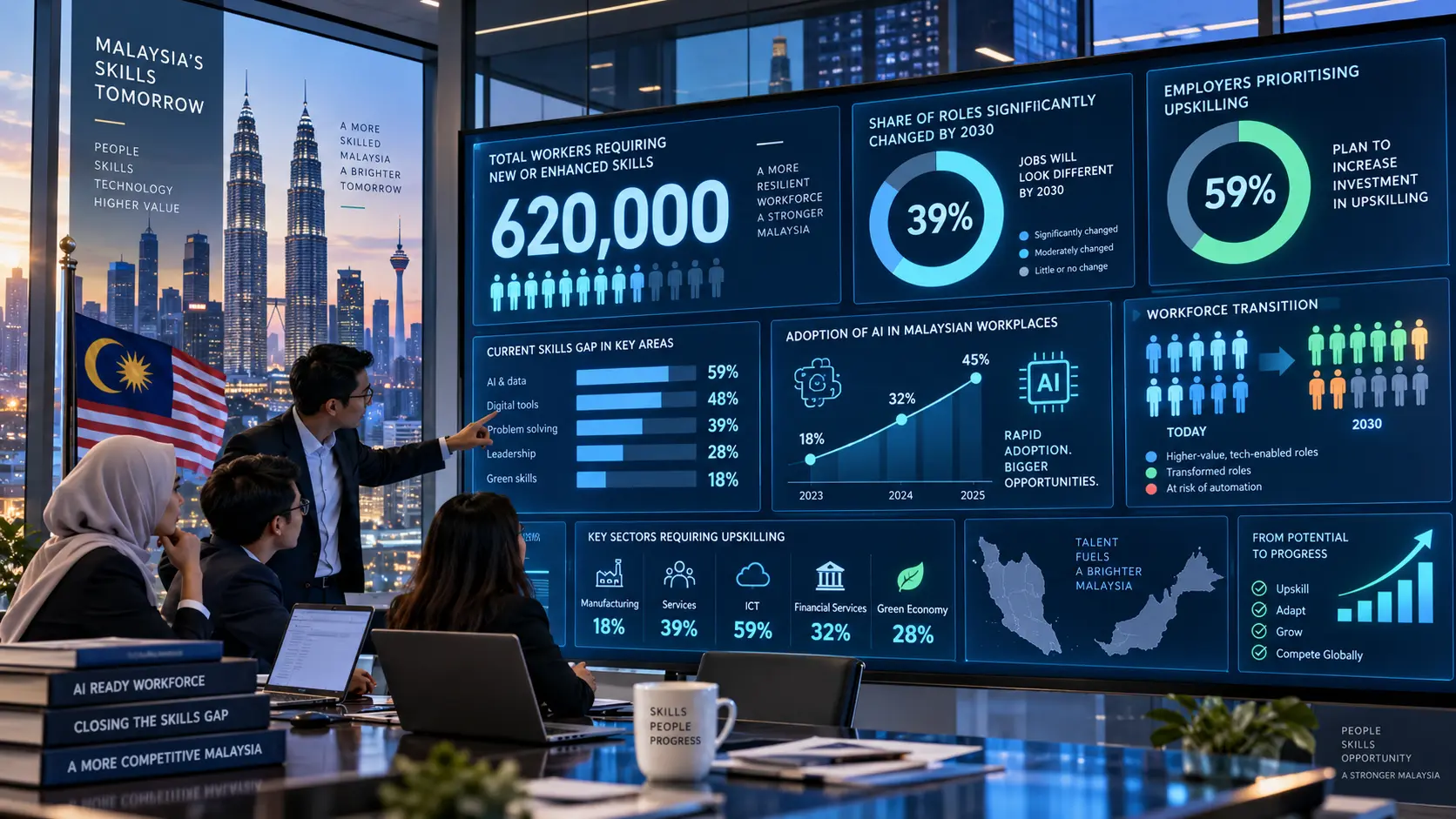
For years, ‘upskilling’ was a slide and now has become a number.
Talent Corporation Malaysia Berhad (TalentCorp) and MyDIGITAL launched the MyMahir National AI Council for Industry (MyMahir–NAICI) in May 2025, bringing together KESUMA and the National AI Office (NAIO).
Early findings from MyMahir Impact Study indicate that approximately 620,000 jobs (around 18% of formal sector roles in Malaysia) are expected to be significantly affected by AI within three to five years. The council’s supporting instruments include an AI Talent Framework spanning the pipeline from basic digital literacy to advanced expertise.
Globally, the World Economic Forum’s ‘Future of Jobs Report 2025’ found that employers expect 39% of workers’ core skills to change by 2030, that 63% of employers identify skills gaps as the single biggest barrier to business transformation, and that 85% plan to prioritise upskilling their existing workforce. Framed at population scale, the report puts it plainly: if the world’s workforce were 100 people, 59 would need training by 2030.
Place those two datasets side by side and the implication for Malaysian employers is direct. Roughly one in five formal-sector roles lies in the path of change within a single planning cycle, and the majority of the response has to come from developing people already on the payroll, not out from a talent market that does not have them.
Malaysia already funds this; most employers under-use it

Malaysia is unusual in having a dedicated statutory mechanism for exactly this problem.
Under the Pembangunan Sumber Manusia Berhad Act 2001, registered employers with 10 or more Malaysian employees contribute a levy of 1% of monthly wages to HRD Corp, with a voluntary 0.5% rate available to employers with five to nine employees, payable by the fifteenth of the following month. Those contributions can be claimed back against approved training.
In my view, the constraint is rarely the availability of funding. It is the absence of a skills plan worth funding. Levy utilisation tends to be reactive: whatever courses are convenient, booked late in the year, disconnected from any view of which capabilities the business will actually need in 2028.
Organisations getting real value are the ones that start from a capability gap analysis, map it to roles, and then draw down the levy against a plan, not the other way round.
That reordering is an HR discipline. Only you can do it for you.
What this actually asks of HR leaders
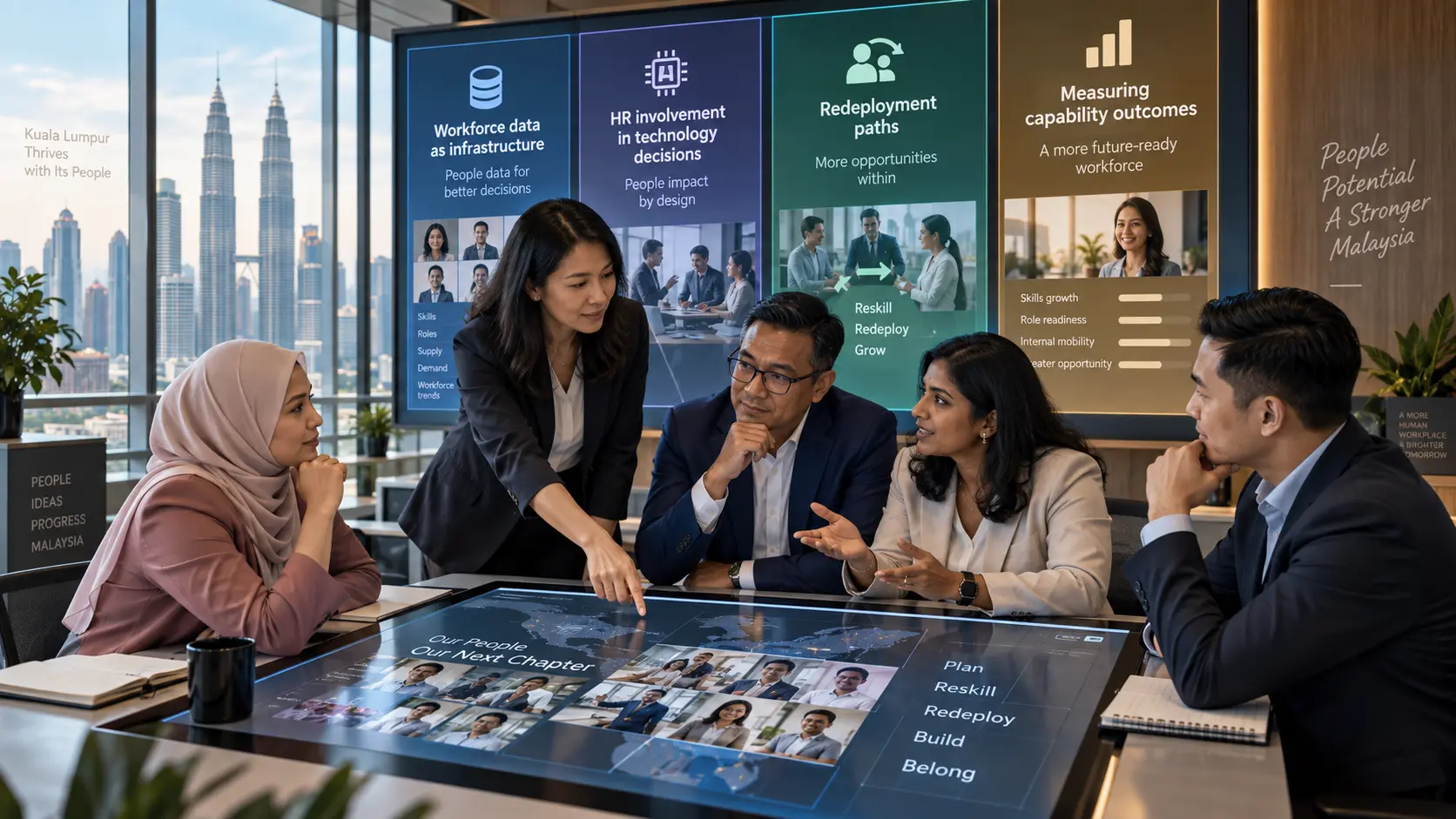
Reading the national agenda as an HR brief rather than an economic one, four obligations follow.
- Treat workforce data as infrastructure
You cannot plan for capability gaps you cannot see. Skills, certifications, role histories, and internal mobility need to live in structured, current systems rather than in spreadsheets and institutional memory. In Malaysia’s context, the Department of Statistics Malaysia (DOSM) reported that ICT and e-commerce contributed 23.4%, or RM451.3 billion, to the economy in 2024, with the ICT industry employing 1.25 million people, or 7.6% of total employment. Organisations competing for a share of that talent pool need to know precisely what they already have.
- Put HR upstream of technology decisions
Automation business cases should carry a workforce impact assessment as standard: which roles change, which skills are needed, what the retraining timeline looks like, and who owns it. This is not a brake on investment. It is what protects the ROI.
- Build redeployment paths, not just training catalogues
If 620,000 roles are exposed to change, the meaningful HR question is not “what training shall we offer?” but “where do these people go next, and what does the bridge look like?” Adjacency mapping (identifying which current roles sit one or two capabilities away from emerging ones) is the most underused tool in the profession right now.
- Measure capability, not attendance
Training hours completed is a compliance metric. Capability acquired, applied and retained is a business metric. The shift from one to the other is where HR earns a strategic seat, and it depends on being able to prove the outcomes.
Human judgement remains the point
At MiHCM we build AI into HR operations in over 20 markets in Asia, and I am consistently clear with clients on one thing: these systems are there to sharpen human decisions, not to make them.
An AI model can surface that a group of production supervisors shares a capability profile close to that of a maintenance planner. It cannot know that one of them is three months from a family relocation, or that another has quietly been the person holding the night shift together for a decade. The technology narrows the variables. People decide.
That principle is not a caveat to the national agenda; it is the condition for meeting it. Malaysia’s digital economy targets rest on 500,000 new digital economy jobs, 3,000 smart factories, and a workforce that can move into roles that do not yet fully exist. Those are outcomes delivered by employers, in individual conversations with individual employees, supported by data robust enough to make the conversation truthful.
The Blueprint set the direction more than five years ago. Phase 3 runs from 2026 to 2030. For HR leaders in Malaysia, that is not a policy timeline. It is a planning landscape, and it starts with knowing exactly who is on your payroll and what they are capable of becoming.

Bakhtiar Pahroraji
Regional GM, Consulting
(Bakhtiar Pahroraji is General Manager – Consulting at MiHCM, working with enterprises across the region on HR transformation. MiHCM is an enterprise HR and payroll technology provider operating across more than 22 markets.)
คำถามที่พบบ่อย
What does the Malaysia Digital Economy Blueprint ask of HR?
The Blueprint, launched under MyDIGITAL in February 2021, is delivered through six strategic thrusts. The fourth — build agile and competent digital talent — is the one HR owns. In practice it means employers, not agencies, must build skills visibility, capability plans and redeployment paths inside their own organisations through Phase 3, which runs from 2026 to 2030.
How many jobs in Malaysia will be affected by AI?
Early findings from the MyMahir Impact Study indicate that approximately 620,000 jobs — around 18% of formal sector roles in Malaysia — are expected to be significantly affected by AI within 3 to 5 years. The study also identified 60 emerging roles across AI, digital, green and deep tech sectors. It underpins the MyMahir National AI Council for Industry (MyMahir–NAICI) launched by TalentCorp and MyDIGITAL on 23 May 2025.
What does the 13th Malaysia Plan target for jobs and wages?
The 13th Malaysia Plan, tabled on 31 July 2025 and covering 2026 to 2030, targets 1.2 million new jobs: 700,000 in manufacturing and 500,000 in the digital economy. It also targets lifting employee compensation to 40% of GDP by 2030 and reducing the ratio of foreign workers in the workforce from 15% to 10%.
Who pays the HRD Corp levy in Malaysia, and at what rate?
Under the Pembangunan Sumber Manusia Berhad Act 2001, registered employers with 10 or more Malaysian employees pay a monthly levy of 1% of wages to HRD Corp. Employers with 5 to 9 Malaysian employees may register voluntarily at 0.5%. The levy is payable by the fifteenth of the following month and can be claimed back against approved training.
How much of the workforce will need reskilling by 2030?
The World Economic Forum’s Future of Jobs Report 2025 found that employers expect 39% of workers’ core skills to change by 2030, and that if the world’s workforce were 100 people, 59 would need training by 2030. Skills gaps were identified by 63% of employers as the biggest barrier to business transformation, and 85% plan to prioritise upskilling.
What is adjacency mapping in workforce planning?
Adjacency mapping identifies which roles an organisation already has that sit one or two capabilities away from the roles it will need. Instead of asking what training to offer, it asks where exposed employees can realistically move next and what the bridge between the two roles looks like. It turns a training catalogue into a redeployment plan.
What are the NIMP 2030 targets relevant to workforce planning?
The New Industrial Master Plan 2030, launched on 1 September 2023, targets 3,000 smart factories by 2030 and manufacturing GDP growth of 6.5% annually. Those targets rest on job architecture as much as on capital equipment: Industry4WRD had already set a goal of raising high-skilled workers in manufacturing from 18% to 35%.