For most of its history, HR reporting has looked backwards. How many people did we hire last quarter? What was our attrition rate last year? Who left, and when? These questions matter, but they all describe a workforce that has already changed. By the time the report lands, the decision window has often closed.
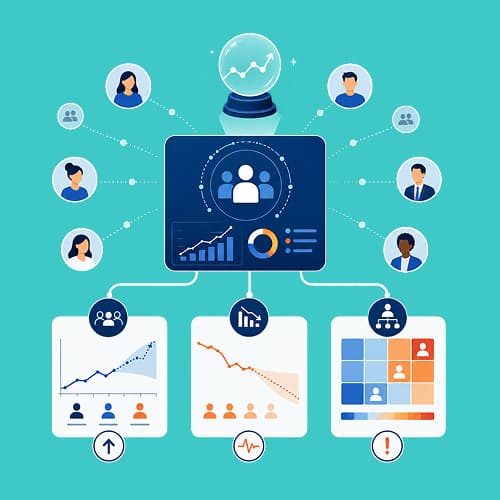
Predictive analytics changes the direction of travel. Instead of explaining what happened, it estimates what is likely to happen next — which roles will be hard to fill, which high performers are at risk of leaving, and where the organisation is dangerously dependent on a single individual. The shift is from hindsight to foresight, and it is reshaping how HR earns its place in strategic conversations.
HR analytics is the collection and application of talent data to improve critical talent and business outcomes — and increasingly, that means forecasting outcomes rather than simply recording them.
What predictive analytics actually means in HR

Gartner defines HR analytics, also known as people analytics, as the collection and application of talent data to improve critical talent and business outcomes.
Predictive analytics is a specific layer within that discipline. It uses historical workforce data, statistical models and machine learning to estimate the probability of future events — a resignation, a hiring shortfall, a skills gap — so that HR can act before the event rather than after it.
The adoption curve is steep. Deloitte has reported that around 70% of companies were using data analytics to support HR decision-making, with usage projected to exceed 80% as analytics becomes a default rather than a differentiator.¹
The momentum is reflected at leadership level. Gartner research has found that roughly 49% of HR leaders identified the future of work as a top priority, with 46% planning increased investment in future-of-work initiatives²— and forecasting is central to that agenda.
From headcount planning to scenario planning

Traditional headcount planning is largely an exercise in arithmetic: current heads, planned hires, expected exits, budget. Predictive analytics turns that static sum into a set of living scenarios. By modelling attrition patterns, seasonal demand, internal mobility and business growth assumptions together, HR can answer questions that a spreadsheet cannot — what happens to our delivery capacity if attrition rises by three points, or if a planned expansion pulls forward by a quarter?
This matters most in organisations operating across multiple markets and business units, where headcount decisions in one region ripple through cost, compliance and capacity elsewhere. Deloitte’s latest human capital research points to real-time analytics and organisational modelling as the tools that let leaders see where the business sits today and steer how and when it adapts, rather than planning on long, fixed cycles.
Done well, predictive headcount planning becomes a continuous conversation between HR and finance, not an annual negotiation.³
Predicting attrition before the resignation lands
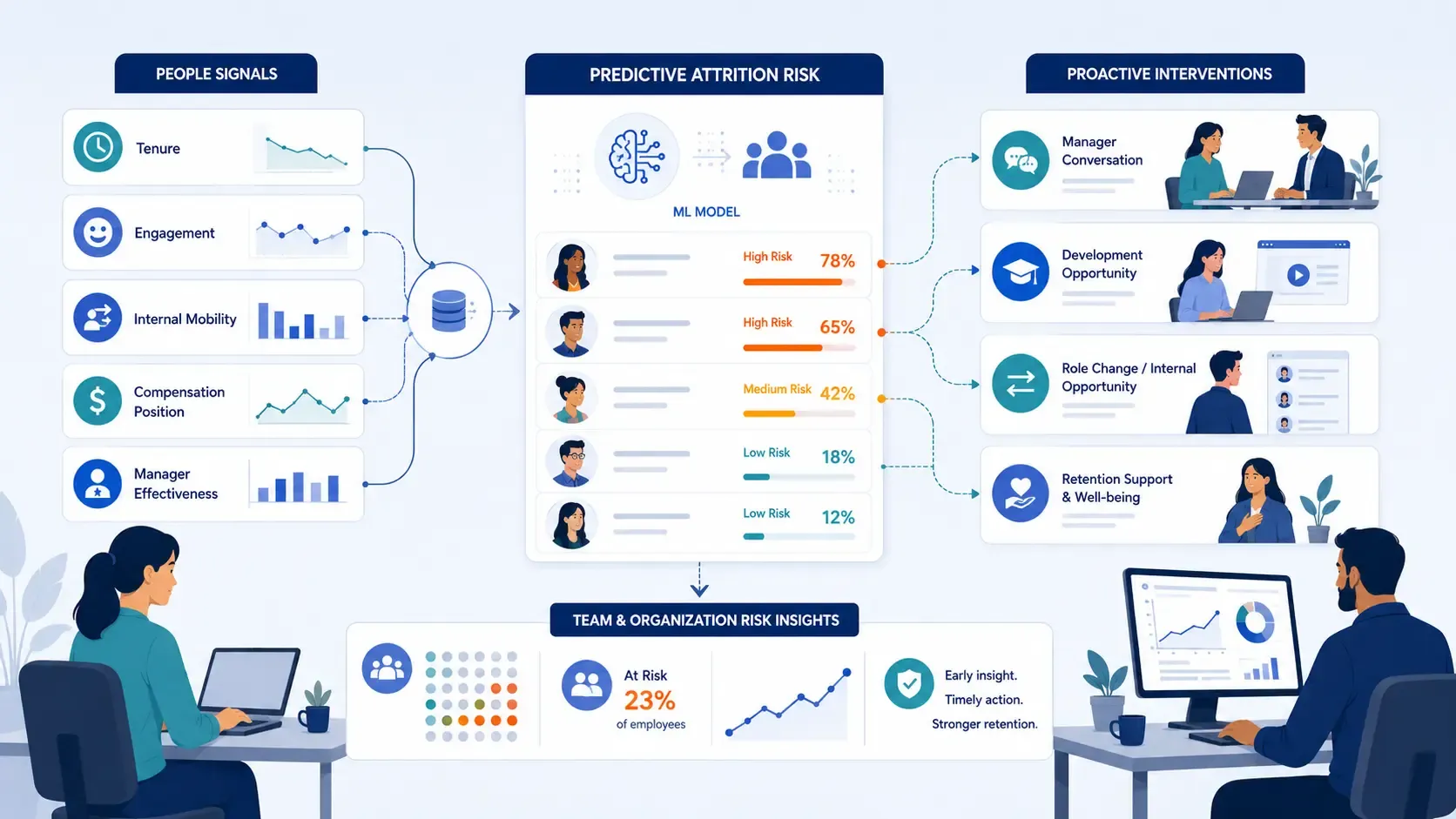
Attrition is the application most associated with predictive analytics, and for good reason. By analysing signals such as tenure, engagement scores, internal movement, compensation position and manager effectiveness, models can flag which employees or teams carry an elevated risk of leaving — often months before a resignation is tendered.
The value is not the prediction itself, but the intervention it enables. A flagged risk is an invitation to act: a career conversation, a role change, a development opportunity or a compensation review. The goal is to make retention proactive rather than reactive, replacing the scramble that follows a surprise departure with a planned response. Used responsibly, attrition modelling is a tool for supporting people, not for surveilling them.
A prediction that does not change a decision is just a more expensive report. The point of forecasting attrition is to create the time and the trigger to act.
Surfacing succession risk before it becomes a crisis
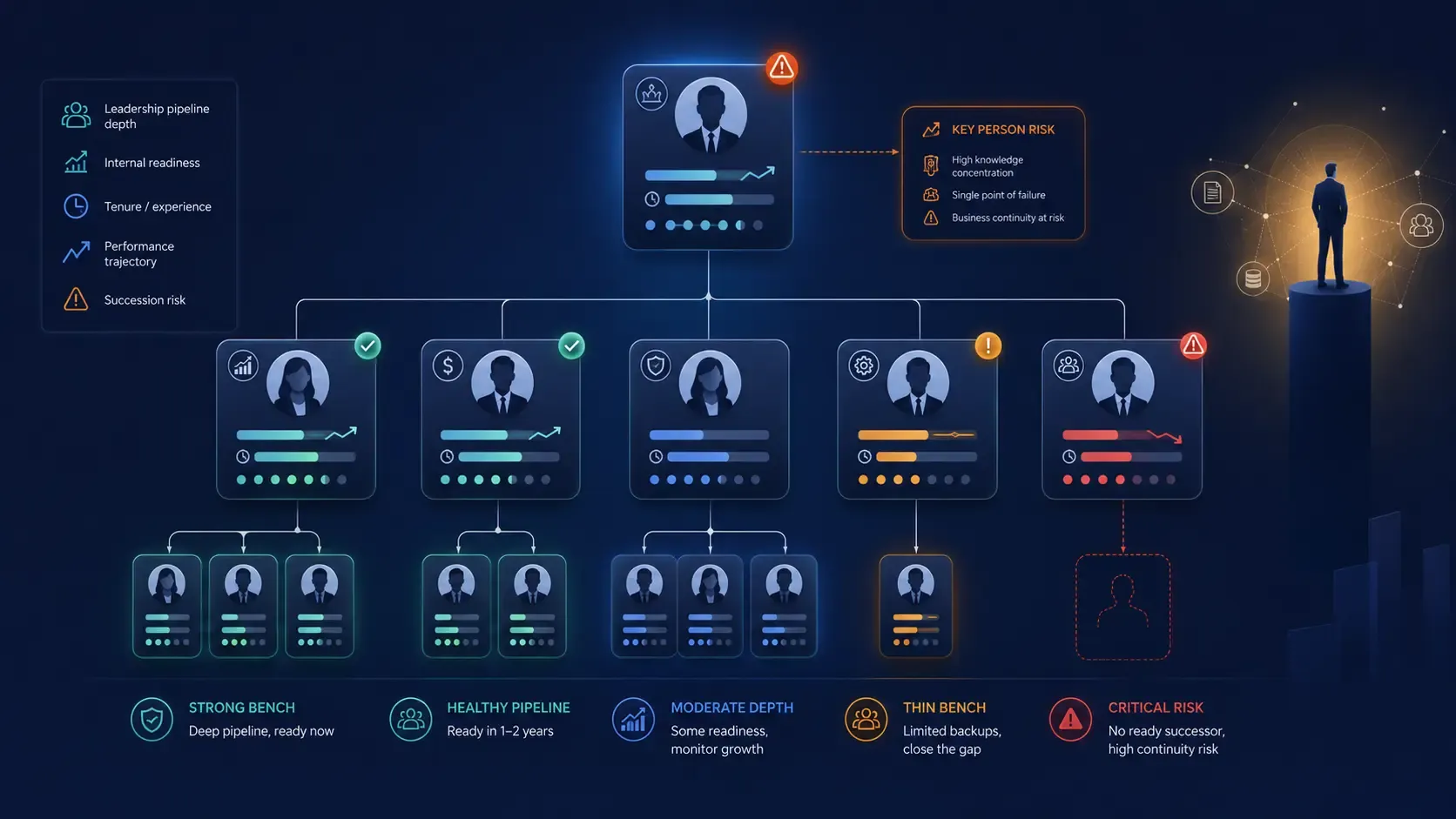
Succession risk is the quiet exposure that few organisations measure until it is too late. It is the senior engineer who holds undocumented knowledge, the country manager with no ready successor, the leadership layer approaching retirement in unison. Each is a single point of failure hiding in plain sight.
Predictive analytics makes this risk visible. By combining performance trajectories, tenure, internal mobility and the depth of the talent pipeline behind each critical role, HR can build a succession-risk view that highlights where the bench is thin and where continuity is fragile. That allows targeted action — accelerated development, deliberate knowledge transfer, or external hiring ahead of need — well before a departure forces a reactive scramble.
Critically, this reframes succession from an annual talent-review ritual into an ongoing risk discipline that sits alongside other forms of operational risk the board already monitors.
Skills forecasting and the reskilling imperative

Predictive analytics also looks beyond who stays and who goes, to what the workforce will need to be able to do. The World Economic Forum’s Future of Jobs Report 2025 estimates that 59% of workers will require reskilling or upskilling by 2030 to keep pace with changing skill demands.⁴
By mapping current capabilities against forecast demand, HR can identify emerging skills gaps early and direct training investment where it will have the highest return — rather than discovering shortages only when a project stalls or a critical hire proves impossible to find. Skills forecasting connects workforce planning, succession and learning into a single forward-looking picture.
The foundations: data quality, governance and responsible AI

Predictive models are only as good as the data and judgement behind them. Three foundations matter. First, data quality — fragmented, inconsistent or incomplete HR data produces confident but wrong predictions. Second, governance — employee data carries privacy and legal obligations that vary by market, and forecasting must operate within them. Third, responsible AI — predictions inform human decisions; they should never make them unaccountably.
This last point is easy to underestimate. Gartner has cautioned that AI deployment decisions made without HR involvement frequently lead to poor adoption and misaligned expectations.⁵The same applies to predictive models: when forecasts are imposed rather than understood, trust erodes. Human judgement should remain central — the model surfaces risk and probability, but a person decides what to do about a colleague’s future.
Foresight is a discipline, not a dashboard. The technology surfaces the signal; people remain accountable for the decision.
Where MiHCM fits
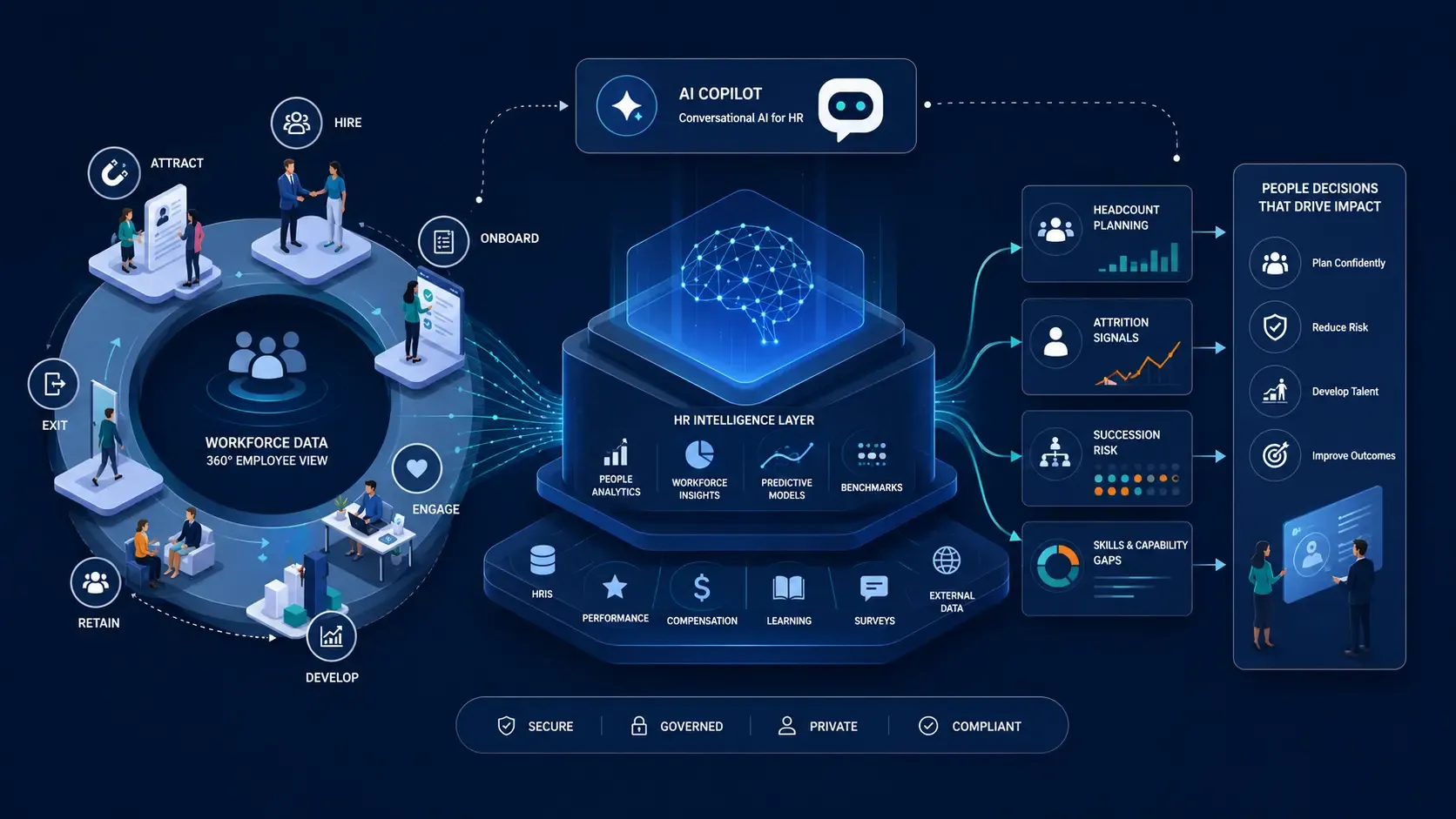
MiHCM brings predictive capability into the everyday flow of HR work rather than treating it as a separate analytics project. Syntra, MiHCM’s AI intelligence and analytics platform, turns workforce data into forward-looking insight — supporting headcount scenarios, attrition signals and the kind of talent-risk views that inform succession planning.
Underpinning this is MiHCM Data and AI, which brings together workforce data across the employee lifecycle so that forecasts draw on a connected, consistent picture rather than disconnected systems. MiA ONE, MiHCM’s personal AI agent, and SmartAssist, its AI HR co-pilot, put relevant insight directly into the hands of HR teams, managers and employees — keeping people, not dashboards, at the centre of the decision.
As a Microsoft Data and AI Solutions Partner, MiHCM builds these capabilities on an enterprise-grade foundation, with responsible AI and data governance treated as prerequisites rather than afterthoughts — which matters for organisations operating across multiple regulatory environments.
Conclusion
Predictive analytics does not replace HR judgement; it sharpens it. By moving from backward-looking reports to forward-looking models, HR can plan headcount as a set of scenarios, address attrition before it bites, surface succession risk before it becomes a crisis, and forecast the skills the organisation will need next. The organisations that benefit most will be those that treat foresight as a discipline — grounded in good data, sound governance and human accountability — rather than as a feature to switch on.
References
- Deloitte — Human Capital Trends research on adoption of data analytics in HR decision-making. https://www.deloitte.com/us/en/insights/topics/talent/human-capital-trends.html
- Gartner — HR leaders’ prioritisation of the future of work and related investment. https://www.gartner.com/en/human-resources
- Deloitte — 2026 Global Human Capital Trends, on real-time analytics and organisational modelling. https://www.deloitte.com/us/en/insights/topics/talent/human-capital-trends.html
- World Economic Forum — Future of Jobs Report 2025, on reskilling and upskilling needs by 2030. https://www.weforum.org/publications/the-future-of-jobs-report-2025/
- Gartner — newsroom research on AI deployment, HR involvement and employee adoption (December 2025). https://www.gartner.com/en/newsroom/press-releases/2025-12-16-gartner-hr-survey-finds-65-percent-of-employees-are-excited-to-use-ai-at-work
- Gartner — HR Analytics definition, Gartner Human Resources Glossary. https://www.gartner.com/en/human-resources/glossary/hr-analytics
- MiHCM — product information (Syntra, MiHCM Data and AI, MiA ONE, SmartAssist, Microsoft Data and AI Solutions Partner). https://www.mihcm.com