
Strategic workforce planning is a 3–5 year, scenario-driven discipline that ensures an organisation has the right people, skills and structure to meet strategic goals.
It bridges business strategy, finance and HR by modelling capacity and capability across plausible futures and recommending actions (hire, redeploy, upskill, outsource) tied to budget constraints and commercial targets.
According to a federal workforce planning guide, planning horizons often split into short (1–3 years) and long (4–5 years) windows, making a 3–5 year view a practical standard for enterprise SWP. OPM (2025).
Why now: rapid adoption of generative AI, persistent skills shortages, hybrid operating models and pressure on labour costs mean single-year hiring cycles no longer deliver the agility organisations need. AI augments SWP by inferring skills from existing systems, running many scenarios quickly and surfacing prioritised interventions — enabling continuous planning rather than an annual spreadsheet exercise. See research on AI’s role in HR systems for practical examples. WEF (2026).
คู่มือนี้ครอบคลุมอะไรบ้าง
- Definition and objectives of SWP, and a pragmatic 3–5 year approach.
- Scenario design, capacity and capability modelling, skills taxonomies, governance and KPIs.
- How AI augments forecasting, scenario simulation and skills mapping.
Who this is for and expected outcomes
- CHROs, heads of workforce planning, HR analytics, finance and talent leaders.
- Outcomes: a pilot scenario, a canonical people dataset and a skills taxonomy starter to inform a prioritised 90-day roadmap.
Quick wins you can expect in the first 90 days
- Clean canonical people and payroll dataset consolidated in MiHCM Enterprise.
- A pilot 3-year scenario for one business unit with cost and risk levers identified.
- A basic leadership dashboard showing top 10 critical skills and immediate redeployment options.
Evidence base: integrated HR systems provide the single source of truth needed for SWP; organisations that centralise HRIS and payroll data unlock better redeployment and cost visibility. IHRIM (2023).
What is strategic workforce planning and why does it matter?
Strategic workforce planning (SWP) is a structured, multi-year process that aligns workforce supply and capability to strategic priorities and financial constraints. Its primary objectives are to ensure delivery capacity, protect strategic capabilities, lower execution risk and optimise talent investment across hiring, learning and redeployment.
SWP differs from operational workforce planning by its horizon and focus: SWP looks 3–5 years ahead at capability shifts and structural changes, while operational planning addresses hiring, scheduling and short-term gaps.
Strategic vs tactical
- SWP: 3–5 years, scenario-driven, capability and role-shape decisions, linked to capital and P&L planning.
- Operational: daily/quarterly, focuses on requisitions, time-to-fill and immediate scheduling needs.
Business value
- Faster delivery and lower contingency hiring costs through redeployment and internal mobility.
- Higher return on L&D by prioritising skills that align to scenarios and measurable outcomes.
- Improved cost control through integrated payroll visibility and scenario-based headcount modelling.
Common failure modes include poor data quality, missing skills taxonomies, isolated HR systems and lack of finance integration. Governance failures—no clear decision rights or cadence—turn SWP into an annual compliance exercise rather than a decisioning tool. Recommended governance is a cross-functional SWP steering group with HR, finance and business-unit leads and a clear cadence for strategic reviews and operational triggers.
Practical outputs
- Capacity-and-skills gap analysis: role/skill demand vs current supply (internal + external pipeline).
- Redeployment playbooks that map time-to-redeploy and cost to fill gaps versus external hire.
- Targeted upskilling plans and a prioritised talent-investment roadmap tied to expected ROI.
Resources: for implementation teams, starting with a canonical people dataset and a prioritised critical-skill roster unlocks the most immediate value and reduces the common failure modes described above. For enterprise practitioners, embedding finance in the steering group ensures SWP choices are budget-aware and actionable.
Setting a 3–5 year horizon and scenario plans
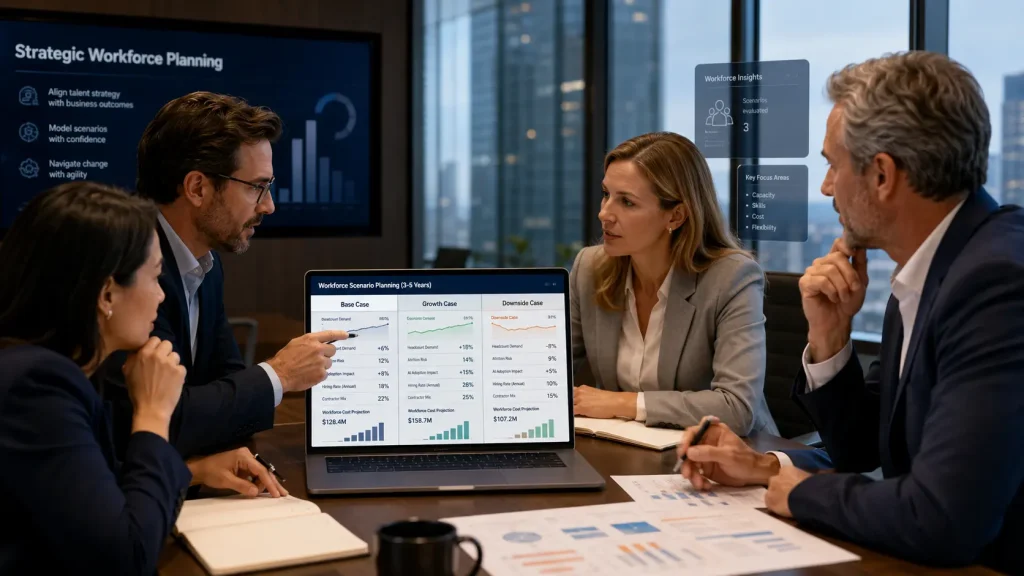
Choosing a 3–5 year horizon balances strategic visibility with credible forecasts for skills and capacity and aligns with typical financial planning cycles. Practical scenario design recognises three core futures: base (expected), upside (growth or rapid automation adoption) and downside (slow growth or elevated attrition).
Each scenario should include explicit levers — hiring rate, attrition, productivity uplift from AI, contractor mix and cost per FTE — so decision-makers can quantify workforce and payroll impacts.
Designing credible scenarios
- Start with strategic drivers: revenue targets, new services, product roadmaps and technology adoption timelines.
- Translate top-line drivers into role- and skill-level demand using a hybrid top-down/bottom-up model: apply strategic targets to expected task volumes and convert tasks into role/skill hours.
- Define trigger thresholds for scenario escalation (e.g., AI adoption > X% of tasks, attrition > Y% in critical cohort).
Driver | Base | Upside | Downside |
AI adoption (% tasks automated) | 10% | 30% | 5% |
Attrition | 12% annual | 9% annual | 18% annual |
Revenue growth | 5% CAGR | 12% CAGR | 0–2% CAGR |
Top-down/bottom-up hybrid modelling
- Top-down: set strategic targets (e.g., revenue, services) and derive role demand at a high level.
- Bottom-up: convert current role/skill supply and task-level measures to available capacity and map shortages by skill and time.
- Reconcile: adjust hiring and upskilling actions until the supply plan fits the financial envelope and strategic risk tolerance.
Scenario libraries should be version-controlled and refreshed quarterly. Align scenario assumptions with finance forecasts and use sensitivity analysis on key drivers (AI adoption rate, hiring velocity, attrition) to stress-test plans.
Best-practice guidance recommends modelling at least three scenarios and maintaining a documented playbook that maps each scenario to recommended actions (hire, train, redeploy, contract, automate). See financial planning literature for the standard three-scenario approach. NBER (2022).
Capacity vs capability analysis — headcount, structure and skills
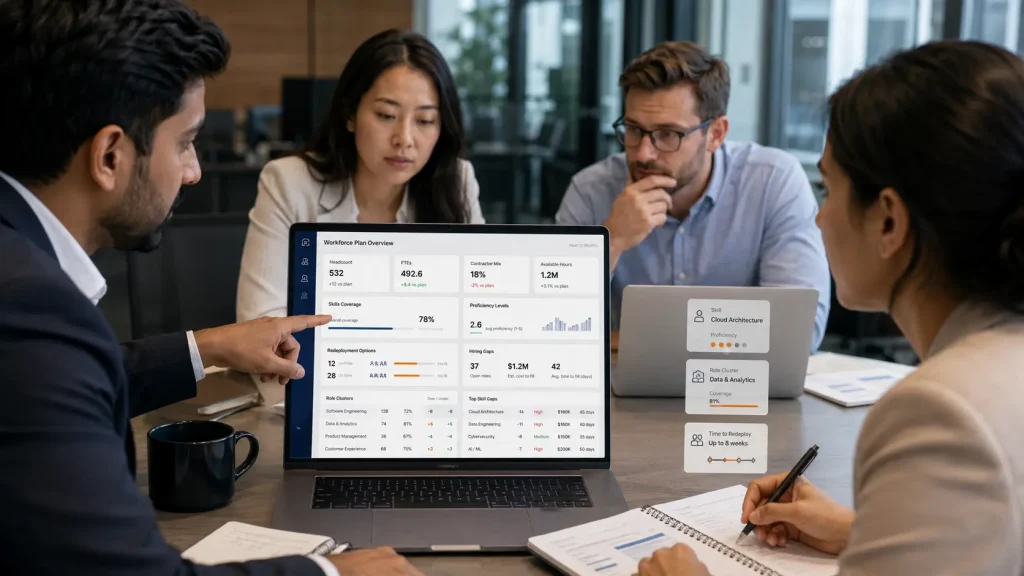
Capacity and capability are distinct planning inputs. Capacity measures heads, full-time equivalents (FTEs), contractor mix and available hours. Capability captures skills, proficiency levels and relevant experience.
Effective SWP models both: capacity answers “can we deliver the work?” while capability answers “do we have the right skills to deliver it well?” Both must be costed and modelled against strategic demand.
Building a talent baseline
- Canonical people dataset: for each employee capture role, grade, location, cost-to-company, manager and employment type (FTE/contractor).
- Skill profiles: mapped to a skills taxonomy with proficiency levels and evidence sources (certs, L&D completions, manager ratings, project history).
- Performance and tenure distributions: to prioritise redeployment pools and retention actions.
Gap analysis method
Demand forecast (by role/skill) minus current supply (internal + pipeline) yields a gap table. Each gap must map to remediation options with time and cost estimates: redeploy (0–3 months), upskill (3–12 months), targeted hire (3–9 months) or contractors/partners (immediate but costlier).
Structure and shape decisions
- Model span of control and T-shaped skill requirements where breadth supports mobility and depth protects critical capabilities.
- Consider hub-and-spoke or matrix models where centralised capability pools support multiple BUs, increasing utilisation and reducing redundant hires.
Levers to close gaps
- Reassign and redeploy: match skills to roles using micro-assignments or internal gig marketplaces.
- Upskill/academy programs with measured competency milestones and time-to-proficiency estimates.
- Targeted external hire where time-to-proficiency or scale requirements exceed internal capacity.
- Strategic partnerships and automation to replace or augment low-value tasks.
Compliance note: for multi-country operations overlay local labour rules and payroll costs on capacity models to avoid regulatory and cost surprises. A canonical people dataset in MiHCM Enterprise plus payroll integration is the operational foundation for reliable capacity-and-capability analysis.
Skills-based strategic workforce planning and taxonomies
Skills-first planning focuses on capabilities rather than job titles to increase resilience and mobility. As roles evolve quickly, planning on skills enables organisations to redeploy talent, target learning investments and shorten time-to-fill by matching internal skills to opportunity.
Designing a skills taxonomy
- Start with critical job families and business-critical skills; define core (required) vs adjacent (nice-to-have) skills and proficiency levels.
- Link skills to learning modules, career paths and performance criteria so taxonomy ownership drives talent actions.
- Maintain governance: assign taxonomy owners, define refresh cadence and integrate feedback loops from managers and L&D.
Automated skill inference
Use HRIS data, job descriptions, performance records, L&D completions and project histories to infer skill profiles at scale rather than relying solely on manual surveys. Automated inference accelerates profile coverage and supports internal mobility marketplaces. Evidence shows skills-based practices increase internal mobility and reduce external hiring reliance. JFF (2023).
Talent mobility and marketplaces
- Expose skill-matched roles and short-term gigs in an internal marketplace to surface redeployment options and reduce agency spend.
- Prioritise critical-skill rosters with ready-now internal candidates and defined stretch development plans.
Maintaining the taxonomy
- Governance: owners, refresh cadence and integration points with recruiting, L&D and performance management.
- Operational links: map skills to requisitions, learning modules and career ladders so actions follow from insights.
Practical templates
- Skills heatmaps by BU to identify concentration and shortages.
- Critical-skill rosters with 3 replacement options and estimated time-to-proficiency.
- Competency matrices that connect proficiency to measurable L&D milestones.
Product fit: MiHCM Data & AI builds and maintains a skills taxonomy and generates employee skill profiles; Analytics visualises heatmaps and SmartAssist recommends mobility or learning actions to close gaps.
How AI changes strategic workforce planning
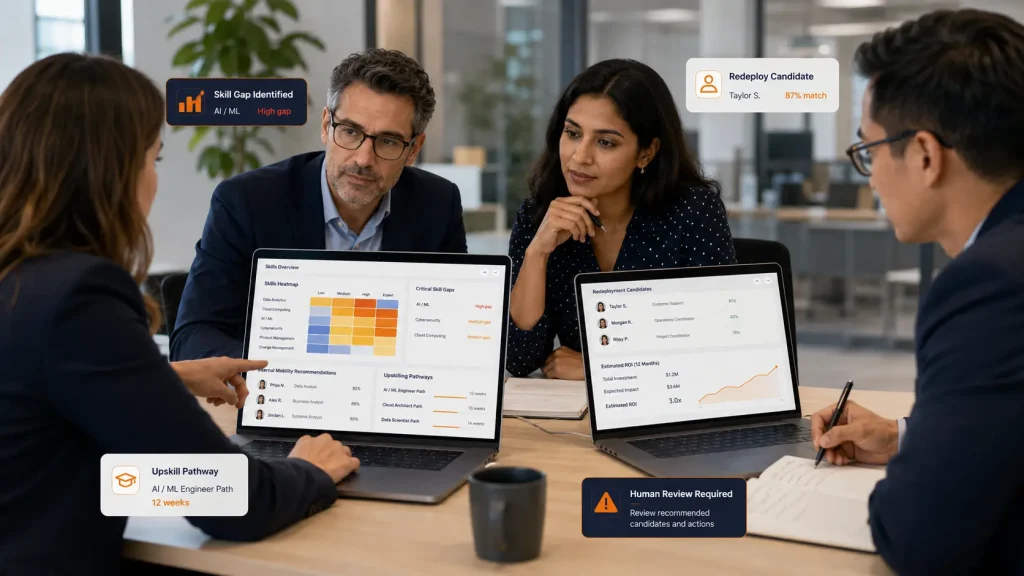
AI transforms SWP from periodic headcount projections into continuous, probabilistic planning at task and skill granularity. It contributes in four core ways: faster scenario simulation, scalable skill inference, task‑level automation impact analysis and surfacing ranked interventions with estimated ROI.
From headcount to task and skills planning
- AI can estimate how tasks within roles are redistributed—augmented vs automated—and quantify net skill-hours needed across scenarios.
- Task-level mapping enables more accurate redeployment and upskilling decisions and tightens cost/benefit estimates for automation versus hiring.
Explainability and guardrails
AI recommendations must be transparent and subject to human-in-the-loop review. Models should expose key drivers, confidence bands and suggested actions; validation against historical scenarios reduces risk. Organisations must implement bias detection, data-quality checks and an ethical AI charter for people algorithms.
Use cases and outcomes
- Predicting attrition cohorts so retention actions target high-risk critical roles.
- Simulating productivity uplift from gen‑AI tools to understand trade-offs between upskilling and hiring.
- Cost/benefit analysis of upskilling vs external hiring for priority skills.
- Identifying redeployment candidates with the right adjacent skills for rapid internal fills.
Operationalising AI means embedding outputs into BAU workflows: feeding recommended actions into hiring approvals, L&D queues and internal marketplaces, and building runbooks for sequencing interventions.
Risk management: monitor model bias, close data gaps, and ensure legal compliance for hiring and selection models. Research and policy guidance indicate AI in HR is promising but emergent; organisations should combine technical controls with governance. NIH/PMC (2025).
Embedding SWP into business-as-usual: governance, stakeholders and cadence
Successful SWP is shared ownership: HR leads design and capability, finance co-sponsors budgets and BUs own outcomes. A common model places HR as convenor, finance as approval and BUs as execution owners, with a cross-functional steering group to arbitrate trade-offs and approve scenario actions.
Decision cadence
- Annual strategic cycle for 3–5 year updates tied to budgeting.
- Quarterly scenario refreshes to capture market and technology shifts.
- Monthly operational triggers for hiring, redeployment and budget variance escalation.
Change management and capability building
- Develop SWP champions in business units with standard templates and training.
- Run capability workshops for HR, finance and people managers focused on scenario interpretation and decision playbooks.
- Integrate SWP metrics into leadership scorecards to drive accountability.
Connecting to finance
Map talent investments to P&L and capital projects; treat capacity constraints as an input to capital allocation. This requires integrated HRIS + payroll and clear modelling conventions for how headcount and contractor spend flow to budgets.
Operational artefacts
- RACI for SWP activities and a meeting cadence (monthly ops, quarterly scenario review, annual strategy sign-off).
- Scenario playbooks mapping triggers to recommended actions and escalation matrices with decision owners.
- Data stewardship policies to maintain the canonical dataset.
Governance checks before scaling: confirm executive sponsorship, validate data quality, prove pilot ROI, document decision rights and codify escalation paths.
Practical strategic workforce planning models and examples
This section presents practical models and examples teams can adopt quickly. Each model maps to common enterprise contexts and offers expected outcomes, timelines and cost trade-offs.
Model 1 — Critical-roles model
Focus on 10–20 roles or skills that deliver disproportionate strategic value (e.g., chief product engineers, lead data scientists). Protect these roles with tailored pipelines, retention incentives and succession slates. Expected outcome: lower delivery risk and quicker recovery from attrition in strategic cohorts.
Model 2 — Skills-cluster model
Group related skills into clusters (e.g., cloud-platform, data-engineering, customer-success) and create mobility pools. This model fits fast-changing tech organisations where titles shift quickly. Expected outcome: faster internal fills and lower agency spend.
Model 3 — Capacity-first financial model
Align FTEs to revenue or subscription targets and treat workforce as a constrained capital input. Use this for scale-focused units where payroll is the primary cost lever; expected outcome: tighter payroll control and explicit trade-offs between people investment and capital allocation.
Example — Manufacturing use-case
Scenario: automation adoption requires re-skilling manual operators to automation technicians over 18 months. Model includes training costs, expected productivity uplift and redeployment windows. Expected outcome: reduced contractor spend, improved OEE and a net cost that becomes positive within 24 months.
Example — Professional services
Use skills heatmaps and an internal marketplace to match consultants to project needs. Expected outcome: reduced agency spend and faster time-to-deploy for billable projects.
Templates
- Scenario workbook example with driver inputs, role/skill demand tables and cost modelling sheets.
- Redeployment playbook mapping candidate identification, short-term bridging assignments and learning pathways.
- Skills-gap prioritisation matrix that ranks gaps by strategic impact, time-to-close and cost.
Rapid SWP pilot (6–12 weeks): Week 0–2: data consolidation; Week 3–5: skills taxonomy and pilot scenario; Week 6–10: scenario simulation and recommended actions; Week 11–12: executive review and go/no-go for scale.
Models and frameworks — comparing strategic workforce planning approaches
Organisations choose SWP frameworks based on strategic horizon, data maturity and industry volatility. The common approaches are headcount-led, role-critical, skills-first and hybrid capacity-and-cost models. Each has trade-offs in data requirements, time-to-value and suitability for different contexts.
แบบจำลอง | Primary inputs | Time-to-value | Best-fit scenarios |
Headcount-led | Requisitions, FTE counts | Fast | Stable industries, small orgs |
Role-critical | Critical-role lists, pipelines | ระดับกลาง | Executive functions, high-risk roles |
Skills-first | Skills taxonomy, L&D, project data | Medium–Long | Fast-changing tech, services |
Hybrid (capacity & cost) | Payroll, skills, P&L | ระดับกลาง | Large enterprises, regulated labour costs |
When to choose each
- Headcount-led: start here if data maturity is low and immediate control of requisitions is primary.
- Role-critical: use to protect strategic functions when a small cohort delivers outsized value.
- Skills-first: adopt when roles change frequently and internal mobility is viable.
- Hybrid: choose for enterprises needing payroll control with skills visibility.
Transition path
- Pilot: validate skills taxonomy on one BU and demonstrate internal mobility outcomes.
- Expand: integrate payroll and finance for capacity-and-cost visibility.
- Enterprise: centralise governance, automate inference and embed into leadership dashboards.
Checklist for model selection: strategic horizon, data maturity, industry volatility, internal mobility culture and finance integration needs.
Metrics, dashboards and KPIs for strategic workforce planning
Effective SWP requires leader-ready dashboards and operational panes for HR. Metrics must combine capability, capacity and cost to guide decisions.
Core KPIs
- Critical skill coverage (%) — proportion of roles covered by internal candidates with required proficiency.
- Internal mobility rate — share of vacancies filled internally vs externally.
- Time-to-fill (internal vs external) — median and variance for critical roles.
- Cost-per-hire and cost-per-upskill — tracked by scenario to compare interventions.
- Turnover by critical cohort — measured monthly and trended.
- Skills gap index — weighted measure of gap severity across critical skills.
Leading indicators
- Application-to-interview ratio for critical roles, learning completion rates for priority skills, and early attrition signals from performance patterns.
Dashboard design
Design a single pane for leaders showing selected scenarios, top 10 gaps, cost impact and recommended actions; provide operational panes for HR with pipelines, learning progress and requisition status. Automated alerts and SLAs should trigger actions for critical-skill depletion, hiring pipeline gaps and budget overruns. Integrated payroll visibility is essential to calculate true workforce cost and ROI on interventions.
Product fit: Analytics dashboards enable scenario comparison and KPI tracking while integration with payroll provides cost and ROI modelling. Integrated data and alerting shorten decision cycles and provide the financial context leadership requires. Evidence supports the central role of integrated HR data in delivering these capabilities. HBS (2021).
Top 10 KPIs to include on your SWP dashboard
- Critical skill coverage (%)
- Internal mobility rate
- Time-to-fill (critical roles) — internal vs external
- Cost-per-hire/cost-per-upskill
- Turnover (critical cohorts)
- Skills gap index
- Hiring velocity (pipeline to offer conversion)
- Learning completion for priority paths
- Payroll variance vs plan
- Redeployment rate (successful internal moves)