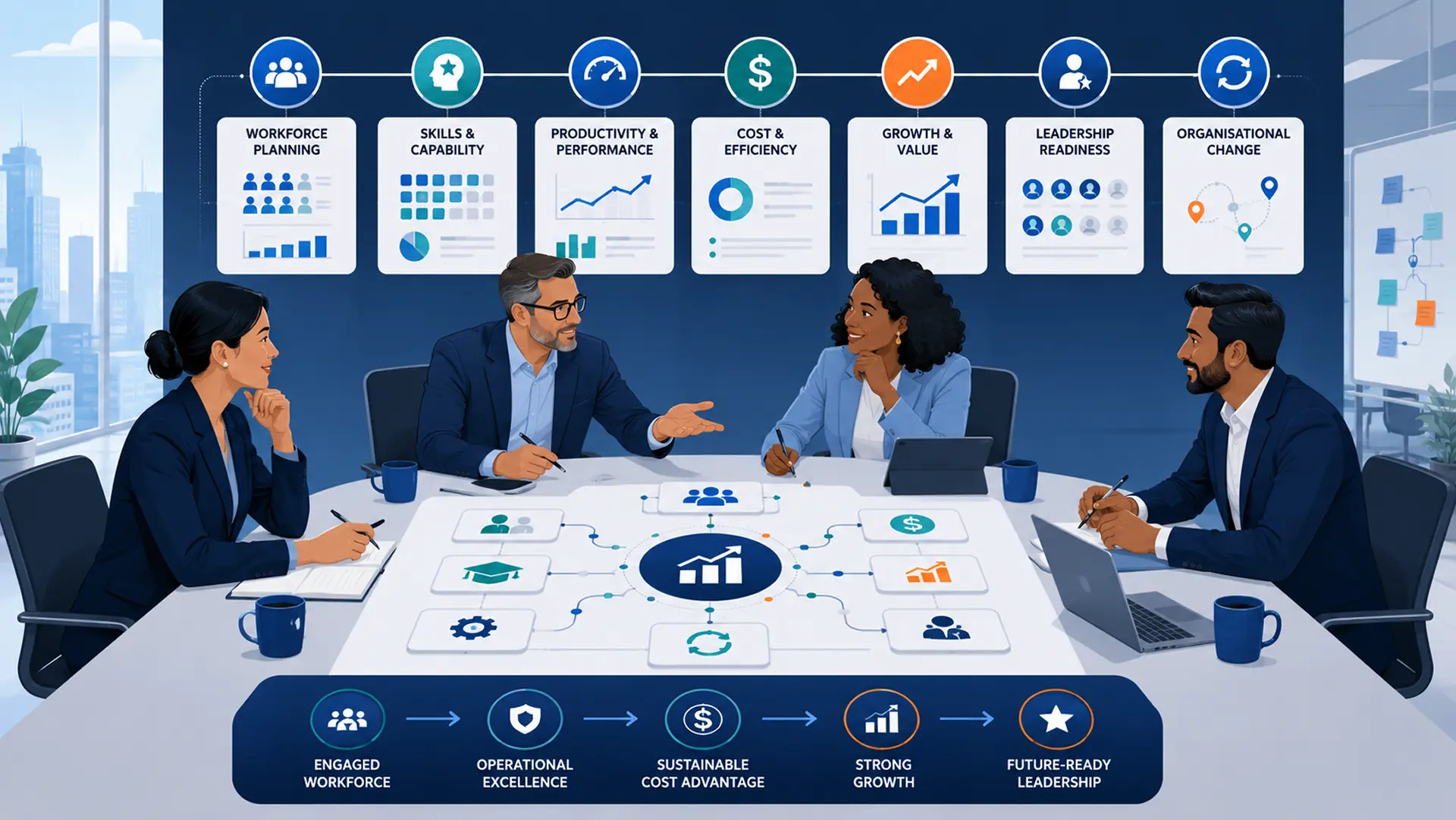
The most common reason an HR strategy fails to land isn’t poor execution. It’s that it was never built from the business strategy in the first place.
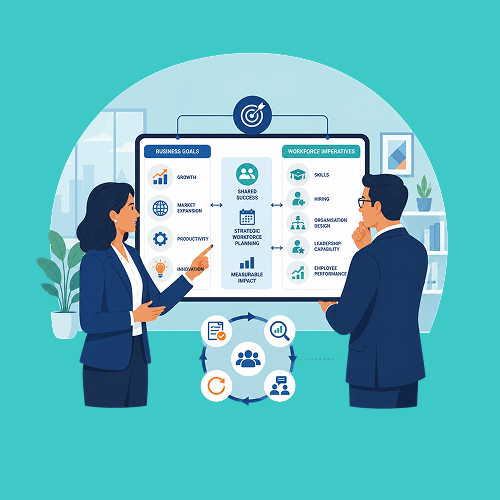
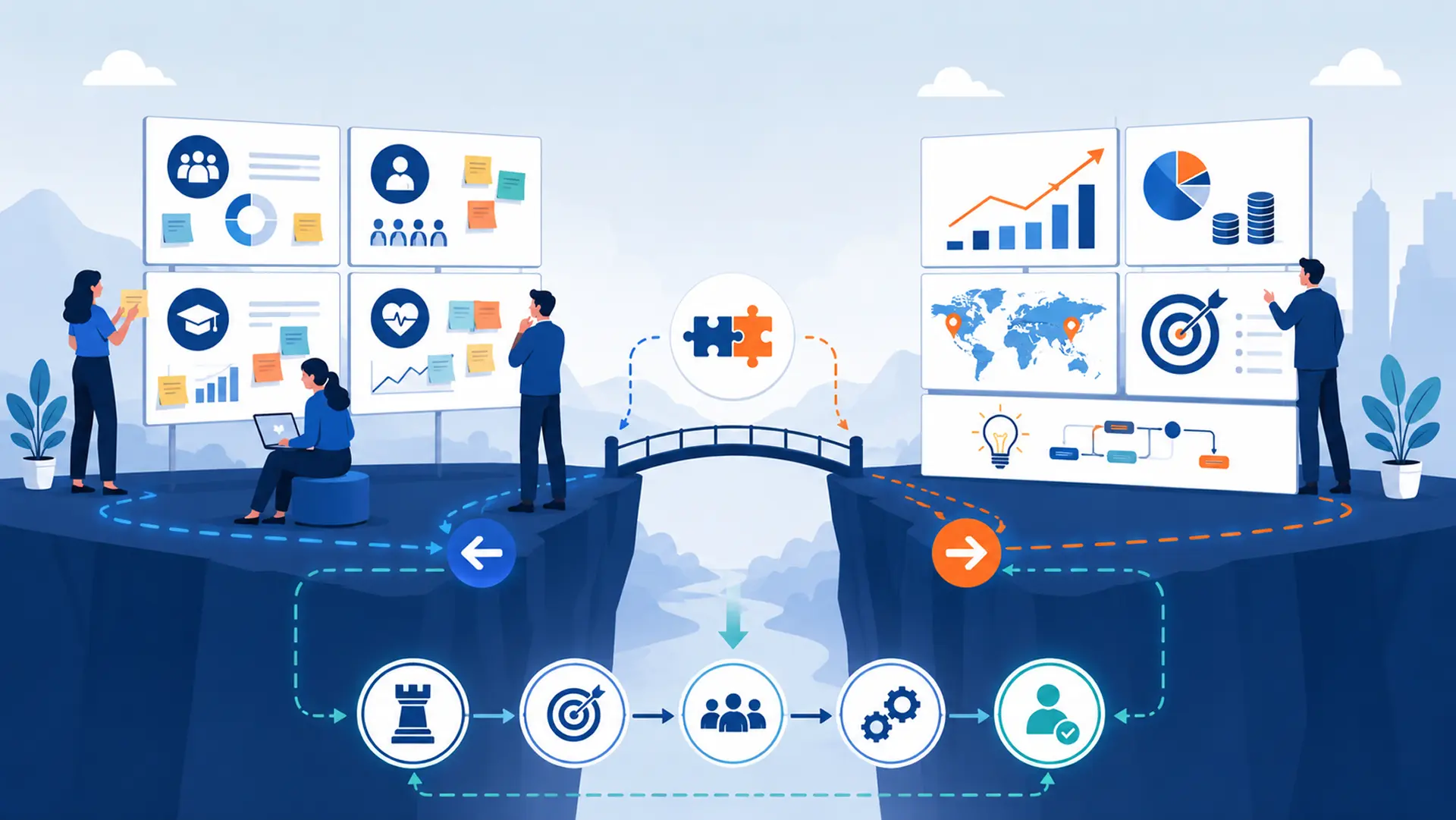
Too many HR strategies begin with an inventory of HR’s own priorities, engagement, retention, learning, wellbeing, and then look for ways to connect them back to the business. The more durable approach runs in the opposite direction: start with where the business is trying to go, then work out what that demands of the workforce, the organisation design and the leadership pipeline that will get it there.
This isn’t a new idea, but it has become a sharper one. Gartner’s 2026 CHRO Priorities research, drawn from a survey of 426 CHROs across 23 industries and four global regions, found that strategic workforce planning remains a top-five priority precisely because organisations are still working to align talent strategies with long-term business goals, even after years of being told to do so1. Alignment, in other words, is still the work, not a box that gets ticked once.
What CHROs are actually prioritising in 2026
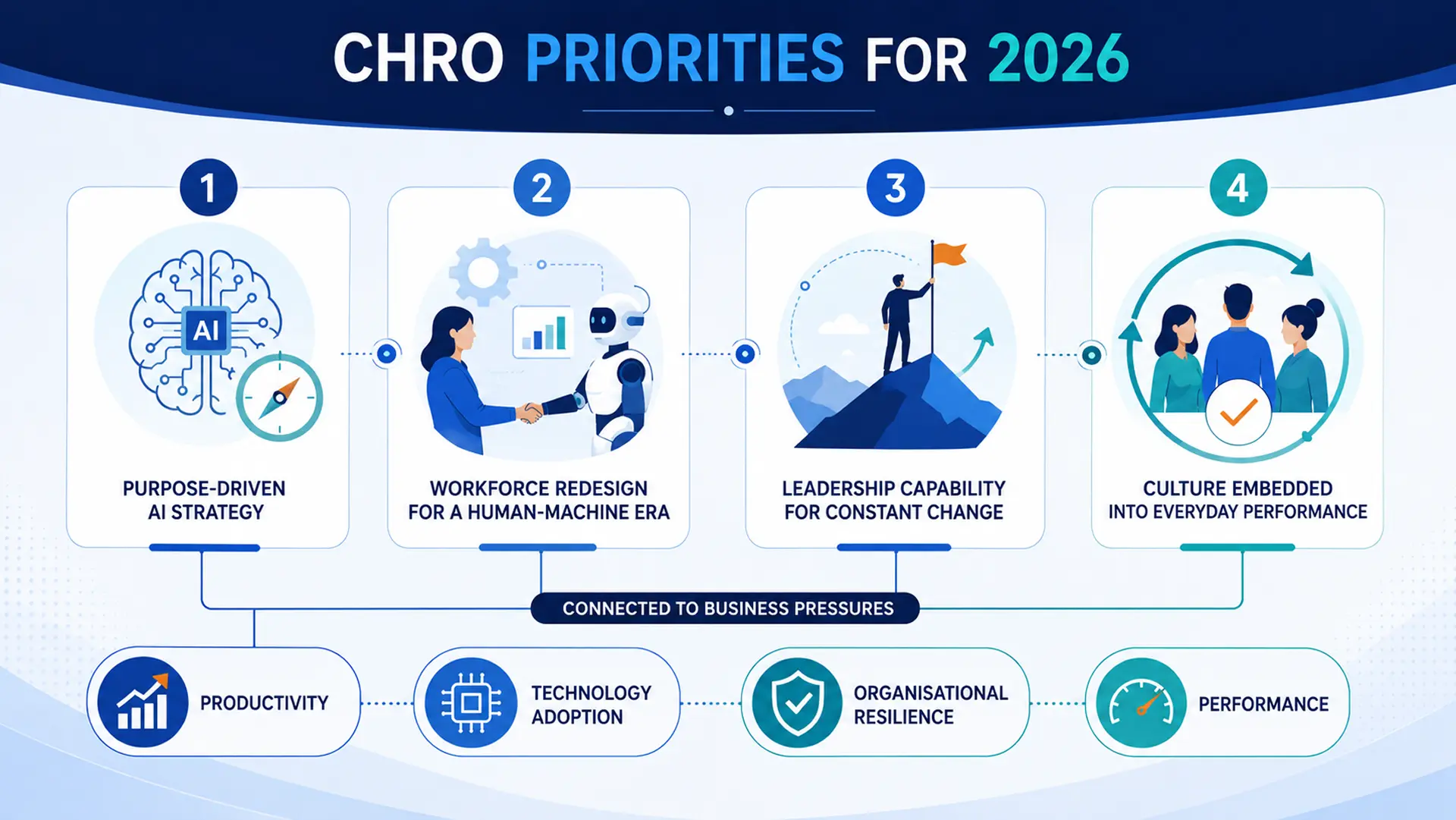
Gartner’s research identifies four themes shaping CHRO agendas this year: building a purpose-driven AI strategy specific to HR, redesigning the workforce for a human-machine era, equipping leaders to manage constant change, and embedding culture into everyday performance rather than treating it as a separate initiative2.
None of these read as HR-only concerns. Each is a direct response to a business-level pressure: cost and productivity, technology adoption, organisational resilience, and performance.
Priority signal | What the research found | Source |
AI-native HR strategy | AI & tech strategy climbed to the #2 CHRO priority for 2026, up from outside the top five | Gartner |
Operating model redesign | Evolving the HR operating model can unlock up to 29% in productivity gains | Gartner |
Culture embedded in performance | Embedding values into daily work can lift engagement by as much as 34% | Gartner |
Speed as strategy | 7 in 10 business leaders say being fast and nimble is their primary competitive strategy for the next three years | Deloitte |
Organisational agility pays off | Truly agile organisations are 2.7x more likely to be top financial performers in their industry | McKinsey Global Institute |
Human-centred AI adoption | Technology-first AI adopters are 1.6x more likely to fall short of expected returns than human-centred adopters | Deloitte |
Table: selected 2026 research findings on HR strategy, operating model and business alignment. Figures are as reported by the cited sources; verify current data before using in external materials.
The productivity case for a redesigned operating model
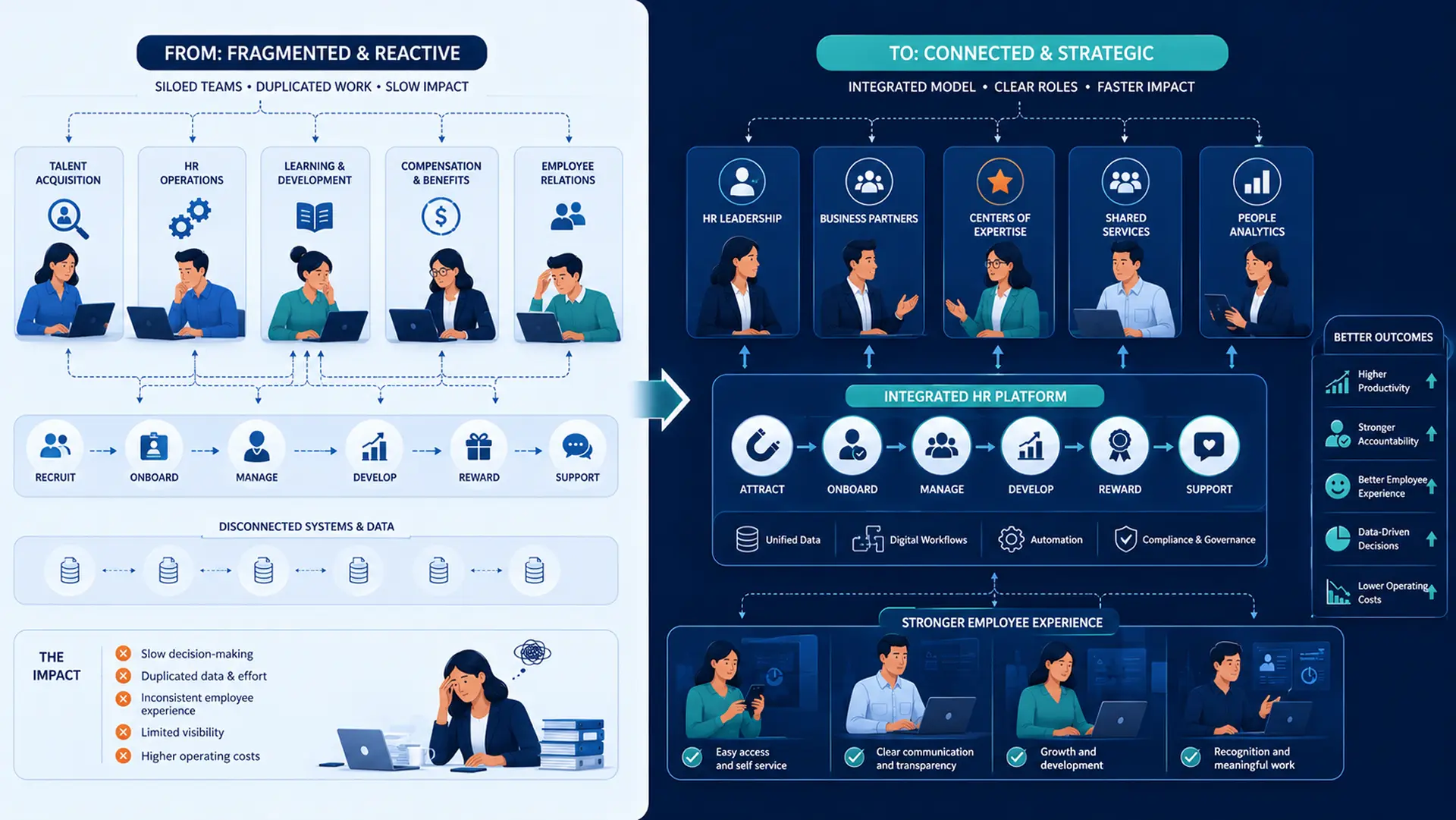
Gartner’s research suggests that evolving the HR operating model, rather than simply adding headcount or new tools to the existing one, can unlock up to 29% in productivity gains, while embedding organisational values into daily work can lift engagement by as much as 34%3.
Both figures point to the same underlying lesson: alignment is a design problem, not a communications problem. An HR strategy that simply restates business goals in an HR memo will not move either number. One that changes how work, roles and decisions are structured might.
Why agility and alignment now go together
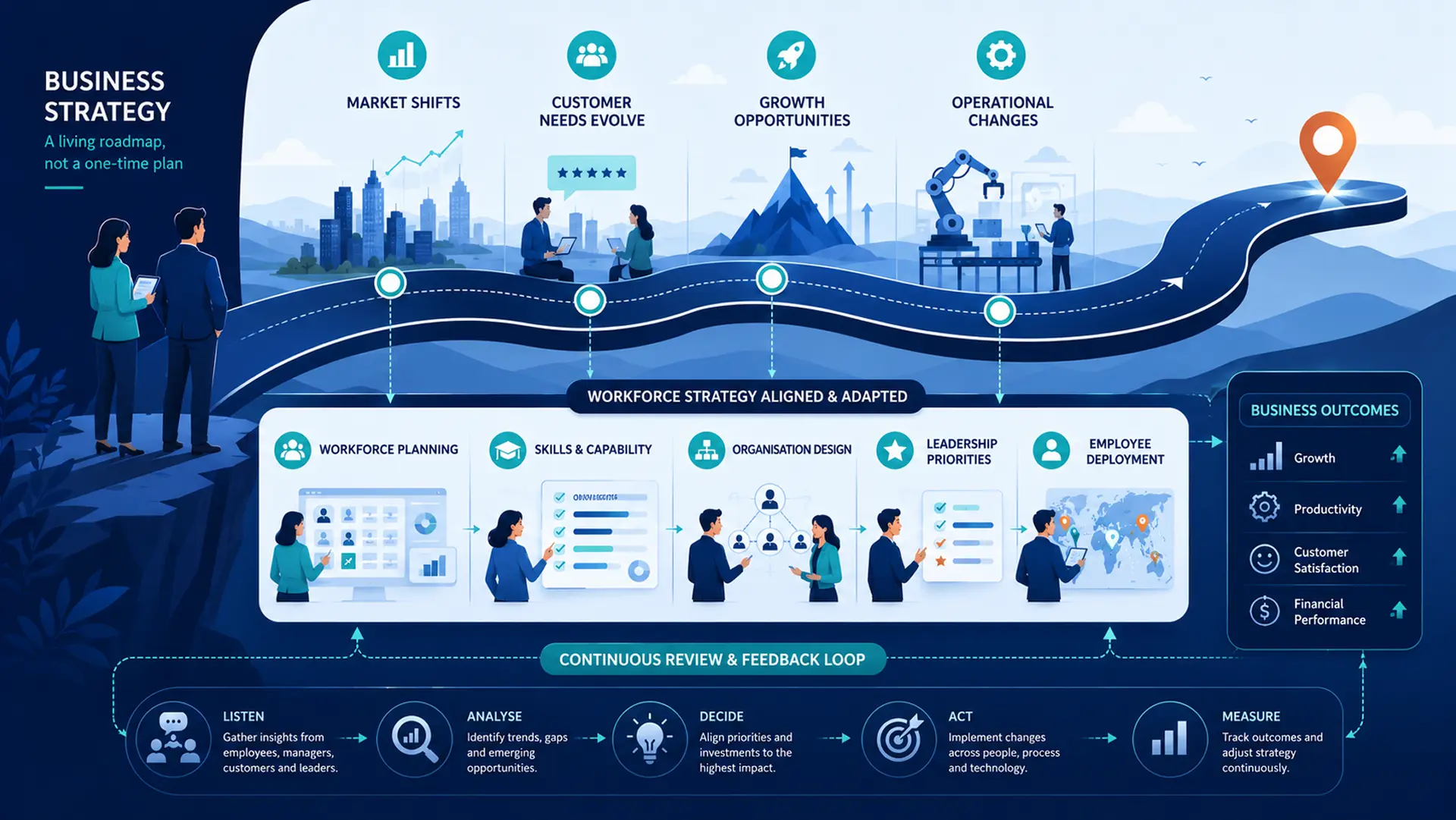
Deloitte’s 2026 Global Human Capital Trends survey, based on responses from more than 9,000 business and HR leaders across dozens of countries, found that seven in ten business leaders say their primary competitive strategy for the next three years is to be fast and nimble, adapting quickly to changing business, customer and market needs4.
Separate research from the McKinsey Global Institute found that truly agile organisations are 2.7 times more likely to be top financial performers in their industry5. An HR strategy aligned to business goals in a genuinely agile organisation therefore cannot be a fixed, annual document. It needs review points built in as often as the business itself resets direction.
Truly agile organisations are 2.7 times more likely to be top financial performers in their industry.
— McKinsey Global Institute, cited in Deloitte’s 2026 Global Human Capital Trends
A caution on AI-led strategy
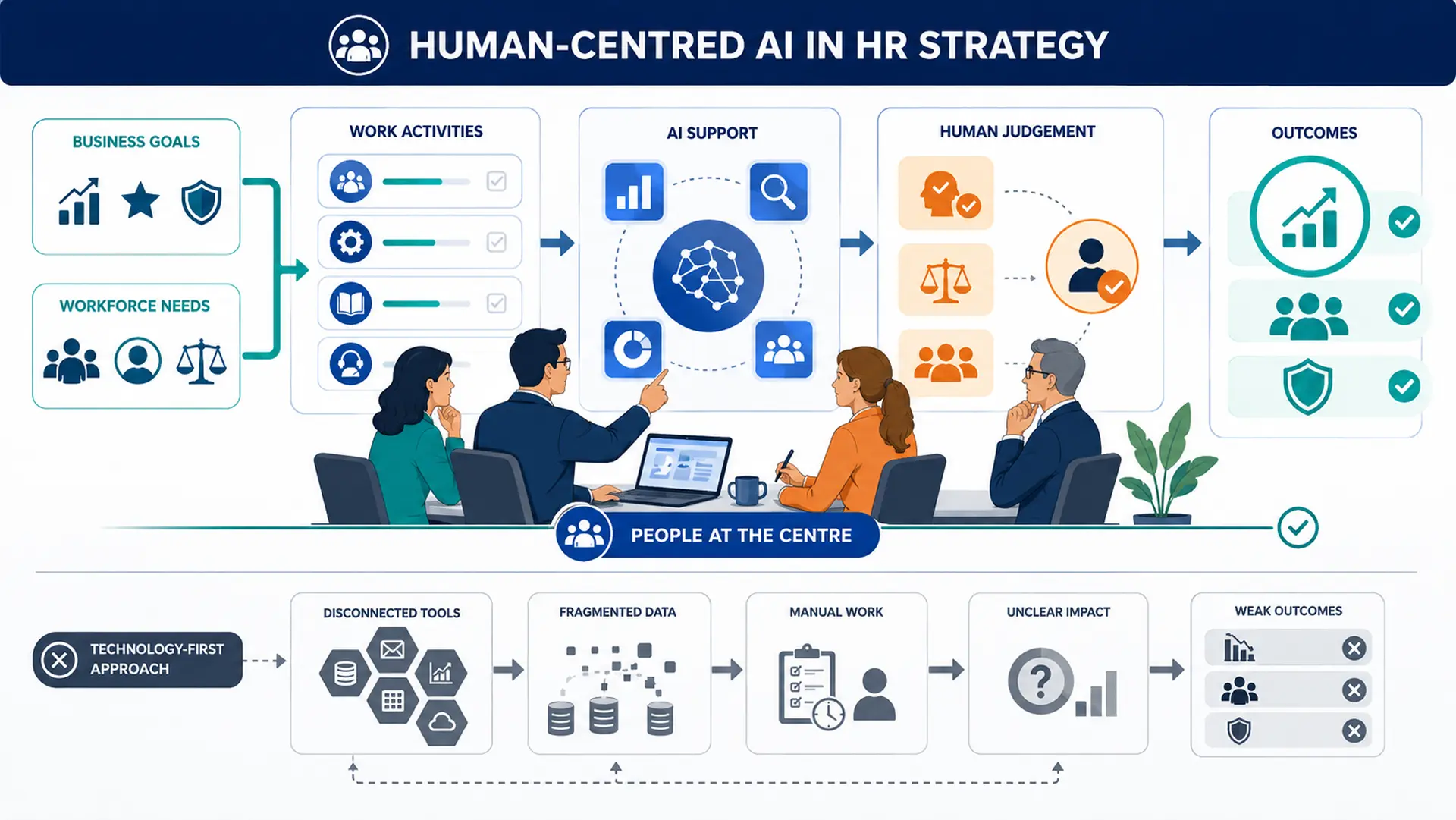
Deloitte’s 2026 research also carries a warning for HR strategies built primarily around technology deployment: organisations taking a technology-first approach to AI are 1.6 times more likely to fall short of expected returns than those that prioritise human-centred design6.
For HR leaders under pressure to fold an AI agenda into the strategy, the research suggests the sequencing matters. Business goals and workforce design should shape where AI is applied, not the other way around.
A practical framework for building the strategy
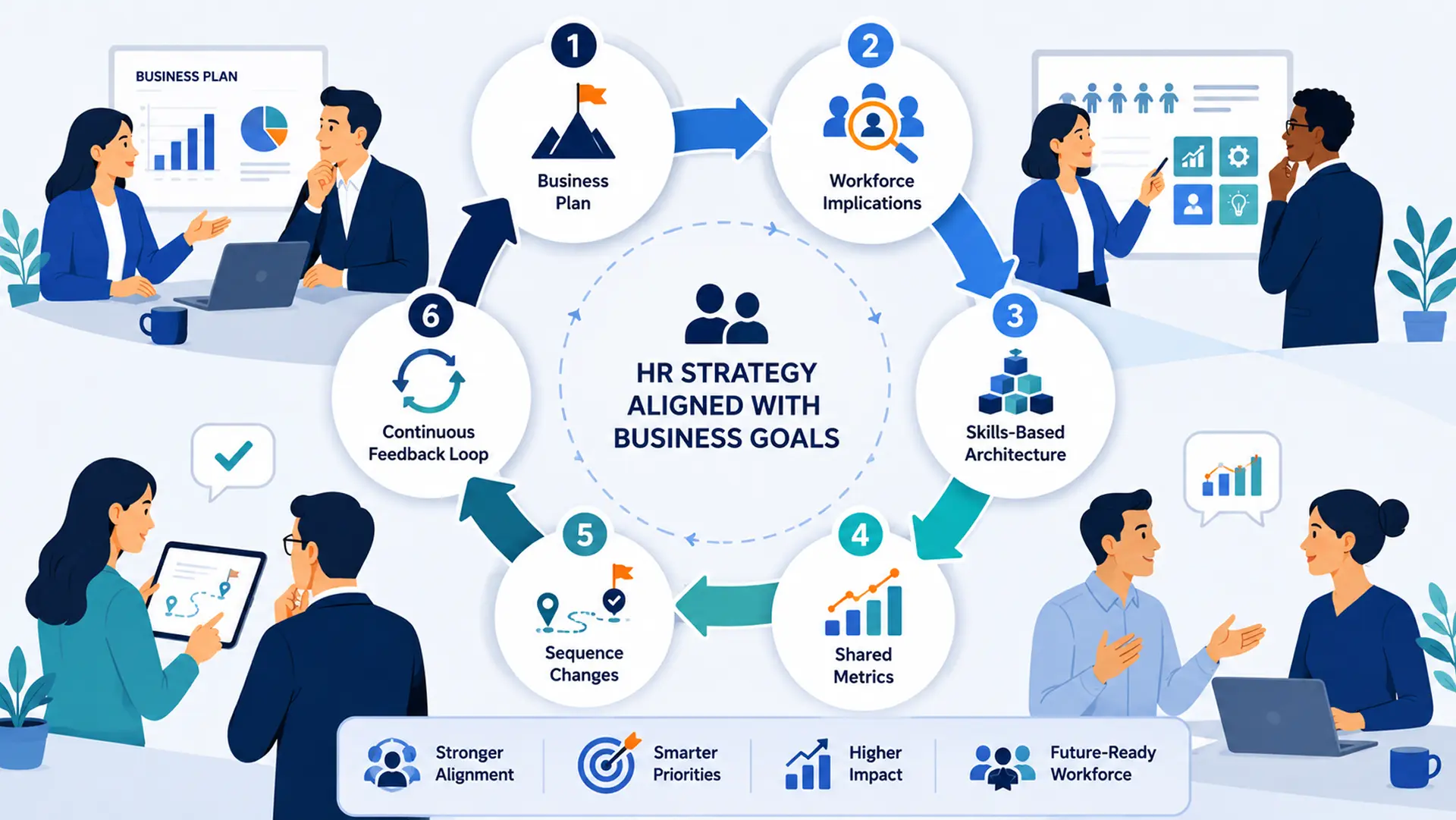
Translating this research into a working HR strategy comes down to a small number of disciplined steps, repeated well rather than expanded endlessly:
- Start from the business plan, not the HR plan. Read the actual strategy documents, revenue targets, market entry plans, cost programmes, before drafting a single HR priority.
- Translate each business goal into a workforce implication. A market expansion implies hiring velocity and local compliance capability; a cost programme implies span-of-control and automation decisions; a new product line implies specific skills gaps.
- Build (or rebuild) a skills-based architecture. Roles framed around fixed job titles age quickly; a skills-based structure adapts as the business goals shift.
- Set shared metrics, not parallel ones. Track HR initiatives against the same business outcomes leadership already reports on, revenue per employee, time-to-market, customer retention, rather than HR-only measures like training hours completed.
- Sequence the change. Business leaders rarely have the appetite for simultaneous transformation across every people process; prioritise the two or three shifts that unlock the most business value first.
- Build the feedback loop in from day one. An HR strategy aligned to business goals at launch will drift without a regular mechanism for re-checking that alignment as those goals shift.
Where the effort usually breaks down
Even well-designed strategies stall on execution. A July 2025 Gartner survey of 140 CHROs found that 64% believe their leaders and managers do not have the mindset to lead change effectively7.
An HR strategy can be perfectly aligned to business goals on paper and still fail if the managers responsible for translating it into daily behaviour are not equipped, or willing, to lead the change it requires. Building manager capability is not a separate workstream from strategy alignment; it is one of the load-bearing parts of it.
Vị trí của MiHCM
MiHCM Enterprise and Syntra, MiHCM’s AI intelligence and analytics platform, are built to close exactly this gap between HR strategy and business outcomes. Syntra brings workforce data, headcount, skills, performance, attrition, into the same view business leaders already use for revenue and operational metrics, so alignment can be tracked continuously rather than reassessed once a year.
SmartAssist, MiHCM’s AI HR co-pilot, and MiA ONE, its personal AI agent, are built around the same principle running through the research above: technology should support the judgement of HR and business leaders, not replace the sequencing decisions that make a strategy land.
For organisations across Asia balancing rapid growth with the discipline of a genuinely business-aligned HR function, that combination of visibility and human-centred design is the practical starting point.
The statistics in this article are drawn from named research published by Gartner, Deloitte and the McKinsey Global Institute, current as of mid-2026. Survey findings reflect the methodology and sample of each study and can change with each annual release. Readers should consult the original reports for full methodology before citing these figures externally.
References
- Gartner, “2026 HR Trends: Top CHRO Priorities & Strategic Insights” and Evanta, “Top 3 Priorities for CHROs in 2026”.
- Gartner, cited in Business Chief, “Gartner: What are HR Leaders’ Top Priorities for Resilience?”, and Complete AI Training, “HR at the Core: Gartner’s 2026 CHRO Priorities”.
- Complete AI Training, “HR at the Core: Gartner’s 2026 CHRO Priorities – AI Strategy, Workforce Redesign and Culture for Resilience”.
- Deloitte Insights, “2026 Global Human Capital Trends”.
- McKinsey Global Institute research, cited in Libertify, “Deloitte 2026 Global Human Capital Trends: Workforce Transformation”.
- Work-Self, “Deloitte 2026 Global Human Capital Trends”.
- Gartner, cited in “Gartner Announces Top Trends Shaping HR Priorities in Australia in 2026”.
Sources correct as of July 2026. Verify current figures against the original research reports before publication.