
Why career growth doesn’t always mean promotion and what that means for modern talent management
By Rashika Fazali
For most of my career, I’ve unconsciously understood career progression in one direction.
Up.
You become good at your job.
Then you become senior.
Then a manager.
Then a head.
Then a director.
And onwards you climb until, presumably, you reach the mysterious upper floors of corporate existence where everyone spends their entire life in meetings.
We’ve even built this idea into our language.
- We climb the corporate ladder.
- We move up.
- We reach the next level.
So when someone is doing exceptionally well, one of the most natural questions we ask is: “What’s next?” And usually, “next” means promotion.
But what if your best employee doesn’t want to be promoted?
What if they’re ambitious, talented, highly engaged, and absolutely uninterested in managing anyone?
Does that mean they don’t want to progress? Or have we simply spent too long confusing career progression with career promotion?
We’ve built a very particular idea of career success
Imagine an exceptional software engineer.
They love solving difficult technical problems. They’re curious. They’ve developed deep expertise. Other people come to them for advice. They become extraordinarily good at what they do.
So eventually, the organisation rewards them. We make them a manager.
Suddenly, instead of spending most of their time solving technical problems, they’re approving leave, conducting performance conversations, managing conflicts, attending meetings and dealing with eight other humans who have inconveniently developed feelings.
We call this progression.
But did that employee actually progress?
Maybe they discover they love leadership.
But we’ve also taken someone away from the work that made them exceptional and moved them into a role requiring a completely different set of skills.
We rewarded excellence at one thing by asking them to stop doing quite so much of it. When you put it like that, it’s a slightly strange system.
Not wanting to be a manager doesn’t mean you’re not ambitious
This is perhaps the assumption worth challenging most.
We often associate ambition with hierarchy.
Someone wants leadership responsibility? Ambitious.
Someone wants to become a director? Ambitious.
Someone wants to run the company one day? Very ambitious.
But what about the person who wants to become extraordinarily good at their craft?
A musician can spend decades mastering an instrument without wanting to conduct an orchestra. A chef can want to become exceptional at cooking without wanting to manage a restaurant group. A software engineer can want to become a world-class architect without wanting fifteen direct reports.
These people aren’t necessarily less ambitious. Their ambition simply points somewhere else. That’s probably why we need to separate ambition from promotion.
Why career progression means different things to different employees
One useful way of thinking about this comes from Self-Determination Theory, developed by psychologists Edward Deci and Richard Ryan.
The theory proposes that human motivation is strongly influenced by three psychological needs:
- Tự chủ – feeling that we have meaningful choice and control.
- Competence – feeling capable and developing mastery.
- Relatedness – feeling connected to other people.
A promotion can absolutely satisfy those needs.
Greater responsibility may provide autonomy. A new challenge can strengthen competence. Leadership can create deeper relationships and belonging. But promotion can also do the opposite.
Imagine our brilliant engineer again.
Management gives them greater status and perhaps better pay. But they now spend less time doing the technical work that gave them a sense of mastery.
Their calendar fills with meetings, reducing their autonomy. And the problems they solve become increasingly administrative rather than technical.
From the outside, their career has moved forward. From the inside, it may not feel like progress at all.
That’s the interesting thing about careers: progress is partly psychological.
Why promotion isn’t always the best career progression
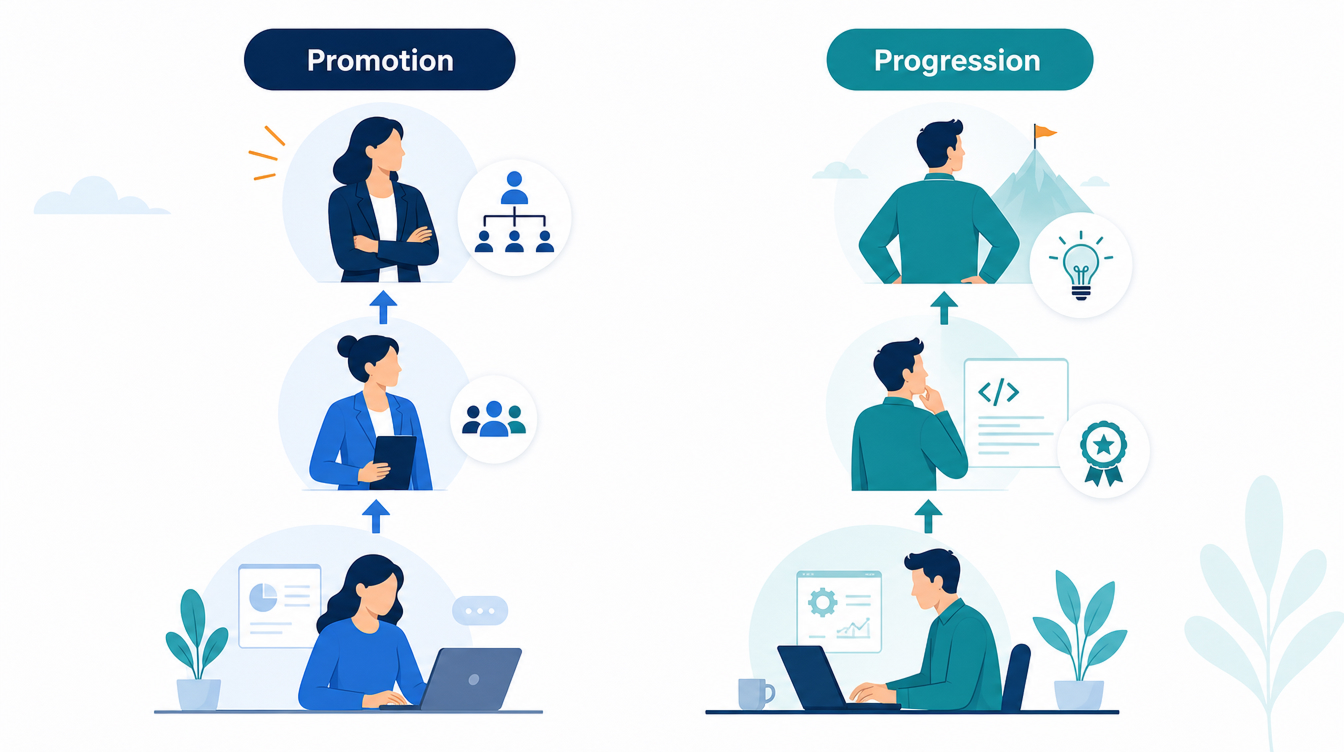
Peter Principle, proposed by Laurence J. Peter, argues that hierarchical organisations keep promoting people who perform well until they eventually reach a role requiring abilities they don’t necessarily possess, i.e. promote them to their level of incompetence.
The classic example is easy to recognise.
Someone is an exceptional salesperson. So, we promote them to sales manager. But selling and managing salespeople aren’t the same skill.
The best salesperson isn’t automatically the best coach. The best engineer isn’t automatically the best engineering manager. The best journalist isn’t automatically the best editor. The best performer isn’t automatically the best leader.
None of this means those people can’t become excellent managers.
Many do.
The problem is assuming that management is the natural reward for being good at something else.
What if careers aren’t ladders?
This metaphor itself is part of the problem.
A ladder only gives you two useful directions.
Up. Or down.
Human careers are considerably messier. What if careers looked more like maps?
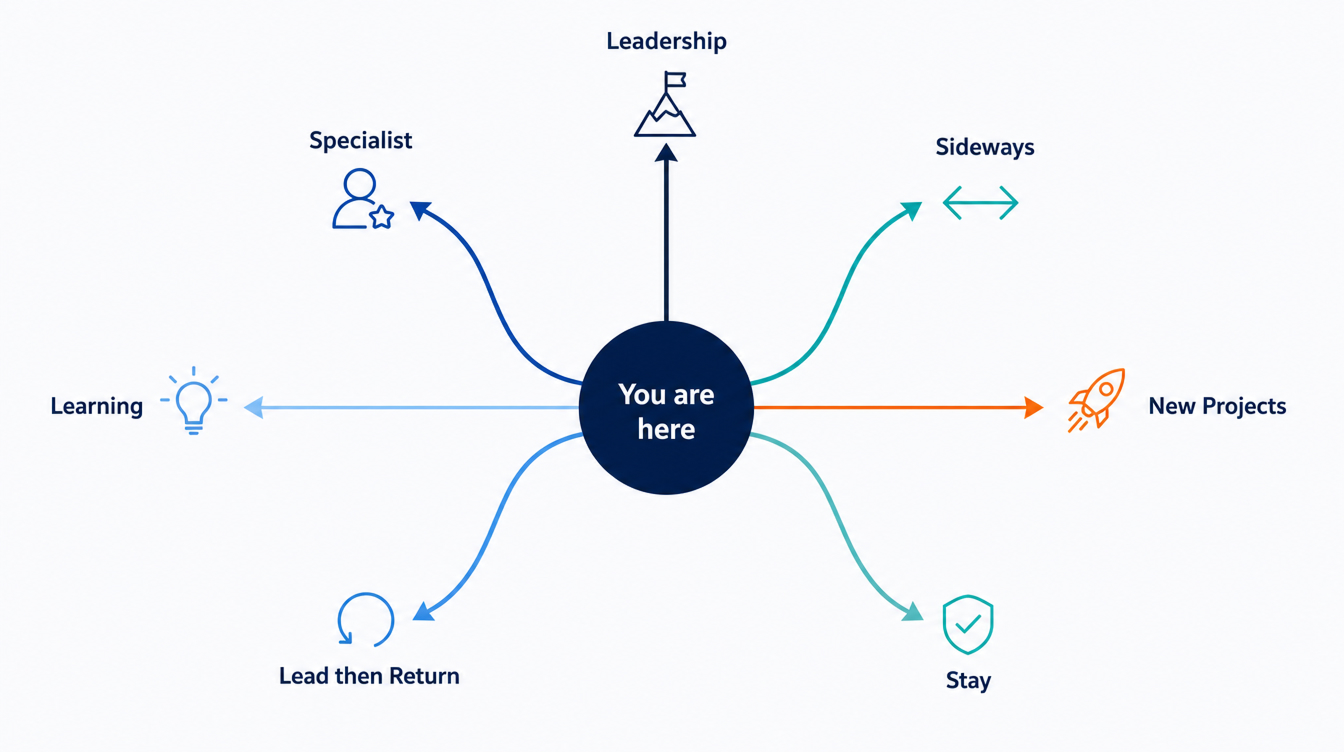
- You could move upward into leadership.
- You could move deeper into specialist expertise.
- You could move sideways into another discipline.
- You could move outward into new projects, markets or experiences.
- You could spend time learning something completely new.
- You could lead for several years and then return to specialist work.
- You could even decide that, for this particular stage of your life, you don’t want to move anywhere.
And that last one is interesting. Because we’re uncomfortable with professional stillness.
If someone hasn’t been promoted for five years, we instinctively wonder whether they’ve stagnated. But what if they’ve spent those five years becoming exceptionally good?
Stability isn’t necessarily stagnation.
Our definition of progress changes as our lives change
There’s another problem with career paths. They often assume we’re designing careers for static human beings.
We’re not.
What someone wants at 25 may be completely different at 35.
At one point in life, someone may want responsibility, travel, and rapid progression. Later, they may value flexibility. Another employee may spend years avoiding leadership and suddenly discover they love mentoring people. Someone else may reach management and realise, “Actually, I was happier doing the work.”
That shouldn’t necessarily be considered a failed career experiment.
Human priorities change because human lives change.
Relationships.
Children.
Health.
Financial needs.
Curiosity.
Confidence.
Experience.
Ambition itself changes shape.
Yet career frameworks can sometimes behave as though an employee selected their desired destination during onboarding and should now proceed obediently towards it.
Humans are rarely that cooperative.
But then we need to talk about money
There’s an uncomfortable practical problem here.
Organisations can tell employees, “You don’t have to become a manager to progress.”
Lovely.
But if the meaningful salary increases, status and influence are overwhelmingly attached to management positions, the organisation has already defined what progression means. The choice exists largely on paper.
This is why specialist career tracks matter.
If an organisation genuinely values deep expertise, there should be meaningful ways for specialists to progress in compensation, recognition, influence, complexity of work, and organisational impact.
Otherwise, we eventually force talented specialists to choose between doing the work they love Và advancing their career.
That’s not much of a career path. It’s an ultimatum wearing business casual.
Maybe employees don’t need a career path. they need career possibilities.
A traditional career path says: You are here → your next role is here → eventually you should get there.
Career possibilities ask something different: Where might you go from here?
Maybe there’s a specialist role. A leadership role. A project opportunity. A new geography. A different department. A mentoring opportunity. A new skill. A temporary assignment. A completely unexpected direction nobody had considered when the employee joined.
The organisation still provides structure. But the employee has agency. And psychologically, that matters.
What can businesses offer instead of traditional promotions?
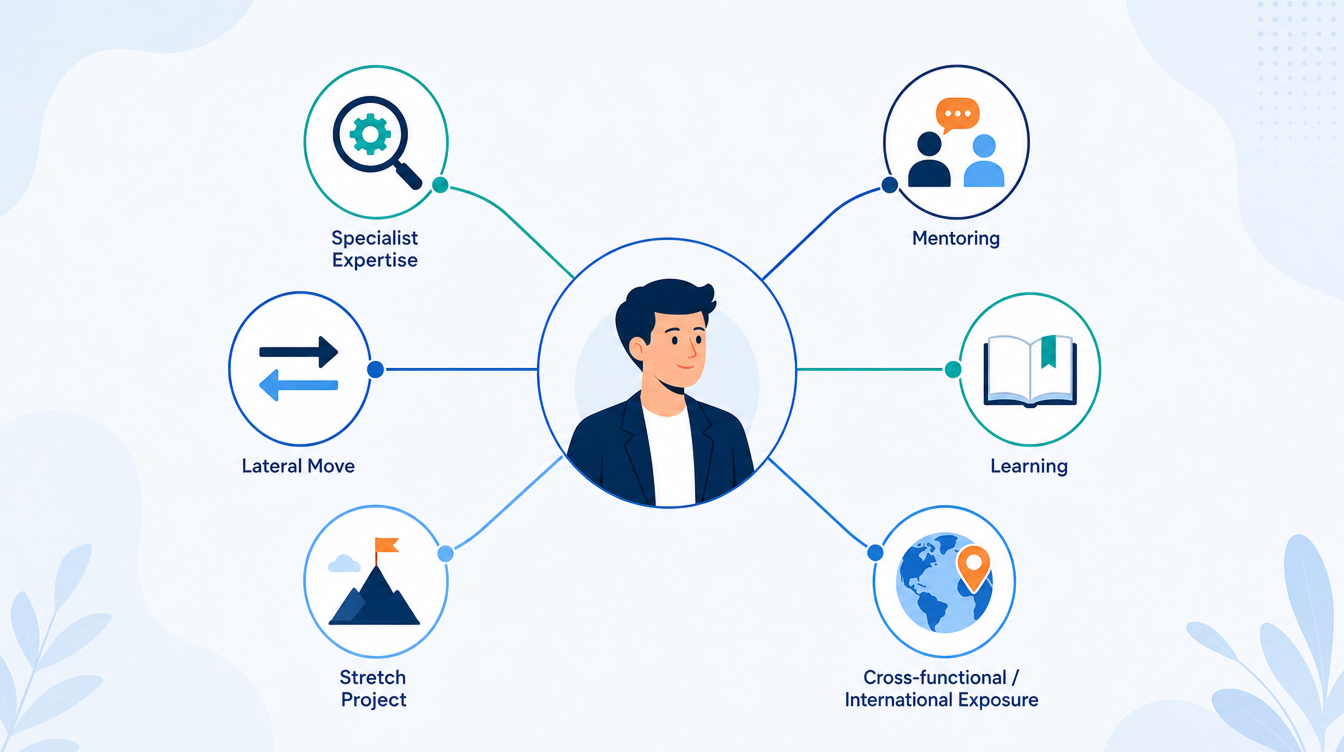
If promotion isn’t the only form of career progression, organisations need to give employees other meaningful ways to grow. And importantly, these alternatives can’t feel like consolation prizes.
Telling an exceptional employee, “We can’t promote you, but here’s an online course” isn’t quite the revolutionary career model we’re looking for.
Career growth can take many forms.
- Specialist career tracks can allow employees to deepen their expertise while progressing in compensation, recognition, and influence without moving into people management.
- Lateral career moves and internal mobility can give employees opportunities to explore different functions, roles or business areas without leaving the organisation.
- Stretch assignments and strategic projects can offer greater responsibility and exposure without requiring a permanent change in job title.
- Mentoring opportunities can allow experienced employees to share their expertise and develop leadership skills without necessarily becoming managers.
- Skills development and learning pathways can help employees build capabilities that open entirely new career possibilities.
- Cross-functional or international exposure can provide new experiences, networks and perspectives while allowing employees to remain within the organisation.
And sometimes growth can simply mean greater autonomy – more ownership over decisions, more complex work, or the freedom to shape how that work gets done.
This is where internal mobility becomes particularly important.
Instead of thinking about career progression only as moving upward, businesses can help employees discover opportunities to move up, across or deeper within the organisation.
The goal isn’t to eliminate traditional promotions. Plenty of employees want them, and leadership roles remain an important form of career progression. The goal is to stop treating promotion as the only visible evidence of progress.
Once businesses recognise that employees define growth differently, career development becomes less about constructing one perfect ladder and more about creating enough meaningful possibilities for different people to keep moving.
How AI is changing career development and talent management

HR systems have traditionally been very comfortable with structure.
Job titles.
Grades.
Reporting lines.
Competencies.
Succession plans.
Organisational hierarchies.
Career paths.
Humans, unfortunately, have never been particularly respectful of neat databases. And now AI is entering talent management.
AI-powered HR systems can increasingly help identify skills, recommend learning, surface internal opportunities, support career planning and potentially suggest roles employees might be suited for.
That’s incredibly powerful. But it introduces an important question: Before AI recommends where an employee should go next, does it understand what “next” means to that employee?
Imagine an AI system sees:
- High performer.
- Six years of experience.
- Excellent technical capability.
- Strong peer feedback.
And recommends: Engineering Manager.
Perfectly logical.
Except the employee wants to become a Principal Engineer or learn AI or work internationally, or spend more time mentoring junior engineers, or take on more complex projects without managing anyone, or right now, they’re perfectly happy.
Data can tell us a remarkable amount about where someone has been but it doesn’t automatically tell us where they want to go.
AI shouldn’t just build a smarter career ladder
This is where personalisation in HR technology becomes much more interesting than simply recommending another course.
An intelligent career system shouldn’t only ask: What role is this employee statistically suited for? It should also help understand:
- What do they want to become better at?
- What kind of work energises them?
- Do they actually want leadership responsibility?
- What skills are they interested in developing?
- Are they looking for progression, exploration, mastery or stability?
- What opportunities exist inside the organisation that could give them that?
And most importantly: Has what they want changed?
The objective shouldn’t be for AI to become extraordinarily good at pushing everyone up the same ladder. It should help us recognise that there are many different ways to move forward.
How career development and internal mobility can improve employee retention
Businesses spend enormous amounts of time trying to understand why good employees leave. People analytics and AI are increasingly being used to identify patterns associated with employee turnover.
But there’s another question worth asking: Did that employee have somewhere meaningful to go without leaving the organisation?
Someone may not want their manager’s job. But perhaps they want a harder problem: a different project, a new skill, a specialist position, international exposure, a temporary assignment, a mentoring role or more autonomy.
If the only visible route to progress is upward, employees whose ambitions point elsewhere may eventually have to leave simply to keep moving.
Retention isn’t always about convincing people to stay where they are. Sometimes it’s about giving them more places to go while staying with you.
What does progress look like to you?
As HR technology becomes more intelligent, we need to think carefully about this.
AI gives us an extraordinary opportunity to personalise learning, understand skills, surface internal opportunities and help employees explore possible career directions.
But intelligent career technology shouldn’t simply become better at telling employees where the organisation thinks they should go. It should help organisations understand where employees themselves want to go. And that starts with a much simpler human conversation.
Instead of always asking talented employees: “What’s your next promotion?” Maybe we should ask: “What does progress look like to you?”
For one person, progress might mean leading 100 people. For another, it might mean becoming one of the best people in the world at what they do. For someone else, it might mean learning something completely new. And for another, at this particular moment in their life, progress might mean having more time for everything that happens outside work.
None of them necessarily lacks ambition. Their ambition looks different.
We’ve spent too long trying to fit very different definitions of success onto the same corporate ladder. And as AI begins helping organisations recommend careers, identify talent, and shape employee development, that distinction becomes even more important.
The future of career development shouldn’t be about building a smarter ladder. It should be about recognising that not everyone wants to climb the same one.

Rashika Fazali
Business Operations Lead – Data & AI
(Rashika Fazali is the Data & AI Business Lead at MiHCM and Deputy General Manager at Futura Tech Labs. She holds a Master’s degree in Business Psychology from London Metropolitan University and has over 16 years of experience spanning the media, entertainment, and technology industries. Her work examines the human factors that shape organisations, brands, and communities, bringing together psychology, artificial intelligence, leadership, and broadcasting, combining psychological insights with real-world experience to help organisations build more engaged, productive, and human-centred workplaces.)