

By Bakhtiar Pahroraji
Ask a Malaysian HR director what has changed most about their role over the past two years, and the answer is rarely about technology. It is about pace. Statutory amendments that arrived once every few years now arrive every few months, and each one lands on the same small team that is also expected to raise productivity, retain scarce talent, and contribute to a digital transformation agenda.
That combination is challenging, but it also poses an opportunity. The organisations I work with across the region that are pulling ahead are not the ones with the largest HR budgets but the ones that stopped treating compliance as administrative transactions and started treating it as the foundation of a workforce data capability. In Malaysia, in 2026, that distinction is becoming the difference between an employer that reacts and an employer that competes.
Malaysia’s digital ambition has become a workforce question
Malaysia’s digital economy is no longer a policy aspiration sitting in a blueprint. According to the Department of Statistics Malaysia, information and communications technology and e-commerce together contributed 23.4 per cent of the national economy, or RM451.3 billion, in 2024. The Malaysia Digital Economy Corporation (MDEC) has stated that it is working towards a digital economy contribution of 25.5 per cent of Gross Domestic Product and reported that approved digital investments under the MDEC initiative reached RM163.6 billion in 2024 — an increase of 250% on the previous year, associated with more than 48,000 jobs.
Those numbers are usually read as an investment story. They should be read as a workforce story. Data centres, global business services hubs, and AI operations do not merely require capital; they require employers who can hire quickly, classify roles accurately, pay correctly, and evidence all of it. The constraint on Malaysia’s digital ambition appears to be administrative capability rather than investment appetite.
Compliance has become the pacesetter for HR technology
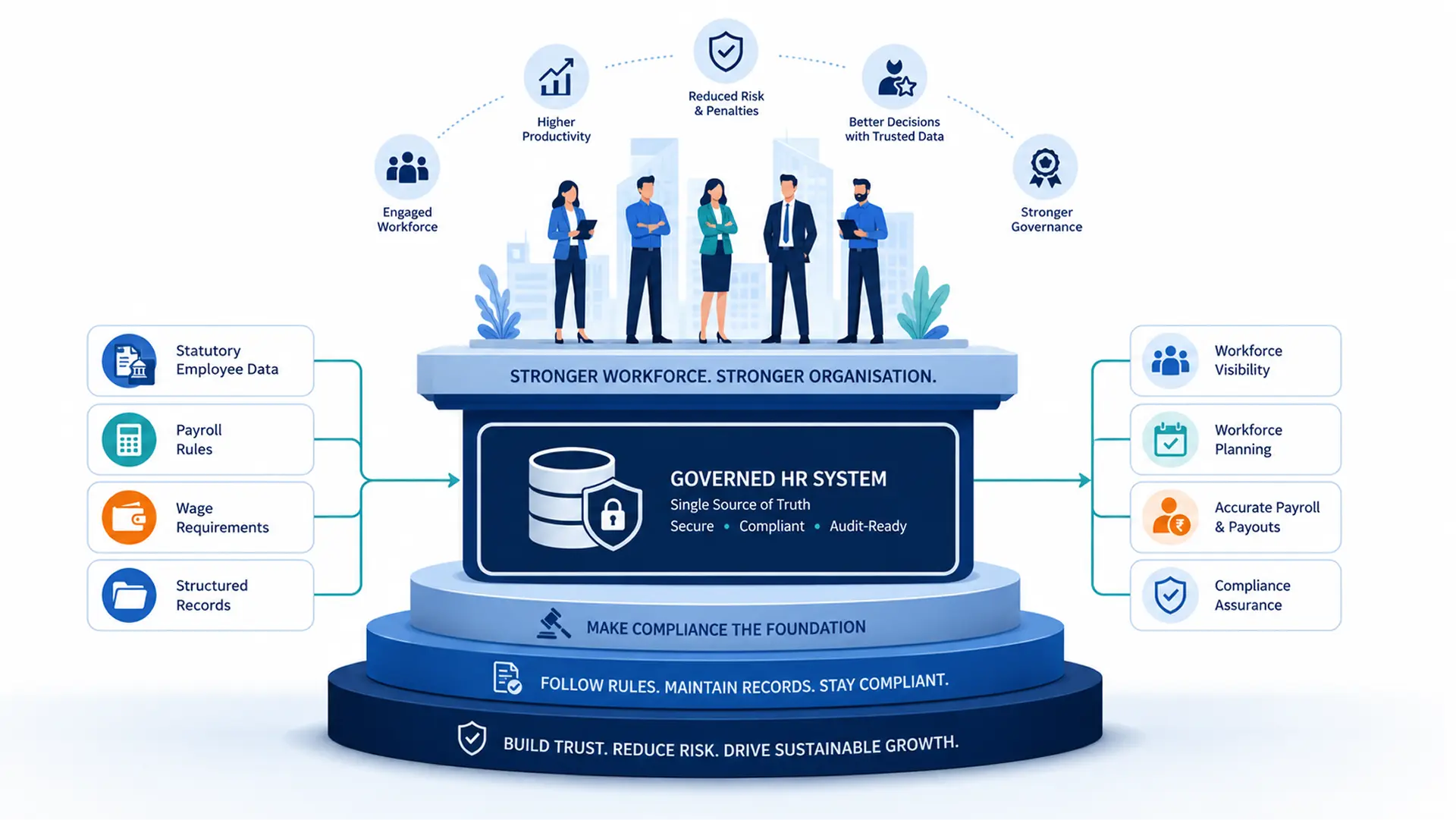
Three changes in quick succession have reset what “good” looks like in Malaysian payroll.
Mandatory EPF contributions for non-Malaysian employees: Under the Employees Provident Fund (Amendment) Act 2025, EPF contributions became mandatory for non-Malaysian employees from October 2025, at 2% from the employer and 2% from the employee, with domestic servants excluded. For employers accustomed to treating expatriate and foreign-worker payroll as an exception, this is not a rate change. It is a data change. It requires reliable nationality, employment pass type, and eligibility data for every individual on the payroll, refreshed every cycle.
A higher minimum national wage: The Minimum Wages Order 2024 raised the monthly minimum wage to RM1,700, from 1 February 2025 to employers with five or more employees and to employers engaged in professional activities classified under MASCO 2020, and from 1 August 2025 to all remaining employers regardless of headcount. The Ministry of Human Resources has also encouraged employers to consider the Progressive Wage Policy, which links wage growth to productivity and skills. The compliance task is straightforward. The strategic task of protecting internal pay equilibrium as the floor rises is not.
Electronic invoicing and the end of unstructured data: The Inland Revenue Board’s MyInvois rollout has pushed electronic invoicing in by annual turnover, with businesses volume in the RM1 million to RM5 million band from 1 January 2026. Payroll and HR are not the primary subjects, but they feel its consequences. Once finance operates on validated, structured, machine-readable records, manual spreadsheets shuffling between HR and finance becomes a pain.
Malaysian authorities are progressively raising the standard of data an employer must be able to produce on demand. Employers who meet that standard with additional headcount and additional spreadsheets will keep meeting it, expensively, for sure. Employers who meet it by consolidating employee data into a single governed system acquire something they did not have before: an accurate, current dashboard of their own workforce.
The productivity question no employer can deny

Malaysia’s productivity performance is improving and remains a national priority. The Department of Statistics Malaysia reported labour productivity growth of 2.4% in 2024, with value added per employed person of RM99,265, and in the first quarter of 2026 recorded productivity per hour worked of RM45.5, up 4.8% year on year, alongside 16.7 million employed persons.
Productivity gains of that magnitude are not delivered by working harder. They are delivered by removing friction. In most of the organisations I visit, HR and payroll teams still spend a substantial share of each month on reconciliation: chasing approvals, correcting attendance records, and rebuilding statutory reports that a system should already hold. Every hour spent there is an hour not spent on workforce planning, capability building, or manager coaching — the activities that actually move enterprise productivity.
This is the practical advocacy for automation in HR, and it is a more honest one than the arguments usually made. The point is not that software is clever, but a correctly configured system removes the rework that consumes the very people you need for higher-value tasks.
Talent mobility: retention is the new recruitment
Malaysia’s labour market is tight. The Department of Statistics Malaysia reported that the labour force reached 17.09 million people in 2025, with a labour force participation rate of 70.8% — the highest level recorded — and 16.58 million employed persons. A near-fully employed market is good news and a difficult operating environment for employers.
It is compounded by a skills mismatch. Randstad Malaysia’s job market and salary guide for 2025 found that 56% of employers reported a shortage of talent with the skills their organisations need. Globally, the World Economic Forum’s Future of Jobs Report 2025 found that employers expect 39% of workers’ core skills to change by 2030, and that 63% of employers identify skills gaps as the primary barrier to business transformation — ranking above culture, regulation, and capital. The same report estimates that if the global workforce were 100 people, 59 would require reskilling or upskilling by 2030.
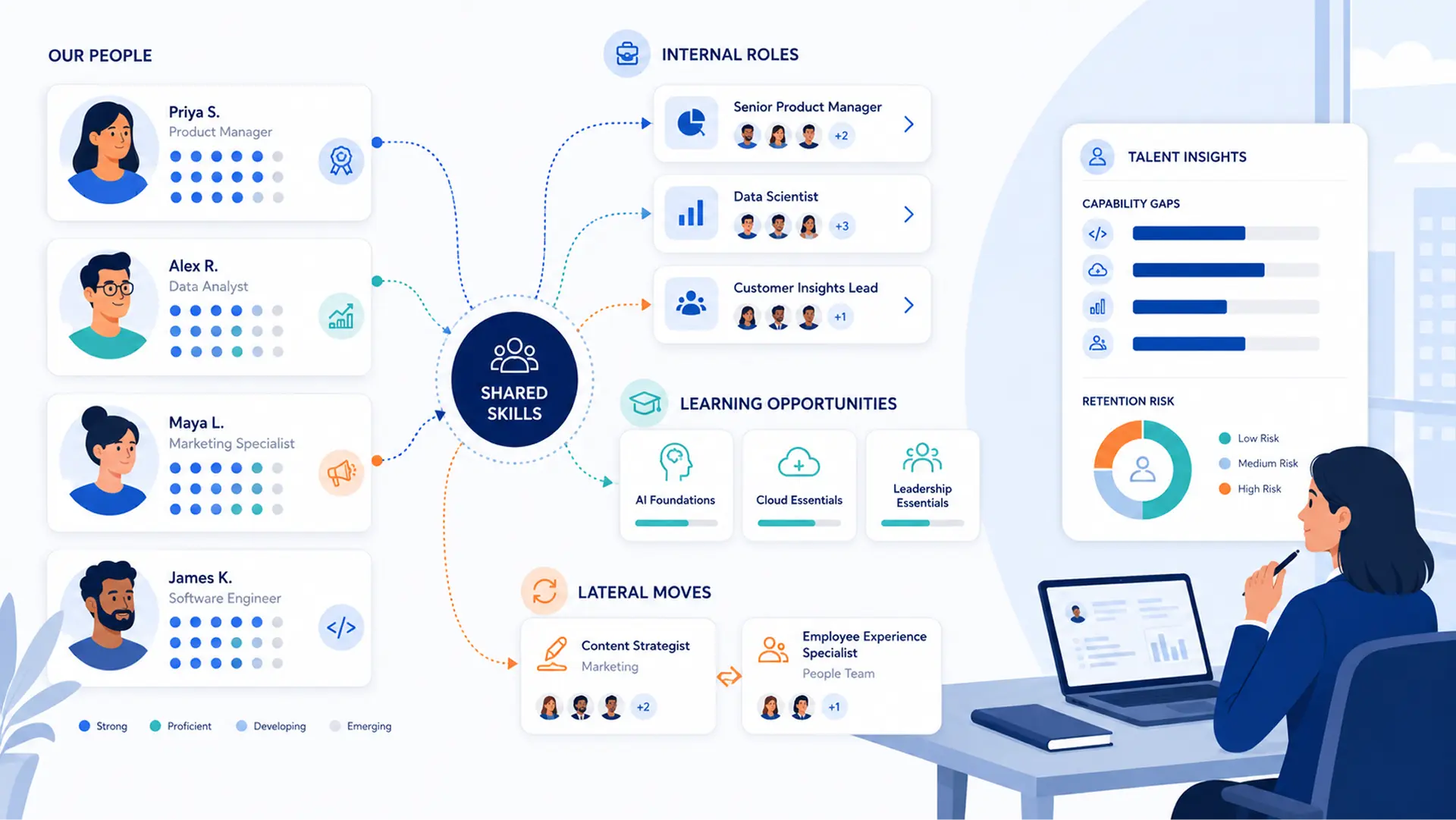
Malaysian employers competing with regional players for the same talent pool is intense; you will not out-recruit this market. You can, however, out-develop and out-retain it. That requires knowing which internal skills you already possess, which are becoming obsolete, and where your flight risk sits. None of that is visible without workforce data that is complete enough to be used.
AI-driven workforce insight: from reporting to foresight

The AI conversation in HR has matured over the past 18 months.
Microsoft’s 2025 Work Trend Index, based on a survey of 31,000 professionals across 31 markets, found that 82% of leaders expected to leverage digital labour to expand workforce capacity within the following 12-18 months, while 53% of leaders said productivity must increase and 80% of the global workforce reported lacking the time or energy to do their job. The gap between what is expected of teams and what teams can absorb is the problem AI is being asked to solve.
In workforce management, the highest-value applications are:
- Anticipation rather than reporting. Attrition risk, overtime surprise, absenteeism and payroll anomalies are all visible in advance in transactional HR data — if something is watching for them continuously rather than monthly.
- Statutory change absorbed by the system. When contribution rules or wage floor change, the adjustment should be a configuration update applied consistently across every entity, not a manual instruction relayed to each country payroll team.
- Answers where employees already are. Most HR queries are routine and repetitive. Resolving them conversationally, at the point of need, returns time to both the employee and the HR team.
- Skills visibility. Understanding capability at the level of skills rather than job titles is the precondition for any credible internal mobility or reskilling programme.
This is the thinking behind how we have built the MiHCM platform. MiHCM Enterprise holds the operational and statutory record. Syntra, our AI intelligence and analytics platform, turns that record into forward-looking workforce insight. SmartAssist supports HR teams as an AI co-pilot, and MiA ONE gives each employee a personal AI agent for everyday HR interactions. The platform is underpinned by our credential as a Microsoft Data and AI Solutions Partner, and our ISO/IEC 27701 certification is part of our wider commitment to privacy governance.
One caution, offered as someone who has seen this go wrong. AI applied to incomplete or inconsistent workforce data does not produce insight; it produces confident error at speed. Data foundations are not the unglamorous prelude to an AI strategy. They are the strategy.
What the shift looks like in practice
For HR and finance leaders in Malaysia weighing where to start, five moves consistently create disproportionate value.
- Audit your statutory data, not just your statutory calculations. Most compliance failures are data failures — a nationality field never updated, employment pass type recorded inconsistently — rather than arithmetic failures.
- Clean up before you automate. Automation layered over three disconnected systems multiplies the reconciliation burden instead of removing it.
- Measure the cost of your current process honestly. Quantify the hours your team spends on rework each cycle. That figure is usually the clearest business case.
- Treat skills as an asset register. Capture capability at skill level and keep it current. It is the only reliable basis for internal mobility.
- Give managers the data, not just reports. Workforce insight that reaches only the HR function changes very little. Insight that reaches the line manager changes behaviour.
A closing thought
Malaysia is asking a great deal of its employers at the moment: increasing minimum wage, wider social protection, digitised reporting, and a national ambition that depends on high-skilled employment. It would be easy to read that list as a burden.
I would read it differently. Every one of those obligations pushes employers towards the same destination — accurate, structured, current workforce data in one place. Organisations that arrive there because they were compelled to will be compliant. Organisations that arrive there deliberately will also be able to forecast their workforce, develop their people, and defend their talent in the tightest labour market Malaysia has seen in years.
Compliance is the floor. What you build on it is the advantage.

Bakhtiar Pahroraji
Regional GM, Consulting
(Bakhtiar Pahroraji is General Manager – Consulting at MiHCM, working with enterprises across the region on HR transformation. MiHCM is an enterprise HR and payroll technology provider operating across more than 22 markets.)
Transparency and verification note
Statistics and regulatory references in this article are drawn from publicly available publications by the organisations named in the text, including the Department of Statistics Malaysia, the Malaysia Digital Economy Corporation, the Employees Provident Fund, the Ministry of Human Resources, the Inland Revenue Board of Malaysia, the World Economic Forum, Randstad Malaysia and Microsoft. Readers are encouraged to verify figures against the original sources, as statutory rates, thresholds and national statistics are revised periodically. This article is intended as general commentary and does not constitute legal, tax or regulatory advice. Employers should confirm their specific statutory obligations with the relevant Malaysian authorities or their professional advisers.
Sources referenced:
- Department of Statistics Malaysia — Malaysia Digital Economy 2025; Labour Productivity by State 2024; Labour Productivity, First Quarter 2026; Labour Force Survey 2025.
- Malaysia Digital Economy Corporation — media release on digital economy contribution and approved digital investments, February 2025.
- Employees Provident Fund (Amendment) Act 2025 — mandatory contributions for non-Malaysian employees from October 2025 wages.
- Minimum Wages Order 2024 and Ministry of Human Resources announcements on the RM1,700 minimum wage and the Progressive Wage Policy.
- Inland Revenue Board of Malaysia — MyInvois e-invoicing implementation phases by annual turnover.
- World Economic Forum — Future of Jobs Report 2025.
- Randstad Malaysia — Malaysia Job Market and Salary Guide 2025.
- Microsoft — 2025 Work Trend Index, “The Year the Frontier Firm Is Born”.