Talent strategy and talent management are two terms used interchangeably in most boardrooms. They are not the same thing.
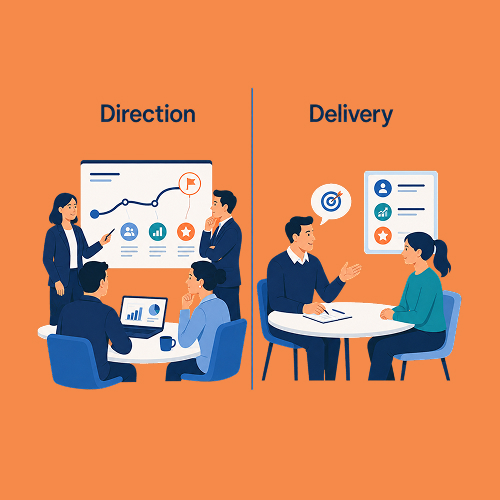
Talent strategy is a set of decisions about where an organisation places its people bets. Talent management is the operating system that carries those decisions into daily work. One answers why and where. The other answers how and how well.
The distinction sounds academic until you watch what happens when it collapses. Organisations end up with polished strategy decks that no process ever touches, or busy HR calendars that produce activity without direction. Both are expensive. Neither is visible on a balance sheet.
Here is what separates the two, why the gap is widening, and what HR leaders can do about it.
What talent strategy actually is
Talent strategy is a choice about scarcity. It accepts that budget, attention and development capacity are finite, then decides where they go.
A credible talent strategy answers a small number of hard questions:
- Which capabilities does the business strategy require in the next 12, 24 and 36 months?
- Which roles actually create disproportionate value, and are they filled with the right people?
- Where do we build, where do we buy, where do we borrow, and where do we automate?
- What are we prepared to stop doing or stop staffing?
- What is the cost of getting this wrong, and who owns that risk?
That last point is what makes it strategy rather than planning. Strategy involves trade-offs and consequences.
The evidence for treating talent this way is strong. McKinsey research indicates that S&P 500 companies which excel at maximising return on talent generate substantially more revenue per employee than the median firm, and that top performers in highly critical roles deliver a multiple of the productivity of average performers in the same role. In a McKinsey survey of more than 600 respondents, the talent practice most predictive of outperforming competitors was the frequent reallocation of high performers to the most critical strategic priorities.
Reallocation is a strategic act. It cannot be delegated to a process.
What talent management actually is
Talent management is the machinery. It is the set of connected processes through which people are attracted, onboarded, developed, measured, moved, rewarded and retained.
In practice, that means:
- Recruitment and selection
- Onboarding and probation
- Goal setting and performance management
- Learning, development and certification
- Succession and internal mobility
- Compensation, benefits and recognition
- Engagement, wellbeing and retention
Talent management is where employees experience the organisation. It is also where most HR technology investment lands, because processes are easier to systemise than choices.
Good talent management is disciplined, consistent and measurable. It is not, by itself, strategic. A perfectly run performance cycle that reinforces last year’s capability model is an efficient way to move in the wrong direction.
The difference at a glance
The clearest way to separate the two is by what each produces, who owns it and how it is judged.
มิติ | Talent strategy | Talent management |
Core question | Where should we place our people bets, and why? | How do we run our people processes well? |
Time horizon | One to three years, revisited continuously | Annual, quarterly and daily cycles |
Primary output | Decisions, priorities and trade-offs | Processes, policies and employee experience |
Typical owner | CHRO with the CEO and executive team | HR business partners, centres of excellence and line managers |
Unit of analysis | Capabilities, critical roles, workforce segments | Individuals, teams, requisitions, cycles |
Measure of success | Business capability delivered; value at risk reduced | Cycle completion, quality, cost, time and engagement |
Failure mode | A strategy nobody operationalises | Activity without direction |
Technology role | Analytics, scenario modelling, workforce planning | Core HR, payroll, recruitment, learning and performance systems |
Why the gap matters more now than it did five years ago
Three shifts have raised the cost of confusing strategy with management.
1. Skills are moving faster than process cycles
The World Economic Forum’s Future of Jobs Report 2025 found that employers expect 39% of workers’ core skills to change by 2030 — down from 44% in its 2023 edition, but still a substantial rate of obsolescence. More telling: 63% of employers identified skills gaps as the biggest barrier to business transformation over 2025 to 2030, ranking ahead of culture, regulation and access to capital. The report also estimates that 59 of every 100 workers will need reskilling or upskilling by 2030, and that 11 of those are unlikely to receive it.
An annual training calendar cannot absorb that. A talent strategy that decides which skills matter, for which roles, in which markets, can.
2. Speed has become the stated competitive strategy
Deloitte’s 2026 Global Human Capital Trends report found that seven in ten business leaders say their primary competitive strategy over the next three years is to be fast and nimble — to adapt quickly to changing business, customer and market conditions. The same research found that 66% of C-suite leaders believe traditional functions such as HR, finance, IT and legal must change, while only 7% say they are making progress towards that goal.
That is a strategy-execution gap, stated plainly by the executives who own it.
3. AI has changed the shape of the workforce, not just its tools
Gartner’s 2026 priorities research, based on insights from 426 CHROs across 23 industries and four global regions, points HR leaders towards a “now-next” talent strategy for a blended human and machine workforce — planning for multiple human-AI scenarios rather than a single forecast.
Gartner’s talent management research for 2026 sharpens the operational consequence. A second-quarter 2025 Gartner survey of 919 employees aged 22 to 27 found that this cohort values job mobility more than job security. Gartner also notes that entry-level hiring has declined as AI takes on lower-value work, leaving organisations more reliant on mid-level talent. As Tony Guadagni, Director, Research in the Gartner HR practice, put it at the Gartner HR Symposium/Xpo, uncertain market conditions combined with the AI revolution and rapidly changing skills demand mean HR leaders must pivot to ensure their talent strategies are effective and drive growth.
Note what that requires. Not a better process. A different set of decisions — then a process rebuilt to serve them.
Symptoms: management without strategy
This is the more common failure, because it looks like competence.
- Headcount plans are built from last year’s headcount plus a percentage.
- Job architecture has not changed even though the operating model has.
- Learning budgets are allocated by department size rather than capability gap.
- Succession plans exist for senior titles but not for the roles that actually create value.
- HR reports cycle completion rates and engagement scores, but cannot say which business capability is at risk.
- Attrition is reported as a single number rather than segmented by criticality.
The tell: HR can describe what it did last quarter in detail, and cannot describe what it chose not to do.
Symptoms: strategy without management
Less common, equally costly, and usually the aftermath of a consulting engagement.
- A skills taxonomy exists in a document but is not embedded in any system of record.
- Critical roles have been identified but no process routes talent towards them.
- Workforce plans are built on data that operational HR systems cannot supply or refresh.
- Line managers have never been briefed on the strategy they are meant to execute.
- The strategy is reviewed annually; the business changes quarterly.
The tell: the strategy is articulate, and nobody below the executive team can name a decision that changed because of it.
How to build a talent strategy that holds
Five moves, in order.
- Start from the business strategy, not from HR. Translate commercial objectives into required capabilities before discussing headcount. If the business intends to enter three new markets, the talent question is which capabilities those markets require and where they will come from.
- Identify critical roles by value, not by seniority. Critical roles are frequently not the most senior ones. Define them by their contribution to strategic outcomes, then assess whether they are currently filled with the right capability.
- Segment the workforce. Different segments warrant different investment. Uniform treatment is the default that feels fair and performs poorly.
- Make explicit build, buy, borrow and automate choices. For each capability gap, decide the route and the cost. Document what you are choosing not to fund.
- Integrate with financial planning. Strategic workforce planning that sits outside the budget cycle is a forecast, not a plan. When HR and finance plan together, cost visibility and credibility both improve.
How to make talent management execute the strategy
Strategy has to become a change in the machinery, or it has not happened.
- Rewrite the inputs. If the strategy prioritises certain capabilities, recruitment scorecards, learning pathways and performance goals must reference them by name.
- Reset the metrics. Move from cycle metrics to capability metrics. Not “94% of reviews completed” but “capability coverage in critical roles moved from 61% to 74%”.
- Equip line managers. Managers make the daily decisions that either compound or contradict the strategy. They need the context, the data and the conversation skills.
- Open internal mobility. If the workforce values mobility, an organisation that cannot offer it internally will supply it externally. Internal mobility is a retention mechanism and a redeployment mechanism at the same time.
- Shorten the review loop. Quarterly strategy reviews against operational data, not annual set pieces.
The data layer that connects the two
Most organisations do not have a strategy problem or a process problem. They have a visibility problem sitting between the two.
Strategy needs data that operational systems hold: skills inventories, internal movement patterns, time-to-capability, attrition by criticality, cost per capability, span and layer analysis, and reliable multi-country workforce records. If that data is fragmented across spreadsheets and disconnected systems, the strategy is built on assumption and cannot be revised at the pace the business is changing.
This is where a unified HR platform stops being an administrative convenience and starts being a strategic instrument.
MiHCM was built for that connection point. MiHCM Enterprise holds the operational record across the employee lifecycle, in multiple markets and under multiple statutory regimes. Syntra, MiHCM’s AI intelligence and analytics platform, turns that record into workforce insight leaders can plan against. SmartAssist and MiA ONE bring HR support and self-service into the flow of daily work, so process quality does not depend on chasing. MiHCM Consulting helps organisations translate a business strategy into a talent strategy that the platform can then execute and measure.
A point worth making plainly: the technology informs the decision. It does not make it. MiHCM’s position on responsible AI is that human judgement stays central. Analytics should sharpen a leadership debate about where to place people bets, not remove the debate.
Five questions for your next leadership meeting
If the difference between strategy and management is still abstract, these questions make it concrete quickly.
- Which ten roles matter most to delivering our strategy, and are they filled with our strongest people right now?
- Which capability gap represents the largest risk to next year’s plan, and what are we spending to close it?
- What did we choose not to invest in this year, and why?
- If a critical person resigned tomorrow, how long until we recover the capability — and do we know that number or are we guessing?
- Can we answer the first four questions from data, or from opinion?
If the answers come from opinion, the immediate priority is not a new strategy. It is visibility.
The takeaway
Talent strategy and talent management are not competing disciplines and not interchangeable ones. They are two halves of a single system.
Strategy makes the choices. Management makes them real. The organisations that pull ahead over the next three years will be the ones that close the distance between the two — and can prove, with data, that a decision taken in a boardroom changed what happened in a team.
That is the work. Everything else is either a deck or a diary.
Ready to connect strategy to execution? |
MiHCM helps enterprises across 22+ countries in Asia turn workforce data into decisions — and decisions into daily practice. Talk to MiHCM Consulting about where your talent strategy is losing contact with the ground. |
Transparency and verification
All statistics in this article are drawn from named, publicly available research from Gartner, Deloitte, the World Economic Forum and McKinsey & Company. Readers are advised to verify figures against the original source publications, as research organisations update methodologies, sample sizes and findings between editions. Where a figure was reported by a secondary publication citing the original research, this is noted in the source list below.
Sources
- World Economic Forum. Future of Jobs Report 2025 — Skills disruption (39%), skills gaps as the leading barrier to transformation (63%), and reskilling requirements (59 in 100; 11 unlikely to receive training).
https://www.weforum.org/publications/the-future-of-jobs-report-2025/ - Deloitte. 2026 Global Human Capital Trends: From Tensions to Tipping Points – Choosing the Human Advantage — Seven in ten leaders cite speed and agility as their primary competitive strategy; 66% of C-suite leaders say traditional functions must change, while only 7% report meaningful progress.
https://www2.deloitte.com/global/en/insights/focus/human-capital-trends.html - Gartner. 2026 Top Priorities for CHROs — Based on insights from 426 CHROs across 23 industries and four global regions, highlighting the need for a “now-next” talent strategy for a blended human-AI workforce.
https://www.gartner.com/en/human-resources - Gartner. Gartner Identifies Four Trends Talent Management Leaders Should Prepare for in 2026 (29 October 2025) — Includes findings from a Q2 2025 survey of 919 employees aged 22–27 on job mobility, entry-level hiring trends, and commentary from Tony Guadagni, Director, Research, Gartner HR Practice.
https://www.gartner.com/en/newsroom - McKinsey & Company. The Critical Role of Strategic Workforce Planning in the Age of AI และ Increasing Your Return on Talent: The Moves and Metrics That Matter — Discusses return on talent, revenue per employee, productivity differences in critical roles, and integrating workforce planning with financial planning.
https://www.mckinsey.com/ - McKinsey & Company. Why Your Talent-Management Strategy Should Link Talent to Value — Survey of more than 600 respondents showing that reallocating high performers to strategic priorities is the talent practice most predictive of outperforming competitors.
https://www.mckinsey.com/