

Global employment looks stable on paper. Underneath, three industries are being reshaped in three very different ways and the HR technology decisions taken in 2026 will decide which employers keep up.
The International Labour Organization opened 2026 with a deceptively calm number. Global unemployment is projected to remain unchanged at 4.9% this year. Read no further and you would conclude that labour markets have settled.1
The ILO itself warns against that reading. The broader global jobs gap (people who want paid work but cannot access it) is projected to reach 408 million in 2026. Close to 300 million workers remain in extreme working poverty, and 2.1 billion are in informal employment without reliable rights, protection or income security. Improvements in job quality have slowed sharply, and the movement of workers into higher-productivity, more formal sectors has decelerated markedly over the past two decades.1
For employers across South Asia and South East Asia, that divergence matters more than the headline. In high- and upper-middle-income economies, ageing populations are stabilising unemployment even as job creation stays modest. In low-income economies, employment is projected to grow 3.1% in 2026, but weak productivity gains mean many of those jobs are low quality. Two labour markets, two entirely different HR agendas.1
Stability in the headline number is not the same as health in the labour market. The pressure has moved from how many people are working to what kind of work they are doing, how quickly their skills are changing, and whether employers can see either clearly.
Sector by sector, the pressure lands differently. Banking, financial services and insurance are planning for smaller, more expensive, more AI-fluent teams. Manufacturing is confronting a skills gap that headcount alone cannot close. Telecom is a mature, low-growth industry trying to fund a transformation without a corresponding revenue lift. Each demands a different HR technology response.
BFSI: The industry planning for a smaller workforce it has not yet designed

No sector is moving faster on AI-driven workforce change than financial services and few are less prepared for what follows.
PwC surveyed 1,004 director-level and above executives at financial services firms with at least US$500 million in revenue in May 2026. Nearly eight in ten expect their workforce to shrink by at least 20 per cent over the next five years. Yet only 42 per cent have carried out enterprise-wide modelling of how AI will change labour capacity, and of those with any modelling in place, only half have examined what happens when processes and workflows are redesigned around AI.2
That is the gap PwC identifies: firms are modelling how many people they can cut rather than designing the workforce they will actually need.2
What the data says about BFSI talent economics
- Pay is moving. Ninety-one per cent of firms are increasing compensation for employees with AI skills, and 86 per cent agree that AI skills training is more valuable than an MBA for many new hires.2
- Sourcing is splitting three ways. Sixty-two per cent plan to hire AI-skilled staff, 61 per cent plan to upskill or reskill existing employees, and 57 per cent plan to partner with external vendors or service providers.2
- The pipeline is the casualty. Thirty per cent of leaders identify entry-level roles as most vulnerable to AI disruption, followed by middle management at 26 per cent — the two layers from which future leaders are usually grown.2
- Data quality is the binding constraint. Forty-one per cent cite fragmented or low-quality data as the single biggest barrier to scaling AI across the workforce — more than any other issue.2
- Governance is unresolved. Ninety per cent say employees using AI tools outside centrally governed systems has created regulatory risk, and there is no consensus on who owns the risk of material harm from AI agents.2
The regulatory dimension is not incidental. Financial services firms operate under supervisory regimes that require explainable, auditable decisions. That makes workforce data lineage, access governance and audit trails an HR technology requirement, not an IT afterthought, and it applies as much to a bank in Colombo or Dhaka as to one in New York.
Manufacturing: A capability gap wearing the costume of a labour shortage

Manufacturing’s workforce problem is frequently described as a shortage of people. The more accurate description is a shortage of the right capabilities. Deloitte and The Manufacturing Institute project that as many as 3.8 million additional manufacturing employees could be needed between 2024 and 2033, with up to 1.9 million of those roles potentially going unfilled if skills and applicant gaps are not addressed.3
Crucially, this is not a story of wholesale automation. Deloitte’s 2026 Manufacturing Industry Outlook projects that more than 81 per cent of task hours in manufacturing will remain human-driven, even as investment in automation accelerates. Uniquely human capabilities such as creativity, collaboration, critical thinking, and adaptability, remain essential on the shop floor.4
What has changed is the skill content of those hours. More than a third of manufacturing executives in Deloitte’s 2025 survey named equipping workers with the skills to make the most of smart manufacturing and operations as their top talent concern.4
Manufacturing is not automating its people away. It is re-specifying what its people need to know — faster than most training systems, competency frameworks and workforce plans were designed to move.
Thailand offers a live illustration. The National Economic and Social Development Council estimates that more than 110,000 workers (16.3 per cent of the automotive industry workforce) may need to move into other industries as the electric vehicle transition accelerates, given that an EV uses roughly 20 parts against about 2,000 in a combustion-engine vehicle. The NESDC has called explicitly for repositioning high-skilled workers as “AI managers” who can work alongside and oversee AI systems.5
Telecom: Transformation on a low-growth budget
Deloitte’s 2026 Global Telecommunications Industry Outlook describes a mature industry: global telecom revenue of roughly US$1.55 trillion in 2025, up about 1.7 per cent on the prior year, with EBITDA margins stable at around 35 per cent and capital expenditure intensity steady at about 18 per cent. Average revenue per user remains largely stagnant.6
It is also a very large employer. Around 24 million jobs were directly supported by the mobile ecosystem in 2024, and by the end of 2026 just under five billion people are expected to have mobile internet access.6
The workforce implication sits in the loyalty problem. Consumer sentiment data cited by Deloitte indicates that up to 77 per cent of consumers feel no loyalty to their provider, with annual churn across telecom providers at around 22 per cent.
Deloitte’s recommendation is that operators increasingly use AI agents to automate routine support so that human teams can concentrate on complex, high-empathy interactions — while the “telco to techco” pivot into cloud, cybersecurity and IoT demands skills the sector has historically bought rather than built.6
Three sectors, three distinct HR mandates
- BFSI needs governance, auditability and role redesign before it needs headcount reduction.
- Manufacturing needs skills visibility at facility, shift and role level, plus credible internal mobility paths.
- Telecom needs redeployment at speed, because the roles it is losing and the roles it is gaining sit in the same organisation.
The regional lens: Malaysia, Bangladesh, Thailand, and Sri Lanka
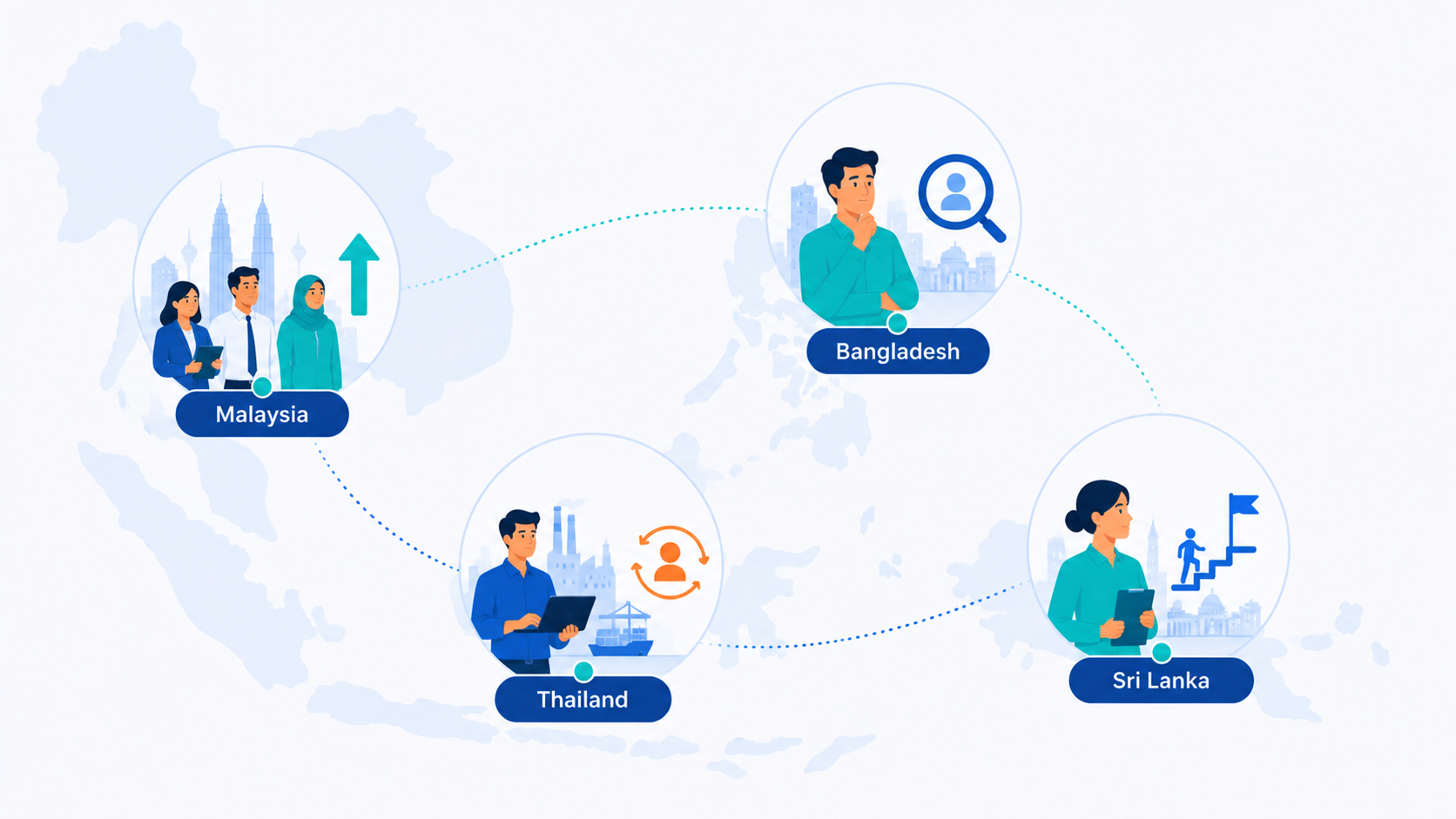
Global sector narratives only become useful when they are read against local labour market conditions. Four of MiHCM’s core markets illustrate how differently the same technological shift lands.
Malaysia — a tight market where productivity is the lever
Malaysia entered 2026 with one of the region’s tightest labour markets. The Department of Statistics Malaysia reported an unemployment rate of 2.9 per cent in the first quarter of 2026, a labour force of 17.23 million and a labour force participation rate of 70.9 per cent, alongside GDP growth of 5.4 per cent. Labour productivity rose 4.3 per cent to RM26,171 per employed person.7
With unemployment below three per cent, growth cannot come from hiring more people. It has to come from productivity, retention and skills — which is precisely where HR technology earns its keep. Services, particularly information and communication activities, led employment growth, while manufacturing and construction also added jobs.7
Bangladesh — structural transition in the largest export sector
ILO research published in 2026 documents a significant shift in Bangladesh’s employment structure. The share of youth employment in manufacturing fell from 25.5 per cent in 2017 to 14.5 per cent in 2022, remaining at around 14 per cent through 2024. Within that, the manufacture of wearing apparel — the backbone of the ready-made garment sector — declined from 12.5 per cent of youth employment in 2017 to 7.6 per cent in 2022 and has stayed near that level, suggesting the sector may be approaching its limit as a generator of youth employment.8
The Bangladesh Bureau of Statistics has responded by conducting the country’s first labour demand survey, covering seven priority sectors including ready-made garments, ICT, and financial and insurance activities, with demand forecasts for 2026. For employers, the message is that workforce planning in Bangladesh is shifting from a supply-side to a demand-side discipline — and that requires data infrastructure most HR functions do not yet have.9
Thailand — low unemployment masking structural displacement
Thailand recorded 41.2 million employed persons in the first quarter of 2026, up 4.6 per cent year on year, with an unemployment rate of just 0.94 per cent. But long-term unemployment rose 27 per cent in the same quarter, and the unemployment rate itself edged up from 0.88 per cent a year earlier and 0.70 per cent in the previous quarter. The NESDC has flagged AI as a risk to Thailand’s labour market structure, particularly for recent graduates in repetitive roles, alongside the automotive transition already noted.5
Sri Lanka — an educated-talent paradox
Sri Lanka’s Department of Census and Statistics reported unemployment of 3.7 per cent in the first quarter of 2026, down from 3.8 per cent a year earlier, with a labour force of 8.41 million and 8.10 million employed. Services accounted for 50.4 per cent of employment, industry 25.9 per cent and agriculture 23.7 per cent.10
The headline conceals the real challenge. Youth unemployment among those aged 15 to 24 stood at 16.1 per cent, and unemployment was highest among those with GCE Advanced Level qualifications and above, at 6.5 per cent — 9.7 per cent for women against 3.2 per cent for men. Labour force participation slipped to 49.2 per cent, with women making up 72.2 per cent of the economically inactive population.10
This mirrors the ILO’s global finding that women are 24.2 per cent less likely than men to participate in the labour force. In Sri Lanka it represents a substantial reserve of qualified talent that better job design, flexible working and transparent progression could unlock.1
The HR technology outlook for 2026
Deloitte’s 2026 Global Human Capital Trends report, published in March 2026, provides the clearest picture of where HR technology investment is succeeding and where it is stalling. The findings are uncomfortable.11
1. The adaptability gap is the defining shortfall
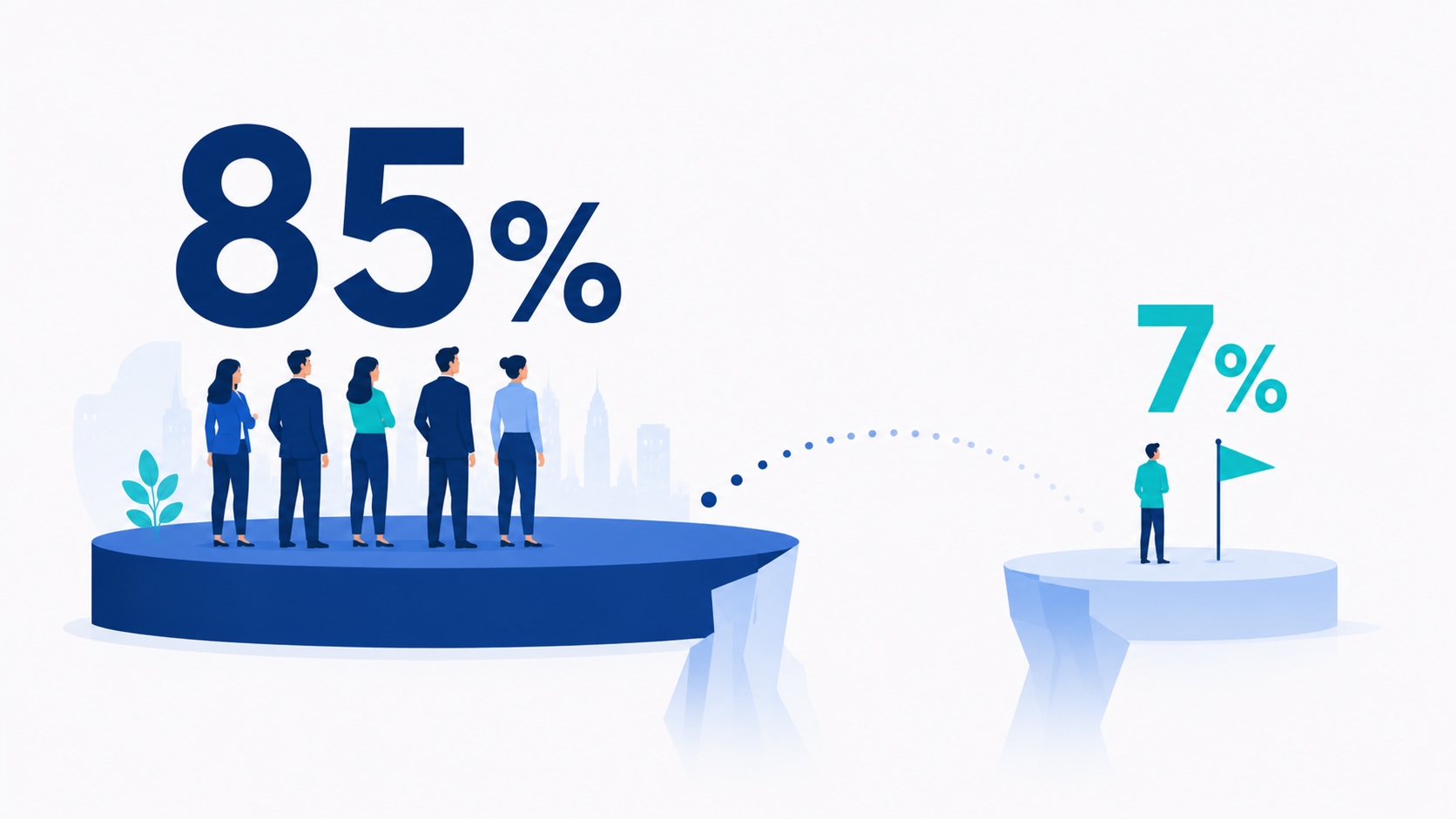
Eighty-five per cent of leaders say building the organisation’s and workforce’s ability to adapt at speed is critical, yet only 7 per cent say they are leading in helping their workforce continuously grow and adapt. Seven in ten business leaders say their primary competitive strategy over the next three years is to be fast and nimble, but only 27 per cent say their organisations manage change well. One-third of surveyed workers experienced 15 major changes in a single year.11
2. Work design, not tool adoption, determines AI returns
Only 6 per cent of leaders say they are making progress in designing human-AI interactions. Sixty per cent of executives use AI in decision-making, but just 5 per cent say they manage it well. Fifty-six per cent design AI solutions solely for business outcomes, while only 40 per cent design for both business and human outcomes.11
Buying AI capability is now the easy part. The differentiator in 2026 is whether an organisation has redesigned the work itself — decision rights, review points, escalation paths and accountability — around the new division of labour between people and systems.
3. Culture debt is becoming a measurable liability
Sixty-five per cent of organisations believe their culture needs to change significantly because of AI, and 34 per cent say culture is actively inhibiting their AI transformation goals. Forty-two per cent of workers say their organisations are not evaluating AI’s impact on people.11
4. Trust in workforce data is now a first-order concern
As AI is embedded in hiring, performance and everyday decisions, the authenticity and lineage of workforce data becomes foundational. Exaggerated CVs, synthetic identities and low-quality inputs risk contaminating both decisions and the models trained on them. This connects directly to the PwC finding that fragmented or poor-quality data is the single largest barrier to scaling AI in financial services.2, 11
5. Skills are repricing, and the market can see it
World Economic Forum research finds that wages for AI roles have risen 27 per cent since 2019, while employers struggle to recruit because workers are not acquiring AI skills at the required pace. In parallel, human-centric skills such as creativity, innovation and adaptability are growing in importance precisely because they are hardest to automate — yet they remain poorly measured and largely invisible in the job market compared with technical AI skills.12
The scale of the response is instructive: more than 25 leading technology companies pledged at Davos 2026 to support the reskilling of 120 million workers by 2030, and the WEF’s Reskilling Revolution has mobilised commitments to reach one billion people by 2030.12
What this means for HR leaders — and where MiHCM fits
Across all three sectors, the same four capabilities separate organisations that are adapting from those that are stuck in pilot mode. Each maps to a specific technology requirement.
See the workforce clearly before redesigning it
The PwC and Deloitte findings converge on one point: poor workforce data defeats good AI intentions. Syntra, MiHCM’s AI intelligence and analytics platform, turns HCM data into workforce analytics, generative insights and conversational automation across the employee lifecycle, giving BFSI and manufacturing leaders the modelling foundation that capacity planning requires. Built on Microsoft Azure, it is supported by MiHCM’s credentials as a Microsoft Data and AI Solutions Partner.
Remove routine work so people can absorb change
When a third of workers face 15 major changes a year, administrative friction is a strategic liability. MiA ONE, MiHCM’s personal AI agent, handles reminders, leave approvals, timesheets and productivity insights, syncing with the underlying HR system. SmartAssist, the AI HR co-pilot, streamlines daily HR tasks, hiring workflows and workforce analytics. For telecom operators redeploying customer-facing teams, this is the same logic Deloitte applies to service: automate the routine so human capacity moves to the complex.
Get multi-country payroll and compliance right, permanently
Employers operating across Malaysia, Bangladesh, Thailand, and Sri Lanka face four different statutory regimes moving at four different speeds. MiHCM Payroll supports multi-region payroll with multi-currency payments and compliance with local regulations. MiHCM Enterprise and MiHCM Lite cover organisations at different points on the scale curve. MiHCM’s ISO/IEC 27701:2025 certification, covering its Malaysia and Sri Lanka operations, addresses the privacy governance expectations that regulated sectors such as BFSI now apply to every vendor.
Turn insight into transformation
Technology alone does not close an adaptability gap. MiHCM Consulting delivers end-to-end HR transformation, change management and advisory services across South Asia and South East Asia, while MiHCM Data and AI supports organisations building the analytics foundations their workforce decisions now depend on.
The 2026 labour market rewards employers who can answer three questions quickly: what skills do we have, what work is changing, and how fast can we move people between the two? Every one of those answers depends on the quality of the workforce data underneath it.
The year ahead
The ILO’s conclusion for 2026 is that with subdued global growth and external financing under pressure, progress will depend increasingly on domestic policy choices — strengthening job creation, boosting productivity, investing in skills and reinforcing labour market institutions.1
The organisational equivalent is just as direct. Employers in BFSI, manufacturing and telecom cannot control global trade uncertainty, ageing demographics or the pace of AI development. They can control how well they understand their own workforce, how deliberately they design work around people and machines, and how quickly they move skills to where the work is. In 2026, that is where the advantage sits.
References
- International Labour Organization, “Employment and Social Trends 2026”, World of Work series, 14 January 2026. https://www.ilo.org/publications/flagship-reports/employment-and-social-trends-2026
- PwC, “The AI workforce planning gap in financial services” (2026 Financial Services Workforce AI Survey; 1,004 executives surveyed 12–22 May 2026), 3 August 2026. https://www.pwc.com/us/en/industries/financial-services/library/ai-workforce-gap-financial-services.html
- Deloitte and The Manufacturing Institute, “Manufacturers Need as Many as 3.8 Million New Employees by 2033”, 2024. https://themanufacturinginstitute.org/manufacturers-need-as-many-as-3-8-million-new-employees-by-2033/
- Deloitte Insights, “2026 Manufacturing Industry Outlook”. https://www.deloitte.com/us/en/insights/industry/manufacturing-industrial-products/manufacturing-industry-outlook.html
- National Economic and Social Development Council (NESDC), Thailand Social Outlook, First Quarter 2026, May 2026; as reported in The Nation Thailand, 25–26 May 2026. https://www.nesdc.go.th
- Deloitte Insights, “2026 Global Telecommunications Industry Outlook”, 18 February 2026. Mobile ecosystem employment and mobile internet access figures cited from GSMA Intelligence, “The Mobile Economy” 2024 and 2025. https://www.deloitte.com/us/en/insights/industry/technology/technology-media-telecom-outlooks/telecommunications-industry-outlook.html
- Department of Statistics Malaysia (DOSM), “Labour Market Review, First Quarter 2026” and “Statistics of the Labour Force, Malaysia, March and First Quarter 2026”. https://www.dosm.gov.my/portal-main/release-content/labour-market-review-lmr-q12026
- Kapoor, R., “Reviving and Reconnecting Economic Growth and Employment in Bangladesh”, ILO Working Paper 162, Geneva: International Labour Office, 2026. https://doi.org/10.54394/00033219
- Bangladesh Bureau of Statistics, first national Labour Demand Survey; as reported in The Daily Star, 27 April 2026. https://www.thedailystar.net/business/economy/news/bbs-conducts-countrys-first-labour-demand-survey-4120121
- Department of Census and Statistics, Sri Lanka, “Sri Lanka Labour Force Survey – Quarterly Report, 1st Quarter 2026”. https://www.statistics.gov.lk/LabourForce/StaticalInformation
- Deloitte, “2026 Global Human Capital Trends: From tensions to tipping points — Choosing the human advantage”, 4 March 2026. https://www.deloitte.com/us/en/insights/topics/talent/human-capital-trends.html
- World Economic Forum, “Jobs and skills transformation: What to know at Davos 2026”, 19 January 2026, citing “New Economy Skills: Building AI, Data and Digital Capabilities for Growth” and “New Economy Skills: Unlocking the Human Advantage”. https://www.weforum.org/stories/jobs-and-the-future-of-work/davos-here-s-what-to-know-about-jobs-and-skills-transformation/
Transparency and verification
All statistics in this article are drawn from named, publicly available sources published by the International Labour Organization, Deloitte, PwC, the World Economic Forum, the Department of Statistics Malaysia, the Department of Census and Statistics Sri Lanka, Thailand’s National Economic and Social Development Council and the Bangladesh Bureau of Statistics. Figures reflect the most recent releases available at the time of writing and are subject to revision by the issuing bodies. MiHCM has not independently verified third-party survey methodologies.