Manufacturing is an industry built on precision, consistency, and control. Those standards apply to production, and they must apply equally to the workforce management systems that support it.
In practice, many manufacturers find that HR remains one of the least digitised functions in their operation: payroll processes that lag behind production data, attendance systems that cannot feed directly into overtime calculations, and compliance records maintained in spreadsheets.
In 2026, the pressure to close that gap has intensified. Labour costs represent a dominant share of manufacturing operating expenditure. Skills gaps are widening as technology transforms shopfloor operations. Labour regulations are being enforced more stringently across ASEAN markets. And manufacturers operating across multiple plants and countries need real-time workforce visibility that disconnected systems cannot provide.
This blog sets out the core HR and workforce management challenges that manufacturing organisations face — and the capabilities that modern HR platforms must provide to address them.
The HR challenges specific to manufacturing
Shift-based workforce management at scale
Most manufacturing operations run continuous or semi-continuous production schedules — two or three shifts per day, seven days a week, across multiple departments and production lines. Managing shift rosters for hundreds or thousands of workers requires a system that can handle rotating patterns, manage coverage across planned absences and unplanned leave, and alert supervisors to gaps in real time.
Manual scheduling — whether in spreadsheets or on notice boards — cannot scale to this requirement. Last-minute call-outs and production schedule changes require instant re-allocation that manual processes cannot support without significant administrative effort and frequent error.
Payroll complexity: overtime, allowances, and incentive pay
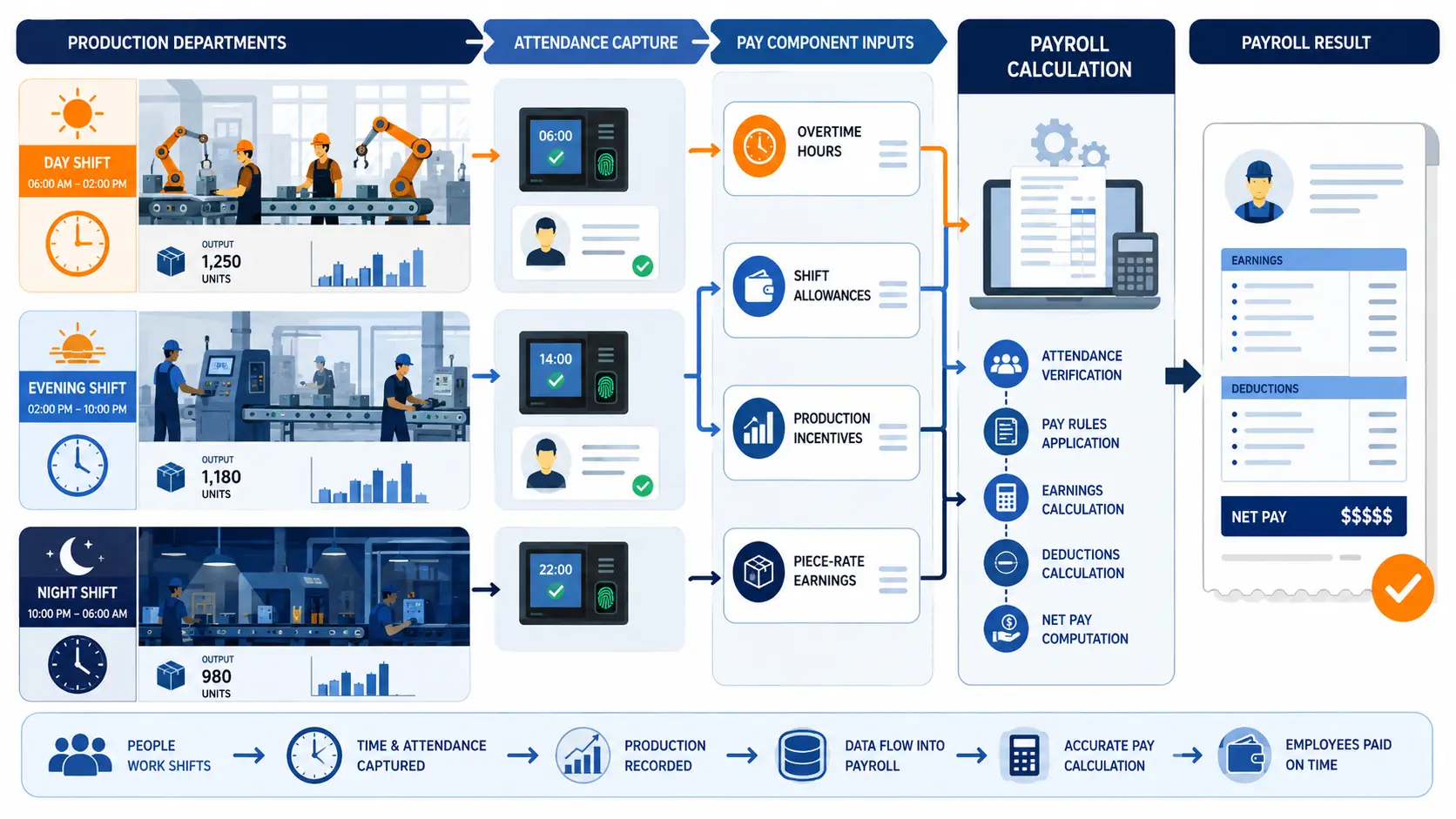
Manufacturing payroll is rarely straightforward. Beyond base pay, it typically includes overtime at statutory premium rates, shift allowances for evening or night work, production or attendance incentive bonuses, and in some cases piece-rate elements for output-based roles. Each of these must be calculated accurately against actual hours worked and production records, and applied correctly to every pay run.
Overtime rules vary by market and must be applied carefully. In Malaysia, the Employment Act specifies overtime rates that differ for work on rest days and public holidays. Similar graduated structures apply in Thailand, Sri Lanka, Cambodia, and Vietnam. Errors in overtime calculation create both compliance risk and workforce trust issues — workers on the shopfloor know their pay, and discrepancies are noticed immediately.
Multi-site workforce visibility
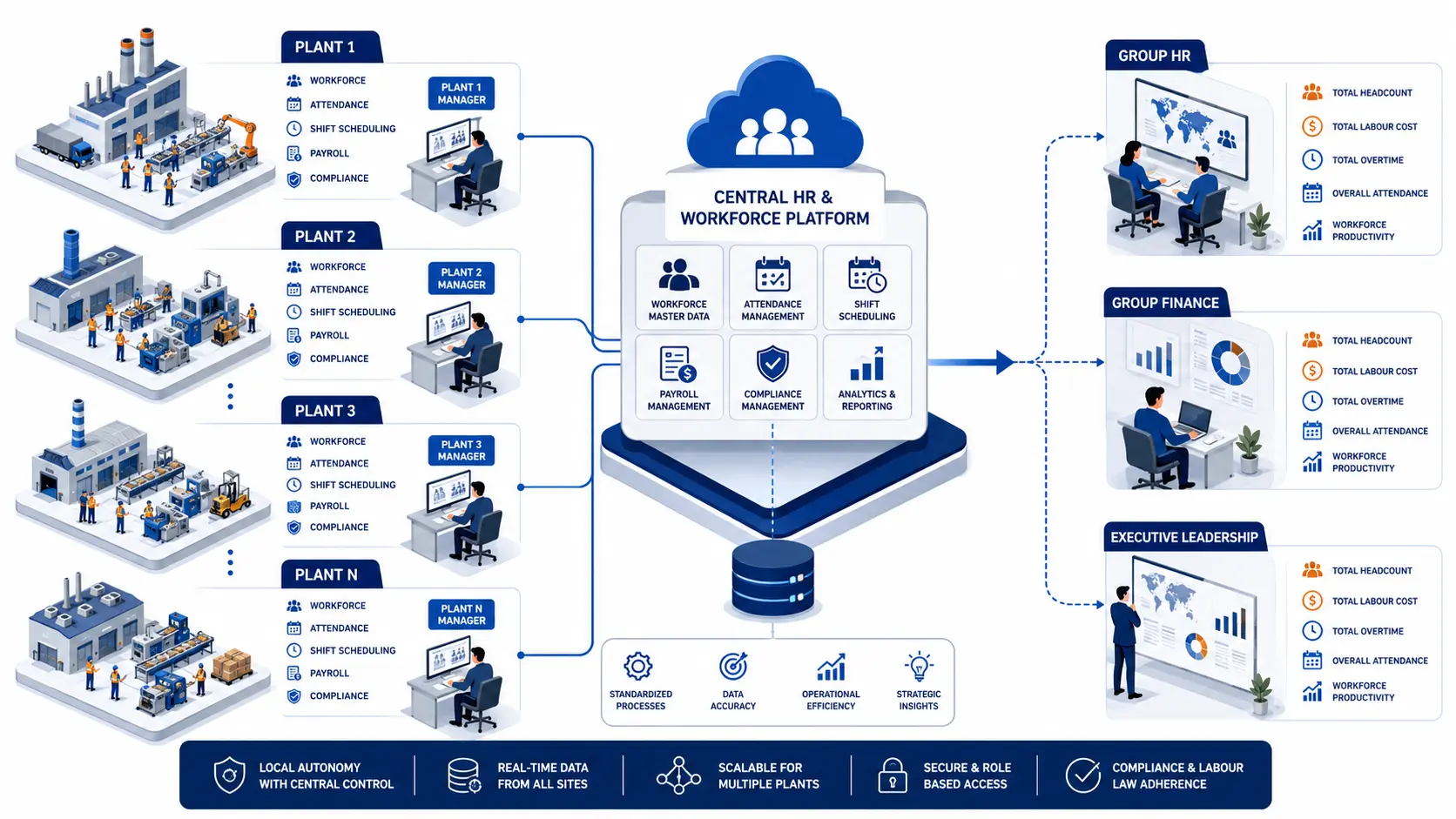
Manufacturers with multiple plants — whether in the same country or across borders — face a persistent data visibility problem. When each site manages attendance, shift scheduling, and payroll independently using different tools or processes, there is no consolidated view of headcount, labour cost, or productivity across the operation. Group or divisional management cannot access the workforce data they need for planning and cost control without manual consolidation.
A manufacturing HR platform must provide real-time visibility across all sites from a single system — with site-level detail available to plant managers and group-level aggregation available to divisional and group leadership.
Labour compliance across multiple markets
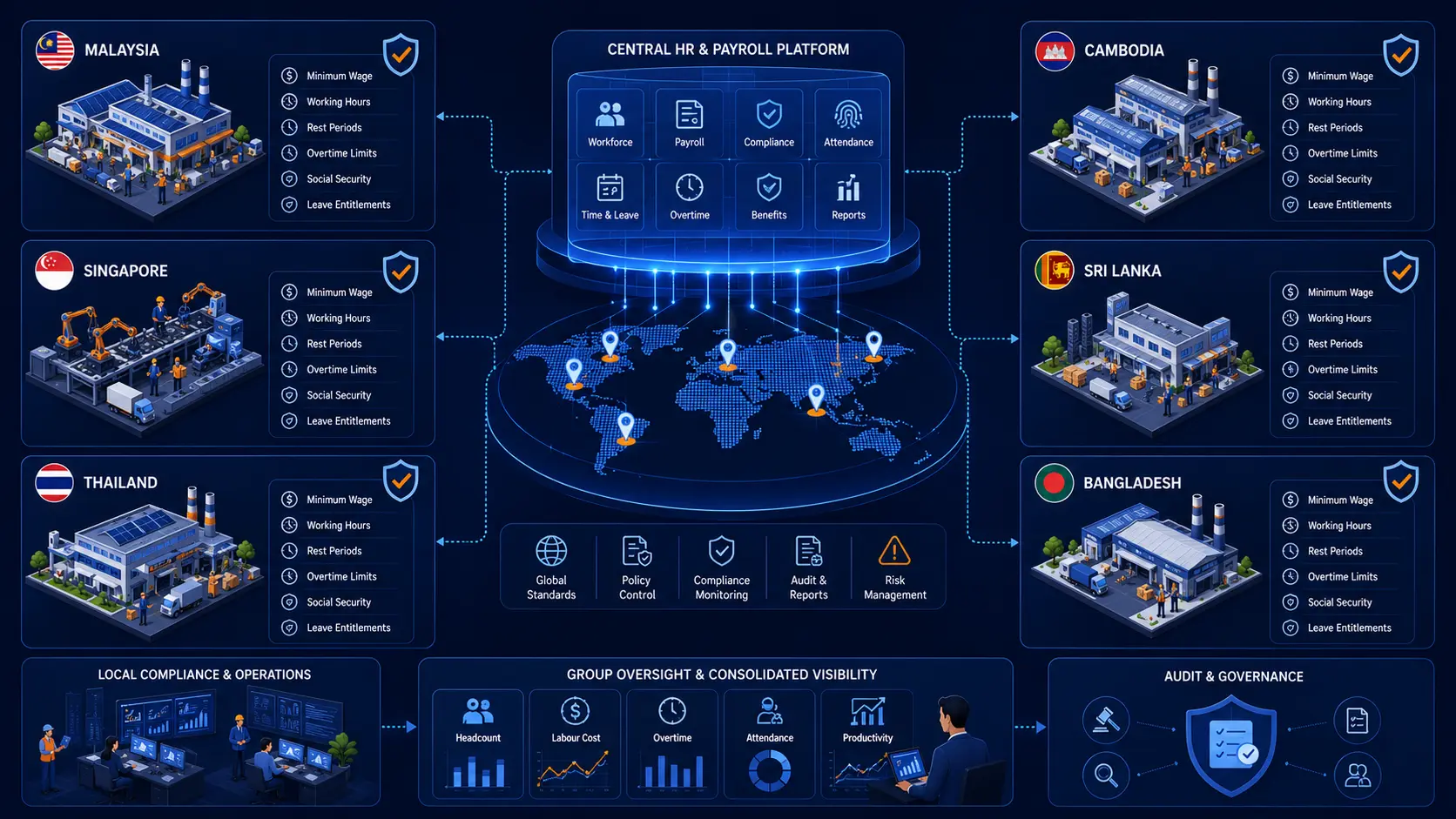
Manufacturers operating in ASEAN and South Asia must comply with labour regulations that differ significantly by market and that change with varying frequency. Minimum wage rates, statutory working hours, mandatory rest periods, overtime caps, social security contributions, and leave entitlements are all governed by local legislation. In a multi-country manufacturing operation, keeping payroll compliant across all markets simultaneously — and updating the system when rules change — is a significant ongoing obligation.
Non-compliance with manufacturing labour laws carries serious consequences: financial penalties, production shutdowns, and reputational damage with global brand customers who conduct social compliance audits as part of their supply chain due diligence.
Skills gaps and workforce transformation
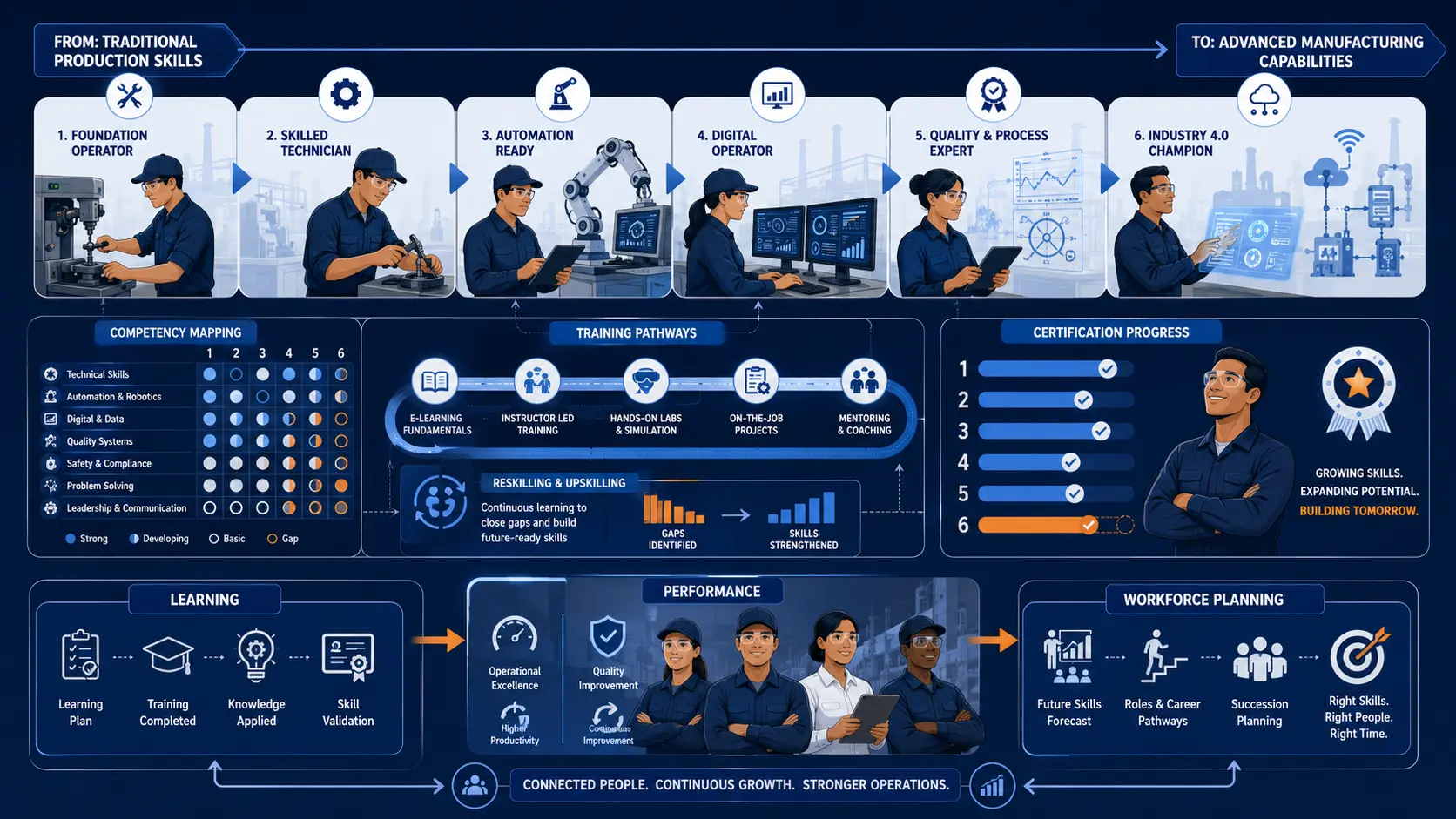
Manufacturing is undergoing a structural transformation. Automation, advanced manufacturing technology, and Industry 4.0 applications are changing the skills required on the shopfloor. At the same time, experienced workers are retiring, and manufacturing’s traditional image creates challenges in attracting younger talent to technical roles.
Research across Southeast Asian manufacturing markets confirms that the skills gap widened further in 2025, particularly in technology-intensive and digital manufacturing roles. HR must respond with structured training and reskilling programmes, competency tracking, and career pathway development — none of which is possible without a platform that connects learning, performance, and workforce data.
Integration between HR and production systems
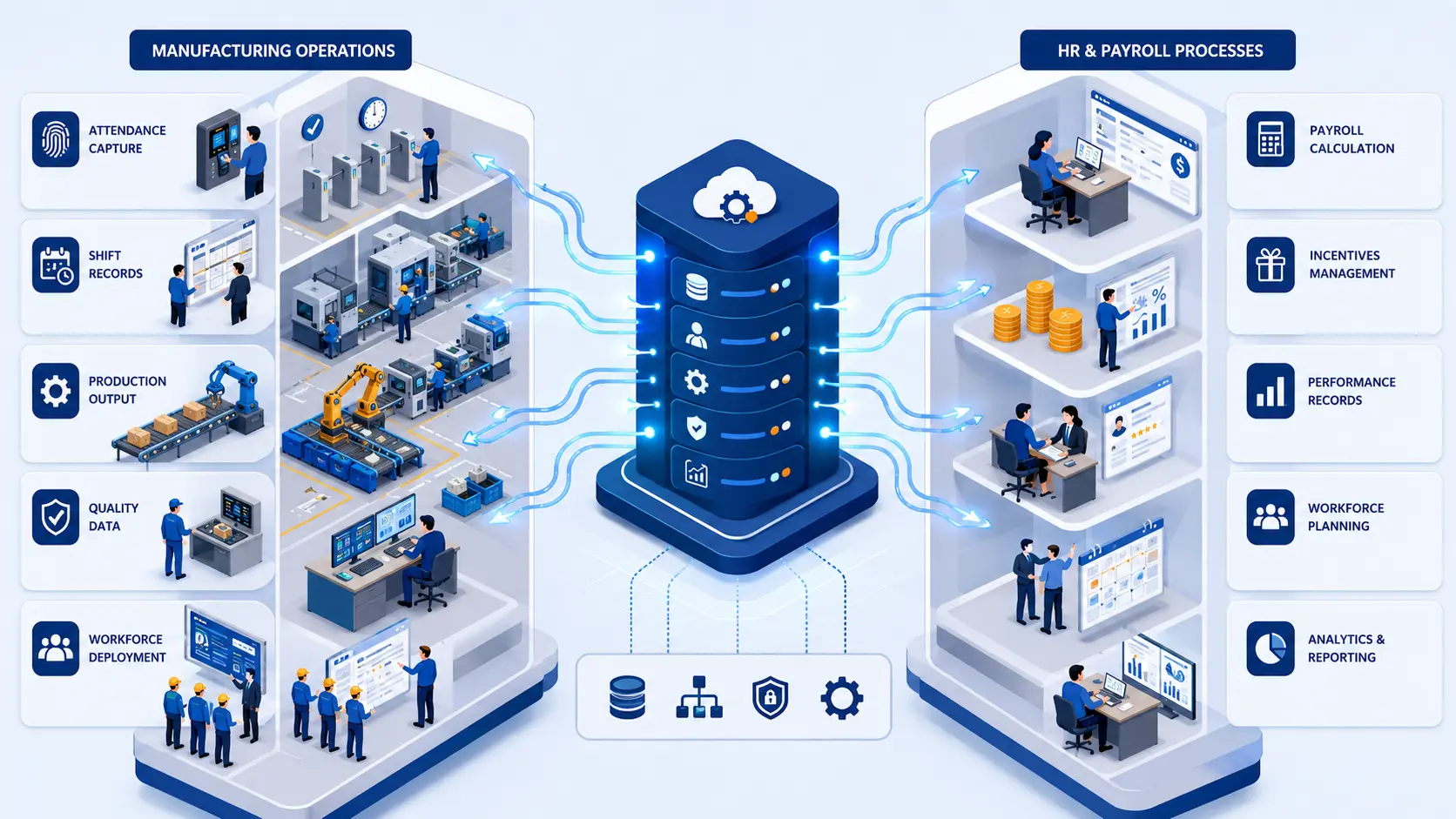
In a well-run manufacturing operation, HR data and production data are tightly connected. Attendance and shift records feed directly into payroll. Productivity and output data informs performance assessments and bonus calculations. Workforce planning draws on production schedules. When HR and production systems are separate and disconnected, these flows become manual — introducing delay, error, and lost insight.
The HR platform must support integration with manufacturing execution systems, ERP platforms, and production management tools, enabling data to move accurately between systems without manual re-entry.
High turnover and onboarding efficiency
Manufacturing typically experiences higher workforce turnover than many other industries, particularly at the production worker level. Frequent onboarding — hiring, contracting, setting up payroll, configuring attendance, and issuing access — creates a persistent administrative burden. Slow onboarding delays productive deployment and increases cost-per-hire. Digital, automated onboarding workflows that connect directly to HR and payroll are essential for managing this at scale.
What manufacturing HR platforms must provide
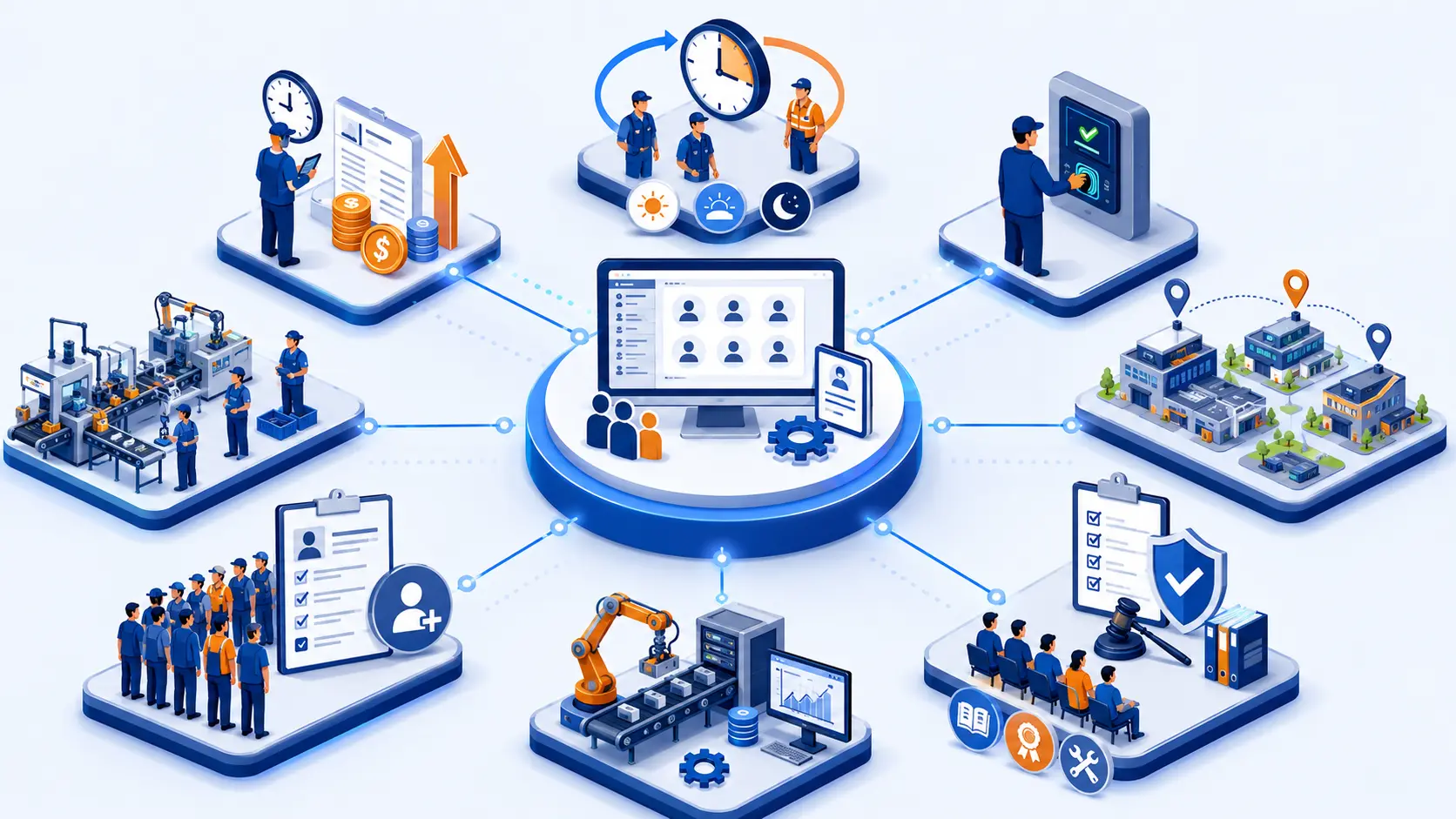
Automated shift scheduling with real-time visibility. The platform must support creation and management of rotating shift rosters across departments and sites, with real-time attendance dashboards showing coverage, absences, and gaps. Managers should be able to reassign or fill shifts from a mobile interface without administrative delay.
Payroll engine built for manufacturing complexity. Overtime, shift differentials, allowances, production incentives, and piece-rate elements must all be configurable within the payroll engine, calculated automatically based on attendance and production records, and applied correctly to every pay run without manual intervention.
Attendance capture that eliminates manual timesheet entry. Clock-in data from biometric devices, RFID readers, facial recognition systems, or GPS mobile apps must feed directly into the payroll engine. Manual timesheet re-entry is the primary source of payroll errors in manufacturing environments. Direct integration eliminates it.
Statutory compliance, automatically maintained per market. Each site’s payroll must apply the correct labour law rules for its market, with automatic updates when regulations change. For manufacturers operating across several ASEAN markets simultaneously, manual maintenance of statutory rules across all sites is unsustainable.
Multi-site analytics and labour cost visibility. Plant managers need site-level attendance, overtime, and productivity data. Group HR and finance need cross-site labour cost aggregation. The platform must serve both through role-appropriate dashboards, without requiring manual data extraction and consolidation.
Performance and skills management connected to workforce data. To close skills gaps, manufacturers need a platform that tracks employee competencies, links training completion to performance records, and surfaces skills coverage data that informs workforce planning. Performance management that sits separately from the core HR and payroll data cannot drive the insight manufacturing HR needs.
Streamlined onboarding for high-volume hiring. Digital onboarding workflows that automatically create employee profiles, set up payroll, configure attendance, and trigger induction tasks reduce time-to-productive-deployment and eliminate the manual steps that slow the process.
Integration with production and enterprise systems. The HR platform must connect to manufacturing execution systems, ERP platforms, and other enterprise tools — enabling real-time data exchange between production and HR without manual reconciliation.
MiHCM for manufacturing organisations
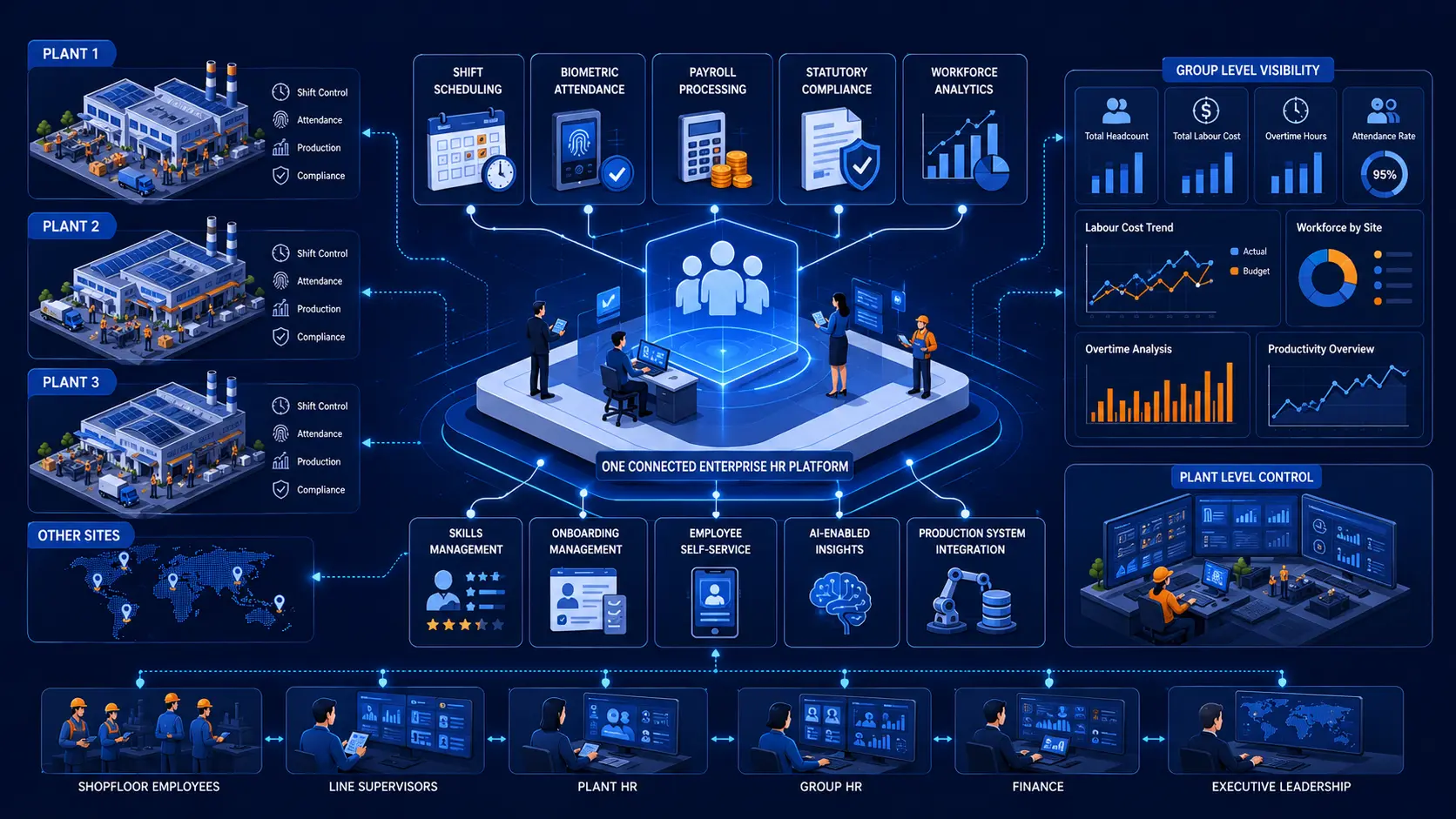
MiHCM Enterprise is deployed by manufacturing organisations across Asia, including apparel and garment manufacturers, process manufacturers, and industrial groups operating across multiple markets and sites.
A leading refined sugar producer in Malaysia — supplying over half of the domestic market and ranked among the top ten largest sugar refiners globally — implemented MiHCM to address HR management challenges arising from its expanding, multi-site manufacturing operations.
Key MiHCM capabilities for manufacturing organisations include:
- Time and Attendance with automated shift scheduling, flexible shift pattern configuration, real-time attendance dashboards, and direct payroll integration — eliminating manual timesheet entry across all sites
- Biometric, RFID, barcode, facial recognition, fingerprint, and GPS mobile clock-in support — capturing accurate attendance data from the shopfloor, production line, or remote site
- MiHCM Payroll with customisable salary formulas supporting overtime, shift differentials, production allowances, and incentive pay structures — calculated automatically per pay run
- Statutory compliance automation across Malaysia, Thailand, Sri Lanka, Cambodia, Bangladesh, and additional markets — with statutory rules maintained and updated within the platform
- Multi-entity, multi-site payroll for manufacturing groups operating across several plants or countries simultaneously
- Integration capability with manufacturing execution systems and enterprise platforms — enabling production data to feed HR calculations directly
- MiHCM Analytics with custom Power BI dashboards for multi-site labour cost visibility, overtime trend analysis, and workforce productivity reporting
- Syntra, MiHCM’s AI intelligence platform, delivering real-time workforce analytics, natural language query of workforce data, and board-ready reporting across sites and entities
- Performance management and talent modules for tracking competencies, managing training programmes, and building the skills visibility that manufacturing workforce planning requires
- Employee self-service via the MiHCM mobile app — enabling shopfloor workers to access payslips, apply for leave, and submit work activities from any device
- SmartAssist and MiA ONE for automated HR workflows and conversational HR support across the workforce
MiHCM’s manufacturing clients include apparel and garment manufacturers managing workforces of 20,000+ employees across multiple countries, as well as industrial and process manufacturers across Asia. Visit mihcm.com to learn more.
The bottom line
Manufacturing HR is not a support function; it is an operational one. Shift scheduling, payroll accuracy, labour compliance, and workforce visibility have direct consequences for production continuity, operating cost, and regulatory standing.
The HR platforms that serve manufacturing well are those built to match its operational intensity: integrated with production systems, built for shift complexity, designed for multi-site visibility, and capable of handling statutory compliance across every market in which the business operates.
To find out how MiHCM supports manufacturing organisations, visit mihcm.com or book a demo.